
Regional Economic and Investment Insights
North Carolina: The Southeast Is Tightening Faster Than It Looks (Dirttodata.Substack)
Summary: North Carolina’s data center and industrial demand is accelerating, driven by established financial, healthcare, and enterprise AI sectors requiring 10-40MW deployments with low latency and execution certainty. This real, anchored demand is colliding with tightening constraints: Duke Energy faces accelerating regional load growth from multiple sources, interconnection timelines are stretching, and land near Raleigh-Durham and Charlotte is becoming scarce and expensive.
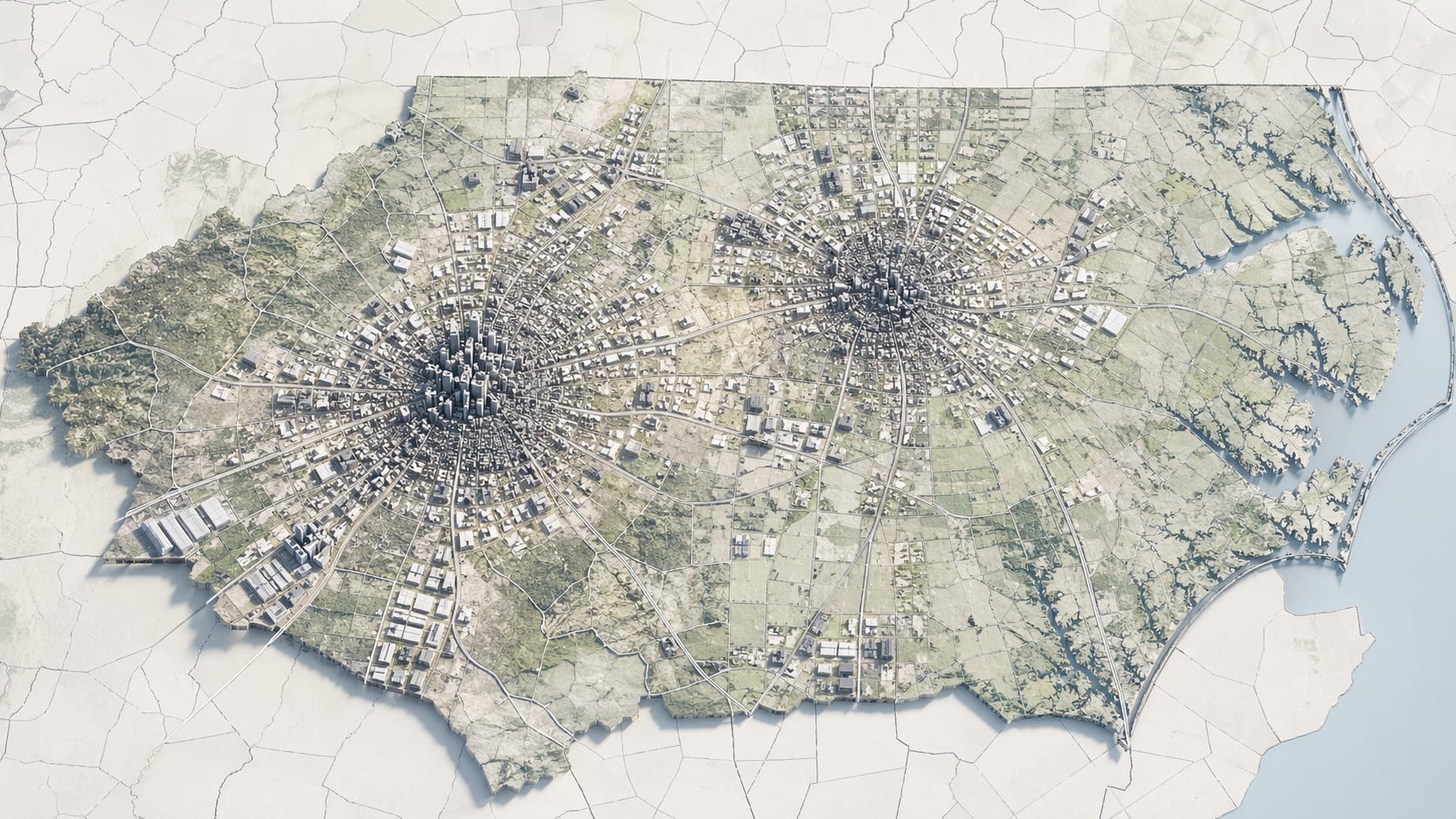
Why it matters: The Southeast’s tightening fundamentals signal a maturing market where predictable execution and power access are becoming the primary constraints for enterprise and AI infrastructure, potentially redirecting capital and projects to secondary corridors.
Context: This follows a pattern seen in Northern Virginia and PJM, where speculative hyperscale growth gave way to infrastructure-led constraints, but North Carolina’s trajectory is distinct for its enterprise and colocation-driven demand base.
"Start with the demand, because that is where most people get this wrong. This is not speculative growth. This is real, anchored demand tied to actual industries that already exist and are." — DIRTTODATA.SUBSTACK
Commentary: The shift from speculative to anchored demand changes the risk profile for developers and investors, favoring operators with established utility relationships and land banks. Duke Energy’s load management could become a critical regional economic variable, and the tightening land market near primary nodes will test the viability of North Carolina’s secondary metros for future deployments.
Date: April 27, 2026 12:00 AM ET
URL: https://dirttodata.substack.com/p/the-southeast-is-tightening-faster
AI Sentiment Score: Negative (50%)
AI Credibility Score: 10.0/10 — High
Scores and text generated by AI analysis of the source article indicated.
Investor Watch: April 27, 2026 – Site Selection Magazine (Siteselection)
Summary: Google’s ‘Project Pegasus,’ an over $8 billion investment, is slated for western Georgia, while AbbVie commits $1.4 billion for a biomanufacturing facility in Durham, North Carolina. These announcements, alongside a noted project in Tulsa, Oklahoma, represent significant capital commitments in Southeastern and Southern states. The bulletin highlights these as examples from the 19 U.S. states whose names end in ‘a,’ framing a regional concentration of high-value corporate projects.

Why it matters: These capital allocations signal where major tech and biopharma firms are anchoring next-generation infrastructure, directly influencing regional labor markets, supply chains, and municipal tax bases.
Context: The Southeast has sustained a multi-year trend of attracting advanced manufacturing and data center investments, driven by lower costs, favorable regulatory environments, and expanding talent pools.
"|<table><tr><td> </td></tr><tr><td> </td></tr><tr><td> LaGrange, Georgia; Durham, North Carolina; Tulsa, Oklahoma This week’s bulletin features projects that landed in three of the 19 states whose names end with the letter “a”: Google is." — SITESELECTION
Commentary: The scale of Google’s investment suggests a strategic bet on Georgia’s utility and land capacity for energy-intensive compute infrastructure, potentially consolidating the Southeast as a primary data center corridor. AbbVie’s precise hiring target in Durham reinforces the Research Triangle’s specialized biomanufacturing cluster, indicating that pharmaceutical capital is following distinct talent and research ecosystems rather than dispersing broadly. The framing around states ending in ‘a’ is a superficial gimmick, but the underlying data points to a continued, deliberate capital flight from traditional coastal tech and biotech hubs toward these regions.
Date: April 27, 2026 12:00 AM ET
URL: https://siteselection.com/newsletter/investor-watch-april-27-2026/
AI Sentiment Score: Negative (66%)
AI Credibility Score: 10.0/10 — High
Scores and text generated by AI analysis of the source article indicated.
The Evolution of Grid Planning Amid Rising Fleet Electrification (Energycentral)
Summary: Electric vehicle adoption, particularly among commercial fleets, is accelerating faster than traditional utility grid planning cycles, with the Southeast and South Central US seeing 15-16% year-over-year sales growth in 2025. This rapid deployment of medium- and heavy-duty fleets, driven by improving total cost of ownership, creates high-impact, concentrated loads that require earlier and more detailed coordination between fleet operators and utilities. The convergence of fleet electrification with broader building electrification is forcing a fundamental shift in infrastructure investment and long-term load forecasting.

Why it matters: For regional economic observers, this acceleration pressures grid reliability and capital allocation, directly impacting industrial competitiveness, energy costs, and the pace of the energy transition in a key manufacturing and logistics corridor.
Context: Utility planning has historically operated on multi-year horizons for generation and transmission, but software-defined physical infrastructure and rapid technological adoption are compressing decision cycles across sectors.
"Medium- and heavy-duty EV fleets can now be procured and deployed in months, and create high-impact loads that demand earlier coordination and more information." — ENERGYCENTRAL
Commentary: The operational tempo mismatch between fleet deployment (months) and grid hardening (years) creates a near-term reliability risk, likely advantaging utilities with proactive interconnection teams and regions with excess transmission capacity. This could force a re-pricing of industrial electricity rates and may accelerate behind-the-meter solutions, shifting investment from public grids to private microgrids for large fleet operators.
Date: April 28, 2026 12:00 AM ET
URL: https://www.energycentral.com/energy-management/post/the-evolution-of-grid-planning-amid-rising-fleet-electrification-ECBcINr1OYjBZeM
AI Sentiment Score: Negative (66%)
AI Credibility Score: 10.0/10 — High
Scores and text generated by AI analysis of the source article indicated.
Post ID: 04d3655c