
Financing, Data, and Industry Analysis
Film & TV Projections 2026 (Americanmovieco)
Summary: A suite of enhanced and extended tax credit programs in key production hubs is creating a more stable and competitive incentive landscape for 2026 and beyond. Major U.S. states like New York and California have made long-term, multi-billion-dollar commitments, while new targeted credits for independent films in the UK, Ireland, and New York aim to segment the market. Internationally, a new Council of Europe co-production treaty for series streamlines cross-border financing and collaboration. These moves collectively signal a shift towards using fiscal policy to lock in production spending and shape project pipelines.

Why it matters: For producers and financiers, these long-term commitments reduce location risk and enable more confident multi-year slate planning, while the new independent credits create a distinct financing pathway outside the studio system.
Context: The global competition for production spending has intensified post-pandemic, with jurisdictions using incentives as a primary tool to secure economic activity and jobs.
"This period of recalibration is being shaped by more disciplined production strategies, a renewed focus on original storytelling, and increasingly competitive global film incentives that provide producers with both stability and long." — AMERICANMOVIECO
Commentary: The move from annual, discretionary programs to decade-long, legislated credits transforms incentives from a negotiation chip into a foundational budget line, effectively socializing a portion of studio and streamer production risk. The segmentation of independent film credits indicates a policy intent to diversify the types of projects attracted, not just the volume of spending. The new European series treaty is a direct institutional response to the logistical friction of streaming-era international co-productions, potentially lowering barriers for mid-budget drama.
Date: April 23, 2026 12:00 AM ET
URL: https://www.americanmovieco.com/blog/film-amp-tv-projections-2026
AI Sentiment Score: Negative (66%)
AI Credibility Score: 9.6/10 — High
Scores and text generated by AI analysis of the source article indicated.
Film Financing Intelligence: How Data Is Replacing Guesswork In … (Vitrina.Ai)
Summary: Film financing intelligence platforms are systematizing the historically opaque process of assembling production capital. By aggregating and analyzing real-time data across pre-sales, tax incentives, co-production funds, equity, and broadcaster deals, these tools map funder mandates, deal structures, and co-investment patterns. This shift replaces reliance on informal networks with structured data, enabling producers to identify viable financing partners and stack combinations in hours rather than months.
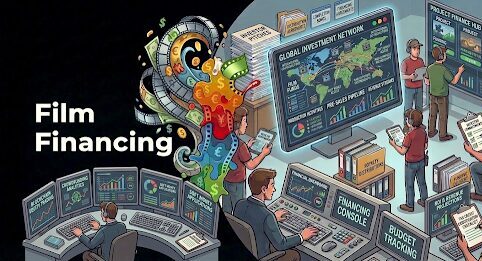
Why it matters: For producers and studio executives, this datafication directly impacts deal velocity, packaging leverage, and the strategic allocation of development resources by making the market’s capital flows transparent.
Context: The financing stack for a typical European co-production now involves over four distinct sources, reflecting a market where complexity and fragmentation have made traditional networking insufficient for efficient capital assembly.
"According to the European Audiovisual Observatory, European co-productions draw from an average of 4.2 distinct financing sources per project — a figure that illustrates how complex modern financing stacks have become." — VITRINA.AI
Commentary: The operational consequence is a power shift from financiers and sales agents who gatekept relationships toward producers who can now model and target capital with precision. This will compress development timelines and increase competition for ‘hot’ funder mandates, while simultaneously exposing gaps in territories or genres where capital is retreating. The platforms themselves become critical infrastructure, potentially influencing deal terms and packaging by highlighting normative stack structures.
Date: April 28, 2026 12:00 AM ET
URL: https://vitrina.ai/blog/film-financing-intelligence-data-production-funding/
AI Sentiment Score: Positive (66%)
AI Credibility Score: 10.0/10 — High
Scores and text generated by AI analysis of the source article indicated.
The Pinched Middle — When NonDē Meets Its Limits (Capitalmeetsstory.Substack)
Summary: The $10M–$15M independent film budget tier is identified as a uniquely treacherous financing zone. It requires a complex, layered capital stack of equity, pre-sales, tax incentives, and gap financing, demanding institutional-level deal-making without the safety net of studio support. The article posits that a ‘Verified Audience’—behavioral proof of market demand—could function as a modern, de-risking substitute for traditional pre-sales.

Why it matters: This analysis clarifies the specific financial choke point for mid-budget independents, directly impacting producers’ packaging strategies, financiers’ risk assessments, and the viability of entire project slates.
Context: The independent film financing model has long relied on pre-sales to secure gap loans, but market fragmentation and streaming’s disinterest in traditional output deals have eroded this mechanism.
"A Verified Audience functions as a form of soft pre-sale — behavioral proof, not just demographic aspiration." — CAPITALMEETSSTORY.SUBSTACK
Commentary: The shift from contractual pre-sales to behavioral data as collateral represents a fundamental change in risk assessment. If validated, it would transfer leverage from traditional sales agents to entities controlling direct audience relationships, potentially redefining which projects are financeable. However, it also introduces new dependencies on platform analytics and raises questions about who underwrites the translation of ‘engagement’ into guaranteed revenue for gap lenders.
Date: April 21, 2026 12:00 AM ET
URL: https://capitalmeetsstory.substack.com/p/the-pinched-middle-when-nonde-meets
AI Sentiment Score: Negative (80%)
AI Credibility Score: 9.7/10 — High
Scores and text generated by AI analysis of the source article indicated.
Roundup: Industry Analysis & Financing, April 28, 2026 (Freakpulse)
Summary: The WGA minimum compensation structure formalizes a two-tiered writing economy, with a $93,000 gulf between high-budget ($141,000) and low-budget ($48,000) original screenplay packages. This codifies the economic floor for studio and streamer work, directly shaping deal-making and risk assessment in the development pipeline.

Why it matters: For writers, producers, and development executives, this establishes the baseline labor economics and structural pressures that define script acquisition and the path to production, directly informing deal-making and risk assessment.
Context: WGA minimums establish the baseline labor economics for studio and streamer work, while the development process remains the primary bottleneck where most projects fail, reflecting industry-wide risk aversion.
"* There are commissioned original scripts — a producer or studio has an idea and hires a writer to develop it. The writer is paid for their work whether or not the." — FREAKPULSE
Commentary: The compensation chasm incentivizes IP development and pitch-based sales over speculative original writing, as the financial risk for a writer pursuing a low-budget original is disproportionate to the guaranteed minimum. For buyers, the low minimum for sub-$5M films creates a buyer’s market for original material, further concentrating development leverage with commissioning entities and pushing viable original work toward the high-budget studio system.
Date: April 28, 2026 12:00 AM ET
URL: https://freakpulse.com/2026/04/28/roundup-industry-analysis-financing-april-28-2026-2026-w18-a0ff6310/
AI Sentiment Score: Negative (75%)
AI Credibility Score: 9.4/10 — High
Scores and text generated by AI analysis of the source article indicated.
Insider Intel: Where’s the Money? The New Financing Deals. (Stage32)
Summary: A Stage32 report highlights the persistent financing paradox in independent film and TV development: producers cannot secure financing without attached talent, but agencies will not allow talent attachment without financing in place. This dynamic is forcing producers to pursue non-traditional relationship-building or seek early-stage financiers willing to back vision over packaged elements. The core constraint is the shrinking value of projects lacking major talent-driven pre-sales.

Why it matters: This directly impacts deal-making velocity and risk allocation, forcing producers to alter their development pipelines and leverage strategies to secure projects.
Context: This reflects a long-standing market inefficiency that intensifies during periods of capital contraction, shifting leverage further toward agencies and established talent.
"The conundrum is as old as Hollywood and as frustrating as ever: you need talent to get financed, but you need financing to attach talent." — STAGE32
Commentary: The report signals a hardening of agency gatekeeping and a retreat of risk capital from purely speculative development. The practical implication is a further bifurcation of the indie market: well-connected producers with deep talent relationships will continue to package, while others must pivot to financiers with a taste for early, high-conviction bets—a much smaller and more idiosyncratic pool. This elevates the strategic value of producer and casting director relationships over traditional sales-agent pipelines.
Date: April 29, 2026 12:00 AM ET
URL: https://www.stage32.com/blog/insider-intel-wheres-the-money-the-new-financing-deals-4452
AI Sentiment Score: Negative (50%)
AI Credibility Score: 10.0/10 — High
Scores and text generated by AI analysis of the source article indicated.
What Streamers Are Buying Next — Short-Form, Anthologies & Interactive Content | EWA Panel (Youtube)
Summary: An EWA panel featuring commissioning executives details a strategic pivot in streamer acquisition, prioritizing short-form content as a low-risk testing ground for audience appetite and genre viability. The calculus now emphasizes retention metrics, multi-format scalability, and executional proof over traditional pitch packaging. Notably, some major buyers are deprioritizing star casting in favor of story originality and director track records, while anthologies are framed as a ‘safe space’ for rapid iteration.

Why it matters: This signals a material change in the gatekeeping criteria for greenlights, directly impacting how producers, directors, and financiers must package and suggest projects to secure funding.
Context: The shift follows years of streaming overspend and a subsequent industry-wide correction, forcing platforms to adopt more data-driven, cost-conscious development funnels that mitigate risk.
"In this EWA Panel Session, industry leaders Mayowa Akindele, Wallace Omobhude, Bolanle Olukanni, and Mohammed Sedik unpack what platforms are currently commissioning and how content strategy is evolving across short-form, anthologies, and." — YOUTUBE
Commentary: The operationalization of short-form as a pilot system commoditizes the development phase, potentially devaluing speculative scripts and elevating directors with demonstrable reels. The explicit downplaying of cast for certain Netflix projects recalibrates packaging leverage, shifting power from talent agencies to proven creative executors. This creates a two-tier market: high-concept, director-driven originals and IP-extensions where track record is the primary currency.
Date: April 28, 2026 12:00 AM ET
URL: https://www.youtube.com/watch?v=72X4Gr1VbQI
AI Sentiment Score: Negative (50%)
AI Credibility Score: 10.0/10 — High
Scores and text generated by AI analysis of the source article indicated.
The State of Theatrical Releasing in 2026: Dead Man Walking or Phoenix Rising? (Youtube)
Summary: A 2026 analysis of theatrical distribution reveals a continued compression of the exclusive theatrical window to three weeks, followed by a premium pay-per-view (PVOD) release, with a novel revenue-sharing agreement granting exhibitors a cut of subsequent PVOD revenue. The discussion notes the traditional distributor-exhibitor split, which declines over a film’s run, incentivizing a shorter window as most distributor revenue is front-loaded. It also observes that studios with output deals to major streamers, rather than operating their own loss-leading services, are currently among the more financially successful.
Why it matters: This signals a fundamental renegotiation of the value chain, directly impacting release strategies, revenue forecasting, and the financial viability of theatrical exhibition.
Context: The post-2020 industry has been defined by experimentation with windows, PVOD, and the immense capital drain of direct-to-consumer streaming operations.
"{ts:860} with Universal for what a three-week window it typically in the past films would play I don’t know Ira you probably {ts:868} know the number it was like at least six." — YOUTUBE
Commentary: The three-week window with PVOD revenue sharing represents a pragmatic, if uneasy, détente between distributors and exhibitors, formalizing the theater’s role as a high-value marketing launchpad for downstream windows. The commentary on studios with Netflix output deals being ‘among the more successful’ underscores a strategic retreat from the ‘streaming wars’ and a recalibration towards wholesale content licensing as a more stable, capital-efficient model. This points to a bifurcated future where theatrical is a premium, truncated event for a shrinking slate, and financial health is tied to judiciously managing direct-to-consumer ambition.
Date: April 22, 2026 12:00 AM ET
URL: https://www.youtube.com/watch?v=cfRo-IpKgyY
AI Sentiment Score: Positive (66%)
AI Credibility Score: 10.0/10 — High
Scores and text generated by AI analysis of the source article indicated.
Making It Work: Production Pressure, Test Audiences & Financing Reality | Off The Lot Podcast (Youtube)
Summary: A podcast episode details the practical mechanics of independent film financing, focusing on the timeline around test screenings and the repeated failure to secure Telefilm Canada funding. The producers reveal that despite multiple applications for production and post-production grants, including a specific request for $217,000 in post-funding, they were consistently passed over. The project was ultimately completed with private investors, who are now the film’s sole financial backers.
Why it matters: It signals a hardening of risk assessment at public funding bodies and underscores the growing reliance on private capital, which reshapes creative control and project viability metrics for independent producers.
Context: Telefilm Canada’s feature film financing programs are a cornerstone of the national industry, but their selectivity and criteria are a constant subject of operational analysis for producers structuring their financial packages.
"The episode wraps with a deeper discussion on film financing, exploring investor relationships, what makes a project commercially viable, and why building the right partnerships is just as critical as the film." — YOUTUBE
Commentary: The repeated Telefilm rejections for a fully financed film, even for a relatively small post-production gap, indicate a shift in commissioning logic toward pre-validation or specific project profiles that this package didn’t meet. For producers, this reinforces the need to treat public funds as a high-variance component rather than a core pillar, pushing financial models toward all-private structures earlier in development. The consequence is a pipeline where investor relationships and commercial packaging leverage decisively outweigh grant-writing prowess for a growing segment of projects.
Date: April 20, 2026 12:00 AM ET
URL: https://www.youtube.com/watch?v=2S8NU7ex2ng
AI Sentiment Score: Negative (60%)
AI Credibility Score: 10.0/10 — High
Scores and text generated by AI analysis of the source article indicated.
FilmLA Reports Early Signs of Production Growth Across … (Mynewsla)
Summary: FilmLA’s Q1 2026 report indicates a 10.7% quarter-over-quarter increase in on-location shoot days, reaching 5,121. The growth is heavily concentrated in tax-incentivized categories, with feature film shoot days up 45.2% from Q4 2025 and TV dramas up 40.5%. However, overall television activity remains down 28.4% year-over-year, and reality TV continues a steep, multi-year decline.

Why it matters: The data provides a granular, early signal of where California’s expanded tax credit program is successfully redirecting production volume and which legacy formats are being permanently displaced.
Context: The report measures the initial impact of the latest round of the California Film & TV Tax Credit Program, where approved projects had 180 days to commence filming.
"FilmLA found that incentivized projects accounted for nearly 7% of all shoot days taking place in the Greater Los Angeles area, including 21.8% of all feature production and 17.1% of all television production happening on location." — MYNEWSLA
Commentary: The incentive is functioning as a targeted subsidy for high-budget scripted production, with features and TV dramas capturing the majority of its benefit. The collapse of reality TV, down 71.1% from its five-year average, signals a structural shift in unscripted pipeline economics and network commissioning away from LA-based physical production. The concurrent rise in commercial and ‘other’ category shoot days suggests the local vendor and crew base is adapting to a more fragmented, lower-margin work mix beneath the headline-grabbing studio projects.
Date: April 28, 2026 12:00 AM ET
URL: https://mynewsla.com/business/2026/04/28/filmla-reports-early-signs-of-production-growth-across-region/
AI Sentiment Score: Negative (50%)
AI Credibility Score: 10.0/10 — High
Scores and text generated by AI analysis of the source article indicated.
Statistics on coproduction | Telefilm Canada (Telefilm.Ca)
Summary: Statistics on coproduction Audiovisual coproductions governed by a treaty allow Canadian producers to benefit from financial participation from foreign sources, and promote and export Canadian talent on the international scene. Every year, coproduction in Canada represents – more than 60 official coproductions – a production volume of $500M

Why it matters: Quantifies the scale of treaty-governed co-production, signaling consistent foreign capital inflow and export viability for Canadian IP.
Context: The $500M volume and 60+ count establish a baseline metric for assessing current international co-production deal flow health.
"Statistics on coproduction Audiovisual coproductions governed by a treaty allow Canadian producers to benefit from financial participation from foreign sources, and promote and export Canadian talent on the international scene. Every year,." — TELEFILM.CA
Commentary: The signal is still worth tracking, but the current extraction path did not yield enough body text for a fuller analytical read. The immediate implication is operational rather than speculative: watch how this changes budgets, workflows, or risk assumptions over the next cycle.
Date: May 01, 2026 12:00 AM ET
URL: https://telefilm.ca/en/we-finance-and-support/coproductions/statistics-on-coproduction
AI Sentiment Score: Negative (75%)
AI Credibility Score: 7.0/10 — Medium
Scores and text generated by AI analysis of the source article indicated.
Post ID: e005a55f