Talent & Creative Signals
First-Look And Overall Deals In 2026: How Talent (Vitrina.Ai)
Summary: First-look and overall deals are opaque financial instruments that structure the relationship between talent and studios, often only becoming public long after their competitive value has expired. Their terms, including milestone-based bonuses and ambiguous IP ownership clauses, are designed to align incentives but frequently obscure the true distribution of power and value. This analysis dissects the standard components of these pacts, revealing the operational mechanics behind Hollywood’s most significant talent investments.
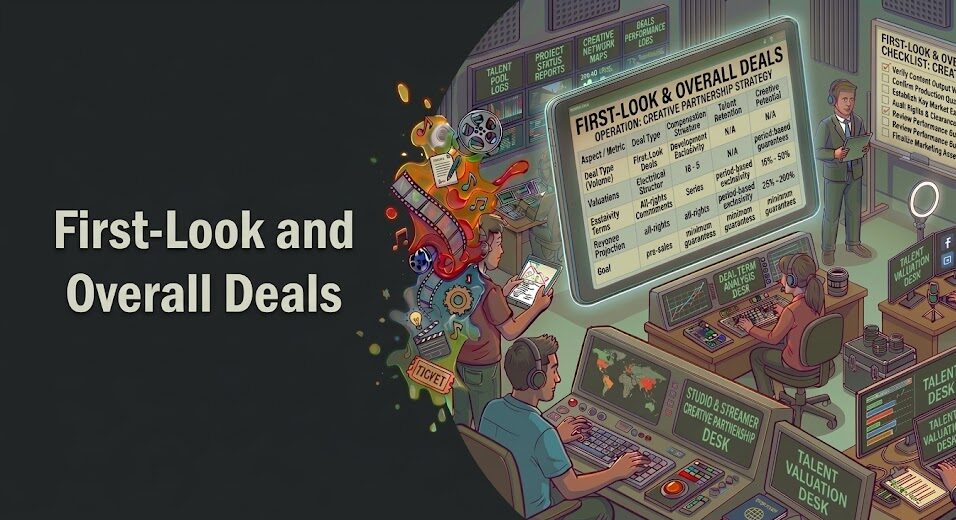
Why it matters: These deals are the primary mechanism for concentrating creative power and financial risk in the entertainment industry, directly influencing what gets made and who profits.
Context: The structure and proliferation of these deals have accelerated in the streaming era as platforms compete for exclusive talent pipelines and proven IP.
"First-look and overall deals are the agreements that don’t make the trades until after they close—and by then, the competitive intelligence they contain is already 6 weeks stale. … A standard talent." — VITRINA.AI
Commentary: The bonus structure functionally turns top creators into venture-style portfolio managers for the studio, with payouts tied to a hit-driven production line. This creates a perverse incentive for volume over quality and obscures the real cost of failure, which is borne by the talent’s locked-up time and creative capital. The vague IP language ensures the studio captures optionality on every developed concept, effectively a call option on the creator’s entire output during the deal term.
Date: May 25, 2026 12:00 AM ET
URL: https://vitrina.ai/blog/first-look-overall-deals-2026/
AI Sentiment Score: Negative (66%)
AI Credibility Score: 10.0/10 — High
Scores and text generated by AI analysis of the source article indicated.
Bari Weiss Tells CBS News Staff That Scott Pelley Broke “Trust and Mutual Respect” (Hollywoodreporter)
Summary: CBS News fired veteran 60 Minutes correspondent Scott Pelley after he publicly accused new leadership, Bari Weiss and executive producer Nick Bilton, of destroying the program’s integrity. Weiss framed the dismissal as necessary to maintain a newsroom built on ‘trust and mutual respect,’ while Pelley’s termination letter cited his ‘remarkable incivility and contempt.’ Pelley countered that management has instructed him to inject falsehoods into stories and has given politicians control over interviews.

Why it matters: The public clash reveals a deep institutional rupture at a flagship news institution, testing whether a new leadership model focused on digital expansion and a contentious editorial stance can coexist with legacy talent and norms.
Context: This follows Weiss’s earlier intervention in a 60 Minutes story about CECOT prison and Bilton’s recent appointment, signaling a deliberate, disruptive transformation of the program’s culture and editorial process.
"Bari Weiss addressed the elephant in the room during CBS News‘ daily editorial meeting Wednesday morning. Late Tuesday night, CBS fired Scott Pelley, the veteran 60 Minutes correspondent and former CBS Evening." — HOLLYWOODREPORTER
Commentary: The exchange is less about one employee’s conduct than a power transfer: Weiss and Bilton are using ‘trust’ as a managerial cudgel to neutralize internal resistance to their overhaul. Pelley’s specific allegations—political interference in interviews and pressure for unverified assertions—if substantiated, would corrode 60 Minutes’ brand equity far faster than any ratings dip. The outcome signals that legacy correspondents’ institutional capital is no longer a shield against new owners imposing their operational doctrine.
Date: Wed, 03 Jun 2026 14:35:52 +0000
URL: https://www.hollywoodreporter.com/business/business-news/bari-weiss-talks-scott-pelley-firing-cbs-news-1236612561/
AI Sentiment Score: Negative (50%)
AI Credibility Score: 10.0/10 — High
Scores and text generated by AI analysis of the source article indicated.
The Weekly Briefing – Broadcast Dialogue (Broadcastdialogue)
Summary: Prem Gill, CEO of Creative BC, is stepping down effective June 26. Meanwhile, Accent Aigu Entertainment, the Toronto production company behind Heated Rivalry, has restructured its leadership, promoting founders Jacob Tierney and Brendan Brady to Chief Creative Officer and CEO, respectively, and appointing Jayme Alter Wilson as President. Kalpana Srinarayanadas has been named Managing Director of the Reelworld Screen Institute.

Why it matters: These moves signal a maturation phase for successful indie producers and a generational shift in key Canadian cultural institutions.
Context: Accent Aigu’s hit series Heated Rivalry has established the company as a significant player, prompting a formal corporate structure to scale operations.
"Creative BC CEO Prem Gill is stepping down, effective June 26. … Kalpana Srinarayanadas is the new Managing Director of the Reelworld Screen Institute . … Jacob Tierney ." — BROADCASTDIALOGUE
Commentary: Accent Aigu’s move from a founder-led ‘prodco’ to a structured C-suite with a dedicated President and CFO is a classic scaling play, indicating institutional confidence and a shift from pure creation to portfolio management. Gill’s departure from Creative BC and Srinarayanadas’s appointment at Reelworld point to a broader recalibration of leadership across Canada’s public-facing creative bodies, often preceding shifts in funding priorities or international strategy.
Date: May 28, 2026 12:00 AM ET
URL: https://broadcastdialogue.com/twb-rsa-052826/
AI Sentiment Score: Positive (66%)
AI Credibility Score: 10.0/10 — High
Scores and text generated by AI analysis of the source article indicated.
What Martin Scorsese’s AI Embrace Means for Filmmaking’s Future: 5 Takeaways (Variety)
Summary: Martin Scorsese has joined German AI firm Black Forest Labs as an adviser, using its FLUX models for storyboarding. His move aligns with a growing, if uneven, acceptance among top-tier directors like James Cameron, Steven Soderbergh, and Doug Liman, who are integrating AI to cut costs and accelerate production. This shift occurs alongside the emergence of fully AI-generated films at major festivals, even as peers like Guillermo del Toro and Christopher Nolan voice strong reservations about AI’s role in creative work.

Why it matters: Scorsese’s endorsement signals a potential tipping point for AI’s legitimacy in high-end filmmaking, accelerating its integration into core creative workflows and reshaping production economics.
Context: Hollywood’s relationship with AI is bifurcating: a pragmatic, cost-driven adoption by some auteurs contrasts with a philosophical resistance from others, all while the technology rapidly advances from back-end tool to on-screen content generator.
"Could the next “Goodfellas” be fully made with AI? Or perhaps the next “Wolf of Wall Street”? Martin Scorsese likely wouldn’t do that — yet. But the 83-year-old Oscar-winning director has become." — VARIETY
Commentary: Scorsese’s advisory role is less about artistic revolution than institutional validation; it grants AI firms cultural capital to sell efficiency tools to a risk-averse studio system. The real signal is the emerging divide: directors focused on scale and output (Cameron, Soderbergh) see AI as an inevitable production lever, while those guarding authorship (del Toro, Nolan) treat it as an existential threat to craft. The DGA negotiations will formalize this tension into contract language, determining whether AI augments labor or replaces it.
Date: Wed, 03 Jun 2026 20:10:32 +0000
URL: https://variety.com/2026/film/news/martin-scorsese-ai-film-future-takeaways-1236766046/
AI Sentiment Score: Negative (75%)
AI Credibility Score: 10.0/10 — High
Scores and text generated by AI analysis of the source article indicated.
Post ID: bf91ce7a