

Made In USA manufacturing and logistics
Lovesac on track with tariff-driven onshoring effort (Supplychaindive)
Summary: Lovesac is on track to begin domestic production of its Sactionals modular sofas this summer, aiming to eliminate overseas manufacturing for its core revenue line. The company is redesigning its inserts specifically for U.S. automation and manufacturing processes, meaning the domestic product will not be a like-for-like copy of the Asian version. This shift is part of a four-pronged tariff strategy that also includes supply base diversification and reduced China exposure. The factory will be third-party operated, not owned by Lovesac, and is expected to lower cost volatility and improve fulfillment speed.
Why it matters: For furniture brands and contract manufacturers, Lovesac’s approach shows that onshoring often requires a full product redesign, not just a factory relocation—changing the bill of materials, automation setup, and supplier relationships.
Context: Lovesac joins a wave of companies—including World Emblem, Apple, and Johnson & Johnson—reshoring production in response to potential new Trump-era tariffs and the need for supply chain resilience.
""We’ve taken a whole new design approach to the product, designing it for manufacturing, designing it for automation," Nelson said." — SUPPLYCHAINDIVE
Commentary: The key operational takeaway is that Lovesac is not simply moving existing production lines; it is re-engineering the product for U.S. automation, which means suppliers and tooling vendors will need to adapt to new specifications. The third-party factory model reduces Lovesac’s capital risk but introduces dependency on a single domestic partner’s capacity and quality. For logistics teams, the shift promises shorter, more predictable lead times but may require renegotiating carrier contracts and warehousing strategies as Asian sourcing winds down. The explicit admission that the U.S. product will differ from the Asian version also signals potential compatibility or service parts challenges down the line.
Date: June 30, 2026 07:05 AM ET
URL: https://www.supplychaindive.com/news/lovesac-on-track-with-tariff-driven-onshoring-effort/824009/
AI Sentiment Score: Negative (83%)
AI Credibility Score: 10.0/10 — High
Scores and text generated by AI analysis of the source article indicated.
Orbital Composites Wins U.S. Space Force Contract To Advance Extreme Environment Materials Manufacturing (Textileworld)
Summary: Orbital Composites has secured a $1.9 million TACFI contract from SpaceWERX to advance robotic additive manufacturing for extreme environment materials—components that must withstand temperatures over 3,000°C, high-velocity combustion gases, and repeated thermal shock. The award targets a structural shortfall in U.S. domestic capacity for rocket nozzles, heat shields, hypersonic structures, and nuclear reactor parts, which currently require 12- to 18-month production cycles and face prohibitive costs. Orbital aims to eliminate supply constraints on solid rocket motors by combining robotics, advanced materials, and physical AI into a scalable platform that can produce mission-ready parts at operationally relevant cycle times. The company is now working with defense primes, government program offices, and commercial space and energy providers to scale qualification and production.

Why it matters: For domestic manufacturing and logistics, this contract signals a shift from bespoke, long-lead-time production toward AI-driven, autonomous factories that could compress material lead times from 18 months to weeks, directly affecting supply chain resilience for hypersonics, missile defense, and nuclear microreactors.
Context: The U.S. has long relied on a handful of specialized suppliers for extreme environment materials, creating single points of failure and capacity bottlenecks. Orbital’s approach mirrors broader DoD efforts to onshore advanced manufacturing through programs like the Defense Production Act Title III and the Strategic and Critical Materials Stock Piling Act.
“Extreme environment materials are the bottleneck in some of the most critical systems the U.S. fields, and today’s manufacturing methods are too slow, too costly, and too capacity-constrained to meet what the moment demands. We are building toward a future where that constraint no longer exists — where AI-driven factories take in a design file and produce a mission-ready part, at operationally relevant cycle times and cost.”
Commentary: The real operational consequence here is the compression of the design-to-field timeline for solid rocket motors and hypersonic components, which currently forces program offices to order years in advance and accept design lock-in. If Orbital’s platform delivers on its promise, it could reshape how primes and program offices manage inventory risk and supply chain buffers. The $1.9 million TACFI is small but strategically placed—it funds the transition from lab demo to production qualification, which is where most advanced manufacturing startups stall. Watch for follow-on production contracts and whether Orbital can achieve the material property certifications required by MIL-STD and NASA standards.
Date: June 29, 2026 03:55 PM ET
URL: https://www.textileworld.com/textile-world/2026/06/orbital-composites-wins-u-s-space-force-contract-to-advance-extreme-environment-materials-manufacturing/
AI Sentiment Score: Negative (75%)
AI Credibility Score: 10.0/10 — High
Scores and text generated by AI analysis of the source article indicated.
BELLA+CANVAS Completes Acquisition By Sanmar, Continues As Independent Brand Led By Megan Spire (Textileworld)
Summary: SanMar Corporation has completed its acquisition of BELLA+CANVAS, which will continue as an independent brand under EVP Megan Spire. The deal preserves the Los Angeles headquarters and existing leadership while granting access to SanMar’s scale and resources. SanMar becomes the exclusive national wholesale distributor, though local and regional partners remain in the network. The brand plans to introduce over 20 new styles in 2027, signaling continued product development investment.

Why it matters: For domestic apparel manufacturers and decorators, this acquisition consolidates wholesale distribution under a single national partner while maintaining regional channel options, which could streamline supply chains but also reduce distributor competition for BELLA+CANVAS products.
Context: BELLA+CANVAS has been a prominent US-made blank apparel brand, and SanMar is the largest distributor in the decorated apparel space. The deal follows a trend of vertical integration in the imprintable apparel market.
"Products will continue to be available directly at bellacanvas.com, through BELLA+CANVAS’s network of long-standing local and regional distributor partners listed below, and through SanMar who will serve as the exclusive national wholesale distributor of BELLA+CANVAS products moving forward." — TEXTILEWORLD
Commentary: The shift to SanMar as exclusive national distributor effectively narrows the wholesale channel for decorators who previously sourced from multiple national houses. Local and regional partners remain, but their inventory access and pricing may shift under the new structure. The 20 new styles for 2027 suggest SanMar is betting on product expansion rather than cost-cutting, which is a positive signal for the brand’s domestic manufacturing footprint.
Date: June 29, 2026 03:39 PM ET
URL: https://www.textileworld.com/textile-world/knitting-apparel/2026/06/bellacanvas-completes-acquisition-by-sanmar-continues-as-independent-brand-led-by-megan-spire/
AI Sentiment Score: Neutral (33%)
AI Credibility Score: 10.0/10 — High
Scores and text generated by AI analysis of the source article indicated.
South Carolina Ports closing terminal temporarily to rein in costs (Supplychaindive)
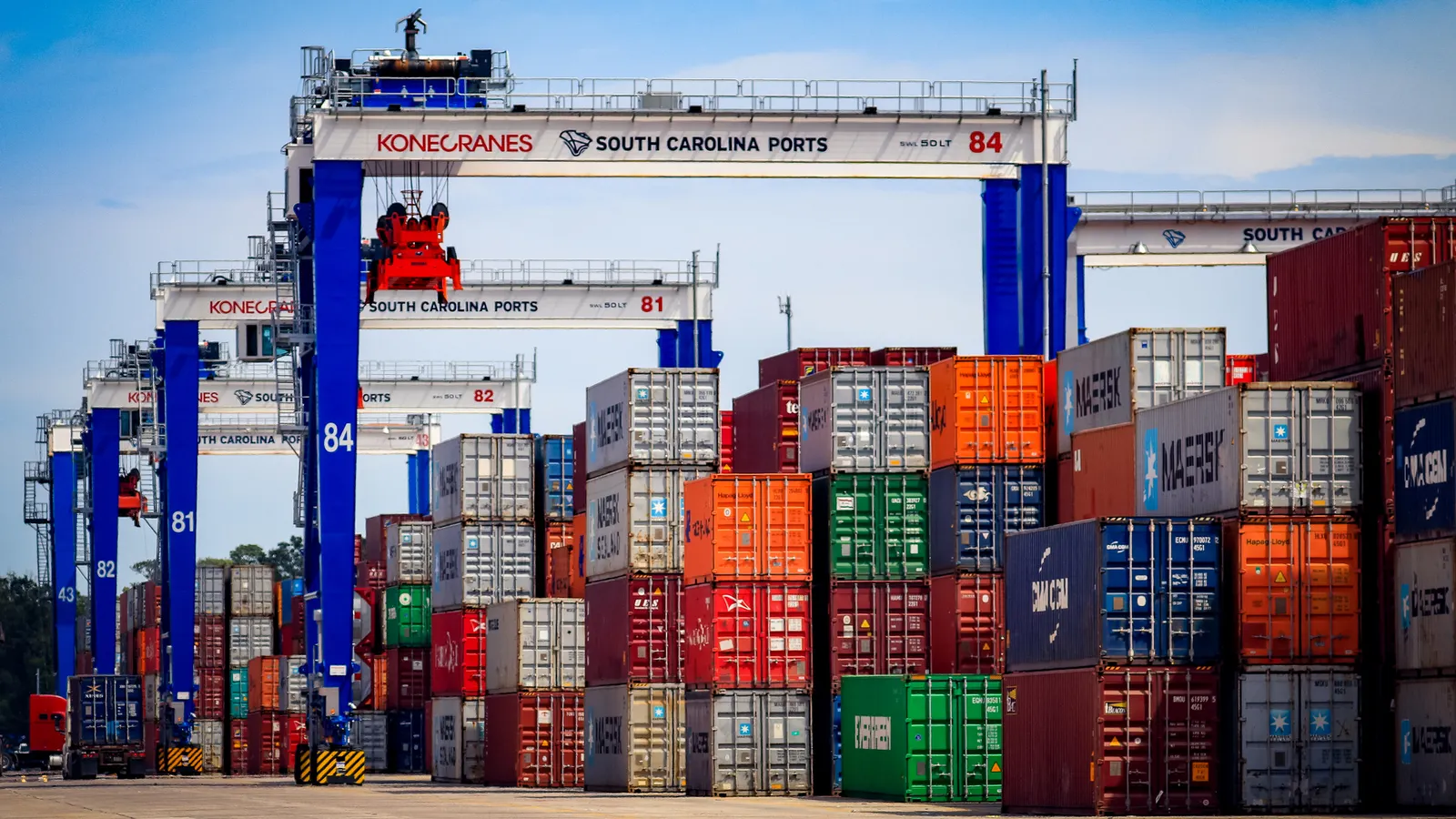
Summary: South Carolina Ports Authority will pause container operations at its Leatherman Terminal starting August 1, consolidating volume to the North Charleston and Wando terminals. The move is driven by cost control measures amid uncertain trade forecasts and tempered volumes. Leatherman currently handles about 5% of port volumes, with MSC as its sole shipping line. The terminal’s reopening depends on volume recovery and cost competitiveness.
Why it matters: For logistics and manufacturing stakeholders, this signals that even recently opened, modern terminals are being idled when demand softens, forcing shippers to adapt to reduced capacity concentration and potentially higher per-container costs at remaining facilities.
Context: Leatherman Terminal opened in 2021 but was shuttered in 2023 due to a labor dispute with the International Longshoremen’s Association, reopening only in 2024. The current closure is purely demand- and cost-driven, not labor-related.
"“We have ample capacity at our other two terminals because of the down market right now, and so, you know, when you go from consolidating all of your containers from three terminals to two, of course, there will be cost savings involved there,” the spokesperson said." — SUPPLYCHAINDIVE
Commentary: Consolidating from three terminals to two reduces fixed operational costs but also compresses the buffer for volume spikes. Shippers relying on Leatherman must now absorb potential congestion and longer drayage at North Charleston or Wando. The indefinite reopening timeline introduces planning uncertainty for importers and exporters in the region. This is a textbook example of port operators adjusting capacity to match a down cycle, not a structural retreat from the Leatherman asset.
Date: July 02, 2026 07:17 AM ET
URL: https://www.supplychaindive.com/news/south-carolina-ports-closing-terminal-temporarily-to-rein-in-costs/824130/
AI Sentiment Score: Negative (77%)
AI Credibility Score: 10.0/10 — High
Scores and text generated by AI analysis of the source article indicated.
Stitch Fix expands AI image generation to improve personalization (Retaildive)
Summary: Stitch Fix has expanded its AI-powered style visualization hub, Stitch Fix Vision, allowing users to upload selfies and see themselves wearing recommended outfits on demand. The feature, previously limited to weekly personalized imagery, now offers a dynamic gallery of AI-generated looks. This update follows a 4.7% year-over-year revenue increase to $340 million in Q3 and the appointment of a new chief product and technology officer.

Why it matters: For personalization and retail tech teams, this signals a shift from batch to real-time AI-driven styling, increasing the operational complexity of image generation pipelines and data integration.
Context: Stitch Fix introduced Vision in October 2025, leveraging billions of client preference data points and generative AI alongside human stylist expertise.
"Dive Brief: – Stitch Fix is expanding its AI-powered style visualization hub, Stitch Fix Vision, the company said in a press release last week. – Users can upload selfies through the Stitch." — RETAILDIVE
Commentary: The move from scheduled to on-demand image generation will stress-test Stitch Fix’s inference infrastructure and content moderation workflows. For competitors, the key question is whether this drives conversion or merely increases engagement metrics without improving return rates. The new tech exec from Walmart Labs and Sephora suggests a push toward scaling these AI capabilities across a larger product surface.
Date: July 02, 2026 09:33 AM ET
URL: https://www.retaildive.com/news/stitch-fix-expands-ai-image-generation-personalization/823815/
AI Sentiment Score: Negative (75%)
AI Credibility Score: 10.0/10 — High
Scores and text generated by AI analysis of the source article indicated.
The loyalty metric no one wants to explain (Retaildive)
Summary: A deep dive into the measurement failures behind loyalty programs reveals that most vendors report repeat purchase rates without establishing a baseline or measuring incrementality. Without a control group, a reported 40% return rate is meaningless—it may simply describe existing behavior. The article argues that the only valid metric is the incremental lift over what would have happened anyway, which requires integrated transaction data and controlled testing. This shifts the focus from vanity metrics to operational precision.

Why it matters: For brands investing in loyalty infrastructure, this clarifies that without proper measurement, you are paying for credit-taking, not behavior change—a direct hit to ROI calculations and vendor selection.
Context: The loyalty tech market is crowded with gift cards, rewards programs, and incentives, but most vendors lack the data integration or experimental design to suggest causation. This is a recurring blind spot in retention strategy.
"A 6% increase in repeat purchases among a targeted cohort, where you can prove those purchases would not have occurred otherwise, is a foundation you can build on. A reported 40% return rate with no control and no baseline is not." — RETAILDIVE
Commentary: The core operational takeaway is that loyalty programs must be designed as experiments from day one, with control groups and transaction-level attribution. This raises the bar for internal analytics teams and vendor RFPs—if a partner cannot show incrementality, their reported lift is noise. The practical consequence is a shift from buying programs to buying measurement frameworks.
Date: June 29, 2026 05:00 AM ET
URL: https://www.retaildive.com/spons/the-loyalty-metric-no-one-wants-to-explain/823601/
AI Sentiment Score: Negative (50%)
AI Credibility Score: 10.0/10 — High
Scores and text generated by AI analysis of the source article indicated.
Saks parent reduces debt to under $1B (Retaildive)
Summary: Exemplar Luxury Group (ELG), the parent of Saks Fifth Avenue, Neiman Marcus, and Bergdorf Goodman, has reduced its debt from $3.4 billion to $840 million after exiting Chapter 11. The company secured $500 million in new capital from its ad hoc secured noteholder group, now the majority owners. However, the restructuring allows interest on one loan to be paid by adding debt rather than cash, and a separate $1.25 billion CMBS loan on the NYC flagship store remains a burden. Analysts warn the balance sheet could weaken over time despite the near-term relief.

Why it matters: For luxury retail operations and their supply chains, this signals continued financial fragility at a key vendor, which may affect payment terms, inventory flow, and the stability of flagship store operations.
Context: ELG entered bankruptcy in January 2026 after a highly leveraged $2.7 billion merger of Saks, Neiman Marcus, and Bergdorf Goodman in 2024, followed by vendor revolts over late payments and declining sales.
"In less than six months under Chapter 11, Exemplar Luxury Group has reduced its debt load by some 75% – a drop of as much as $2.3 billion, according to advisory firm." — RETAILDIVE
Commentary: The ability to pay interest by adding debt rather than cash is a liquidity band-aid, not a cure. For vendors and logistics partners, the risk of delayed payments or reduced orders persists, especially if the CMBS loan on the flagship store forces cash outflows. The tangled financial structure suggests operational discipline will be tested, and any misstep could reignite supply chain friction.
Date: July 02, 2026 08:36 AM ET
URL: https://www.retaildive.com/news/saks-parent-reduces-debt-under-1b-exemplar-luxury-group-chapter-11-bankruptcy/824310/
AI Sentiment Score: Negative (80%)
AI Credibility Score: 10.0/10 — High
Scores and text generated by AI analysis of the source article indicated.
Toyota North America adjusts supply chain, manufacturing leadership (Supplychaindive)
Summary: <figure><div><img src="https://imgproxy.divecdn.com/xOQQba6gc7uUfxx5s0k0HuOFXJmr9m8UWGYWBmeJaJ8/g:ce/rs:fill:1600:900:1/Z3M6Ly9kaXZlc2l0ZS1zdG9yYWdlL2RpdmVpbWFnZS9UTU5BLUhlYWRxdWFydGVycy1FeHRlcmlvci1FbnRyYW5jZS0xNTAweDEwNjEuanBn.webp" /></div></figure><p>Changes include expanded roles for Group VP of Supply Chain Kevin Austin and Group VP of Vehicle Supply Chain Kensuke Morita.</p> Leadership restructuring signals a formal elevation of supply chain oversight, suggesting process bottlenecks or strategic pivots are being addressed.

Why it matters: Leadership restructuring signals a formal elevation of supply chain oversight, suggesting process bottlenecks or strategic pivots are being addressed.
Context: Expanded roles for key VPs imply a shift in operational accountability, likely impacting decision-making authority on sourcing and logistics.
"<figure><div><img src="https://imgproxy.divecdn.com/xOQQba6gc7uUfxx5s0k0HuOFXJmr9m8UWGYWBmeJaJ8/g:ce/rs:fill:1600:900:1/Z3M6Ly9kaXZlc2l0ZS1zdG9yYWdlL2RpdmVpbWFnZS9UTU5BLUhlYWRxdWFydGVycy1FeHRlcmlvci1FbnRyYW5jZS0xNTAweDEwNjEuanBn.webp" /></div></figure><p>Changes include expanded roles for Group VP of Supply Chain Kevin Austin and Group VP of Vehicle Supply Chain Kensuke Morita.</p>." — SUPPLYCHAINDIVE
Commentary: The signal is still worth tracking, but the current extraction path did not yield enough body text for a fuller analytical read. The immediate implication is operational rather than speculative: watch how this changes budgets, workflows, or risk assumptions over the next cycle.
Date: June 29, 2026 11:06 AM ET
URL: https://www.supplychaindive.com/news/toyota-north-america-adjusts-supply-chain-manufacturing-leadership/823798/
AI Sentiment Score: Neutral (50%)
AI Credibility Score: 10.0/10 — High
Scores and text generated by AI analysis of the source article indicated.
Post ID: 738c5b94