

Made In USA manufacturing and logistics
Sensormatic Introduces Sewn-In RFID Tags for Apparel Authentication, Loss Prevention (Rfidjournal)
Summary: Sensormatic Solutions has introduced two sewn-in RFID tagging options—the RFID Seam Tag and RFID Brand Label—designed to be permanently embedded in garments without altering fit or appearance. The tags aim to strengthen inventory visibility, authenticate products, and deter theft, counterfeiting, and return fraud across the retail supply chain. Available worldwide, they are compatible with existing RFID ecosystems and can be applied at the source, extending the useful life of RFID investments. The move signals a shift from removable, adhesive tags to permanent, tamper-resistant identifiers embedded at manufacturing.

Why it matters: For domestic apparel manufacturers and retailers, sewn-in RFID shifts tagging upstream, changing production workflows and requiring coordination with source-tagging service bureaus. It also raises the stakes on data ownership and item-level traceability from factory floor to point of sale.
Context: Retailers have long used removable RFID tags for inventory and loss prevention, but those tags are easily removed or transferred, limiting their value for authentication and post-sale tracking. Sewn-in tags address that gap by making the identifier part of the garment itself, a move that aligns with broader industry pressure to combat counterfeiting and omnichannel shrinkage.
"Key Takeaways – Sensormatic’s sewn-in RFID options are designed to improve inventory visibility and brand protection without changing a garment’s fit or look. – Permanent, tamper-resistant tags can help retailers address theft,." — RFIDJOURNAL
Commentary: The practical consequence is a shift in where tagging happens: sewn-in tags must be applied during garment construction, not at the distribution center, which means brands and contract manufacturers need to integrate RFID into sewing lines and quality control. That raises labor and equipment costs at the factory, but it also creates a durable digital fingerprint that survives the product’s lifecycle, enabling new use cases like secondhand market authentication and recall traceability. The tamper-resistant design effectively turns the tag into a brand-protection tool, but it also complicates returns and recycling, since the tag cannot be easily removed without damaging the item. Retailers adopting this will need to rework their source-tagging agreements and ensure their RFID readers and software can handle the higher read density and permanent tag placement.
Date: July 31, 2026 09:00 AM ET
URL: https://rfidjournal.com/news/sensormatic-introduces-sewn-in-rfid-tags-for-apparel-authentication-loss-prevention/225181
AI Sentiment Score: Negative (50%)
AI Credibility Score: 10.0/10 — High
Scores and text generated by AI analysis of the source article indicated.
ITMF: Global Textile Machinery Shipments Shrunk In 2025, Except For Spinning (Textileworld)
Summary: Global textile machinery shipments contracted across nearly every segment in 2025, with long-staple spindles down 42%, shuttle-less looms down 28%, and flat knitting machines down 22%. The only bright spots were short-staple spindles and open-end rotors, which grew 3.3% and 3.5% respectively, driven almost entirely by Asian buyers. North and Central America saw a 264% surge in short-staple spindle deliveries, though from a small base. China and India remain the dominant investors, while Türkiye and Bangladesh cut rotor purchases sharply.
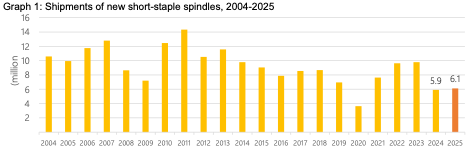
Why it matters: For US-based manufacturers and logistics planners, the divergence between spinning growth and weaving/knitting declines signals where capacity is being added and where it is being idled, affecting yarn availability, import competition, and equipment lead times.
Context: The ITMF survey covers 200+ machinery makers and is the industry’s benchmark for capital investment trends. The 2025 data reflects post-pandemic overcapacity correction in weaving and knitting, while spinning investment continues to consolidate in Asia.
"In 2025, global shipments of new short-staple spindles and open-end rotors increased by +3.3% and 3.5%, respectively (year-on-year). Deliveries of long-staple spindles decreased by -42%." — TEXTILEWORLD
Commentary: The 264% jump in North/Central American short-staple spindle deliveries—to 77K units—is the outlier worth watching, suggesting reshoring momentum in yarn production despite the broader downturn. But with 95% of spinning investment still going to Asia, US mills could remain reliant on imported machinery and face longer lead times for weaving and knitting equipment, which are contracting globally. The sharp drops in Türkiye and Bangladesh rotor purchases could tighten supply of open-end yarn in those export hubs, potentially shifting sourcing patterns for US apparel importers.
Date: July 28, 2026 03:02 PM ET
URL: https://www.textileworld.com/textile-world/2026/07/itmf-global-textile-machinery-shipments-shrunk-in-2025-except-for-spinning/
AI Sentiment Score: Negative (60%)
AI Credibility Score: 10.0/10 — High
Scores and text generated by AI analysis of the source article indicated.
Post ID: b2881e62