
Emerging Tech & Weak Signals
Korea Opens Citizen Lottery to Pick National AI Champion Starting Friday (Techtimes)
Summary: South Korea’s Ministry of Science and ICT will deploy a 200-person citizen lottery panel to evaluate four competing AI foundation models in the Dokpamo competition, marking the first documented use of sortition in national AI procurement. The panel’s scores will directly influence which team is eliminated, with the two final winners anchoring the country’s ‘AI for All’ service for 51 million residents. The evaluation abandons blind testing because models self-identify when asked, and instead relies on transparent, hands-on citizen assessment to capture real-world usability that benchmarks miss. The field includes LG AI Research, SK Telecom, Upstage, and Motif Technologies, with the citizen panel running August 8–11.

Why it matters: This is the first time a government has given ordinary citizens binding authority over AI procurement, setting a precedent for how public trust and real-world usability might be weighed against benchmark scores in national AI decisions. The outcome will shape Korea’s $5.7 billion sovereign AI infrastructure and could influence how other governments approach AI evaluation.
Context: The Dokpamo competition is part of Korea’s broader sovereign AI strategy, with a parallel Frontier AI initiative targeting frontier-scale models. The citizen panel follows a documented shift in procurement criteria toward agentic capability and real-world applicability, driven by a 37% benchmark-to-deployment gap in enterprise AI.
"South Korea’s government-backed AI competition will put an unusual question to 200 ordinary people beginning Friday: which of four competing AI models is good enough to power a free national AI service." — TECHTIMES
Commentary: The shift from blind to transparent evaluation is a pragmatic acknowledgment that generative AI’s self-identification makes blinding impossible, but it also introduces a new variable: citizen perception of brand and provenance may influence scores, even with guidance to focus on performance. The panel’s absolute-scoring results are directly tied to elimination, making this a real test of whether participatory mechanisms can influence consequential decisions—a gap that prior experiments have failed to close. Watch for whether the citizen scores diverge from benchmark rankings, which would signal a meaningful reweighting of what ‘quality’ means in AI procurement.
Date: August 06, 2026 03:58 PM ET
URL: https://www.techtimes.com/articles/323429/20260806/korea-opens-citizen-lottery-pick-national-ai-champion-starting-friday.htm
AI Sentiment Score: Negative (66%)
AI Credibility Score: 10.0/10 — High
Scores and text generated by AI analysis of the source article indicated.
TutorMoments: Do AI tutors know when to help and when to hold back? (Huggingface.Co)
Summary: Hugging Face and Learning Commons released TutorMoments, a replay-based evaluation framework that tests whether LLMs can balance scaffolding against pushing for rigor in real tutoring transcripts. Across seven models, default ‘helpful assistant’ behavior led to over-helping, and while prompt engineering improved scores, it did not close the gap to human judgment. The dataset, code, and replays are open-sourced, offering a new benchmark for AI tutoring that measures pedagogical judgment rather than fixed behaviors.

Why it matters: This is the first benchmark that operationalizes the help-vs-hold-back trade-off in AI tutoring, shifting evaluation from rule-based metrics to context-dependent judgment—critical for the growing market of AI tutors in K-12 classrooms.
Context: Existing tutoring benchmarks reward single behaviors like ‘never give the answer,’ but TutorMoments uses teacher-annotated decision points from real sessions to score whether a model’s move matches what the moment called for, revealing that LLMs default to over-helping.
"Language models, though, are trained to be helpful, and a helpful assistant tends to do the hard part for you—explaining the concept, laying out the steps, and guiding you to the answer. In a tutoring session, that can cut short the productive struggle—the effortful, sometimes frustrating problem-solving that learning research has long tied to stronger understanding." — HUGGINGFACE.CO
Commentary: The finding that prompt engineering lifts scores but leaves models far from human judgment suggests that current RLHF alignment—optimizing for helpfulness—is fundamentally misaligned with pedagogical needs. The open-sourced replay pipeline is a useful tool for developers, but the reliance on an LM classifier for scoring introduces a circularity risk: models are judged by models. Expect this to become a standard evaluation layer for AI tutors, but watch for validation studies against real student outcomes before treating scores as learning proxies.
Date: August 07, 2026 01:53 PM ET
URL: https://huggingface.co/blog/allenai/tutormoments
AI Sentiment Score: Negative (71%)
AI Credibility Score: 10.0/10 — High
Scores and text generated by AI analysis of the source article indicated.
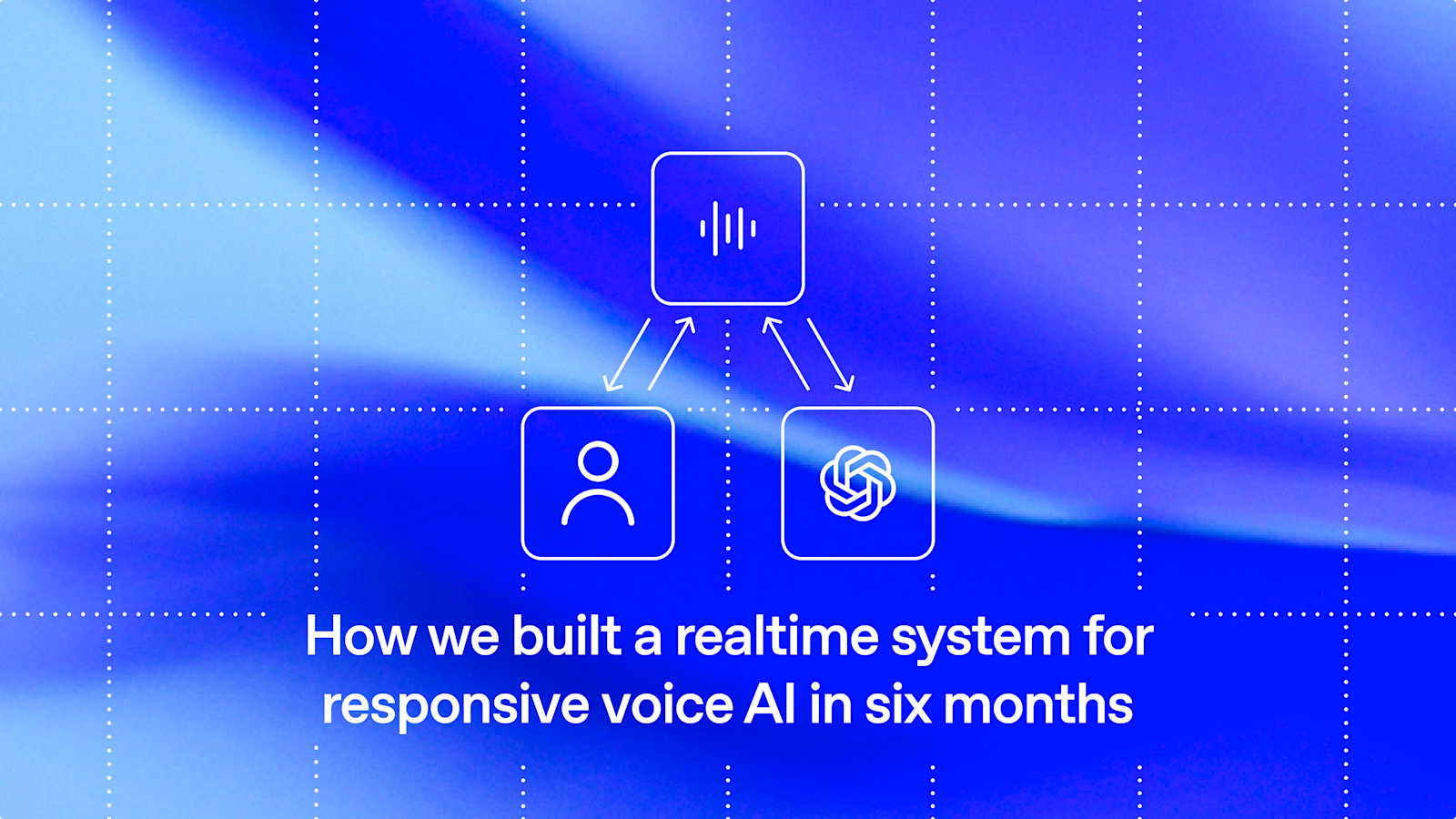
How we built a realtime system for responsive voice AI in six months (Openai)
Summary: OpenAI details the architecture behind GPT-Live, its third-generation full-duplex voice model that eliminates the turn detector from the audio path. The system streams audio directly through a stateful inference engine, delegates deep reasoning to frontier models asynchronously, and uses a new WebRTC optimization (WARP) plus Instant Connect to cut session startup from six round trips to one. Built in six months, the system powers ChatGPT Voice and is slated for a public API.
Why it matters: This is the first production-grade blueprint for full-duplex voice AI, showing how to decouple the live media loop from application logic—a pattern that will define the next wave of voice interfaces and agentic coordination.
Context: Previous voice systems relied on turn detectors and cascaded or speech-to-speech models, which added latency and ignored conversational cues. OpenAI’s shift to a full-duplex model with asynchronous delegation marks a structural break from both the turn-based and cascaded paradigms.
"How we built a realtime system for responsive voice AI in six months By Justin Uberti and Zahan Malkani, Members of Technical Staff For voice AI, knowing when to speak is harder." — OPENAI
Commentary: The WARP and Instant Connect specs are the sleeper story—they’re open standards that could reshape WebRTC startup latency across the industry, not just for OpenAI. The silent test methodology, which exposed capacity and geography issues invisible in load tests, is a template for any team shipping realtime AI. The real signal is that voice AI is moving from ‘fast enough to demo’ to ‘fast enough to be the default interface,’ and the bottleneck is now transport and state management, not model intelligence.
Date: August 03, 2026 03:00 AM ET
URL: https://openai.com/index/continuous-voice-interaction-with-gpt-live
AI Sentiment Score: Negative (75%)
AI Credibility Score: 10.0/10 — High
Scores and text generated by AI analysis of the source article indicated.
Lumilens Emerges from Stealth with More Than $900 Million in Funding to Break AI’s Connectivity Bottlenecks in the Data Center (Financialcontent)
Summary: Lumilens emerged from stealth with over $900 million in total funding at a $5.51 billion valuation, backed by a multi-billion-dollar customer agreement with a top hyperscaler. The company ships optical interconnects for both scale-out and scale-up AI data center fabrics, addressing the shift from GPU scarcity to connectivity bottlenecks. Its portfolio includes 800G/1.6T pluggable transceivers and near-package/co-packaged optics, all built on the LumiCore platform. The funding round was co-led by Atreides Management, Bain Capital Ventures, Meritech, Seligman Ventures, and Spark Capital.

Why it matters: This signals a structural shift in AI infrastructure: compute is no longer the binding constraint; optical connectivity is. Lumilens’ rapid qualification and deployment inside a hyperscaler’s production data centers suggests the industry is moving from copper to photonics faster than expected, with implications for GPU cluster design, supply chains, and the competitive landscape for optical components.
Context: McKinsey projects 800G transceiver supply shortfalls of 40-60% through 2027, and 1.6T shortfalls of 30-40% through 2029. Copper’s ~1.5-meter reach limit forces scale-up networks to stay within a single rack, capping tightly coupled GPU domains at hundreds of processors. Lumilens’ approach mirrors earlier silicon photonics efforts at Juniper (via Aurrion) but targets AI-specific scale-up and scale-out fabrics.
"A single 400,000 GPU data center requires more than 2.4 million transceivers and more than five million fiber strands from a market already unable to keep pace. McKinsey projects that 800G optical transceiver production could fall 40-60% short of industry demand through 2027, with 1.6T transceiver shortfalls of 30-40% persisting through 2029." — FINANCIALCONTENT
Commentary: The real signal is not the funding but the qualification and shipping timeline: two years from founding to production deployment inside a hyperscaler is unusually fast for optical hardware, suggesting the bottleneck is acute enough to compress vendor qualification cycles. The multi-billion-dollar agreement indicates that hyperscalers are already committing to photonic scale-up, which could accelerate the shift away from copper and force incumbents like Coherent and Lumentum to respond. Watch for whether Lumilens’ manufacturing-as-a-product model can actually scale to the volumes required, or whether it becomes a design house reliant on partners. The valuation implies a $100B+ TAM, but the real test is whether the technology delivers the promised power and density gains in production, not just in demos.
Date: August 06, 2026 09:00 AM ET
URL: https://www.financialcontent.com/article/bizwire-2026-8-6-lumilens-emerges-from-stealth-with-more-than-900-million-in-funding-to-break-ais-connectivity-bottlenecks-in-the-data-center
AI Sentiment Score: Positive (50%)
AI Credibility Score: 10.0/10 — High
Scores and text generated by AI analysis of the source article indicated.
Orchard: An open framework for scalable agentic AI (Microsoft)
Summary: Microsoft Research has released Orchard, an open-source framework for scalable agentic AI built around Orchard Env, a Kubernetes-based environment service that standardizes training and evaluation across software engineering, web navigation, and personal assistant agents. The framework enables training directly inside real deployment harnesses like Codex, OpenClaw, and ZeroClaw, and includes three domain-specific recipes: Orchard-SWE, Orchard-GUI, and Orchard-Claw. Orchard-SWE achieves 69.7% on SWE-bench Verified (73.0% with value-model reranking) using only ~3 billion active parameters, approaching frontier systems over 10 times larger. Orchard-GUI reaches 68.4% average on web-navigation benchmarks with just 400 demonstrations and 2,200 tasks, while Orchard-Claw improves Codex-harness success from 18.6% to 51.5% after training. The project releases training data, evaluation methods, and the environment service to lower the cost of agentic AI research.

Why it matters: This signals a shift in agentic AI research from proprietary, monolithic stacks to reusable, open environment layers—lowering the barrier for small teams to train agents that perform near frontier levels. The harness-embedded training approach directly addresses the train/deploy mismatch that has plagued open agent development.
Context: Agentic AI research has been bottlenecked by closed infrastructure—custom sandboxes, proprietary datasets, and simplified training loops that don’t match real deployment. Orchard’s release follows a pattern of Microsoft Research open-sourcing infrastructure (e.g., earlier agent frameworks) but is notable for its explicit focus on environment-as-a-service and cross-harness training.
"Orchard closes this gap: a lightweight proxy records the harness’s own model calls as training data while each rollout runs in its own container, so an agent can be trained end-to-end directly in the harness that it will be deployed with—OpenClaw, Codex, ZeroClaw, or others—and across several harnesses." — MICROSOFT
Commentary: The most consequential innovation is not the benchmark numbers but the environment abstraction: by decoupling the runtime from the training framework, Orchard makes agent training a commodity service, not a bespoke engineering effort. The value-model reranking trick—reusing trajectories from prior experiments—points toward cumulative agent learning, a path that could compound open-model capabilities. Watch for whether the community adopts Orchard Env as a standard, which would undercut the moats of proprietary agent platforms. The 73% SWE-bench result with 3B active parameters is a direct challenge to the ‘scale is all you need’ orthodoxy, though the reliance on distillation from larger models (MiniMax-M2.5, Qwen3.5-397B) tempers the claim of independent capability.
Date: August 03, 2026 12:00 PM ET
URL: https://www.microsoft.com/en-us/research/blog/orchard-an-open-framework-for-scalable-agentic-ai/
AI Sentiment Score: Negative (75%)
AI Credibility Score: 10.0/10 — High
Scores and text generated by AI analysis of the source article indicated.
Post ID: 70923ef4