
Fashion retail operations and sourcing strategies
Apparel brands’ responses to the 2025 US tariffs led to significant … (Business-Humanrights)
Summary: A 2026 report from the Business and Human Rights Centre details how apparel brands’ reactive sourcing adjustments to 2025 US tariffs transferred financial shocks directly to suppliers, leading to widespread factory closures, layoffs, and wage cuts. The commercial pressure manifested as order cancellations, price reductions, and demands for suppliers to absorb tariff costs. Women and migrant workers in countries like Bangladesh, Cambodia, and Sri Lanka faced the most severe consequences, including food insecurity and heightened exploitation risks.

Why it matters: For sourcing executives and production managers, this documents a concrete failure mode in crisis response, showing how standard cost-shifting tactics directly destabilize the supplier base and create operational and reputational liabilities.
Context: This follows a long-established pattern where brands use purchasing power to externalize volatility, but the 2025 tariffs provided a specific, large-scale stress test that crystallized the human rights outcomes of those decisions.
"# Apparel brands’ responses to the 2025 US tariffs led to significant human rights risks for workers Apparel brands’ responses to the US tariffs in 2025 exposed suppliers to sudden commercial shocks." — BUSINESS-HUMANRIGHTS
Commentary: The report operationalizes ‘responsible purchasing’ as honoring agreed prices and payment terms during disruptions—a direct challenge to the prevailing just-in-time, cost-optimization playbook. For brands, this creates a tangible due diligence requirement: future tariff or trade shocks must be modeled not just for margin impact but for supplier solvency and worker welfare, with contractual and auditing mechanisms adjusted accordingly. The findings shift the compliance burden upstream, making a brand’s crisis procurement strategy a measurable component of its human rights record.
Date: April 23, 2026 12:00 AM ET
URL: https://www.business-humanrights.org/en/from-us/press-releases/apparel-brands-responses-to-the-2025-us-tariffs-led-to-significant-human-rights-risks-for-workers/
AI Sentiment Score: Negative (83%)
AI Credibility Score: 10.0/10 — High
Scores and text generated by AI analysis of the source article indicated.
Seasonal Inventory Planning: Strategy for Fashion Retailers (Easyreplenish)
Summary: Easyreplenish outlines a systematic framework for seasonal inventory planning in fashion retail, emphasizing the integration of trend forecasting, pre-season demand modeling, and a structured buying calendar to align supply with volatile demand. The process culminates in a post-season review loop to refine future accuracy.

Why it matters: For fashion retailers and brands, the operational discipline outlined here directly impacts margin preservation, markdown velocity, and capital allocation, making inventory planning a core financial lever rather than a creative afterthought.
Context: This reflects a broader industry shift toward data-driven merchandising, where success hinges on synchronizing long-lead-time supply chains with short-cycle demand signals.
"A well-executed seasonal plan defines when to launch new collections, how deep to buy, what to restock mid-season, and when to initiate markdowns or clearance." — EASYREPLENISH
Commentary: The framework formalizes the tension between creativity and capital management, pushing brands to treat buying calendars and performance reviews with the same rigor as design. Failure to institutionalize this loop cedes advantage to competitors with superior demand sensing and agile replenishment.
Date: April 20, 2026 12:00 AM ET
URL: https://www.easyreplenish.com/blog/seasonal-inventory-planning
AI Sentiment Score: Negative (50%)
AI Credibility Score: 10.0/10 — High
Scores and text generated by AI analysis of the source article indicated.
April 2026 – FASH455 Global Apparel … (Shenglufashion)
Summary: A 2026 academic study analyzes H&M’s published factory list and the sourcing strategies of major U.S. apparel firms in response to persistent tariff hikes. Brands like Kontoor, Oxford Industries, and Victoria’s Secret detail operational pivots, including price increases, assortment elevation, and reduced promotions. The analysis frames these moves as direct responses to margin pressure and a fluid macro environment, questioning the feasibility of responsible sourcing under heightened cost competition.

Why it matters: For sourcing managers and brand strategists, this documents the concrete, margin-protecting playbook—price hikes, product mix shifts, promotional discipline—becoming standard operating procedure under tariff regimes, directly impacting forecasting, vendor negotiations, and consumer positioning.
Context: The apparel industry’s decades-long low-cost, globally dispersed sourcing model is being stress-tested by geopolitical tensions and protectionist trade policies, forcing a reevaluation of cost structures and supply chain ethics.
"To better understand H&M’s fast fashion business model and its implications for the company’s sourcing practices, this study analyzed H&M’s detailed factory list published in February 2026, which includes 1,455 entries." — SHENGLUFASHION
Commentary: The quoted corporate responses reveal a sector-wide shift from absorption to pass-through, with strategic nuance: Oxford Industries uses tariffs to justify a ‘more elevated assortment,’ effectively blending cost recovery with brand upscaling. Victoria’s Secret’s pullback on promotions to regain pricing power indicates tariffs are catalyzing a broader correction in discount-driven retail psychology. The central tension for practitioners is whether this margin-focused calculus leaves budgetary or strategic room for the enhanced auditing and supplier partnerships that ‘responsible sourcing’ ostensibly requires.
Date: April 21, 2026 12:00 AM ET
URL: https://shenglufashion.com/2026/04/
AI Sentiment Score: Negative (75%)
AI Credibility Score: 10.0/10 — High
Scores and text generated by AI analysis of the source article indicated.
Quick Commerce 2.0: Slower, safer, and more profitable for fashion … (Dfupublications)
Summary: The quick commerce sector is pivoting from a pure speed model to a ‘profitable precision’ strategy, with fashion and apparel emerging as a key driver. The shift is motivated by superior unit economics: fashion orders offer higher average values and gross margins than FMCG, despite higher return rates. This makes slower, more careful delivery economically viable, allowing platforms to monetize ‘social emergencies’ like last-minute outfit needs.

Why it matters: For fashion brands and logistics operators, this recalibrates the economics of last-mile delivery, prioritizing margin over velocity and altering inventory, partnership, and return-handling strategies.
Context: This follows increased regulatory pressure on unsafe delivery practices and represents a maturation of quick commerce as it expands beyond groceries into higher-margin, non-essential categories.
"With government scrutiny on unsafe delivery timelines intensifying and platforms expanding into non-essential categories such as fashion and apparel, the industry is shifting from a ‘speed-at-all-costs’ model to one centered on ‘profitable." — DFUPUBLICATIONS
Commentary: The integration of fashion forces a redesign of quick-commerce logistics, shifting from high-volume, low-margin throughput to a model that can absorb higher handling and return costs. Brands must now evaluate which product lines are suited to impulse ‘social emergency’ purchases and adapt packaging and sizing tools to mitigate return rates. For platforms, this creates a new vendor management layer focused on curation and margin protection, not just speed.
Date: April 28, 2026 12:00 AM ET
URL: https://www.dfupublications.com/index.php/news/apparel/quick-commerce-2-0-slower-safer-and-more-profitable-for-fashion-retail
AI Sentiment Score: Negative (50%)
AI Credibility Score: 10.0/10 — High
Scores and text generated by AI analysis of the source article indicated.
Blog Articles – FASH455 Global Apparel & Textile Trade and Sourcing (Shenglufashion)
Summary: A 2026 academic study examines how U.S. fashion companies are adapting sourcing strategies and business practices in response to rising tariffs and geopolitical tensions. It highlights specific corporate responses, including price increases, product mix elevation, and a pullback on promotions to protect margins. The analysis underscores the technical complexity of apparel rules of origin and their critical role in determining applied tariff rates.
Why it matters: For sourcing managers and brand operators, this signals a shift from pure cost-minimization to a more complex calculus balancing tariff engineering, product architecture, and pricing power to maintain profitability.
Context: The sourcing playbook is being rewritten under sustained trade policy pressure, forcing a reevaluation of supply chain geography, product costing, and go-to-market tactics.
"- Based on the videos, what have been the expected and unexpected impacts of tariffs on apparel-exporting countries? – Based on the videos, what ethical challenges emerge in apparel sourcing and global." — SHENGLUFASHION
Commentary: The operational pivot is clear: brands are using tariff pressures as a cover to fundamentally reset product architecture and pricing strategies, moving upmarket rather than just passing on costs. This creates a bifurcated market where scale players with compliance expertise can exploit rules of origin, while smaller brands face margin compression or consolidation pressure. The feasibility of ‘responsible sourcing’ now depends on a firm’s ability to absorb or engineer around these new tariff-inclusive costs, making it a luxury of margin and operational sophistication.
Date: April 21, 2026 12:00 AM ET
URL: https://shenglufashion.com/blog/
AI Sentiment Score: Negative (75%)
AI Credibility Score: 10.0/10 — High
Scores and text generated by AI analysis of the source article indicated.
US Clothing Imports Are Not Just Slowing, they Are Becoming … (Wto-Mww)
Summary: US apparel and footwear importers face a compounding operational crisis where slowing volume is secondary to a confluence of volatile costs, shifting sourcing, unpredictable tariffs, and heightened security risks. The core challenge is a breakdown in planning, as traditional buffers are too thin to absorb simultaneous shocks across raw materials, freight, and policy. This transforms a procurement function into a complex, integrated risk-management discipline.

Why it matters: For fashion brands, manufacturers, and logistics managers, this shifts the competitive advantage from buying power to integrated supply-chain planning, requiring new cross-functional workflows and earlier risk assessment.
Context: This follows years of post-pandemic supply-chain realignment, where brands shortened inventory cycles and diversified sourcing away from China, creating a more fragmented and less predictable pipeline.
"US Clothing Imports Are Not Just Slowing, they Are Becoming Harder to Plan … US apparel and footwear imports are weakening, but the bigger issue isnot volume alone. Apparel supply chains are." — WTO-MWW
Commentary: The implication is a structural shift in apparel operations: planning teams must now model tariff scenarios concurrently with raw-material bids and freight contracts, while security protocols become a direct input to margin calculations. This elevates supply-chain analytics from a cost-center to a core strategic function, likely benefiting vendors offering integrated visibility platforms. Brands that fail to connect these historically siloed domains will face margin erosion not from demand weakness, but from cascading, unmanaged cost shocks.
Date: April 23, 2026 12:00 AM ET
URL: https://www.wto-mww.com/en/post/us-clothing-imports-are-not-just-slowing-they-are-becoming-harder-to-plan
AI Sentiment Score: Negative (70%)
AI Credibility Score: 10.0/10 — High
Scores and text generated by AI analysis of the source article indicated.
Navigating Import Regulations for Textiles and Apparel … (Exploretex)
Summary: In 2026, import compliance for textiles and apparel has evolved from a logistical task to a core strategic function, driven by stringent environmental regulations in the EU and a volatile tariff landscape in the US. The India-UK Free Trade Agreement introduces new sourcing options but also competitive complexity, while labeling and HTS code accuracy are now critical legal requirements. A single data error can trigger shipment seizures and fines, forcing brands to adopt hybrid sourcing models and rely on sophisticated manufacturing partners for real-time regulatory navigation.

Why it matters: For fashion brands, retailers, and their supply chain managers, operational success now depends on mastering a complex, data-driven compliance environment where regulatory missteps directly threaten profitability and market access.
Context: This reflects a broader industry shift where trade policy is increasingly tied to environmental and social governance (ESG) criteria, moving beyond simple tariff negotiations to integrated compliance regimes.
"In the global fashion economy of 2026, the movement of goods is no longer just about logistics—it is about data, transparency, and high-stakes compliance. For fashion brands and retailers, **navigating import regulations." — EXPLORETEX
Commentary: The elevation of compliance to a ‘critical strategic pillar’ fundamentally alters brand economics, requiring dedicated resources and shifting competitive advantage to firms with embedded technical expertise. This creates a new vendor landscape where partners like EXPLORETEX are valued not for manufacturing alone but for their ability to navigate regulatory dataflows. The hybrid sourcing model (e.g., basics from India, compliant pieces from Portugal) illustrates how trade agreements are now actively shaping product architecture and line planning, not just costing.
Date: April 22, 2026 12:00 AM ET
URL: https://exploretex.com/navigating-import-regulations-for-textiles-and-apparel/
AI Sentiment Score: Positive (66%)
AI Credibility Score: 10.0/10 — High
Scores and text generated by AI analysis of the source article indicated.
The Ultimate Guide to Fashion Sourcing in 2026: Strategies for … (Exploretex)
Summary: A 2026 sourcing guide for fashion brands reframes procurement from a cost-minimization exercise to a strategic partnership based on four pillars: technical capability, scalability, compliance, and geographical advantage. It emphasizes transparent cost engineering and the need for supply chain resilience over pure labor arbitrage. The operating model presented treats sourcing as integral to margin management and brand reputation.

Why it matters: For brand operators and production heads, this codifies a shift in vendor management priorities that directly impacts product margins, launch velocity, and compliance risk.
Context: The guide reflects an industry-wide pivot from opaque, price-driven sourcing to audited, partnership-based supply chains, driven by consumer demand for transparency and the logistical fractures exposed in recent years.
"The margin between a thriving global label and a struggling startup often comes down to the efficiency, sustainability, and reliability of their fashion sourcing networks. As consumer demands shift toward transparency, quality,." — EXPLORETEX
Commentary: The guide’s framework formalizes a procurement discipline that treats factories as R&D and risk-mitigation partners, not just contractors. This elevates the sourcing manager’s role from negotiator to strategic operator, requiring deeper technical and geopolitical literacy. For vendors, it creates a bifurcated market: compliant, transparent partners will command premium rates and longer-term contracts, while opaque low-cost operators will be relegated to disposable, high-risk projects. The explicit call for ‘open-book cost breakdowns’ shifts bargaining power and forces brands to understand true cost drivers beyond fabric.
Date: April 21, 2026 12:00 AM ET
URL: https://exploretex.com/fashion-sourcing/
AI Sentiment Score: Negative (80%)
AI Credibility Score: 10.0/10 — High
Scores and text generated by AI analysis of the source article indicated.
How geopolitics is redefining fashion supply chains and … (Apparelviews)
Summary: The traditional fashion sourcing playbook, focused on optimizing for cost and lead time in a stable global map, is being invalidated by geopolitical volatility. Brands now face a strategic imperative to build resilient, diversified supply chains capable of absorbing shocks from shifting tariffs, trade routes, and regional policies. This shift elevates supply chain management from a procurement function to a core leadership concern, prioritizing dependable execution over lowest-cost geography. The emerging model favors regionalized networks for speed and risk reduction, forcing a redesign of supplier relationships and internal coordination systems.
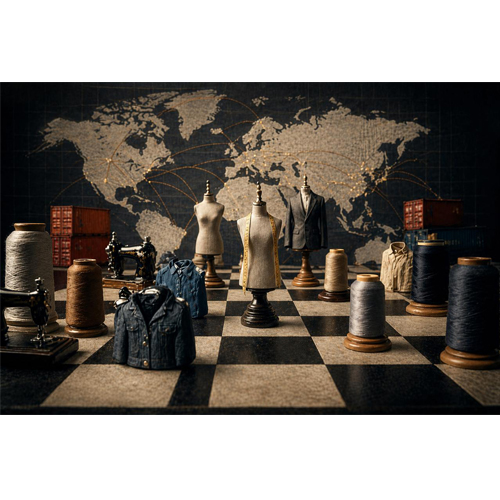
Why it matters: For sourcing, production, and operations teams, this redefines success metrics from cost efficiency to systemic resilience, requiring new skills in network orchestration and contingency planning.
Context: This follows a multi-year trend of ‘China plus one’ strategies, but the article argues most implementations fail by treating diversification as a one-time geographic shift rather than a continuous operational rebuild.
"For years, fashion brands treated sourcing like a map problem. Pick the best country for price, capacity, and lead times, then scale. That playbook is getting rewritten. In today’s global environment, the." — APPARELVIEWS
Commentary: The practical consequence is a bifurcation of labor: procurement teams must now architect flexible, category-specific supplier ecosystems, while leadership absorbs supply chain risk into core strategy. This will accelerate investment in supply chain visibility tech and favor brands that can manage complexity over those that merely outsource it. The shift to regional response cycles will also pressure design and merchandising to adopt more agile, test-and-react workflows, fundamentally altering the seasonal calendar.
Date: April 23, 2026 12:00 AM ET
URL: https://www.apparelviews.com/how-geopolitics-is-redefining-fashion-supply-chains-and-why-execution-will-matter-more-than-geography/
AI Sentiment Score: Negative (71%)
AI Credibility Score: 10.0/10 — High
Scores and text generated by AI analysis of the source article indicated.
Data-Driven Fashion Strategy for Brands and Retailers (Textilelearner.Net)
Summary: The fashion industry’s operational core is shifting from creative instinct to a data-driven hybrid model focused on predictability and margin protection. Key levers include demand sensing using real-time digital signals to replace traditional forecasting, personalized customer experiences powered by behavioral data, and real-time optimization of inventory, pricing, and marketing spend. This transition is framed as a competitive necessity for higher full-price sell-through and profitability in a volatile market.

Why it matters: For practitioners, this mandates new technical workflows, vendor partnerships, and skill sets, moving decision-making from seasonal planning to continuous, signal-responsive operations.
Context: This reflects a broader industry maturation where fashion’s economics are being recalibrated through retail-tech and supply-chain analytics, following the playbook of Amazon and Alibaba.
"The fashion industry is not only driven by instinct alone; data sits at the core of how brands design, produce, price, and sell. What was once a creative-led industry is now a." — TEXTILELEARNER.NET
Commentary: The operational consequence is a re-tooling of the entire pipeline: design must integrate predictive trend data, merchandising becomes a real-time allocation game, and supply chains require API-driven flexibility. This creates a new class of winners—brands that can operationalize data fluency—and pressures traditional creative and buying roles to develop analytical competencies or risk obsolescence.
Date: April 26, 2026 12:00 AM ET
URL: https://textilelearner.net/data-driven-fashion-strategy-for-brands-and-retailers/
AI Sentiment Score: Negative (66%)
AI Credibility Score: 10.0/10 — High
Scores and text generated by AI analysis of the source article indicated.
US fashion firms accelerate sourcing shift as supply chains … (Just-Style)
Summary: Many companies noted that full sourcing realignment takes 12–18 months or more. 12-18 month sourcing realignment timeline suggests phased, rather than immediate, operational shifts are necessary.

Why it matters: 12-18 month sourcing realignment timeline suggests phased, rather than immediate, operational shifts are necessary.
Context: Focus on near-term vendor diversification and inventory buffering to mitigate protracted supply chain transition risk.
[Metadata-only note] The available source data did not expose a direct source quote this cycle.
Commentary: The signal is still worth tracking, but the current extraction path did not yield enough body text for a fuller analytical read. The immediate implication is operational rather than speculative: watch how this changes budgets, workflows, or risk assumptions over the next cycle.
Date: April 21, 2026 12:00 AM ET
URL: https://www.just-style.com/features/us-fashion-firms-accelerate-sourcing-shift-as-supply-chains-falter/
AI Sentiment Score: Negative (50%)
AI Credibility Score: 10.0/10 — High
Scores and text generated by AI analysis of the source article indicated.
Crocs Margins Under Pressure: Tariffs or Strategy Misstep? (Zacks)
Summary: Crocs’ fiscal 2025 margins declined, with adjusted gross margin falling to 58.3% due primarily to tariff headwinds and strategic actions to stabilize its North American market. The company’s reset, including increased retailer support and reduced marketing, constrained revenue by approximately $45 million. Crocs is targeting $100 million in cost reductions for fiscal 2026 to support margin recovery.

Why it matters: For fashion brands and operators, this illustrates how macroeconomic policy (tariffs) directly intersects with channel management strategy to compress profitability, forcing a re-evaluation of cost structures and market support.
Context: Footwear and apparel brands are navigating persistent tariff pressures alongside the need to manage channel health and inventory levels, making margin protection a core operational discipline.
"For fiscal 2025, adjusted gross margin declined to 58.3%, down 50 basis points (bps) year over year, mainly due to a 130-bps tariff headwind, partially offset by sourcing efficiencies." — ZACKS
Commentary: The report underscores that tariff impacts are quantifiable and immediate, translating directly into basis-point margin erosion. Crocs’ response—channel cleanup paired with aggressive cost-cutting—signals a shift from growth-focused marketing to operational austerity for margin defense, a template other brands may follow under similar pressure.
Date: April 20, 2026 12:00 AM ET
URL: https://www.zacks.com/stock/news/2903110/crocs-margins-under-pressure-tariffs-or-strategy-misstep
AI Sentiment Score: Negative (62%)
AI Credibility Score: 10.0/10 — High
Scores and text generated by AI analysis of the source article indicated.
Content Hub | Fashion buying Insights – Source Fashion (Source-Fashion)
Summary: Explore the ultimate resource for fashion procurement and wholesale supply chains. From finding reliable international suppliers to mastering private label manufacturing, we provide the actionable data you need.

Why it matters: Focus on actionable data for procurement and private label manufacturing workflows. Indicates a need for vetted supplier sourcing.
Context: The resource emphasizes mastering supply chain logistics, suggesting immediate operational review of current vendor reliability and cost structures.
"Explore the ultimate resource for fashion procurement and wholesale supply chains. From finding reliable international suppliers to mastering private label manufacturing, we provide the actionable data you need." — SOURCE-FASHION
Commentary: The signal is still worth tracking, but the current extraction path did not yield enough body text for a fuller analytical read. The immediate implication is operational rather than speculative: watch how this changes budgets, workflows, or risk assumptions over the next cycle.
Date: April 28, 2026 12:00 AM ET
URL: https://www.source-fashion.com/content-hub
AI Sentiment Score: Negative (66%)
AI Credibility Score: 7.0/10 — Medium
Scores and text generated by AI analysis of the source article indicated.
Textiles (Apparelnews.Net)
Summary: Industry events like Texworld and Apparel Sourcing Los Angeles are serving as operational hubs for brands and manufacturers navigating volatile trade policy. The co-location of these shows with Printsource at the California Market Center provided a concentrated venue for sourcing diversification, with exhibitors from over 16 countries. This reflects a tactical shift in procurement strategy away from single-region dependency.

Why it matters: For sourcing executives and production managers, this signals a move from passive ordering to active, on-the-ground supply chain reconnaissance as a core business function.
Context: Proposed and implemented tariffs have forced apparel brands to reassess their material and finished-goods pipelines, making multi-country sourcing a risk mitigation tactic rather than a cost-saving measure.
"Exhibitors from more than 16 countries presented their offerings, affording a selection of resources and services to attendees and opportunities to diversify their supply chains." — APPARELNEWS.NET
Commentary: The trade show is evolving from a marketing venue into a critical intelligence-gathering node for tariff navigation. This increases the operational burden on brand teams, requiring more travel, vetting, and relationship management, but it also creates leverage against incumbent suppliers who may have previously enjoyed pricing power due to logistical inertia.
Date: April 27, 2026 12:00 AM ET
URL: https://www.apparelnews.net/news/textiles/
AI Sentiment Score: Negative (75%)
AI Credibility Score: 7.0/10 — Medium
Scores and text generated by AI analysis of the source article indicated.
Post ID: 43361843