Intellectual Property & Patent Law Updates
Patents, Property Rights, and What Patent Policy Keeps Getting Wrong | IPWatchdog Unleashed (Ipwatchdog)
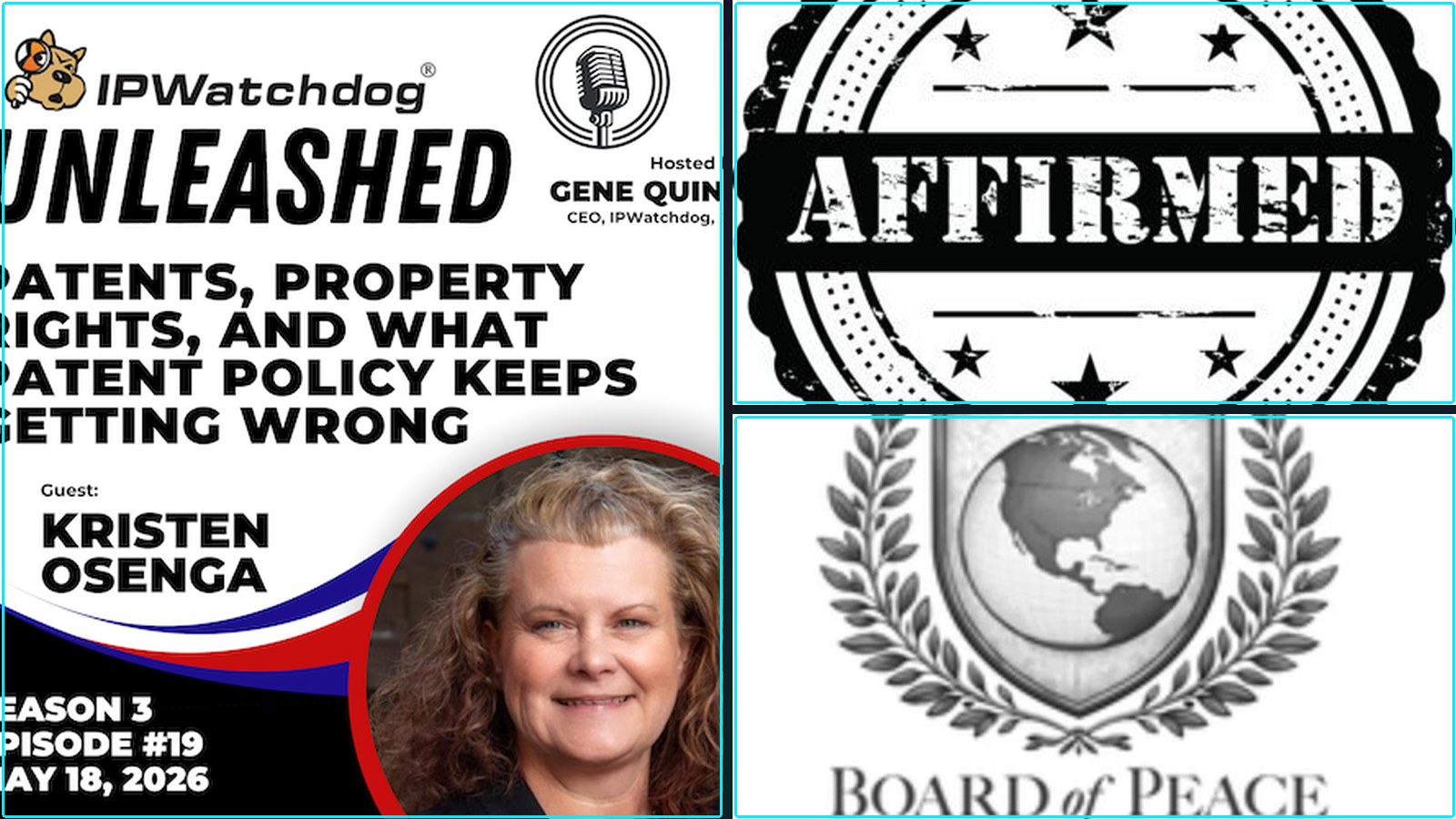
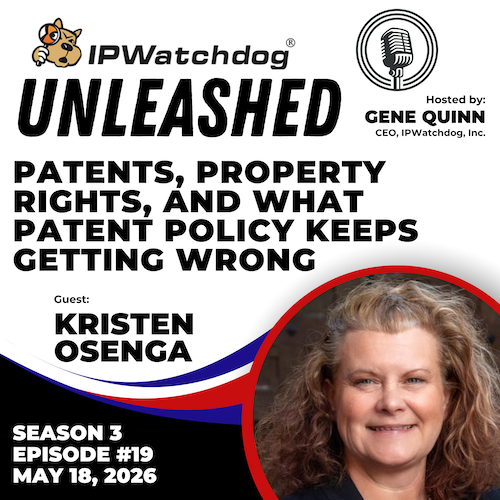
Summary: IPWatchdog interviews Kristen Osenga, a law professor and former patent litigator, who critiques the dominant academic and policy narrative that treats patents as problems to be constrained rather than property rights designed to incentivize innovation. She argues that policy has been distorted by the ‘patent troll’ frame, which focuses on the status of patent owners rather than their litigation conduct, and by the misconception of patents as monopolies. This has led to a steady erosion of enforcement mechanisms, from injunctions to damages, often based on assumptions misaligned with the realities of commercialization and investment.
Why it matters: The credibility of the patent system hinges on policy being grounded in the operational realities of innovation, not in slogans that advantage large implementers at the expense of inventors, startups, and universities.
Context: This interview reflects a sustained counter-narrative within patent policy circles, pushing back against 15 years of legal and judicial trends that have weakened patent enforcement, particularly for non-practicing entities and SEP holders.
"This week on IPWatchdog Unleashed, I spoke with Kristen Osenga, who is a Professor of Law and Associate Dean for Academic Affairs at the University of Richmond School of Law. Kristen is." — IPWATCHDOG
Commentary: Osenga’s distinction between conduct and status is the operational pivot; if adopted, it would reframe legislative and judicial approaches away from categorical suspicion of non-practicing entities and toward policing specific abuses. This realigns the system with its original intent to protect the inventor’s product—the invention itself—regardless of their manufacturing capacity. The continued conflation of these concepts directly advantages large technology implementers by lowering their cost of infringement, thereby shifting bargaining power and risk away from early-stage innovators. For policy, the immediate implication is that any future reform—be it on injunctions, SEP licensing, or litigation procedure—must be evaluated against this behavioral litmus test to avoid further skewing the innovation ecosystem.
Date: Wed, 20 May 2026 17:21:21 +0000
URL: https://ipwatchdog.com/2026/05/20/patents-property-rights-patent-policy/
AI Sentiment Score: Negative (60%)
AI Credibility Score: 10.0/10 — High
Scores and text generated by AI analysis of the source article indicated.
CAFC Affirms PTAB Ruling That DraftKings Failed to Prove Unpatentability of Gaming Patent Claim (Ipwatchdog)
Summary: The Federal Circuit affirmed a PTAB ruling that DraftKings failed to suggest the unpatentability of claim 18 of AG 18, LLC’s location-based gaming patent. The court upheld the Board’s refusal to consider a new prior art combination raised for the first time in a reply footnote, emphasizing that petitioners cannot introduce new theories after institution. It also rejected DraftKings’ collateral estoppel argument, which sought to cobble together limitations from other invalidated claims. The decision leaves a single patent claim standing against a major gaming operator.
Why it matters: This ruling reinforces procedural rigidity at the PTAB, increasing the risk for IPR petitioners who make even minor drafting errors in their petitions.
Context: The CAFC has consistently barred the PTAB from considering new grounds or prior art references not squarely presented in the original petition, a principle that limits post-institution strategic shifts.
"The CAFC emphasized that its case law prohibits the Board from entertaining theories that were absent from the petition and found that [DK’s] late-raised footnote did not respond to any argument in [the] patent owner response." — IPWATCHDOG
Commentary: The decision underscores that the PTAB’s trial-like procedures offer no leniency for petition drafting oversights, effectively turning minor clerical omissions into case-losing events. For frequent filers like DraftKings, this elevates the cost and precision required of outside counsel in pre-filing review. It also illustrates the strategic vulnerability of challenging complex, multi-claim patents where a single surviving dependent claim can preserve enforcement leverage.
Date: Wed, 06 May 2026 18:15:32 +0000
URL: https://ipwatchdog.com/2026/05/06/cafc-affirms-ptab-ruling-draftkings-failed-prove-unpatentability-gaming-patent-claim/
AI Sentiment Score: Negative (85%)
AI Credibility Score: 10.0/10 — High
Scores and text generated by AI analysis of the source article indicated.
Raskin Presses Squires on Motives for Board of Peace Trademark Filings (Ipwatchdog)
Summary: Ranking Member Jamie Raskin has escalated his inquiry into USPTO Director John Squires’s role in filing trademark applications for the Trump Administration’s ‘Board of Peace.’ Raskin’s letter alleges violations of the Lanham Act and standard USPTO procedures, framing the filings as part of a potential scheme to create a private slush fund. The core dispute centers on Squires’s claim of ‘custodial’ authority to register marks on behalf of the administration, a practice Raskin challenges as unprecedented.
Why it matters: This probes the politicization of a core administrative agency and tests the legal boundaries of the USPTO Director’s authority, with direct implications for the integrity of the trademark system and separation of powers.
Context: The inquiry follows a pattern of congressional oversight targeting perceived norm violations in the use of executive branch administrative powers, particularly where personal political branding and public policy intersect.
"Are you a willing accomplice to President Trump’s efforts to cover up that his ‘Board of Peace’ is an attempt to create a secretive private slush fund with billions of U.S. taxpayer and foreign government dollars, or are you an unwitting enabler to this scheme being forced to do the President’s bidding outside your lawful duties and powers?" — IPWATCHDOG
Commentary: Raskin’s binary framing—’willing accomplice’ or ‘unwitting enabler’—forces a political and legal reckoning for Squires, moving the debate from procedural curiosity to potential malfeasance. The ‘custodial’ defense, if accepted, would create a novel and expansive executive power over symbolic state assets, inviting future abuse. The bipartisan concern noted suggests the issue transcends partisan lines, focusing on institutional integrity. The outcome could set a precedent for how administrative agencies navigate politically charged directives under the guise of IP policy.
Date: Wed, 06 May 2026 16:15:28 +0000
URL: https://ipwatchdog.com/2026/05/06/raskin-presses-squires-on-motives-for-board-of-peace-trademark-filings/
AI Sentiment Score: Negative (75%)
AI Credibility Score: 10.0/10 — High
Scores and text generated by AI analysis of the source article indicated.
Post ID: 0d9c4750