

Emerging Tech & Weak Signals
Echoverse: Deep, evolving environments for computer-use agents (Microsoft)
Summary: Microsoft’s Echoverse project trains computer-use agents in twelve synthetic worlds—ten deep domain worlds and two capability worlds—that reproduce real application behavior with coherent state and database-grounded verification. A 9B model trained on these worlds nearly doubles its base score (36.5% to 67.1%), coming within fourteen points of GPT-5.4, and transfers to live-web benchmarks it never saw. The key finding is that depth, not environment count, drives learning: shallow worlds actively regress agent performance, while deep worlds and targeted control drilling generalize. The project also demonstrates a co-evolution loop where the world, tasks, and verifier improve alongside the model, and shows that reinforcement learning against these grounded worlds pushes agents past imitation.

Why it matters: This reframes the synthetic-data arms race: instead of scaling environment count, the leverage is in building deep, stateful worlds that preserve causal structure and co-evolving them with the model. For anyone building or evaluating computer-use agents, this is a concrete recipe for closing the gap to frontier models without scale.
Context: Synthetic environments for agent training have proliferated, but most are shallow clones that fail to capture the stateful, login-gated workflows that matter. Echoverse builds on this by treating environment construction and model training as one loop, with verifiers grounded in database state rather than pixel judgments.
"A shallow world is the cheap option. It stands up fast and looks convincing, but it only rehearses isolated, correct-looking clicks. Train on that and the model will pick up the wrong reflexes, over-stepping and looping and repeating dead actions, because nothing in the easy world ever punished them. A deep world costs more, but its trajectories carry the dependent structure that transfers to the live site." — MICROSOFT
Commentary: The most disruptive implication is that shallow synthetic environments are not just useless—they are actively harmful, teaching agents bad habits that regress performance on live sites. The co-evolution loop, where every graded rollout also repairs the world, turns evaluation into a compounding asset rather than a static benchmark. The release of four worlds with grounded verifiers is a practical gift to the research community, but the real signal is that the bottleneck has shifted from data volume to data fidelity and targeted skill drilling. Expect this to accelerate the trend toward closed-domain, stateful training environments and away from scraping public web data.
Date: July 30, 2026 01:00 PM ET
URL: https://www.microsoft.com/en-us/research/blog/echoverse-deep-evolving-environments-for-computer-use-agents/
AI Sentiment Score: Negative (85%)
AI Credibility Score: 10.0/10 — High
Scores and text generated by AI analysis of the source article indicated.
Beyond RAG: Task-aware knowledge compression for enterprise AI on AWS (Aws.Amazon)
Summary: Artificial Intelligence Beyond RAG: Task-aware knowledge compression for enterprise AI on AWS If you’re using Retrieval-Augmented Generation (RAG) for complex analytical tasks that span hundreds of documents, such as financial due diligence or regulatory compliance reviews, you’ve likely hit its ceiling. Similarity search surfaces relevant fragments but often misses cross-document connections. This post shows you how to address that gap using task-aware knowledge compression (TAKC), a technique that pre-compresses entire knowledge bases into task-specific representations deployed on AWS.
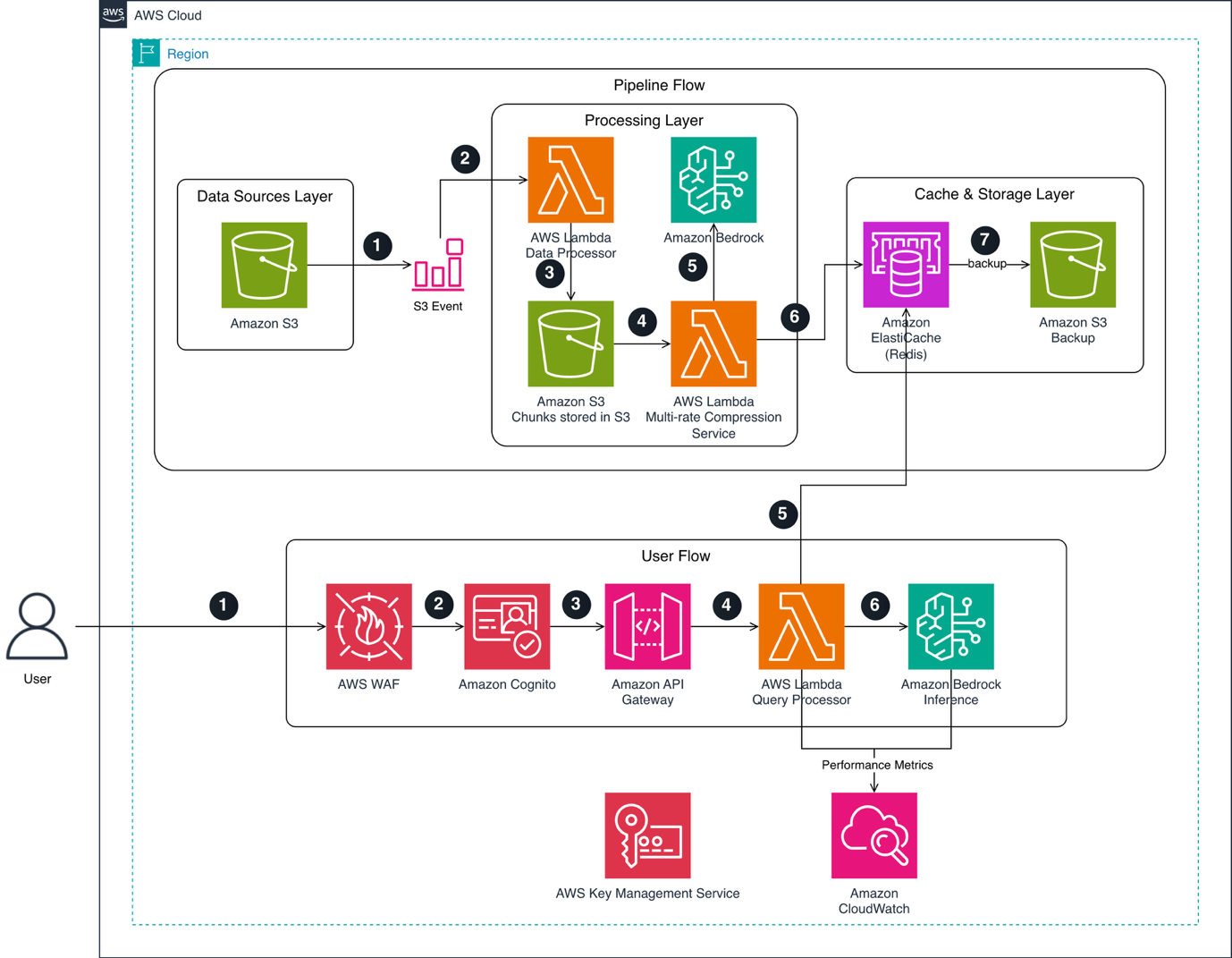
Why it matters: This matters for Emerging Tech & Weak Signals because it gives a concrete current signal to track: Artificial Intelligence Beyond RAG: Task-aware knowledge compression for enterprise AI on AWS If you’re using Retrieval-Augmented Generation (RAG) for complex analytical tasks that span hundreds of documents, such as financial due diligence or regulatory compliance reviews, you’ve likely hit its ceiling.
Context: Artificial Intelligence Beyond RAG: Task-aware knowledge compression for enterprise AI on AWS If you’re using Retrieval-Augmented Generation (RAG) for complex analytical tasks that span hundreds of documents, such as financial due diligence or regulatory compliance reviews, you’ve likely hit its ceiling. Similarity search surfaces relevant fragments but often misses cross-document connections. This post shows you how to address that gap using task-aware knowledge compression (TAKC), a technique that pre-compresses entire knowledge bases into task-specific representations deployed on AWS.
"Artificial Intelligence Beyond RAG: Task-aware knowledge compression for enterprise AI on AWS If you’re using Retrieval-Augmented Generation (RAG) for complex analytical tasks that span hundreds of documents, such as financial due diligence." — AWS.AMAZON
Commentary: The immediate implication is operational rather than speculative: watch how this changes budgets, workflows, or risk assumptions over the next cycle.
Date: July 27, 2026 12:11 PM ET
URL: https://aws.amazon.com/blogs/machine-learning/beyond-rag-task-aware-knowledge-compression-for-enterprise-ai-on-aws/
AI Sentiment Score: Neutral (50%)
AI Credibility Score: 10.0/10 — High
Scores and text generated by AI analysis of the source article indicated.
MoonPay PayBox Brings Non-Custodial Crypto Payments to Claude and ChatGPT (Techtimes)
Summary: MoonPay launched PayBox on July 29, 2026, a non-custodial payment system for Claude and ChatGPT that uses multi-party computation (MPC) to split private keys across hardware-isolated enclaves, so no single party—including the AI or MoonPay—can sign a transaction alone. It supports eight blockchains, Visa’s agentic commerce tokenization, and the x402 standard, with two authorization modes: Always Ask (per-transaction passkey) and Autonomous (user-set spending limits). The product is the first consumer-facing agentic payment option for non-developers, backed by MoonPay’s $100 million acquisition of Sodot and a broad regulatory footprint including a New York BitLicense and MiCA authorization.

Why it matters: This is the first practical, non-custodial payment rail for consumer AI agents, shifting the agentic commerce debate from ‘can we secure the keys’ to ‘who is liable when the AI spends badly’—a gap current consumer protection law does not cover.
Context: Previous attempts—OpenAI’s Instant Checkout (killed March 2026), Ledger’s hardware-based Agent Stack, and Stripe’s developer-focused Link wallet—either failed, required physical hardware, or targeted enterprises. PayBox is the first to combine MPC+TEE with open rails (x402, Visa) for individual users.
"Ask Claude to book you a flight, and until yesterday you hit the same wall every AI assistant user has always hit: the moment money needs to move, you leave the conversation." — TECHTIMES
Commentary: The security architecture is sound, but the real risk is now behavioral: Autonomous mode shifts custody risk to user configuration, and the legal framework (EFTA, chargeback rules) has no answer for AI-initiated irreversible transactions. The EU AI Act’s Article 14 deadline (August 2) could force enterprises to choose Always Ask mode or justify Autonomous mode under human oversight rules. Watch for whether MoonPay’s upcoming DeFi features—perps, leveraged positions—could push users into risk profiles they don’t fully understand, and whether regulators step in before the first high-profile loss.
Date: July 30, 2026 09:59 AM ET
URL: https://techtimes.com/articles/322179/20260730/moonpay-paybox-brings-non-custodial-crypto-payments-claude-chatgpt.htm
AI Sentiment Score: Negative (71%)
AI Credibility Score: 10.0/10 — High
Scores and text generated by AI analysis of the source article indicated.
LFM2.5-Encoders for Fast Long-Context Inference on CPU (Huggingface.Co)
Summary: LFM2.5-Encoders for Fast Long-Context Inference on CPU Here’s what you get: – Strong for their size: match or beat larger encoders on GLUE, SuperGLUE, and multilingual tasks. – 8,192-token context with latency that grows slowly as inputs get longer. – Fast on CPU: about 3.7× faster than ModernBERT-base at long context.

Why it matters: This matters for Emerging Tech & Weak Signals because it gives a concrete current signal to track: LFM2.5-Encoders for Fast Long-Context Inference on CPU Here’s what you get: – Strong for their size: match or beat larger encoders on GLUE, SuperGLUE, and multilingual tasks.
Context: LFM2.5-Encoders for Fast Long-Context Inference on CPU Here’s what you get: – Strong for their size: match or beat larger encoders on GLUE, SuperGLUE, and multilingual tasks. – 8,192-token context with latency that grows slowly as inputs get longer. – Fast on CPU: about 3.7× faster than ModernBERT-base at long context.
"LFM2.5-Encoders for Fast Long-Context Inference on CPU Here’s what you get: – Strong for their size: match or beat larger encoders on GLUE, SuperGLUE, and multilingual tasks. – 8,192-token context with latency." — HUGGINGFACE.CO
Commentary: The immediate implication is operational rather than speculative: watch how this changes budgets, workflows, or risk assumptions over the next cycle.
Date: July 28, 2026 11:01 AM ET
URL: https://huggingface.co/blog/LiquidAI/lfm2-5-encoders
AI Sentiment Score: Positive (40%)
AI Credibility Score: 10.0/10 — High
Scores and text generated by AI analysis of the source article indicated.
Post ID: eb6c87f9