

Regional Economic Indicators (Southeast Focus)
CargoNet reports $304.6M in losses, Scott Cornell says Q2 theft drop is no trend yet (Freightwaves)
Summary: Verisk CargoNet’s Q2 2026 data shows cargo theft incidents fell 26% year-over-year to 677, but estimated losses more than doubled to $304.6 million, driven by high-value metals and enterprise technology thefts. Scott Cornell of SPG Cargo & Logistics cautions that one quarter does not establish a trend, noting law-enforcement arrests may be contributing to the decline. Copper remains the top targeted metal for a record two-year stretch, while seafood thefts rose by 11 events.
Why it matters: For Southeast-focused logistics and manufacturing stakeholders, the shift toward high-value, low-volume thefts—especially metals and tech—signals where to concentrate security investments and carrier vetting, even as overall incident counts drop.
Context: Cargo theft has remained elevated for years, with organized groups increasingly using fraud schemes like fictitious pickups and business email compromise. The Southeast’s growing industrial and tech corridors make it a prime target for high-value commodity theft.
"Lower incident volume should not be mistaken for lower risk,” Keith Lewis, Verisk CargoNet’s vice president of operations, said. “The groups driving the largest losses are not necessarily trying to steal more freight; they are trying to identify the right shipment." — FREIGHTWAVES
Commentary: The doubling of losses despite fewer incidents signals a strategic pivot by theft rings toward precision targeting, not a reduction in threat. For shippers and carriers in the Southeast, this means tightening controls around metals and enterprise tech loads, not just relying on volume-based metrics. The sustained copper theft streak suggests a robust resale market that will keep these loads at risk until enforcement or pricing shifts. Treating one quarter as a trend is a mistake; the real signal is the severity shift, which demands a more selective, intelligence-driven security posture.
Date: August 07, 2026 03:44 PM ET
URL: https://www.freightwaves.com/news/cargonet-reports-304-6m-in-losses-scott-cornell-says-q2-theft-drop-is-no-trend-yet
AI Sentiment Score: Negative (54%)
AI Credibility Score: 10.0/10 — High
Scores and text generated by AI analysis of the source article indicated.
Modal shift dampens trucking market (Freightwaves)
Summary: Intermodal rail volumes for domestic containers are up 10% year-over-year while long-haul truckload tenders have fallen to their lowest point of the year, a divergence that began in mid-July. The shift is driven by widening cost spreads—truckload contract rates from Chicago to Elizabeth, NJ are up 31% versus 5% for intermodal, and Atlanta-to-Elizabeth trucking is up nearly 60% versus 6% for intermodal. This modal shift is most pronounced in long-haul lanes over 800 miles, where intermodal has the greatest cost advantage. The article warns that intermodal carriers will likely raise rates, rail infrastructure has limits, and shippers may face risks if they over-rely on rail, especially with tight downstream inventories and the upcoming peak season.
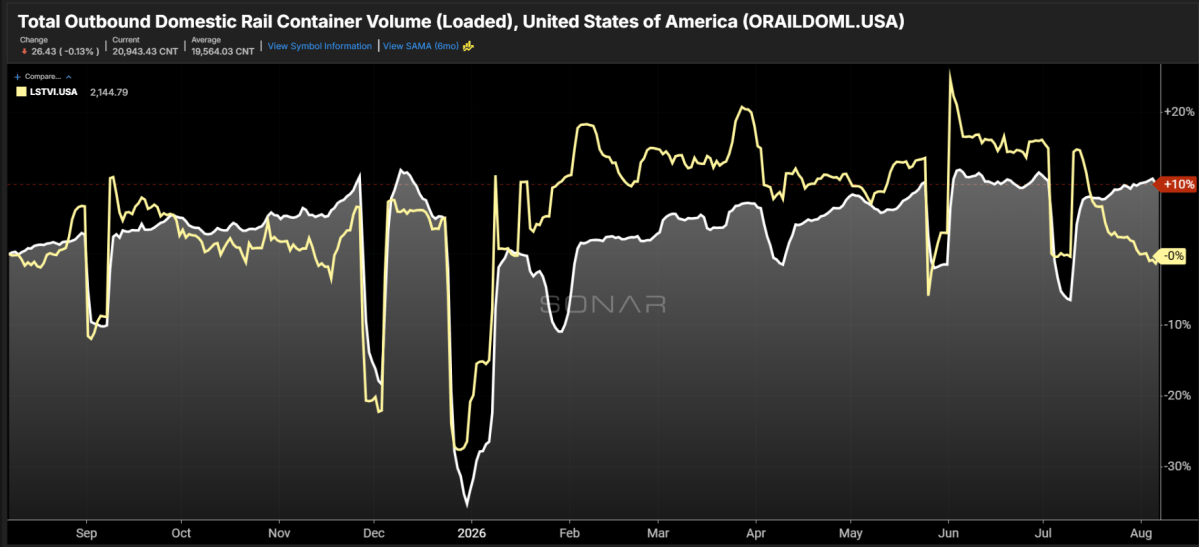
Why it matters: For Southeast-focused readers, the 20%+ growth in Atlanta domestic container volumes signals a structural shift in freight flows that could reshape regional logistics capacity, drayage demand, and trucking employment, while also exposing shippers to rail capacity constraints and rate increases.
Context: The modal shift is a response to elevated truckload costs, but it is not new—shippers have historically shifted to intermodal during trucking upcycles. The current divergence is notable because it is happening in August, outside peak season, and despite strong import volumes at California ports.
"Truckload contract rates from Chicago to Elizabeth, NJ are up 31% (including fuel), compared to intermodal’s 5%. Trucking rates from Atlanta to Elizabeth are up nearly 60%, compared to just 6% for intermodal. These differentials are too great for many shippers to overlook." — FREIGHTWAVES
Commentary: The rate spread is unsustainable, and intermodal carriers have clear pricing power—they could raise rates into double digits and still retain business. The looming transcontinental merger may temporarily hold rates down, but once resolved, expect a repricing. Shippers who have shifted to rail are exposed to drayage bottlenecks and tight inventories; a demand shock in Q4 could force a costly scramble back to truckload. Watch Atlanta and Chicago as bellwethers for whether this modal shift becomes structural or reverts after the upcycle.
Date: August 08, 2026 08:30 PM ET
URL: https://www.freightwaves.com/news/modal-shift-dampens-trucking-market
AI Sentiment Score: Negative (62%)
AI Credibility Score: 10.0/10 — High
Scores and text generated by AI analysis of the source article indicated.
Post ID: 305f9bb1