

Freight Market Trends and Broker Operations
Motive and Highway Restore ELD Data Access After Integration Dispute (Freightwaves)
Summary: Highway and Motive have restored the frequency at which Highway can access electronic logging device data belonging to Motive customers when carriers authorize that access, ending a disruption that began earlier after Motive limited the API connection and indicated Highway would need to compensate it for the data. The joint statement says no action is required from carriers or brokers and that the companies are in discussions to update their existing agreement. The statement does not address compensation, licensing fees, or whether Performance Suggest coverage has been reinstated for Motive carriers. Neither company disclosed how long the disruption lasted, how many carriers were affected, or how many brokers experienced reduced visibility.

Why it matters: A connection that brokers rely on to verify capacity went down and came back inside a week without carriers or brokers taking any action, which demonstrates both how quickly commercial disputes between vendors can reach freight and how little visibility the affected parties have into them.
Context: The agreement that governs the connection is still being written, so the conditions that produced this disruption have not yet been resolved.
"The statement is also explicit that the underlying contract has not been rewritten. The companies describe themselves as in discussions to update their existing agreement, which places the commercial terms in an open state even as the technical connection returns to normal. What has been announced is a restoration of service, not a settlement." — FREIGHTWAVES
Commentary: The speed of resolution—inside the same week the dispute became public—is notable, but the open commercial terms mean the root cause persists. The third open question—whether the updated agreement will establish a pricing framework for ELD data access—has reach beyond these two companies, since carrier vetting platforms depend on data connections to dozens of ELD providers and the commercial terms underpinning most of those connections were set years ago. Brokerage risk teams will want to know whether Performance Suggest coverage has been restored for Motive carriers before adjusting their carrier selection back.
Date: August 28, 2026 04:12 PM ET
URL: https://www.freightwaves.com/news/motive-and-highway-restore-eld-data-access-after-integration-dispute
Generated Analysis Tone: Negative (90%)
Source Registry Score: 10.0/10 — High
Generated text and tone describe the analysis; the source registry score is not a factual truth rating.
Diesel Prices: It’s a Refining Crisis, Not Crude (Freightwaves)
Summary: On-road diesel prices hit the high $5.60s this week, driven not by crude oil but by a refining capacity crunch, with crack spreads above $100 per barrel versus a typical $15–$25 range. Ultra-low distillate inventories have fallen to levels not seen since the early 2000s or late 1990s, and Ukrainian drone strikes on Russian refineries plus elevated U.S. Gulf Coast exports are tightening supply. Multi-Service Fuel Card CEO Aaron Decker expects diesel to remain above $5 for the foreseeable future, and estimates fewer than 10% of carriers are paying full retail prices.

Why it matters: This matters because diesel prices above $5 and crack spreads above $100 directly affect carrier operating costs and fuel surcharge calculations, and the source states that fuel surcharges tied to retail benchmarks may not reflect what most fleets actually pay.
“It’s not necessarily a crude issue or a crude crisis,” Decker said. “We’re not in a crude crisis, we’re in a refining crisis.” Ultra-low distillate inventories have fallen to levels not seen since the early 2000s, and even the late 1990s, he added — a signal he called “really troubling.”
Date: August 26, 2026 06:42 PM ET
URL: https://www.freightwaves.com/news/diesel-prices-its-a-refining-crisis-not-crude
Generated Analysis Tone: Neutral (50%)
Source Registry Score: 10.0/10 — High
Generated text and tone describe the analysis; the source registry score is not a factual truth rating.
$100M Acquisition: How Descartes & Tai Boost Broker Efficiency (Freightwaves)
Summary: Descartes Systems Group has acquired TAI Software for $100 million, folding an AI-powered freight brokerage platform into a global logistics network that already includes MacroPoint, MyCarrierPortal, and Aljex. The deal, disclosed during a FreightWaves Today interview, is the company’s second major TMS acquisition in two years — the first being 3G, which serves the managed transportation market — and is aimed squarely at brokers squeezed by margin pressure, rising fraud risk, and fragmented technology stacks. Existing TAI customers will see no immediate changes but will gain access to a broader set of tools over time, according to Walter Mitchell, VP of Transportation Management Solutions at Descartes and former CEO of TAI Software. The combined platform will pipe MacroPoint and MyCarrierPortal carrier data into TAI’s existing quote-automation and AI workflows, targeting better rates and faster carrier identification without adding headcount. Truckload is the first mode expected to benefit, with fraud prevention and TMS-native risk signals cited as priority capabilities; drayage, cross-border, and LTL follow.

Why it matters: For brokers, the acquisition promises a single execution layer to operate efficiently, saving time and delivering value to customers, as stated by Andrew Wimer, Associate GM of Transportation Management Solutions at Descartes.
Context: TAI’s product roadmap heading into the deal was already focused on two aspirational goals: building a TMS from which a broker would “never have to make a check call again” and one where a broker would “never lose a load again.”
“We really believe that the future state here is a single execution layer for the customers, for the brokers to operate efficiently, not for AI sake or automation sake, like Mitch said, for realizing and earning or seeing value in saving time, in delivering value to their customers.” — Andrew Wimer, Associate GM of Transportation Management Solutions, Descartes
Date: August 27, 2026 02:54 PM ET
URL: https://www.freightwaves.com/news/100m-acquisition-how-descartes-tai-boost-broker-efficiency
Generated Analysis Tone: Positive (66%)
Source Registry Score: 10.0/10 — High
Generated text and tone describe the analysis; the source registry score is not a factual truth rating.
Abandoned vans lead deputies to $123K in Brooks shoes from BNSF boxcar theft (Freightwaves)
Summary: San Bernardino County deputies recovered more than $123,000 in Brooks running shoes after a suspected BNSF train boxcar burglary near Ludlow, California. Two abandoned vans were found after a train made an emergency stop, and BNSF Police confirmed the boxes inside came from the boxcar. No suspects have been identified, and the investigation remains open.

Why it matters: Rail theft can move high-value freight out of the supply chain before a shipper, buyer or carrier identifies the loss, and this case shows how quickly merchandise can leave rail equipment and enter vehicles on the ground.
"Rail theft can move high-value freight out of the supply chain before a shipper, buyer or carrier identifies the loss. This case shows how quickly merchandise can leave rail equipment and enter vehicles on the ground." — FREIGHTWAVES
Date: August 25, 2026 05:49 PM ET
URL: https://www.freightwaves.com/news/abandoned-vans-lead-deputies-to-123k-in-brooks-shoes-from-bnsf-boxcar-theft
Generated Analysis Tone: Neutral (33%)
Source Registry Score: 10.0/10 — High
Generated text and tone describe the analysis; the source registry score is not a factual truth rating.
BMO Trucking Credit: The END of Transparent Data? | FreightWaves (Freightwaves)
Summary: BMO’s transportation lending unit, one of the largest truck lenders in the U.S., is set to be sold to Stonepeak, with the deal expected to close in the fourth quarter. The transaction will almost certainly end the quarterly disclosure of truck credit metrics that FreightWaves has tracked for six to seven years, eliminating a rare, transparent look at loan quality across the trucking cycle. The most recent quarter showed meaningful improvement: gross impaired loans fell from well over $500 million to roughly $440 million, and allowances dropped significantly. Write-offs were essentially flat, down about $1 million, but that metric lags market conditions by design. Stonepeak declined to confirm any intention to continue publishing the data.
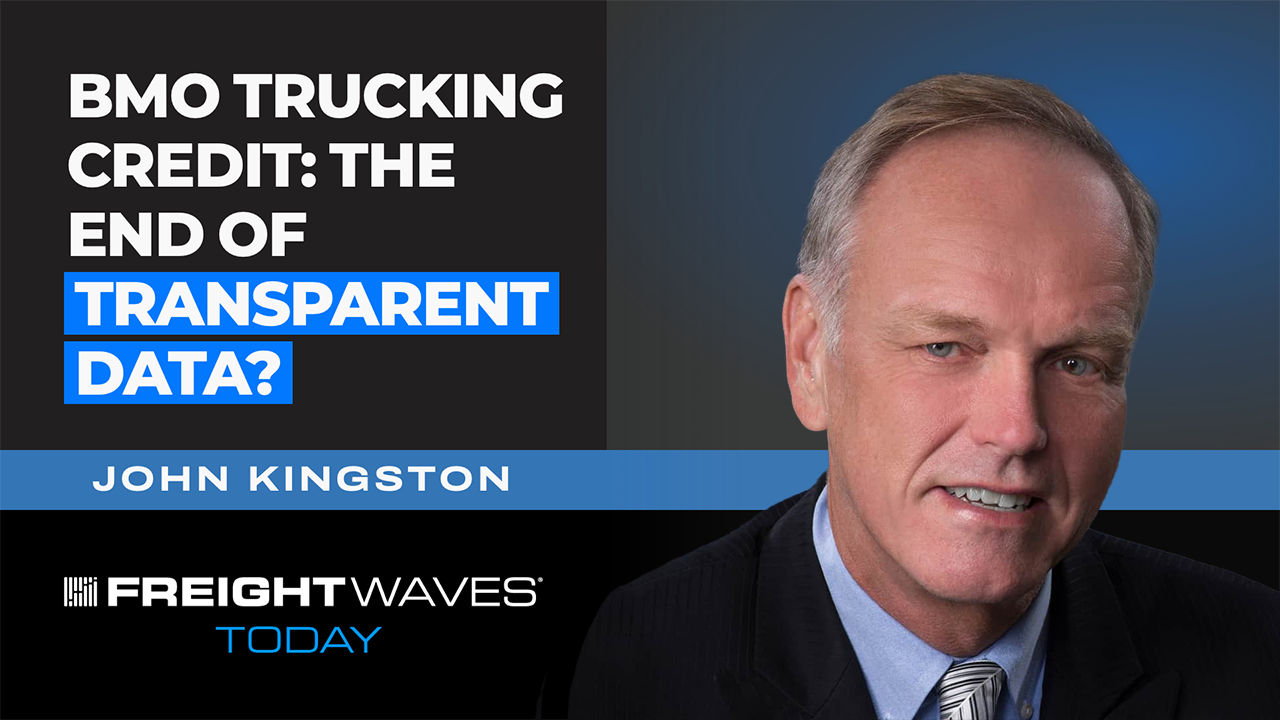
Why it matters: The sale will almost certainly end the quarterly disclosure of truck credit metrics that FreightWaves has tracked for six to seven years, eliminating what has been a rare, transparent look at loan quality across the trucking cycle.
"That transaction will almost certainly end the quarterly disclosure of truck credit metrics that FreightWaves has tracked for six to seven years, eliminating what has been a rare, transparent look at loan quality across the trucking cycle." — FREIGHTWAVES
Commentary: The loss of BMO’s quarterly data removes a key public window into trucking credit stress just as conditions improve. FreightWaves is now calling on other trucking lenders to step forward with comparable transparency, and Mitsubishi Credit was floated as one potential candidate to fill the void. The timing of the sale near a cyclical trough—’It seems to me that they sold at the bottom’—raises questions about whether the industry’s recovery will be visible to outside observers.
Date: August 25, 2026 02:44 PM ET
URL: https://www.freightwaves.com/news/bmo-trucking-credit-the-end-of-transparent-data-freightwaves
Generated Analysis Tone: Negative (60%)
Source Registry Score: 10.0/10 — High
Generated text and tone describe the analysis; the source registry score is not a factual truth rating.
Freight Market Health: What 13.57% Rejections Mean (Freightwaves)
Summary: Truckload tender rejections have stabilized near 13.57% after peaking above 17.5% around July 4th, recovering from a January trough of roughly 6%. FreightWaves analysts characterize this as a healthy baseline, not weakness, with brokers now viewing 12%-13% as the ‘tight market’ threshold, up from 8%. Spot rates rose 7% from August 22 through late August, signaling early seasonal firming. Analysts expect rejection rates to firm through September-November, driven by a later Labor Day, back-to-school surges, and an earlier holiday peak season as retailers move West Coast import freight sooner.

Why it matters: For shippers and carriers in the Southeast and nationally, the current stability window is a rare opportunity to adjust spot-to-contract freight mix before expected Q4 volatility, with rejection rates historically firming into fall.
Context: The market is approaching the one-year anniversary of English proficiency enforcement and non-domiciled CDL crackdowns, making October year-over-year comparisons a closely watched metric.
“They said that 8% used to feel like — 8% tender rejections used to feel like, oh gosh, things are tight. And now they feel like it’s more that 12% to 13% where things are tight and where they have a little bit more leverage with shippers in the market with tender rejections,” Fuller said.
Commentary: The shift in the ‘tight market’ threshold from 8% to 12%-13% reflects a structural change in carrier-shipper leverage, not just cyclical recovery. The 7% spot rate rebound in late August suggests early firming, but the 0.3% monthly decline indicates fragility. The October anniversary of CDL enforcement could distort year-over-year comparisons, making this fall’s data particularly noisy. Market participants should treat the current stability as a planning window, not a new normal.
Date: August 25, 2026 02:30 PM ET
URL: https://www.freightwaves.com/news/freight-market-health-what-13-57-rejections-mean
Generated Analysis Tone: Negative (71%)
Source Registry Score: 10.0/10 — High
Generated text and tone describe the analysis; the source registry score is not a factual truth rating.
Post ID: 2c7014b5