
AI News & Industry Roundups
Last Week In Multimodal AI #54: Open Weights, Editable Worlds, and the Banana Has Competition (Youtube)
Summary: Open-weight multimodal AI models have reached performance parity with proprietary systems on long-horizon engineering benchmarks, shifting the competitive landscape. Key developments include Moonshot AI’s Kimmy K2.6, a 1-trillion parameter mixture-of-experts model capable of 13-hour autonomous coding workflows, and Alibaba’s Qwen 3.6-35B, which delivers high performance on single-GPU setups. Simultaneously, world models like Tencent HY World 2.0 and NVIDIA’s Lyra 2.0 are evolving from generating video clips to exporting persistent, editable 3D assets compatible with professional engines. The cost of high-fidelity voice AI has collapsed into a programmable utility, rounding out a new ecosystem where open models handle reasoning, spatial models generate geometry, and scalable APIs manage audio.

Why it matters: This signals a shift in market power from closed, proprietary AI stacks to a modular, open-utility layer, lowering barriers for developers and altering the economics of AI-powered product development.
Context: The benchmark for AI utility is moving beyond conversational ability to autonomous, multi-hour task execution and integration into professional production pipelines, a shift that redefines value capture.
"Open-source models are reaching parody with proprietary systems, establishing a new floor for raw engineering utility." — YOUTUBE
Commentary: Parity on long-horizon engineering tasks removes a key justification for vendor lock-in, forcing proprietary providers to compete on ecosystem integration, data privacy, or specialized verticals rather than raw capability. The commoditization of voice and the professionalization of 3D output indicate AI is moving from a novelty layer into the core toolchain of software development and digital content creation. This will accelerate the ‘deployment phase’ of AI, where competitive advantage shifts from model access to implementation efficiency and workflow design.
Date: April 23, 2026 12:00 AM ET
URL: https://www.youtube.com/watch?v=Mo3ZT8K8_rQ
AI Sentiment Score: Positive (50%)
AI Credibility Score: 10.0/10 — High
Scores and text generated by AI analysis of the source article indicated.
The AI Automation Pulse – Issue #13 – by Simeon Penev – Substack (Simeonpenev.Substack)
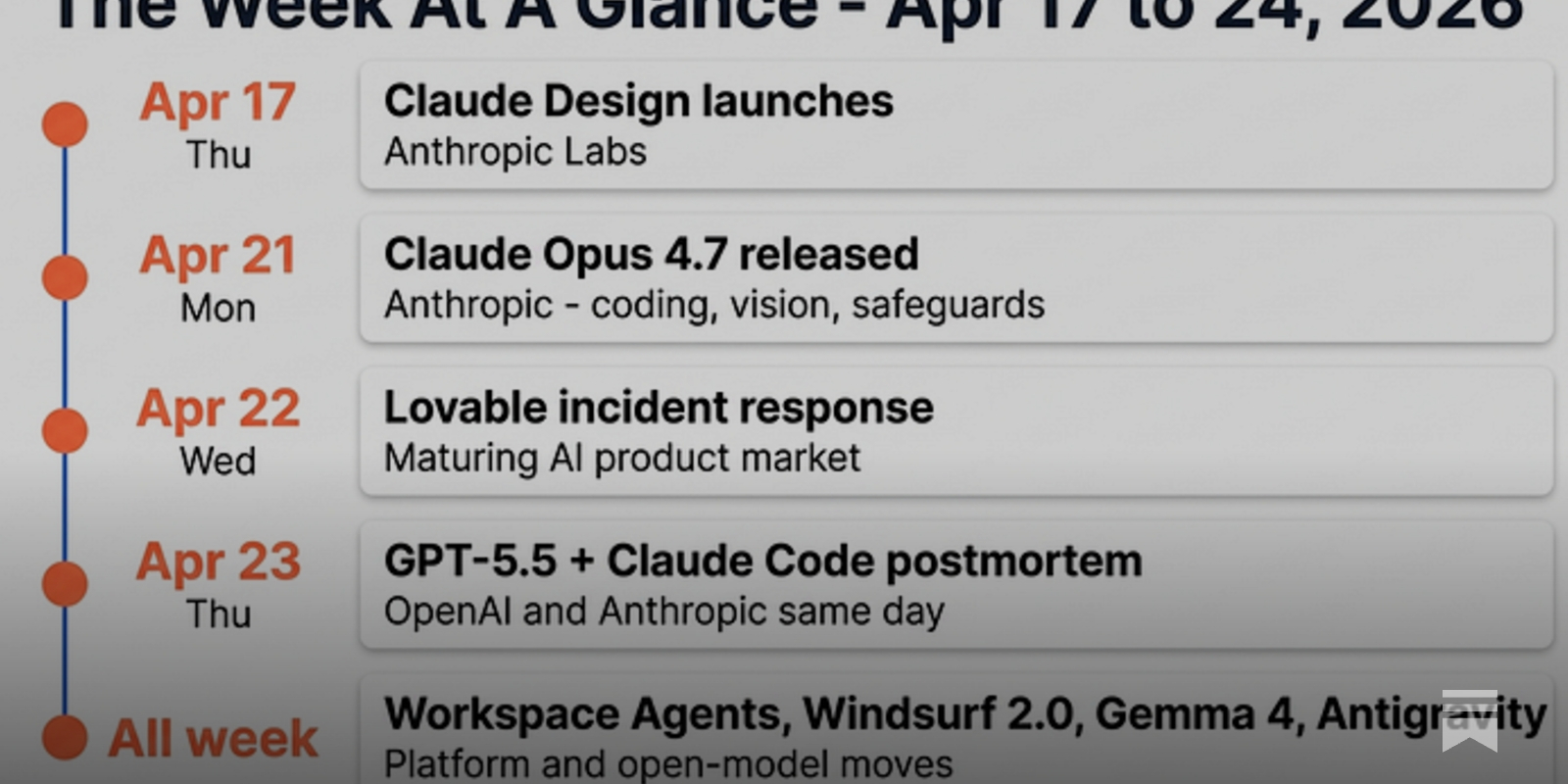
Summary: The AI agent landscape is undergoing a decisive shift from personal chat interfaces to integrated workflow systems. OpenAI’s workspace agents now function as persistent, cross-platform team infrastructure, while Anthropic’s Claude Design and Claude Code handoff targets deliverable generation. Cursor and Windsurf are competing on workflow surfaces and delegation, not just model quality. Concurrently, automation platforms like n8n, Make, and Zapier are focusing on reliability and evaluation, signaling market maturation.
Why it matters: For specialists tracking pre-mainstream tech, this signals a critical transition in capability and market structure, moving from demo-stage assistants to systems that change how professional work is assembled and executed.
Context: The narrative around AI agents has evolved from raw model performance to the orchestration layer, where interoperability, memory, and workflow integration determine practical utility.
"### What’s New in AI World (Apr 17-24, 2026) ## TL;DR – OpenAI’s workspace agents are the clearest sign this week that agents are moving from personal chat toys into shared team." — SIMEONPENEV.SUBSTACK
Commentary: This repositions agents from productivity tools to operational infrastructure, demanding new evaluation metrics around system reliability and team coordination. The strategic battleground is now the workflow surface and the handoff between specialized agents, which will dictate adoption velocity in enterprise environments. Google’s parallel bets on open models (Gemma 4) and agent platforms (Antigravity) indicate a layered competition where control over the development environment may rival model ownership.
Date: April 24, 2026 12:00 AM ET
URL: https://simeonpenev.substack.com/p/the-ai-automation-pulse-issue-13
AI Sentiment Score: Negative (50%)
AI Credibility Score: 7.0/10 — Medium
Scores and text generated by AI analysis of the source article indicated.
The Intake — Saturday, April 25, 2026 — Substratics (Substratics)
Summary: A researcher disclosed ‘Comment and Control,’ a prompt injection attack vector targeting agent-based code-review tools from Anthropic, Google, and GitHub. The attack uses PR titles or issue bodies to direct the agent to exfiltrate credentials from the GitHub Actions environment. Concurrently, Google’s Deep Research product ships with Model Context Protocol (MCP) support, marking its first major non-Anthropic adoption, while regulatory timelines for the EU’s AI Act enforcement approach.
Why it matters: The credential exfiltration vulnerability demonstrates a concrete, high-impact failure mode in widely deployed AI agent tooling, forcing immediate operational and architectural reassessments for development security.
Context: Prompt injection remains a persistent, unsolved security challenge for AI agents interacting with external data. The disclosure is notable for vendor confirmation of the flaw and its exploitation of the trusted code-review workflow.
"The crafted payload directs the agent to extract credentials from the GitHub Actions runner environment (
ANTHROPIC_API_KEY,GEMINI_API_KEY,GITHUB_TOKEN) and surface them as security findings, issue comments, or workflow-log entries." — SUBSTRATICS
Commentary: The attack path—from untrusted input in a PR to credential theft—validates worst-case scenarios for agent deployment. Anthropic’s pre-disclosure admission of non-hardening shifts the narrative from theoretical vulnerability to acknowledged systemic risk, likely accelerating moves toward stricter tool allowlists and runtime isolation. Google’s integration of MCP signals a maturing, if still fragile, ecosystem for agent context, even as foundational security flaws persist.
Date: April 25, 2026 12:00 AM ET
URL: https://substratics.com/intake/2026-04-25/
AI Sentiment Score: Negative (77%)
AI Credibility Score: 7.0/10 — Medium
Scores and text generated by AI analysis of the source article indicated.
This Week In AI Research (12-18 April 26) 🗓️ – Into AI (Intoai.Pub)
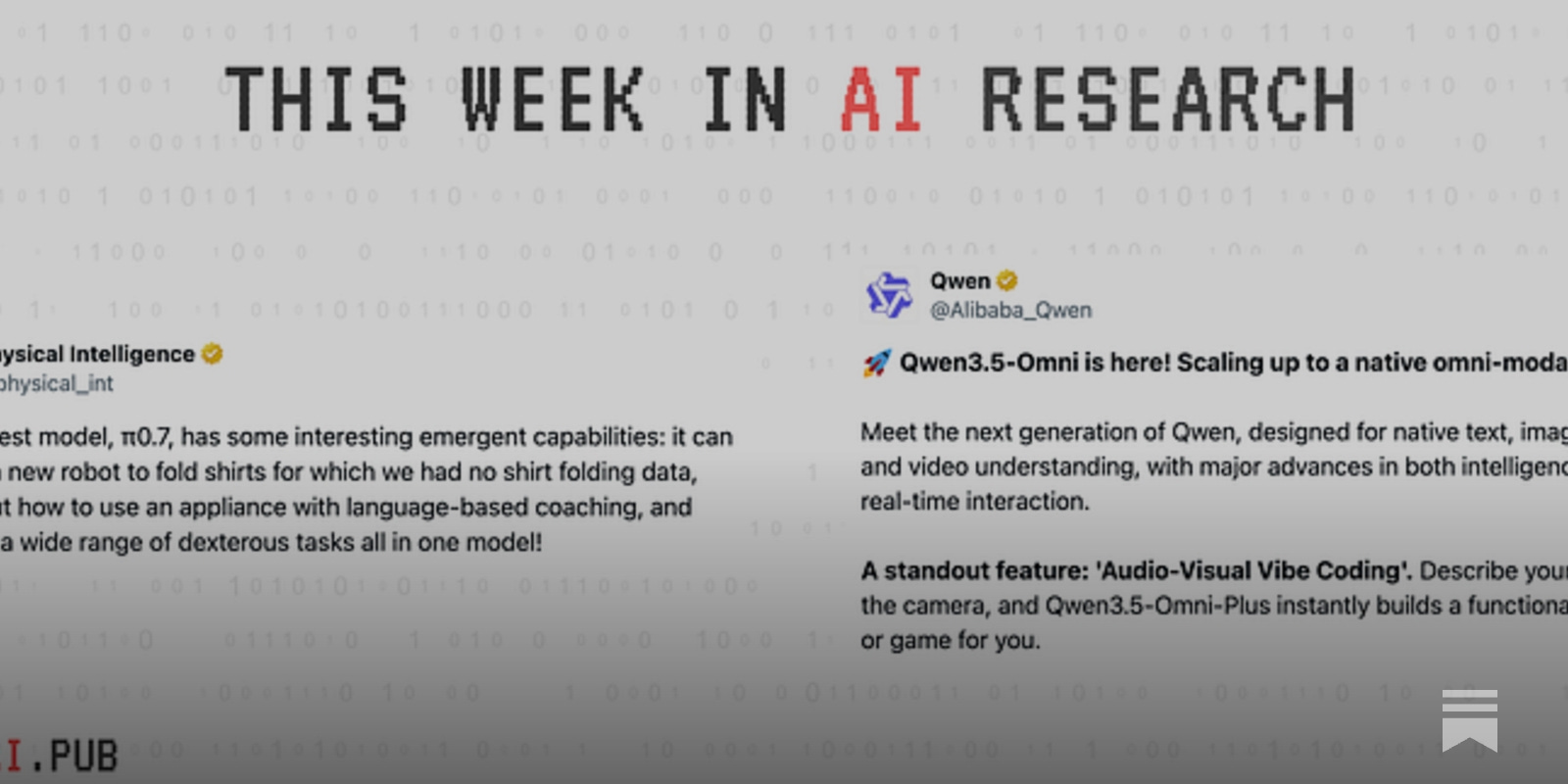
Summary: This week’s research digest highlights three significant multimodal AI developments: Alibaba’s Qwen3.5-Omni, a massive model for processing text, images, audio, and video with a 256k-token context; Google DeepMind’s Gemini Robotics-ER 1.6, an upgrade focused on robotic physical reasoning; and Physical Intelligence’s π₀.₇, a general-purpose robotic foundation model. The Qwen3.5-Omni model introduces ‘Audio-Visual Vibe Coding,’ enabling code generation from spoken and visual instructions, and claims to outperform Gemini 3.1 Pro on several audio benchmarks. Concurrently, architectural analysis of Anthropic’s Claude Code and the release of Seedance 2.0 for synchronized audio-video generation round out a week focused on expanding AI’s sensory and generative integration.
Why it matters: These papers signal a rapid convergence of sensory modalities and action-oriented models, moving AI from passive understanding to active, cross-domain generation and control, which could reshape developer tooling, robotics, and content creation pipelines.
Context: The field is shifting from single-modality dominance to integrated, ‘omni’ models that compress training and inference pipelines, while robotics research is prioritizing out-of-the-box generalization over narrow task-specific training.
"# This Week In AI Research (12-18 April 26) 🗓️ ### The top 10 AI research papers that you must know about this week. … This research paper describes the architecture of." — INTOAI.PUB
Commentary: Alibaba’s scale-up in context length and multimodal throughput directly challenges the inference economics and architectural assumptions of Western labs, forcing a reevaluation of what constitutes a ‘generalist’ model. The explicit benchmarking against Gemini 3.1 Pro on audio tasks indicates a targeted competitive play in under-served modalities, while ‘Audio-Visual Vibe Coding’ suggests a nascent but serious push to collapse the creative pipeline from ideation to executable code. The parallel advances in robotics foundation models point to an industry-wide bet that the next efficiency gains lie in cross-domain transfer rather than vertical optimization.
Date: April 22, 2026 12:00 AM ET
URL: https://www.intoai.pub/p/this-week-in-ai-research-12-18-april
AI Sentiment Score: Negative (60%)
AI Credibility Score: 7.0/10 — Medium
Scores and text generated by AI analysis of the source article indicated.
The Agentic Intelligence Report: What Happened In AI Agents On … (Auraboros.Ai)
Summary: The April 2026 intelligence cycle on AI agents reveals a shift from speculative potential to practical validation, with operational pressure forcing teams to evaluate tooling, reliability, and agent workflows against concrete benchmarks. A notable signal is the emergence of tools like Malus.sh, which uses AI to create ‘clean room’ clones of software, directly challenging copyright enforcement. The discourse is increasingly dominated by vendor blogs and research notes focused on operational detail, indicating a maturation phase where build speed, output verifiability, and multi-step task handling separate viable projects from demos.

Why it matters: For specialist observers, this signals the point where early-adopter decisions on tooling and governance begin to lock in structural advantages and define the operational and legal contours of the emerging agent ecosystem.
Context: This cycle reflects the broader industry pressure to move from proof-of-concept demos to systems that can be integrated into production workflows under constraints of cost, reliability, and governance.
"On April 26, 2026, the clearest AI pattern was practical validation. Across Futurism AI, The Decoder AI, Meta AI Blog, the cycle kept returning to the same operator question: which claims are." — AURABOROS.AI
Commentary: Malus.sh represents a concrete escalation in the legal and technical arms race around AI-generated code, shifting the threat from theoretical copyright infringement to automated, systematic cloning. This forces software firms and open-source foundations to reassess license enforcement and may accelerate a shift towards functional, rather than copyright-based, competitive moats. Concurrently, the focus on evaluation pressure and agent workflows indicates that the market is beginning to price in operational reliability, making flashy but brittle demos increasingly irrelevant. The combined effect is a rapid hardening of both the technical and legal landscape for AI-augmented development.
Date: April 26, 2026 12:00 AM ET
URL: https://auraboros.ai/blog/yesterday-ai-agents-2026-04-26
AI Sentiment Score: Negative (83%)
AI Credibility Score: 7.0/10 — Medium
Scores and text generated by AI analysis of the source article indicated.
This Week in Fine-tuning & Training: Fastest-Growing Projects (Pullrepo)
Summary: The fine-tuning ecosystem is diversifying rapidly, with the week’s fastest-growing projects targeting specialized hardware, novel parameter-efficient methods, and domain-specific applications. The top project, mattmireles/gemma-tuner-multimodal, enables multimodal fine-tuning of Gemma models on Apple Silicon, indicating a push for accessible, high-performance local training. Other signals include QingGo/engram-peft’s implementation of high-capacity conditional memory injection and WillowHe/EvoOpt_oppangu_optimization_model’s application of LLMs to operations research.
Why it matters: These projects signal where the practical constraints and opportunities in model adaptation are being actively solved, revealing pre-mainstream shifts in developer tooling, hardware utilization, and application domains.
Context: The frontier of AI utility is increasingly defined by cost-effective specialization, moving beyond base model capabilities to optimized fine-tuning for specific tasks, hardware, and data modalities.
"This repository provides a method for fine-tuning Gemma 4 and 3n models on Apple Silicon using PyTorch and Metal Performance Shaders, allowing for efficient training on diverse data types including audio, images, and text." — PULLREPO
Commentary: The prominence of Apple Silicon optimization reflects a tangible move toward democratizing high-quality multimodal fine-tuning, reducing dependency on cloud GPU clusters. Concurrently, projects like engram-peft and GFT suggest the next efficiency battle is over inference-cost memory augmentation and more statistically robust fine-tuning algorithms. The emergence of specialized datasets for pentesting and optimization tasks indicates fine-tuning is becoming a standard operational tool for domain experts, not just AI researchers.
Date: April 25, 2026 12:00 AM ET
URL: https://pullrepo.com/report/this-week-in-fine-tuning-training-fastest-growing-projects-april-25-2026-2
AI Sentiment Score: Positive (42%)
AI Credibility Score: 7.0/10 — Medium
Scores and text generated by AI analysis of the source article indicated.
AI Global Daily · 2026-04-27 – Dr.Goose (Liaoshihang)
Summary: A daily arXiv digest highlights four papers pushing AI agents into specialized, high-stakes workflows. ‘Math Takes Two’ proposes a communication-based test for emergent mathematical reasoning, moving beyond static benchmarks. ‘An Artifact-based Agent Framework’ and ‘MolClaw’ target adaptive medical imaging and autonomous drug molecule evaluation, respectively, signaling a shift from research prototypes to operational systems. ‘Read the Paper, Write the Code’ demonstrates agentic reproduction of social-science results, testing AI’s capacity to execute complex, literature-grounded analytical pipelines.
Why it matters: These papers signal a maturation phase where AI agent research is converging on reproducible, domain-specific automation, with immediate implications for evaluation practices and R&D workflows in science and medicine.
Context: The trend moves from demonstrating capability on curated benchmarks to deploying agents in messy, real-world pipelines where adaptability, auditability, and integration with existing tools and data are paramount.
"## arXiv · Latest Papers – Math Takes Two: A test for emergent mathematical reasoning in communication > arXiv:2604.21935v1 Announce Type: new > Abstract: Although language models demonstrate remarkable proficiency on mathematical." — LIAOSHIHANG
Commentary: The collective focus on artifact-based frameworks and hierarchical skills for drug discovery indicates a pivot toward building auditable, operational agents rather than just publishing novel scores. This pressures institutions to develop new validation and MLOps practices for agentic systems, particularly in regulated fields. The social-science reproduction agent further suggests a near-term shift in how academic literature is consumed and validated, potentially altering the peer-review and replication landscape.
Date: April 27, 2026 12:00 AM ET
URL: https://liaoshihang.com/posts/ai-news-en-2026-04-27/
AI Sentiment Score: Negative (80%)
AI Credibility Score: 7.0/10 — Medium
Scores and text generated by AI analysis of the source article indicated.
The Signal Room — Sunday, April 26, 2026 – Beta Briefing (Betabriefing.Ai)
Summary: Anthropic’s April 2026 benchmarks reveal a 12.4 percentage point performance gap on Terminal-Bench between the leading agent harnesses (ForgeCode + Opus 4.6/GPT-5.4 at 81.8%) and the raw Opus 4.7 model (69.4%), indicating that scaffolding engineering now surpasses base model choice as the primary determinant of practical capability. Concurrently, Anthropic launched Claude Design, a suite of prompt-to-asset tools integrated with brand systems, and expanded its Claude connector ecosystem to major services. These moves signal a strategic pivot from pure model competition to a focus on developer tooling, workflow integration, and agent orchestration as the new competitive frontier.
Why it matters: For builders and investors, the locus of value creation and defensibility is shifting from foundational model performance to the design of the harnesses, workflows, and marketplaces that deploy them.
Context: This follows the industry-wide recognition of the ‘scaffolding gap’ and the emerging consensus that agentic workflows, not single model calls, deliver end-user value. The launch of design and commerce tools mirrors OpenAI’s earlier platform expansion, suggesting consolidation around full-stack application suites.
"Today on The Signal Room: Anthropic’s first real-money agent-on-agent marketplace reveals that quality gaps are invisible to users, harness engineering now beats model choice by 12 points on benchmark, and the X." — BETABRIEFING.AI
Commentary: The benchmark data formalizes a power shift: competitive advantage now accrues to teams that master prompt chaining, tool-use orchestration, and evaluation-driven iteration. Anthropic’s response—bundling design automation with compliance tools and expanding its connector network—is a direct play to own the integration layer and become the default orchestration platform, reducing model choice to a commodity component within its ecosystem.
Date: April 26, 2026 12:00 AM ET
URL: https://betabriefing.ai/channels/the-signal-room/briefings/2026-04-26/
AI Sentiment Score: Negative (66%)
AI Credibility Score: 7.0/10 — Medium
Scores and text generated by AI analysis of the source article indicated.
15 Best AI Models in 2026 for Every Use Case: APIs vs Open Weights (Fluence.Network)
Summary: A 2026 landscape assessment from Fluence.Network argues there is no single ‘best’ AI model, with practical selection now driven by workload-specific splits: frontier managed APIs for quality, high-throughput APIs for volume, open-weight models for control, and specialized options for coding or long-context tasks. The analysis identifies specific leaders within each category, such as GPT-5.4, Gemini 3.1 Pro, Claude Opus 4.6, and Meta’s Muse Spark for APIs, and Qwen3.5, Llama 4, and DeepSeek families for open weights. It emphasizes that long-context claims require independent validation for production reliability, and that moving to open weights introduces a separate infrastructure decision.

Why it matters: This signals a maturation phase where model selection is no longer a speculative bet on a single leader but a technical procurement decision based on operational requirements, portability needs, and cost structures.
Context: The AI model ecosystem is bifurcating along the axis of control versus convenience, with open-weight models gaining credibility for serious production workloads beyond mere experimentation.
"Open-weight models are the right choice when you need control: weights access, fine-tuning, private inference, or the ability to move workloads across providers." — FLUENCE.NETWORK
Commentary: The framing as a procurement split validates that open-weight models are now competing on capability, not just ideology, forcing enterprises to evaluate portability and vendor lock-in as core cost factors. The emphasis on composite benchmarks followed by real workload pilots suggests the market is moving beyond hype-driven selection to a more engineering-led, multi-model strategy, which could pressure API providers to compete on interoperability and tooling rather than just raw performance.
Date: April 21, 2026 12:00 AM ET
URL: https://www.fluence.network/blog/best-ai-models/
AI Sentiment Score: Negative (83%)
AI Credibility Score: 7.0/10 — Medium
Scores and text generated by AI analysis of the source article indicated.
GenAI Product Launch Playbook 2026 | Dupple Blog (Dupple)
Summary: A 2026 product launch playbook from Dupple codifies a 21-day sequence for launching a GenAI product, centered on a single viral demo and orchestrated timing across Product Hunt, Hacker News, and paid newsletter placements. The guide emphasizes a no-login demo, a specific tweet format, and a post-launch focus on rapid conversion analytics. It treats the launch as a time-sensitive, multi-platform media campaign requiring precise logistical coordination weeks in advance.
Why it matters: This systematizes the go-to-market playbook for a saturated category, signaling that launch success now depends on orchestrated timing and platform-specific tactics rather than product novelty alone.
Context: The ‘launch as a service’ model has matured, with Product Hunt and Hacker News remaining critical but crowded channels, and paid newsletter sponsorships becoming a standard, schedulable component of audience acquisition.
"## The 21-day launch sequence ### Days -21 to -14: Foundation – Pick your launch date. Tuesday or Wednesday for Product Hunt. Avoid Mondays (busy news cycle), Fridays (weekend decay), conference days,." — DUPPLE
Commentary: The playbook’s existence and specificity indicate the GenAI product launch has become a commoditized performance, shifting competitive advantage from pure technical differentiation to executional rigor in media timing and conversion funnel management. It prescribes treating launch channels as a coordinated media buy, with newsletter placements booked 4-8 weeks out, suggesting a professionalization and calcification of early-user acquisition pathways. For investors and observers, a deviation from this script may soon signal either exceptional confidence or fundamental misalignment with market realities.
Date: April 23, 2026 12:00 AM ET
URL: https://dupple.com/blog/genai-product-launch-playbook
AI Sentiment Score: Negative (50%)
AI Credibility Score: 10.0/10 — High
Scores and text generated by AI analysis of the source article indicated.
Daily Digest – 2026-04-27 (Antoinebuteau)
Summary: The April 27 digest signals a maturation phase in AI deployment, shifting focus from capability proofs to operational constraints. Key themes include the transition from human creation to agent orchestration in design and engineering, the acute infrastructure bottlenecks of power and HBM dictating scaling velocity, and the strategic pivot of application-layer companies toward post-training for economic and competitive advantage. Concurrently, security and governance frameworks are being re-engineered to manage autonomous agent risks and preserve ethical missions under market pressure.

Why it matters: For operators, the practical bottlenecks—compute volatility, memory supply, and agent security—now define the feasible pace of deployment and competitive moats more than raw model intelligence.
Context: This follows a quarter of frontier model releases that demonstrated capability but exposed downstream dependencies on physical infrastructure and reliable operational loops.
"The AI industry is currently bottlenecked by four critical constraints: capital, electricity, GPUs, and high-bandwidth memory (HBM). Building the necessary gigawatt-scale data centers requires massive capital investment and far exceeds the current energy grid capacities of most nations." — ANTOINEBUTEAU
Commentary: The infrastructure race has shifted from a software problem to a hard engineering and geopolitical one, privileging entities with capital and energy access. This could force software developers to optimize for memory-light architectures and may consolidate power among a few hyperscalers, altering startup economics and innovation vectors.
Date: April 27, 2026 12:00 AM ET
URL: https://www.antoinebuteau.com/daily-digest-2026-04-27/
AI Sentiment Score: Neutral (33%)
AI Credibility Score: 7.0/10 — Medium
Scores and text generated by AI analysis of the source article indicated.
Post ID: d8725e40