Smart Textiles & Wearable Technology
Smart Clothing Technology in 2026: Who’s Leading the … (Spanglobalservices)
Summary: The smart clothing market in 2026 is not a unified field but a collection of five distinct competitive arenas: consumer fitness, clinical healthcare, military/industrial safety, luxury fashion-tech, and the foundational materials/platform layer. Each arena has different leading players, buyer motivations, and go-to-market strategies. Attempting to address the market as a single entity is identified as a primary strategic error.
Why it matters: For brands, manufacturers, and investors, this segmentation dictates where to allocate R&D, sales, and partnership resources to avoid wasted capital and misaligned product development.
Context: Smart textiles are evolving from passive sensing to active response and ultra-smart, self-adapting systems with onboard ML, pulling in diverse industries from sportswear to defense under the same technological umbrella but with divergent commercial realities.
"Short answer: There is no single leader in smart clothing in 2026. The market has split into five competitive arenas, each with different winners, different buyers, and completely different go-to-market strategies. Treating." — SPANGLOBALSERVICES
Commentary: The operational consequence is a forced specialization: a vendor’s tooling, supply chain, and regulatory compliance must be tailored to a specific arena’s needs. For example, Epicore’s pivot to industrial worker health via a DuPont partnership demonstrates the clinical arena’s overlap with industrial safety, requiring a dual-compliance pipeline, while Toray’s manufacturing localization with MAS Holdings serves a separate need for scalable, sustainable production for consumer and defense contracts. The 35% healthcare market share makes it the revenue concentration point, but the growth vectors are in arena-specific integrations and material science partnerships like Gentherm’s thermal management or ThermoSoft’s FiberThermics.
Date: April 22, 2026 12:00 AM ET
URL: https://www.spanglobalservices.com/blog/smart-clothing-technology-in-2026/
AI Sentiment Score: Positive (50%)
AI Credibility Score: 10.0/10 — High
Scores and text generated by AI analysis of the source article indicated.
AI in Textiles: Implementing and Regulating New Technology (Textiles.Ncsu.Edu)
Summary: A conference hosted by NC State’s Fashion and Textile Business Excellence Cooperative convened industry leaders to discuss operational AI applications. Presentations covered AI in body scanning for made-to-measure uniforms, electronic print design generation, and AI agents for demand forecasting. A significant focus was on the practical implementation of AI into existing production systems and supply chains, with emphasis on data quality. The discussion framed Agent AI as an autonomous system for e-commerce, planning, and operations, distinct from generative AI’s assistive role.

Why it matters: For practitioners, the event signals a shift from experimental AI to focused implementation, clarifying which tools affect specific pipeline stages like sampling, forecasting, and inventory management.
Context: The fashion industry is moving past generic AI hype toward tool-specific deployments that address chronic inefficiencies in forecasting accuracy, sampling waste, and mass customization.
"Jin said generative AI is a system that guides a human, while agent AI is an autonomous vehicle that independently reaches its destination." — TEXTILES.NCSU.EDU
Commentary: The distinction between generative and agent AI, as framed by Jin, reorients vendor evaluation and internal skill-building. Agent AI’s promise in autonomous trend analysis and inventory management suggests a coming consolidation of planning and ops roles, while generative AI’s role in design and sampling becomes a cost-center tool for accelerating iteration, not replacing designers. The emphasis on ‘good information’ fed into AI underscores that data hygiene and integration projects are now prerequisites for ROI, not optional IT upgrades.
Date: April 23, 2026 12:00 AM ET
URL: https://textiles.ncsu.edu/news/2026/04/ai-in-textiles-implementing-and-regulating-new-technologies/
AI Sentiment Score: Negative (83%)
AI Credibility Score: 7.0/10 — Medium
Scores and text generated by AI analysis of the source article indicated.
Smart Wear and Wearables the Fusion of Fashion and Technology (Apparelviews)
Summary: Smart wearables are evolving beyond niche applications into luxury and everyday fashion, integrating conductive yarns for biometrics, self-regulating materials for climate control, and IoT sensors for usage analytics. The sector is increasingly defined by sustainability drivers, including recycled materials, solar-charging capabilities, and self-healing textiles aimed at reducing waste and carbon emissions. Customization is advancing through AI-driven fit proposals and functional personalization, while data security and technology costs remain unresolved constraints on market growth.

Why it matters: For fashion brands and tech suppliers, this signals a shift from prototyping to scalable production, requiring new material sourcing, data infrastructure, and manufacturing partnerships.
Context: The convergence of technical textiles and consumer electronics has been gradual, but recent material advances and luxury market entry indicate a maturation phase where operational integration, not just concept, defines competitiveness.
"Sensors embedded in clothing can record wearing frequency and usage conditions, enabling product improvements and personalized recommendations based on data." — APPARELVIEWS
Commentary: The operational consequence is a dual pipeline: one for physical garment production, now involving conductive yarn suppliers and specialized cut-and-sew units, and another for data ingestion and analytics, requiring brands to build or partner on IoT platforms. This bifurcation could pressure mid-sized labels lacking in-house tech teams, while luxury houses may leverage customization and traceability as margin-protective differentiators. The emphasis on durability and reduced washing directly impacts quality control protocols and lifecycle marketing, turning post-purchase data into a core R&D asset.
Date: April 23, 2026 12:00 AM ET
URL: https://www.apparelviews.com/smart-wear-and-wearables-the-fusion-of-fashion-and-technology/
AI Sentiment Score: Negative (66%)
AI Credibility Score: 10.0/10 — High
Scores and text generated by AI analysis of the source article indicated.
Covestro : FILK Freiberg, and OUT e.V. develop flexible, conductive polymer smart textile system (Marketscreener)
Summary: A consortium of Covestro, FILK Freiberg, and OUT e.V. has developed a smart textile platform using a water-based polyurethane dispersion film impregnated with carbon nanotubes. This creates a uniform conductive ‘potential field’ within the textile, which is then laser-structured to tune electrical properties, enabling the free distribution of LEDs and sensors without conventional wiring. The system supports real-time monitoring and bidirectional communication, with an initial application demonstrated as a sensor-controlled newborn bodysuit for jaundice phototherapy.

Why it matters: This platform shifts smart textile manufacturing from rigid, wired assemblies to flexible, uniformly conductive substrates, potentially lowering integration costs and enabling new form factors for medical and consumer wearables.
Context: Smart textiles have been constrained by the need for discrete, inflexible wiring, limiting design and increasing production complexity. This research, funded under a German industrial collective research program, represents a materials science approach to the problem.
"Laser structuring of the conductive polymer surface allowed precise tuning of the electrical properties of the potential field, enabling LEDs and sensors to be distributed freely across the textile surface without traditional wiring." — MARKETSCREENER
Commentary: The operational consequence is a decoupling of electronic component placement from fixed conductive pathways, simplifying design and potentially reducing assembly labor. For medical wearables like the jaundice suit, this could mean lower-cost, more patient-friendly devices that shift care out of hospital incubators. The use of Covestro’s Impranil dispersion suggests a path to scalability via existing textile coating lines, though carbon nanotube integration and laser structuring add new process steps and vendor dependencies.
Date: April 20, 2026 12:00 AM ET
URL: https://www.marketscreener.com/news/covestro-filk-freiberg-and-out-e-v-develop-flexible-conductive-polymer-smart-textile-system-ce7e50d3de80f020
AI Sentiment Score: Negative (85%)
AI Credibility Score: 10.0/10 — High
Scores and text generated by AI analysis of the source article indicated.
Powering wearable technology with MXene textile supercapacitor … (Sciencedaily)
Summary: Drexel University and Accenture Labs researchers have developed a textile supercapacitor using MXene-coated cotton, capable of powering an Arduino microcontroller for nearly two hours after a minutes-long charge. The five-cell, vacuum-sealed patch produces 6V and represents a shift from rigid batteries to flexible, textile-integrated energy storage.

Why it matters: This directly impacts the material sourcing, assembly, and durability testing pipelines for wearable tech, moving power from a discrete component to a textile substrate.
Context: E-textiles have historically relied on off-the-shelf, rigid batteries, limiting garment design and comfort; flexible energy storage has been a missing component.
"## Researchers create 6V textile supercapacitor to power wearable technology … Researchers are one step closer to making wearable textile technology a reality. Materials scientists have reported a new design of a." — SCIENCEDAILY
Commentary: The dip-coating process suggests a scalable, roll-to-roll manufacturing path, potentially lowering unit costs versus sewing in battery packs. For brands, this reduces design compromises and could improve return rates by enhancing garment drape and washability. The vacuum-sealing requirement, however, adds a packaging step that textile mills and cut-and-sew operators must now integrate, affecting line speed and quality control protocols.
Date: April 22, 2026 12:00 AM ET
URL: https://www.sciencedaily.com/releases/2023/01/230130130457.htm
AI Sentiment Score: Neutral (50%)
AI Credibility Score: 10.0/10 — High
Scores and text generated by AI analysis of the source article indicated.
2023: Medical textile innovations that can transform healthcare (Fibre2Fashion)
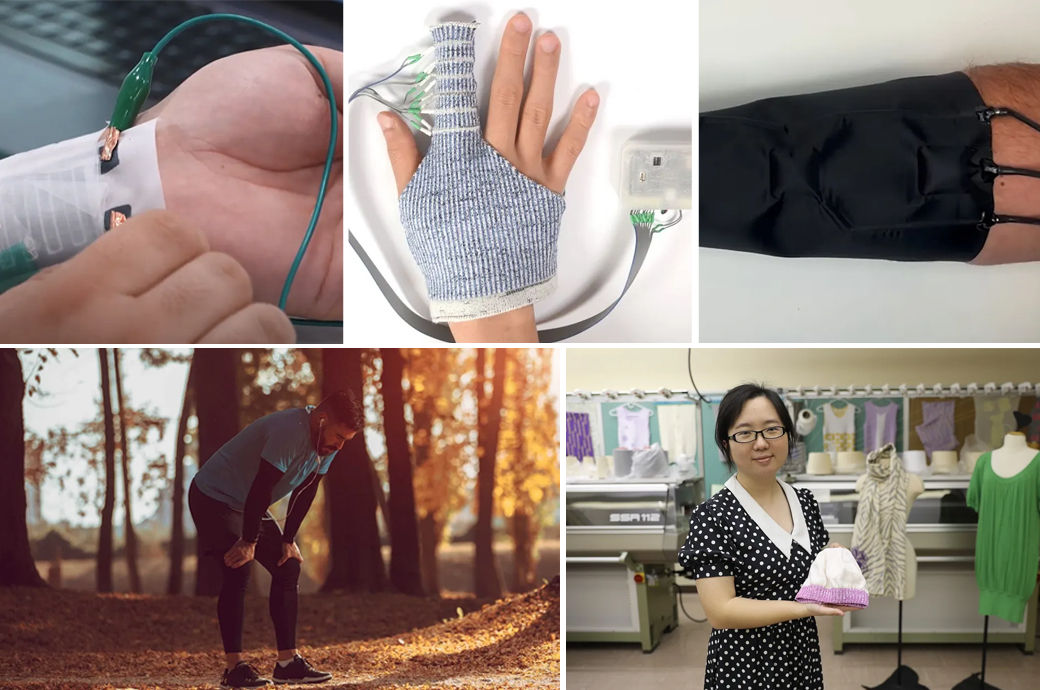
Summary: Academic and research institutions globally are advancing medical textiles from lab prototypes toward practical, wearable applications. Key 2023 developments include ETH Zurich’s leggings-integrated exhaustion sensor, UWE Bristol’s washable heart-rate monitoring fabric, LSU’s thermochromic infant hat, and Rice University’s haptic textile system. These innovations focus on integrating sensing and feedback directly into garment structures, aiming to replace discrete medical devices.
Why it matters: For fashion-tech practitioners, these research vectors signal a shift toward textiles as primary sensing and diagnostic interfaces, which will alter material sourcing, manufacturing partnerships, and product development cycles for performance and medical apparel.
Context: Medical textiles represent a high-value convergence of advanced materials science, wearable electronics, and healthcare logistics, where durability, washability, and patient compliance are critical commercial hurdles beyond mere technical feasibility.
"### Insightsl- In 2023, global research in medical textiles made significant strides. – Cornell University’s KnitDema aids hand oedema patients with a wearable massage technology. – ETH Zurich developed a textile sensor." — FIBRE2FASHION
Commentary: The emphasis on washability and garment integration, as seen in the UWE Bristol and ETH Zurich projects, moves the field beyond ‘strap-on’ sensors toward true textile-first design. This pressures supply chains to source conductive yarns and printing techniques that survive industrial laundering. For brands, it means future health-monitoring apparel may emerge from textile R&D labs rather than electronics assembly lines, reshaping vendor relationships and IP strategy.
Date: April 21, 2026 12:00 AM ET
URL: https://www.fibre2fashion.com/news/medical-textiles/2023-medical-textile-innovations-that-can-transform-healthcare-292107-newsdetails.htm
AI Sentiment Score: Neutral (33%)
AI Credibility Score: 10.0/10 — High
Scores and text generated by AI analysis of the source article indicated.
The Ultimate Guide to the Virtual Dressing Room – WearView (Wearview.Co)
Summary: WearView’s guide positions virtual dressing rooms as a direct response to the ‘imagination gap’ in fashion e-commerce, where customers cannot visualize fit. The core operational shift is the move from 2D photography to 3D garment digitization, using tools like TG3D Studio to create photorealistic ‘digital twins.’ This infrastructure enables AI-generated on-model imagery, which the source claims drives significant reductions in return rates and increases in conversion.

Why it matters: For brands and operators, this changes the cost structure of sampling, marketing asset production, and reverse logistics, directly impacting profitability.
Context: Virtual try-on has evolved from gimmicky AR filters to a pipeline-dependent technology requiring high-fidelity 3D asset creation and integration into e-commerce platforms.
"Ever tried to buy a shirt online, only to hesitate because you have no idea how it will actually look on you? That’s the exact problem a virtual dressing room solves. Think." — WEARVIEW.CO
Commentary: The claimed metrics, if replicable, would reorder capital allocation for mid-tier brands, shifting spend from physical sample production and return processing to 3D scanning and AI rendering tools. However, the guide’s simplified ‘upload photos’ workflow contradicts the need for high-precision digitization mentioned earlier, revealing a market tension between accessibility and fidelity. The practical constraint remains input quality: the pipeline is only as good as the initial garment data, making upstream digitization a new critical vendor decision.
Date: April 21, 2026 12:00 AM ET
URL: https://www.wearview.co/blog/virtual-dressing-room
AI Sentiment Score: Negative (50%)
AI Credibility Score: 10.0/10 — High
Scores and text generated by AI analysis of the source article indicated.
Fashion and Luxury Data Annotation Services for Retail AI – DataVLab (Datavlab.Ai)
Summary: DataVLab, a data annotation service provider, is marketing specialized workflows for fashion and luxury retail AI. Its services focus on labeling garments, accessories, patterns, and materials to train models for product discovery, visual search, and catalog automation. The firm also highlights applications in quality control and brand protection through the detailed annotation of design elements for counterfeit detection.

Why it matters: For fashion brands and their tech vendors, the availability of specialized annotation services directly impacts the cost, speed, and accuracy of deploying AI for core retail and operational functions.
Context: The push for AI-driven personalization and operational efficiency in retail has created a burgeoning market for vertically-specific training data, moving beyond generic image recognition datasets.
"Fashion and luxury brands are increasingly adopting AI to deliver better product discovery, personalized recommendations, visual search tools, and automated catalog organization. Accurate annotated datasets are essential for recognizing clothing items, materials,." — DATAVLAB.AI
Commentary: The emergence of niche annotation vendors like DataVLab signals a maturation of the retail AI toolchain, shifting the bottleneck from model architecture to data pipeline quality. For brands, this specialization promises higher accuracy in visual search and trend analysis but introduces new vendor dependencies and integration costs. The explicit focus on counterfeit detection and quality control annotation also indicates a growing operational, rather than just customer-facing, application of computer vision in the sector.
Date: April 20, 2026 12:00 AM ET
URL: https://datavlab.ai/industry/fashion-luxury
AI Sentiment Score: Negative (50%)
AI Credibility Score: 7.0/10 — Medium
Scores and text generated by AI analysis of the source article indicated.
Graph Network-Based Predictive Modeling for Next-Generation … (Intechopen)
Summary: A graph network analysis of patent data maps the convergence of textile engineering with electronics, sensing, and digital computing, identifying specific IPC code intersections as hot spots for next-generation wearable textiles. The study frames this convergence within Industry 4.0 and 5.0 paradigms, highlighting actionable pathways in biocompatible wearables and human-machine interface textiles. It provides a predictive framework for R&D strategy, moving beyond material science to system-level integration.

Why it matters: For manufacturers and R&D teams, this analysis shifts strategic planning from speculative bets to targeted investment in specific, patent-validated technology intersections, directly affecting pipeline prioritization and partnership selection.
Context: Smart textile development has been fragmented across material science, electronics, and software domains; this study uses quantitative patent mapping to reveal the precise technical junctions where commercializable innovation is most likely.
"Overall, the centrality results suggest that future breakthroughs will likely emerge at the intersections of garment design, digital computing, medical devices, and layered textile composites, providing clear pathways for innovation in healthcare, sports, and IoT-driven applications of smart wearable textiles." — INTECHOPEN
Commentary: The operational consequence is a reallocation of lab resources and IP strategy towards cross-disciplinary teams combining D03D (woven fabrics) with H05K (printed circuits) and G01N (sensing). For brands, this signals vendor consolidation around suppliers mastering these convergences, impacting sourcing contracts and time-to-market for functional apparel. The emphasis on IPC codes over generic ‘innovation’ rhetoric provides a concrete tool for scouts and investors to audit a startup’s patent portfolio against validated convergence vectors.
Date: April 24, 2026 12:00 AM ET
URL: https://www.intechopen.com/online-first/1236203
AI Sentiment Score: Negative (50%)
AI Credibility Score: 7.0/10 — Medium
Scores and text generated by AI analysis of the source article indicated.
Fit Collective Secures €3.4 Million Pre‑Seed to … (Mycapital.Co.Uk)
Summary: Fit Collective, a London-based fashiontech startup founded by Savile Row-trained designer Phoebe Gormley, has secured a €3.4 million pre-seed round, reportedly the largest for a solo female founder in the UK. The company’s AI platform analyzes returns data, fabric behavior, and sales patterns to predict and optimize garment fit at the pattern-making stage, aiming to prevent returns rather than manage them post-sale. Early adopters include brands like Rixo, Ro & Zo, and Boden.

Why it matters: This signals investor confidence in operational tech that directly addresses the costly, wasteful problem of sizing-related returns, shifting focus from post-purchase logistics to pre-production design decisions.
Context: The apparel industry faces mounting pressure from $230 billion in annual returns costs and sustainability mandates, driving demand for data-driven tools that integrate directly into technical design and production workflows.
"London‑based fashion technology startup Fit Collective has closed a €3.4 million (£3 million) pre‑seed funding round to scale its AI‑driven platform that helps apparel brands improve garment sizing and reduce costly returns." — MYCAPITAL.CO.UK
Commentary: Fit Collective’s pre-production intervention targets the root cause of returns, potentially altering the cost structure and environmental footprint of apparel brands. Its integration as a ‘co-pilot’ for technical teams suggests a shift in workflow, where AI-driven sizing recommendations become a standard input at the pattern-making stage, directly impacting time to market and material waste. The funding scale indicates that backers see tangible ROI in reducing return volumes, not just in customer-facing tech.
Date: April 28, 2026 12:00 AM ET
URL: https://mycapital.co.uk/fit-collective-secures-e3-4-million-pre-seed-to-revolutionize-garment-sizing-with-ai/
AI Sentiment Score: Negative (71%)
AI Credibility Score: 7.0/10 — Medium
Scores and text generated by AI analysis of the source article indicated.
Post ID: 8185eeec