
Industry Analysis & Financing
Filmmaking in the Age of AI(9): Screenwriting Is Not Typically a High … (Sunnyspaceundefined)
Summary: The article outlines the standard commissioning and development pipeline for screenplays, distinguishing between original commissions, IP development, and pitch-based deals. It details the WGA minimum compensation structure for feature films, highlighting the stark difference between high-budget ($141,000) and low-budget ($48,000) original screenplay packages. The piece frames the development phase as a chaotic, multi-stakeholder process where institutional risk management often conflicts with creative integrity.
Why it matters: For writers, producers, and development executives, this codifies the economic floor and structural pressures defining script acquisition and the fraught path to production, directly informing deal-making and risk assessment.
Context: WGA minimums establish the baseline labor economics for studio and streamer work, while the development process remains the primary bottleneck where most projects fail, reflecting industry-wide risk aversion.
"* There are commissioned original scripts — a producer or studio has an idea and hires a writer to develop it. The writer is paid for their work whether or not the." — SUNNYSPACEUNDEFINED
Commentary: The $93,000 gulf between budget tiers formalizes a two-tiered writing economy, pushing viable original work toward the high-budget studio system and commoditizing low-budget scripts. This structure incentivizes IP development and pitch-based sales over speculative original writing, as the financial risk for a writer pursuing a low-budget original is disproportionate to the guaranteed minimum. For buyers, the low minimum for sub-$5M films creates a buyer’s market for original material, further concentrating development leverage with commissioning entities.
Date: April 21, 2026 12:00 AM ET
URL: https://www.sunnyspaceundefined.com/cosmos/filmmaking-in-the-age-of-ai(9)
AI Sentiment Score: Negative (75%)
AI Credibility Score: 7.0/10 — Medium
Scores and text generated by AI analysis of the source article indicated.
Your Documentary Is Not Enough. The Nonfiction Hot List Has a Plan. (Indiewire)
Summary: Producer Adam Neuhaus, a former ESPN 30 for 30 developer, has launched the Nonfiction Hot List, a curated public list of works-in-progress modeled on The Blacklist. The initiative, which received 640 submissions in its first round and is scaling to an expected 3,000-5,000, functions as a top-of-funnel discovery tool and a strategic consultancy, offering free feedback to rejected applicants. Neuhaus is using this position to advocate for a fundamental shift in nonfiction development, arguing filmmakers must build audience and ancillary assets (like branded products) from inception, rather than relying on a completed film and the traditional festival-buyer pipeline.

Why it matters: It signals a structural pivot in nonfiction commissioning and financing, moving value creation upstream and forcing producers to adopt a multi-platform, audience-first mindset to secure development capital and distribution.
Context: This follows a broader industry trend, articulated by firms like IPR.VC, where investment is predicated on a project’s ability to build a ‘world’ with sustained audience engagement, not just a discrete film.
"The filmmakers who will survive, even thrive, in whatever comes next are the ones willing to build a sex toy, build a spreadsheet, build a relationship with equine therapists in every state, and stop waiting for someone to tell them their work is real." — INDIEWIRE
Commentary: Neuhaus is operationalizing the audience-as-asset thesis long championed by Seed&Spark, but from within the development community. His access to thousands of raw projects positions him to identify cross-project marketing opportunities and package them for brands—a service traditional agencies are poorly structured to provide. This model directly challenges the scarcity-based, gatekeeper-dependent economics of festivals and broadcasters, proposing a more entrepreneurial and data-informed path to sustainability for nonfiction creators.
Date: Wed, 22 Apr 2026 19:30:00 +0000
URL: https://www.indiewire.com/news/analysis/nonfiction-hot-list-adam-neumann-documentary-1235190113/
AI Sentiment Score: Negative (75%)
AI Credibility Score: 10.0/10 — High
Scores and text generated by AI analysis of the source article indicated.
Film Financing Explained: Every Source, Structure, and Strategy in … (Vitrina.Ai)
Summary: A guide from Vitrina.Ai details the current, more rigorous state of independent film financing, where capital access now requires demonstrable collateral, realistic modeling, and clear contractual structures. It highlights the operational mechanics of using pre-sales and minimum suggests as collateral with specialty lenders and explores the contrasting, institutionalized model of India’s 91 Film Studios, a SEBI-regulated fund that invests across slates with a mandatory co-producer requirement.
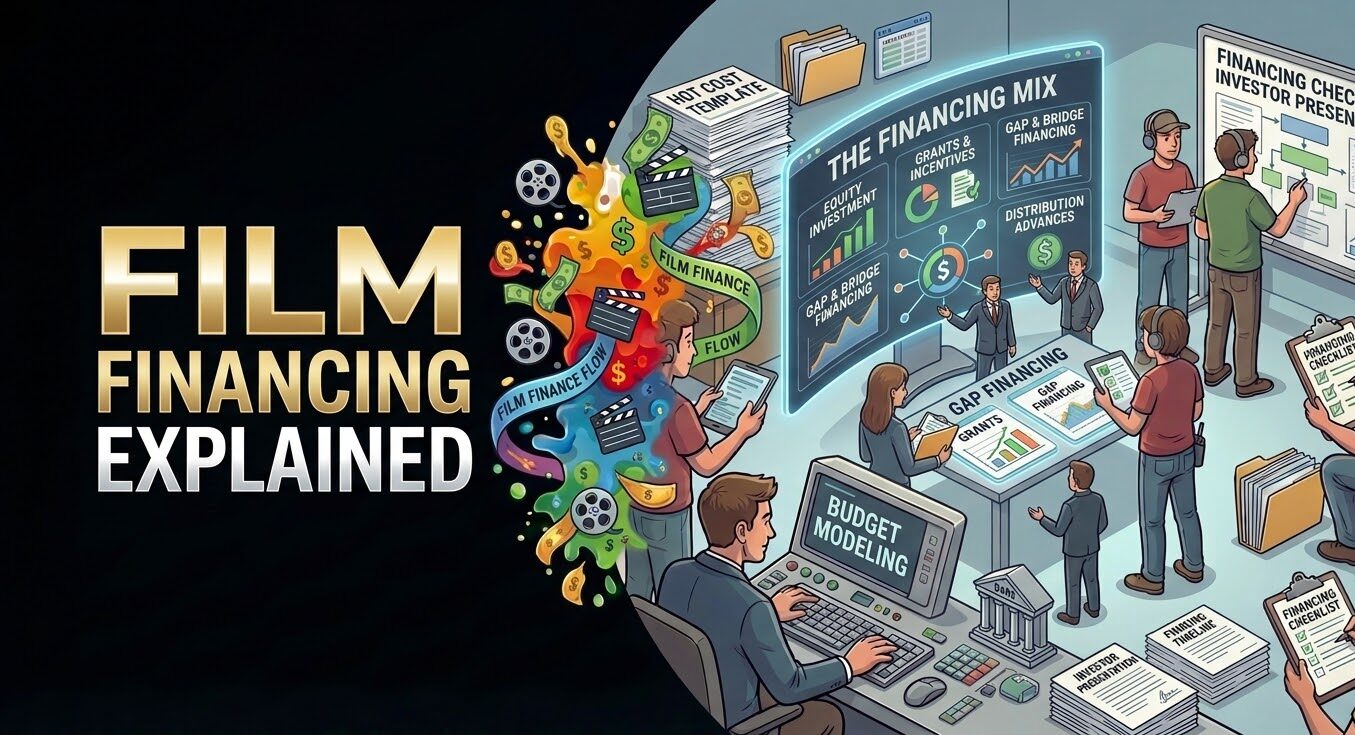
Why it matters: For producers and financiers, this signals a shift from speculative packaging to verifiable asset-based lending and the emergence of regulated, slate-based equity models as a structural alternative to project-by-project financing.
Context: This reflects a broader industry trend where risk capital is becoming more disciplined, requiring producers to function more like asset managers with bankable collateral, while institutional models seek to mitigate endemic risks like non-completion and distribution failure.
"This guide covers: Debt financing for film · Equity investment in film · Minimum guarantees and pre-sales · Film tax incentives · Completion bonds · Regulated fund structures · How the capital." — VITRINA.AI
Commentary: The emphasis on ‘coherence’ over capital availability recalibrates producer leverage; success now hinges on forensic budget defense and rights packaging, not just creative pitch. The 91 Film Studios model, particularly its co-producer requirement, institutionalizes a market validation mechanism that directly attacks the high failure rates in regional production, effectively making the fund a de facto distributor and completion guarantor. This bifurcation—between asset-backed debt in the West and slate-based equity in India—illustrates the global fragmentation of risk management strategies as the independent sector seeks scalable, repeatable structures.
Date: April 23, 2026 12:00 AM ET
URL: https://vitrina.ai/blog/film-financing-explained-every-source-structure-and-strategy/
AI Sentiment Score: Negative (62%)
AI Credibility Score: 9.6/10 — High
Scores and text generated by AI analysis of the source article indicated.
Global TV, Film & Media Industry News Roundup, Wednesday 22 … (Furtherandbetter.Substack)
Summary: U.S. film and TV production spending in Canada increased 9.5% to CAN$5.32 billion in 2025, driven by a 12.1% rise in TV series and a 54.4% surge in other foreign projects. This rebound signals a post-strike recovery and sustained demand for Canadian VFX services. The data, from the Canadian Media Producers Association, indicates a broader industry stabilization and a return to pre-disruption production patterns.

Why it matters: This quantifies the pace of the post-strike recovery for physical production and VFX pipelines, directly informing location budgeting, vendor capacity planning, and labor mobility decisions for studios and financiers.
Context: Canada has long been a major production hub for U.S. studios, offering cost efficiencies and talent pools, with its activity serving as a leading indicator of overall Hollywood production health and capital deployment confidence.
"# Global TV, Film & Media Industry News Roundup, Wednesday 22 April 2026 ### AI disruption, Canada production rebound, WGA deal, streaming economics, indie boom, Portugal incentives, YouTube power, studio consolidation, and." — FURTHERANDBETTER.SUBSTACK
Commentary: The rebound, particularly in TV and ‘other foreign projects’, suggests studios are prioritizing proven, scalable pipelines to clear backlogs and meet slate obligations, favoring efficiency over experimentation. The sustained VFX demand underscores Canada’s entrenched position in the high-cost post-production ecosystem, which is less susceptible to short-term location incentives. This data point should temper narratives of a permanent production exodus from traditional hubs, indicating a reversion to established economic and logistical calculus now that labor stability has been temporarily secured.
Date: April 22, 2026 12:00 AM ET
URL: https://furtherandbetter.substack.com/p/global-tv-film-and-media-industry-5fb
AI Sentiment Score: Positive (44%)
AI Credibility Score: 10.0/10 — High
Scores and text generated by AI analysis of the source article indicated.
Global TV, Film & Media Industry News Roundup, Monday 20 April … (Furtherandbetter.Substack)
Summary: The UK government’s AI policy pivot away from broad text and data mining exemptions is forcing the television industry toward a structured licensing model. This shift, detailed in a new report, aims to protect creative IP by requiring rights-holders and producers to negotiate frameworks for AI training data. The move signals a regulatory tightening that prioritizes copyright protection over unconstrained AI development.

Why it matters: This redefines the cost structure and legal risk for AI tool adoption in production pipelines, compelling studios and vendors to formalize data sourcing and rights clearance.
Context: The global scramble to regulate AI’s use of copyrighted material has created uncertainty for media producers; the UK’s position influences EU and US policy debates.
"# Global TV, Film & Media Industry News Roundup, Monday 20 April 2026 ### Global TV shifts: BBC funding overhaul, Netflix UK expansion, AI licensing rules, major media deals blocked, streaming IP." — FURTHERANDBETTER.SUBSTACK
Commentary: This creates immediate overhead for post-production houses and VFX vendors reliant on AI tools, likely slowing adoption and favoring large studios with in-house legal teams. It also establishes a new revenue stream for archives and libraries, turning training data into a licensable asset class. The policy effectively mandates a ‘cleared materials’ standard for AI, mirroring traditional production workflows but at a data-scale complexity that will test existing rights management infrastructure.
Date: April 20, 2026 12:00 AM ET
URL: https://furtherandbetter.substack.com/p/global-tv-film-and-media-industry-34e
AI Sentiment Score: Negative (80%)
AI Credibility Score: 7.0/10 — Medium
Scores and text generated by AI analysis of the source article indicated.
Post ID: a0ff6310