Archaeological discoveries and fieldwork updates
New Archaeological Discoveries Of April 2026 | Livestream (Youtube)
Summary: A slate of April 2026 discoveries refines the material record of Bronze Age to Roman-era Europe and North Africa. In Bulgaria, a Roman military camp with coins, tent pegs, and shoelace fittings is linked to the aftermath of the Battle of Pedna. In Poland, S17 expressway construction reveals Neolithic burial sites, mammoth remains, and a continuum of settlement evidence. In Egypt, a six-year excavation at Tel Al Farama uncovers a previously unknown temple complex dedicated to a local deity, prompting a reassessment of Palooium’s regional religious significance.

Why it matters: These finds recalibrate timelines of military occupation, settlement continuity, and religious practice, turning infrastructure projects and systematic digs into engines of historical revision.
Context: Infrastructure-led archaeology continues to be a primary driver of discovery in Europe, while long-term missions in North Africa challenge established narratives of cultural and religious hegemony.
"So, like I said, archaeologists found Bronze Age traces at Hohenna Shao {ts:447} Castle. … So, pottery from the 9th to 11th {ts:593} centuries uh came to light in debris linked to." — YOUTUBE
Commentary: The Bulgarian camp artifacts—mundane items like tent pegs and shoelace fittings—provide a granular view of Roman logistical presence post-battle, moving beyond grand strategy to the soldier’s ground. The Polish finds, especially mammoth remains alongside Neolithic burials, complicate simple chronological layers, suggesting landscape memory or resource reuse over millennia. The Egyptian temple discovery directly challenges the periphery narrative for Palooium, indicating a more complex, locally rooted religious landscape than previously mapped, where ‘reshaping interpretations’ is a concrete outcome of sustained fieldwork, not just academic rhetoric.
Date: April 30, 2026 12:00 AM ET
URL: https://www.youtube.com/watch?v=UZv6XWO_QjU
AI Sentiment Score: Negative (66%)
AI Credibility Score: 10.0/10 — High
Scores and text generated by AI analysis of the source article indicated.
Hidden Secrets: Archaeologists Uncover Mystery Object in … – GES (Ges.Kiev.Ua)
Summary: A University of Wrocław team led by Agata Kubala has used CT and X-ray imaging on the fragile mummy of an eight-year-old Egyptian boy, creating detailed 3D models. The non-invasive analysis revealed a previously unknown object resting on the child’s chest, which researchers hypothesize may be a papyrus scroll. If confirmed, the scroll could contain personal information, potentially restoring the boy’s lost identity.
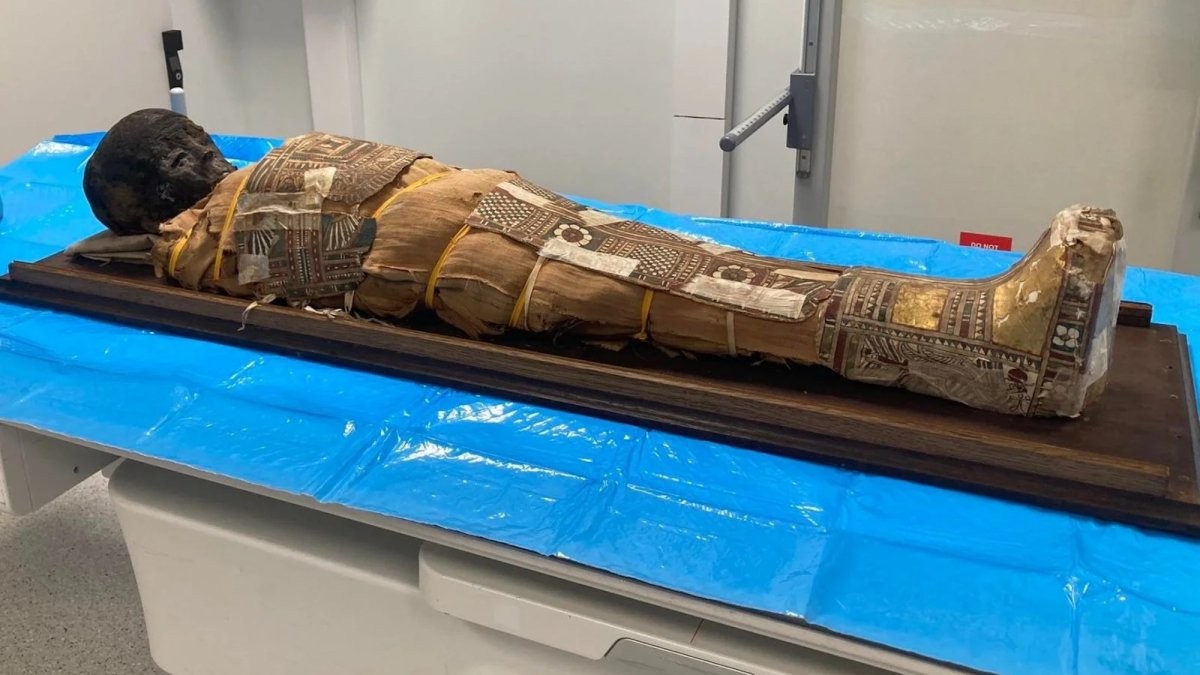
Why it matters: This demonstrates how modern non-invasive techniques are shifting the ethical and practical boundaries of Egyptology, enabling the recovery of intimate personal histories from artifacts too fragile for physical handling.
Context: The mummy is part of a collection at the University of Warsaw’s Department of Archaeology, its provenance obscured by World War II. The field is increasingly reliant on digital imaging to extract data without compromising physical integrity.
"Archaeologists in Poland are piecing together the life and death of an ancient Egyptian child, thanks to modern imaging technology that is revealing secrets hidden for millennia. A research team led by." — GES.KIEV.UA
Commentary: The operational shift here is definitive: the primary artifact is now the digital model, not the physical remains. This redefines ‘handling’ and pushes the discipline toward computational archaeology. The potential to recover a name from an unopened scroll underscores a move from demographic study to individual biography, altering the narrative scale of ancient history.
Date: April 14, 2026 12:00 AM ET
URL: https://ges.kiev.ua/en/uk-uaprihovani-tayemnitsi-arheologi-vijavili-zagadkovij-predmet-na/amp/
AI Sentiment Score: Positive (40%)
AI Credibility Score: 7.0/10 — Medium
Scores and text generated by AI analysis of the source article indicated.
Archaeologists Just Found an Impossible Civilization Deep Beneath a Volcano Crater! (Youtube)
Summary: Archaeological work in a volcanic region has uncovered evidence of organized structures within a collapsed crater, a location previously deemed uninhabitable due to extreme environmental risks. The discovery of interconnected spaces and deliberate construction challenges assumptions about ancient human settlement patterns and environmental adaptation. Researchers are now investigating whether the site served as a temporary refuge, ritual complex, or part of a larger unknown network.
Why it matters: This finding recalibrates our understanding of ancient human agency and risk calculus, pushing the boundaries of where and how complex societies could establish a foothold.
Context: Previous models of ancient habitation often correlate settlement viability with stable, resource-rich environments, treating volcanic zones as purely destructive or transiently used.
"Buried beneath layers of volcanic rock and ash, the site reveals organized structures, interconnected spaces, and clear signs of deliberate construction, suggesting sustained activity in a location once considered uninhabitable." — YOUTUBE
Commentary: The implication is not merely a new dot on the map, but a shift in the logic of pre-modern settlement. It suggests that perceived ‘hostile’ environments could be integrated into cultural or strategic geographies, potentially for isolation, resource access, or cosmological significance. This forces a reevaluation of risk-reward frameworks in archaeology, moving from purely ecological determinism toward understanding how belief systems, political pressures, or trade networks might drive occupation of volatile margins.
Date: April 14, 2026 12:00 AM ET
URL: https://www.youtube.com/watch?v=OD5rkox7KRA
AI Sentiment Score: Negative (66%)
AI Credibility Score: 10.0/10 — High
Scores and text generated by AI analysis of the source article indicated.
Ancient Civilizations News (Sciencedaily)
Summary: Two distinct archaeological findings, separated by millennia, have provided new genetic and forensic evidence reshaping our understanding of historical pandemics and inter-species conflict. In Jordan, direct genetic evidence of Yersinia pestis has been identified in a mass grave, confirming the bacterium’s role in the Plague of Justinian in the 6th century CE. Meanwhile, in Belgium, cave evidence suggests Neanderthal groups practiced selective cannibalism, targeting women and children from outside groups.

Why it matters: These findings refine our models of historical disease vectors and the behavioral complexity of hominin species, directly impacting academic debates on societal collapse and human-Neanderthal interactions.
Context: The Plague of Justinian is a pivotal event in late antiquity, while Neanderthal behavior remains a contested field where new evidence frequently overturns assumptions about social structure and violence.
"Aug. 30, 2025 Scientists have finally uncovered direct genetic evidence of Yersinia pestis — the bacterium behind the Plague of Justinian — in a mass grave in Jerash, Jordan. … Apr." — SCIENCEDAILY
Commentary: The Jordan finding moves the Justinianic Plague from a historical narrative to a microbiologically confirmed event, allowing for more precise modeling of its demographic impact and trade route transmission. The Belgian evidence suggests Neanderthal inter-group conflict was not random violence but a structured practice with potential demographic motives, complicating simplistic narratives of Neanderthal extinction and forcing a reassessment of the nature of ‘human’ behavior in the deep past.
Date: April 30, 2026 12:00 AM ET
URL: http://sciencedaily.com/news/fossils_ruins/ancient_civilizations/
AI Sentiment Score: Negative (75%)
AI Credibility Score: 10.0/10 — High
Scores and text generated by AI analysis of the source article indicated.
Post ID: 61d7c747