
General Reshoring Trends & Industrial Manufacturing
Manufacturing Returning to America — Standard Time® Blog (Strdtime)
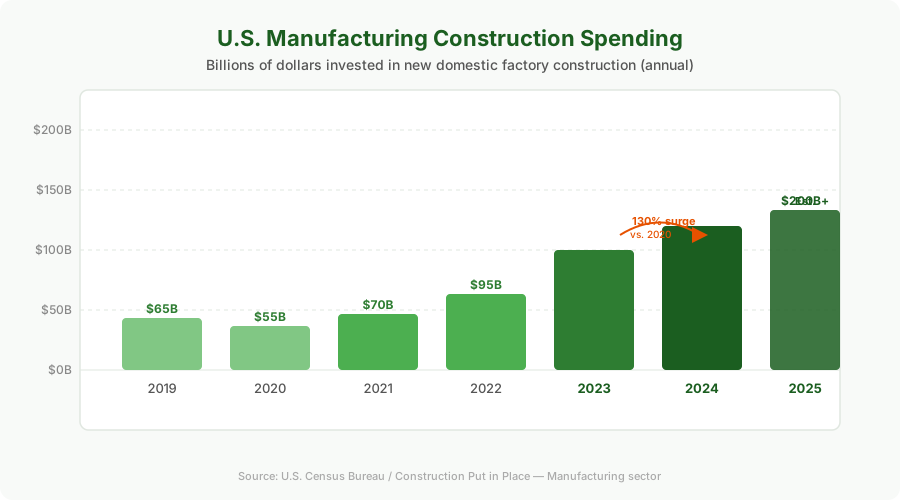
Summary: U.S. manufacturing construction spending has surged over 130% since 2020, driven by semiconductor fabs, EV battery plants, defense production, and general manufacturing. This is not a cyclical recovery but a structural shift, underpinned by supply chain fragility, tariffs, government incentives like the CHIPS Act, and automation narrowing labor cost gaps. The investment is in permanent, policy-locked fixed assets, creating a durable floor for domestic production.
Why it matters: For domestic manufacturers and their suppliers, this surge in demand and investment fundamentally changes the competitive landscape, placing a premium on operational readiness, data visibility, and workforce planning.
Context: This follows decades of offshoring and a recent, acute focus on supply chain resilience, now accelerated by targeted industrial policy.
"The investment is going into permanent fixed assets — fabrication plants, foundries, assembly facilities — that take years to plan, permit, and build, and that are not going to be mothballed when the next quarter comes in light." — STRDTIME
Commentary: The structural shift means procurement criteria have changed: OEMs now audit for digital production scheduling and real-time labor tracking, not just quality certs. The primary constraint is the skilled labor shortage for welders, machinists, and CNC operators, which will dictate the pace of capacity absorption. Existing shops must modernize their operational data systems or lose contracts to competitors who can provide cost and schedule visibility.
Date: April 23, 2026 12:00 AM ET
URL: https://strdtime.com/articles/448-manufacturing-returning-to-america
AI Sentiment Score: Negative (71%)
AI Credibility Score: 9.4/10 — High
Scores and text generated by AI analysis of the source article indicated.
The Reshoring of Commercial Equipment Manufacturing: What It Means for Transit and Fleet Operations (Globaltrademag)
Summary: Reshoring of commercial equipment manufacturing is accelerating due to supply chain fragility, rising transport costs, and policy incentives, directly impacting transit and fleet operations. The shift reduces lead times and improves reliability for agencies but introduces higher upfront labor costs. A hybrid model of domestic assembly with global sourcing for components like semiconductors is emerging as the near-term reality.

Why it matters: For fleet and transit managers, this changes procurement timelines, maintenance logistics, and total cost of ownership calculations, forcing a re-evaluation of vendor relationships and capital planning.
Context: This follows a multi-year trend of supply chain regionalization, but the article highlights its concrete operationalization in a capital-intensive, maintenance-heavy sector.
"For the short term, many companies will rely on a mix of domestic assembly with global sourcing, while production is evolving to more local and regional areas." — GLOBALTRADEMAG
Commentary: The practical implication is a bifurcated supply chain: final assembly and bulky, regulation-sensitive components move onshore, while high-tech subassemblies remain globally sourced. This creates a new layer of logistics complexity for operations teams, who must now manage two distinct vendor ecosystems with different lead times and cost structures.
Date: April 29, 2026 12:00 AM ET
URL: https://www.globaltrademag.com/the-reshoring-of-commercial-equipment-manufacturing-what-it-means-for-transit-and-fleet-operations/
AI Sentiment Score: Negative (71%)
AI Credibility Score: 10.0/10 — High
Scores and text generated by AI analysis of the source article indicated.
VF Put RFID Under The Model Already Running — Rack & Reason (Rack-Reason)
Summary: VF Corporation is implementing item-level RFID across its brand portfolio, beginning with The North Face in Q2-2026 and extending to Vans and Timberland. The deployment will cover over 1,500 stores, distribution centers, and, critically, vendor partners at the source, meaning finished goods will be tagged before leaving the factory. This move by a major apparel conglomerate signals a shift from pilot programs to enterprise-wide supply chain digitization.

Why it matters: For manufacturers and logistics operators, this mandates a new data-layer integration at the point of production, altering vendor workflows and imposing upstream compliance costs.
Context: RFID adoption in apparel has been gradual, often limited to select stores or DCs; VF’s scale and upstream ‘source’ tagging represent a maturation of the technology’s operational role.
"The deployment reaches distribution centres and, in Hope Waldron’s phrasing, “vendor partners at the source,” which means finished goods are being tagged before they leave the factory." — RACK-REASON
Commentary: This isn’t just a retail inventory play; it’s a supply chain re-engineering that transfers tagging labor and cost to manufacturing partners, potentially reshaping vendor contracts and factory line processes. The real constraint is vendor compliance—imposing new hardware, software, and training burdens on a global supplier base. For domestic producers, this could accelerate consolidation around vendors with the capital to automate, while smaller shops face a new barrier to entry. The data captured at source fundamentally changes allocation, recall, and sustainability tracking, moving VF toward a real-time, item-level digital twin of its physical inventory.
Date: April 24, 2026 12:00 AM ET
URL: https://rack-reason.com/en/vf-put-rfid-under-model-already-running/
AI Sentiment Score: Negative (75%)
AI Credibility Score: 10.0/10 — High
Scores and text generated by AI analysis of the source article indicated.
Post ID: 638dcf9e