
AI, 3D & Digital Fashion Tools
AI-Driven Apparel Image Retrieval and Feature Optimization for Smart and Sustainable Textile Manufacturing (Intechopen)
Summary: Integrated impact of image retrieval in textile industry applications. Abstract In response to mounting environmental challenges, excessive resource use, and the rapidly increasing volume of textile waste, the global textile and apparel sector is accelerating its transition toward digital transformation to achieve greater efficiency, sustainability, traceability, and intelligent manufacturing practices. Artificial intelligence (AI) has emerged as a highly transformative enabler for smart and sustainable textile systems, particularly through the use of computer vision, machine learning and deep learning technologies.

Why it matters: This matters for FashionTech because it gives a concrete current signal to track: Integrated impact of image retrieval in textile industry applications.
Context: Integrated impact of image retrieval in textile industry applications. Abstract In response to mounting environmental challenges, excessive resource use, and the rapidly increasing volume of textile waste, the global textile and apparel sector is accelerating its transition toward digital transformation to achieve greater efficiency, sustainability, traceability, and intelligent manufacturing practices. Artificial intelligence (AI) has emerged as a highly transformative enabler for smart and sustainable textile systems, particularly through the use of computer vision, machine learning and deep learning technologies.
"Integrated impact of image retrieval in textile industry applications. Abstract In response to mounting environmental challenges, excessive resource use, and the rapidly increasing volume of textile waste, the global textile and apparel." — INTECHOPEN
Commentary: The immediate implication is operational rather than speculative: watch how this changes budgets, workflows, or risk assumptions over the next cycle.
Date: May 07, 2026 12:00 AM ET
URL: https://www.intechopen.com/online-first/1245305
AI Sentiment Score: Negative (66%)
AI Credibility Score: 10.0/10 — High
Scores and text generated by AI analysis of the source article indicated.
Fashion PLM Blog â Tech Packs, Costing, Production & Supply Chain | KÅbÅ (Kobolabs.Io)
Summary: A Kobo Labs report details the current state of AI in fashion, distinguishing between production-ready applications and overhyped experiments. It finds a 90% failure rate for AI initiatives scaling beyond pilots, primarily due to data fragmentation, and a widening gap between enterprise and mid-market capabilities. Commerce AI (recommendations, forecasting, sizing) shows proven ROI, while agentic AI and design tools remain largely experimental or require significant data infrastructure most brands lack.

Why it matters: For practitioners, this clarifies where to allocate resources now versus where to wait, and underscores that data structuring via PLM is the non-negotiable prerequisite for any meaningful AI adoption.
Context: The fashion AI vendor market is consolidating, with PLM platforms acquiring AI capabilities and a price war emerging from challengers like Style3D, while regulatory pressures (DPP, ESPR) are creating new compliance-driven use cases.
"Ninety percent of AI initiatives fail to scale. This is not a technology failure. It is a data failure." — KOBOLABS.IO
Commentary: The report’s core insight reframes the AI challenge from a tooling problem to a data governance and systems integration problem. For mid-market brands, this means the immediate operational priority is not selecting an AI vendor, but consolidating product data from spreadsheets and WhatsApp into a structured PLM. The high ROI from commerce AI is accessible primarily to those with clean, SKU-level data, creating a two-tier adoption curve. The impending agentic wave will exacerbate this divide, as it requires a fully connected data layer most brands do not possess.
Date: May 08, 2026 12:00 AM ET
URL: https://www.kobolabs.io/research/state-of-fashion-ai
AI Sentiment Score: Negative (66%)
AI Credibility Score: 10.0/10 — High
Scores and text generated by AI analysis of the source article indicated.
ASOS: Redesigning online fashion at the speed of AI (Ukstories.Microsoft)
Summary: ASOS is deploying Microsoft’s Azure, Dynamics 365, and AI tools across its entire value chain, aiming to shift from transactional e-commerce to an adaptive, conversational experience. The partnership focuses on consolidating data for faster trend identification, automating back-office and customer service functions with AI agents, and using 3D design to compress the design-to-shelf cycle to roughly three weeks.

Why it matters: This signals a move from basic personalization to dynamic, agent-driven operations, setting a new benchmark for speed and data integration in fast-fashion’s digital pipeline.
Context: Fast-fashion’s competitive edge has long depended on supply chain velocity; AI integration now pushes that imperative into real-time customer interaction and automated internal workflows.
"ASOS: Redesigning online fashion at the speed of AI Fashion retailer ASOS is applying artificial intelligence and cloud services throughout its whole value chain in a frontier AI transformation partnership with Microsoft,." — UKSTORIES.MICROSOFT
Commentary: The three-week cycle, enabled by trend-scouting AI and 3D design, resets the tempo for fast-fashion’s product development, pressuring rivals to match this integration of social data analysis with rapid physical production. Consolidating data into a single Azure repository is a prerequisite for the self-service analytics and agent automation now handling half of customer enquiries and 15% of code, indicating a shift toward centralized data governance as a core operational capability. The 93 identified agentic use cases, constrained but human-supervised, suggest a near-term future where AI agents manage swathes of the fashion retail workflow, from inventory to customer styling.
Date: April 30, 2026 12:00 AM ET
URL: https://ukstories.microsoft.com/features/asos-redesigning-online-fashion-at-the-speed-of-ai/
AI Sentiment Score: Negative (50%)
AI Credibility Score: 9.6/10 — High
Scores and text generated by AI analysis of the source article indicated.
Fashion Draws Closer To Some Fixed Ideas About AI, Just … (Theinterline)
Summary: The fashion industry’s AI adoption is moving past speculative hype into a phase of operational integration. Major cloud providers like AWS and Microsoft are publishing retail-specific playbooks and case studies, while deployments are focusing on tangible ROI within established workflows. Applications are crystallizing around virtual try-on, agentic checkouts, generative design, and shopfloor control, targeting long-standing strategic aims like reducing returns and personalizing discovery.

Why it matters: For fashion practitioners, this shift means AI is becoming a measurable tool for efficiency and revenue, moving from R&D budgets to core operational spend, with clear implications for vendor selection and workflow redesign.
Context: This follows a multi-year cycle where fashion tech was dominated by metaverse and NFT experiments; the current pivot reflects a broader industry focus on supply chain resilience, cost control, and direct monetization of digital tools.
"Well, Amazon Web Services (AWS) recently published a “generative AI playbook for retail,” which certainly puts a neat bow around a lot of the common ideas: virtual try-on, sizing recommendations, and personalisation." — THEINTERLINE
Commentary: The ASOS-Microsoft case study signals a critical threshold: AI implementations are now being justified by traditional ROI metrics, not novelty. This could pressure vendors to demonstrate concrete impacts on time-to-market, digital sampling cost, or return rates. For studios and brands, the focus shifts to integrating these tools into existing PLM and ERP systems, creating demand for technical roles that bridge design and data engineering.
Date: May 01, 2026 12:00 AM ET
URL: https://www.theinterline.com/2026/05/01/fashion-draws-closer-to-some-fixed-ideas-about-ai-just-as-the-subsidies-are-running-out/
AI Sentiment Score: Negative (80%)
AI Credibility Score: 10.0/10 — High
Scores and text generated by AI analysis of the source article indicated.
Arts University Bournemouth takes AI and VR fashion tech … (Edtechinnovationhub)
Summary: Arts University Bournemouth is launching a commercial agency at Fashion SVP 2026 to directly connect student and graduate talent with brand briefs, alongside showcasing AI pattern tools and VR design workflows already in use by major brands. This represents a deliberate shift from a traditional graduate supplier model to positioning the university as a live commercial and R&D partner for the industry.

Why it matters: This redefines the labor pipeline and vendor ecosystem for fashion brands, offering a new channel for procuring AI-driven design, traceability, and costing tools alongside fresh talent, potentially altering studio resourcing and academic-industry collaboration models.
Context: Universities have long been talent feeders, but commercial pressure and the need for rapid tech integration are pushing them toward more direct, project-based industry partnerships.
"#### Arts University Bournemouth arrives at Fashion SVP 2026 in London with AI pattern tools, VR design workflows, and a new commercial agency model that puts student talent directly inside brand briefs." — EDTECHINNOVATIONHUB
Commentary: If successful, this model could compress the traditional graduate recruitment funnel, giving brands earlier, cheaper access to trained talent while monetizing university IP in AI pattern engineering and DPP systems. It pressures other institutions to commercialize their labs or risk being sidelined as mere credentialing bodies.
Date: April 28, 2026 12:00 AM ET
URL: https://www.edtechinnovationhub.com/news/arts-university-bournemouth-takes-ai-and-vr-fashion-tech-to-olympia-london-this-week
AI Sentiment Score: Negative (66%)
AI Credibility Score: 7.0/10 — Medium
Scores and text generated by AI analysis of the source article indicated.
Fast fashion inventory AI and IoT landscape 2026 (Patsnap)
Summary: Patent and academic literature analysis through 2026 shows a shift in fashion supply chain automation from generic optimization algorithms (2019-2022) to integrated, fashion-specific platforms and circular economy compliance tools (2023-2025). The landscape remains sparse, with Refashiond OS’s 2022 WO patent for a fashion-specific supply chain OS standing as a notable exception. Recent Chinese and Indian patents focus on live-stream retail optimization and unsold inventory conversion, indicating regional specialization.

Why it matters: For supply chain and operations managers, the underpopulated IP space signals a window for strategic tooling investment before platform lock-in occurs.
Context: Fast fashion inventory management has long relied on adapted retail algorithms; dedicated fashion-tech platforms represent a move from adaptation to native architecture.
"With only one WO patent (Refashiond OS Inc., 2022) explicitly targeting fashion industry supply chain automation as a platform OS, the IP landscape for fashion-specific demand-supply orchestration platforms remains substantially underpopulated as of 2026." — PATSNAP
Commentary: The concentration of literature in the ‘Emerging Phase’ on circularity and digital passports means new inventory systems must now bake in compliance data flows, increasing integration complexity but potentially reducing audit overhead. The single active platform patent suggests first-mover advantage is still attainable, but the pending CN and IN filings on live-stream and conversion platforms point to fragmentation by regional retail models.
Date: May 01, 2026 12:00 AM ET
URL: https://www.patsnap.com/resources/blog/articles/fast-fashion-inventory-ai-and-iot-landscape-2026/
AI Sentiment Score: Positive (50%)
AI Credibility Score: 10.0/10 — High
Scores and text generated by AI analysis of the source article indicated.
Smart Wear and Wearables the Fusion of Fashion and … (Apparelviews)
Summary: The article outlines the current state of smart wear, defined as garments and accessories integrating sensors and electronic circuits. It highlights applications in health monitoring, environmental adaptation, and luxury, using examples like conductive yarn for biometrics and IoT-enabled data collection on garment usage. The piece positions this fusion as a driver for new market value, personalized products, and sustainability-focused innovation, while noting persistent challenges around data security and technology costs.

Why it matters: For industry practitioners, the operational shift from passive apparel to data-generating, function-integrated products alters design pipelines, material sourcing, manufacturing tolerances, and post-sale customer relationship models.
Context: Smart wearables have evolved from niche fitness trackers into integrated textile systems, pushing fashion brands to develop competencies in electronics integration, data analytics, and lifecycle management beyond traditional cut-and-sew operations.
"Sensors embedded in clothing can record wearing frequency and usage conditions, enabling product improvements and personalized recommendations based on data." — APPARELVIEWS
Commentary: The explicit call-out of embedded sensors for recording wear data signals a move from speculative R&D to operational feedback loops. For brands, this creates a direct pipeline from physical garment use to design iteration and marketing, potentially reducing return rates through fit analytics and increasing customer lifetime value through data-driven replenishment. However, it imposes new burdens on supply chains for durable, washable electronics and necessitates robust data governance frameworks to manage the privacy implications of continuous biometric and behavioral monitoring.
Date: April 23, 2026 12:00 AM ET
URL: https://www.apparelviews.com/smart-wear-and-wearables-the-fusion-of-fashion-and-technology/
AI Sentiment Score: Neutral (33%)
AI Credibility Score: 10.0/10 — High
Scores and text generated by AI analysis of the source article indicated.
AI Turns Thrift Into Profitable Fashion Marketplace (Letsdatascience)
Summary: AI has moved from a peripheral tool to the operational core of the secondhand fashion market, enabling platforms to standardize and monetize inherently unique inventory. By deploying computer vision and generative models for visual search, automated tagging, and cross-marketplace matching, these systems solve the fundamental cataloging and discovery problems that previously constrained scale. This technical shift underpinned the sector’s growth to $289 billion in 2025 and is projected to drive it to $393 billion within five years.

Why it matters: For practitioners in fashion operations and retail tech, this signals a shift in required vendor capabilities, cataloging workflows, and the economic model for handling non-uniform goods.
Context: Secondhand retail has historically been bottlenecked by the manual labor required to describe, price, and match one-off items, making scalability and profitability elusive.
"AI has converted secondhand apparel from a logistical headache into a high-margin retail channel. … Platforms solved the core technical challenge of uniqueness by applying computer vision and generative models to discovery,." — LETSDATASCIENCE
Commentary: The operational consequence is a redefinition of the unit economics for resale, where margin is now a function of data pipeline efficiency rather than just labor arbitrage. This creates a new class of essential vendor tools for visual identification and cross-platform aggregation, forcing brands and marketplaces to integrate these systems or cede pricing power. It also suggests that ‘uniqueness’ as a logistical constraint is now a solvable engineering problem, which could ripple into other fragmented asset markets like vintage collectibles or used industrial equipment.
Date: April 21, 2026 12:00 AM ET
URL: https://letsdatascience.com/news/ai-turns-thrift-into-profitable-fashion-marketplace-81e30183
AI Sentiment Score: Negative (66%)
AI Credibility Score: 10.0/10 — High
Scores and text generated by AI analysis of the source article indicated.
Photo-Based Authentication for Luxury Resale Power Sellers (Startupheist)
Summary: The luxury resale market’s growth is shifting from bargain hunting to high-stakes transactions, with buyers seeking authenticated $1,500–$4,000 items. Current authentication services like Entrupy and Real Authentication are either brand-limited, post-sale, or consignment-captive, leaving a gap for pre-listing seller tools. The entry of Walmart and Amazon into pre-owned luxury via partnerships like Rebag is turning authentication from a boutique service into a prerequisite infrastructure layer, creating demand for an API-first, low-latency trust product.

Why it matters: For power sellers and platforms, the lack of a portable, pre-sale authentication badge is a conversion bottleneck and operational risk as major retailers mandate verified inventory.
Context: Counterfeit luxury goods, especially ‘superfakes,’ are proliferating via small-parcel channels, with Louis Vuitton, Gucci, and Chanel accounting for over half of flagged submissions. Marketplaces like Poshmark only authenticate post-sale for high-ticket items.
"The resale market solved transactions. It hasn’t solved portable trust." — STARTUPHEIST
Commentary: The operational consequence is a forced workflow shift: sellers must now factor authentication latency and cost into pricing and listing velocity. For platforms, integrating a third-party trust API becomes a supply-chain requirement, similar to payment processors. This creates a vendor opportunity for a service that reduces buyer hesitation pre-sale, directly impacting conversion rates and return volumes.
Date: May 08, 2026 12:00 AM ET
URL: https://www.startupheist.com/photo-based-authentication-for-luxury-resale-power-sellers/
AI Sentiment Score: Negative (50%)
AI Credibility Score: 7.0/10 — Medium
Scores and text generated by AI analysis of the source article indicated.
Virtual Try-On Technology for Ecommerce 2026 (Claimlane)
Summary: Virtual try-on technology, powered by AR, AI body mapping, and 3D rendering, is moving from speculative feature to operational tool for e-commerce. Its primary value proposition is a direct attack on return rates and a boost to conversion by letting customers visualize products on themselves. The current bottleneck is not the AR runtime but the creation of 3D product assets at scale, with AI-generated models from photos becoming the practical choice for large catalogs. Implementation is now framed as a progressive rollout, starting with high-return SKUs, with integration timelines of 4-8 weeks for basic SDKs.

Why it matters: For fashion brands and retailers, this shifts the operational focus from generic innovation to a measurable, phased deployment targeting specific cost centers like returns and conversion funnel drop-offs.
Context: The conversation around virtual try-on has matured from ‘if’ to ‘how,’ with the industry now focused on asset pipeline logistics, ROI measurement, and integration into existing e-commerce workflows.
"Virtual try-on technology attacks this problem directly. Using augmented reality (AR), AI body mapping, and 3D rendering, customers can see how a product looks on them before placing an order. Glasses on." — CLAIMLANE
Commentary: The operational center of gravity has shifted from the front-end AR experience to the back-end 3D asset pipeline. This creates a new vendor landscape and internal workflow centered on 3D modeling cost, speed, and quality, making the decision between manual modeling, AI generation, or scanning a critical production calculation. The prescribed progressive rollout strategy turns virtual try-on from a blanket marketing expense into a targeted operational lever, directly tying deployment to pre-identified return-rate data.
Date: May 04, 2026 12:00 AM ET
URL: https://www.claimlane.com/resources/blog/virtual-try-on-technology-ecommerce
AI Sentiment Score: Negative (80%)
AI Credibility Score: 7.0/10 — Medium
Scores and text generated by AI analysis of the source article indicated.
Fashion Digital Twins: How Virtual Garments Are Transforming the … (Pixofix)
Summary: The article outlines a production pipeline for creating and maintaining fashion digital twins—dynamic, data-rich 3D garment models that simulate fabric behavior and manufacturing details. It details a four-stage process from base model creation to quality checks, emphasizing accuracy, cross-functional review, and standardized visual language. The operational focus is on establishing repeatable workflows, documentation, and scheduled audits to treat these assets as living products.

Why it matters: For studios and brands, this codifies a new core production workflow that directly impacts time to market, sampling cost, and return rates through improved fit and material accuracy.
Context: Digital twins move beyond static 3D mockups into operational assets that require sustained investment in tooling, labor specialization, and pipeline discipline.
"Treat your twins like living products, not one-off files." — PIXOFIX
Commentary: This shifts digital asset management from a project-based cost center to a product lifecycle function, requiring dedicated roles for simulation, QA, and data integration. Studios will need to retool retouching and post-production checklists around 3D consistency, not just 2D image correction. Brands that master this pipeline will gain leverage in customer data (through fit interaction) and manufacturing throughput (by reducing physical sampling), but face upfront labor and tooling reallocation.
Date: May 04, 2026 12:00 AM ET
URL: https://www.pixofix.com/blog/fashion-digital-twins-how-virtual-garments-are-transforming-the-future-of-e-commerce
AI Sentiment Score: Negative (50%)
AI Credibility Score: 10.0/10 — High
Scores and text generated by AI analysis of the source article indicated.
2026: Why Virtual Try-On is Killing the Fashion Photoshoot (Weshop.Ai)
Summary: Virtual Try-On (VTO) technology has reached a fidelity tipping point in 2026, moving from a gimmick to a core operational tool. The key shift is the adoption of high-fidelity physics models, like the cited ‘nanobanana pro’ architecture, which simulate fabric behavior and garment geometry in real-time. This enables single-button API integration for brands, eliminating the need for manual 3D mapping or prompt engineering. The primary impact is the transformation of marketing and production pipelines, notably by generating marketing assets before physical production and slashing logistics costs through reduced returns.

Why it matters: For fashion practitioners, this changes the cost structure and timeline of product launches, directly affecting sampling budgets, influencer outreach logistics, and return rates.
Context: The fashion industry has long sought to digitize sampling and fit visualization to reduce waste and speed time-to-market, but previous solutions struggled with the ‘uncanny valley’ of digital representation.
"To understand why 2026 is the tipping point, we have to look at the “Uncanny Valley” of fashion AI. For years, Virtual Try-On felt like a cheap digital sticker. Today, it operates." — WESHOP.AI
Commentary: The operational consequence is a decoupling of marketing from physical supply chains, allowing campaigns to run concurrent with manufacturing. This pressures studios and photographers specializing in product shots, as the need for pre-production photoshoots collapses. The shift to a ‘digital model’ as the primary tool redefines vendor relationships, favoring AI integrators over traditional creative production crews. The reduction in return rates directly impacts bottom-line logistics costs, making VTO a capital expenditure with a clear, measurable ROI on waste reduction.
Date: April 22, 2026 12:00 AM ET
URL: https://www.weshop.ai/blog/why-2026-is-the-year-the-professional-photoshoot-dies-thanks-to-virtual-try-on/
AI Sentiment Score: Negative (83%)
AI Credibility Score: 10.0/10 — High
Scores and text generated by AI analysis of the source article indicated.
Podcast: Will A Drive For Shared Truth Bring Fashion Back … (Theinterline)
Summary: The podcast discusses the operational shift toward digital product passports, driven by regulations like the EU’s ESPR, which mandate standardized, durable, and enforceable product-level data. Companies such as TextileGenesis are implementing traceability solutions using blockchain principles, while consultancies like EY are involved in building the necessary enterprise plumbing. This move extends data control beyond traditional enterprise boundaries, even for large industry players.

Why it matters: For practitioners, this mandates new data infrastructure, alters supply chain workflows, and introduces compliance-driven traceability as a core operational requirement, not just a marketing feature.
Context: The EU’s Ecodesign for Sustainable Products Regulation (ESPR) is forcing fashion and consumer goods companies to adopt digital product passports, creating a market for turnkey solutions and consultancies.
"You have serious companies like TextileGenesis who are architecting fibre-forward traceability on top of blockchain principles, even if they don’t describe themselves as blockchain companies. A massive panel of companies right now." — THEINTERLINE
Commentary: The push for ‘durable and standardised’ data transforms traceability from a voluntary audit to a mandated, technical pipeline. This could force brands to integrate new vendor systems like TextileGenesis, recalibrate IT budgets toward compliance plumbing, and extend data governance to previously uncontrolled tiers of their supply chain. The operational consequence is that provenance becomes a non-negotiable cost of doing business in regulated markets.
Date: April 21, 2026 12:00 AM ET
URL: https://www.theinterline.com/2026/04/21/podcast-will-a-drive-for-shared-truth-bring-fashion-back-around-to-blockchain/
AI Sentiment Score: Negative (50%)
AI Credibility Score: 10.0/10 — High
Scores and text generated by AI analysis of the source article indicated.
Fit Analyzer vs Size Chart: Which Cuts Returns More? (Alhena.Ai)
Summary: Alhena.Ai’s analysis positions AI-powered fit analyzers as decision-making tools that outperform static size charts in reducing returns. Citing McKinsey and SAIZ data, it notes that 70% of returns are fit-related, and 71% of those shoppers consulted a size chart before buying. The company claims its fit analyzer reduces returns by 20-35% versus 5-10% for charts, by interpreting chart data for the shopper and resolving ambiguity.
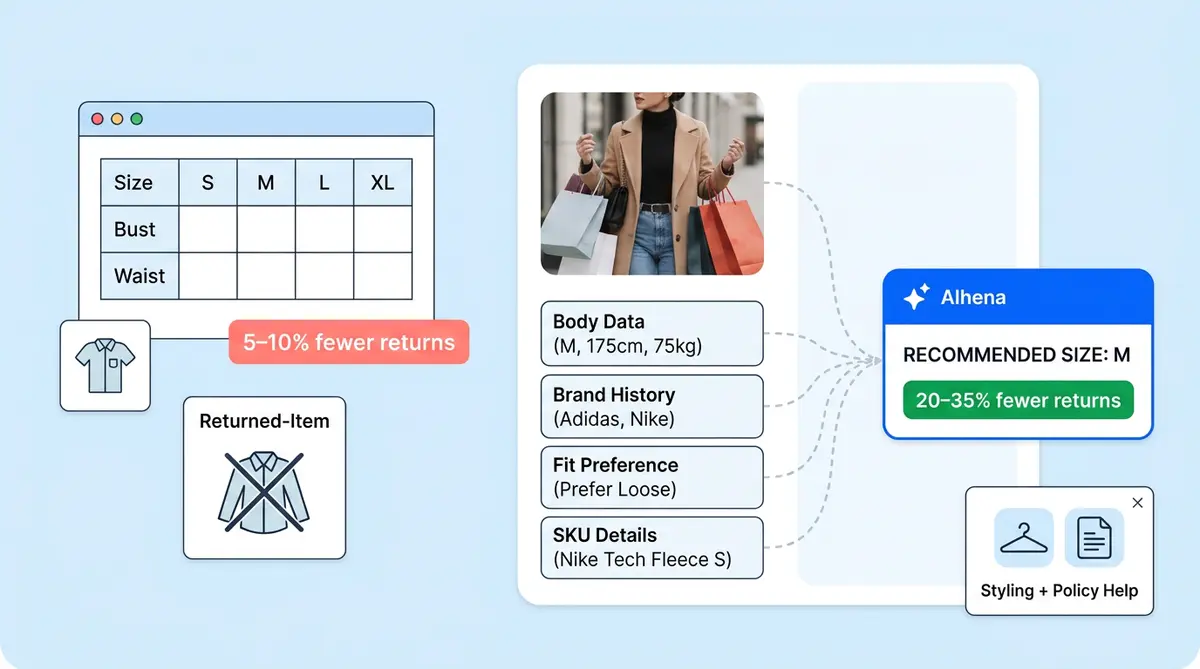
Why it matters: For e-commerce operators, the choice between a passive data table and an active recommendation engine directly impacts return rates, conversion, and inventory costs.
Context: The fashion industry’s shift toward digital fit tools aims to solve the chronic return problem driven by sizing inconsistency and shopper error.
"A size chart is a dictionary. A fit analyzer is a translator for apparel sizing. Both give you sizing information, but only one shows what the fit will look like on the." — ALHENA.AI
Commentary: The claimed performance gap reframes the sizing problem from one of data access to one of decision support. This moves the operational burden from the shopper to the vendor’s tooling, requiring integration with product metadata and inventory systems. For brands, the implication is that sizing is now a software feature requiring deployment and maintenance, not just a static chart in a CMS.
Date: April 24, 2026 12:00 AM ET
URL: https://alhena.ai/blog/fit-analyzer-vs-size-chart-returns/
AI Sentiment Score: Negative (60%)
AI Credibility Score: 9.7/10 — High
Scores and text generated by AI analysis of the source article indicated.
3D retail’s last barrier isn’t creation. It’s delivery. | Miris (Miris)
Summary: The primary obstacle to scaling 3D visualization in retail is no longer asset creation cost or format fragmentation, but delivery infrastructure. While AI-driven pipelines have slashed production costs and standards like OpenUSD are resolving format wars, existing delivery methods force a trade-off between visual fidelity, load speed, scale, and cost. WebGL compresses assets to death; pixel streaming scales costs exponentially. Adaptive spatial streaming, as deployed by platforms like Miris, emerges as the architectural solution, enabling CDN-like scaling while preserving the visual detail that drives conversion and reduces returns.

Why it matters: For retail operations, the choice of delivery architecture determines whether 3D visualization can be deployed as a scalable, cost-effective infrastructure layer or remains a niche, high-cost experiment.
Context: 3D visualization is moving from a conversion-boosting feature to a baseline expectation, with proven impacts on return rates and basket size, forcing retailers to operationalize it across their full catalog.
"Investing in beautiful 3D assets is meaningless if you cannot get them to customers at scale. And here, retailers face an old tradeoff in new clothes." — MIRIS
Commentary: The shift from creation to delivery as the critical barrier signals a maturation of the market; retailers like Lowe’s, Amazon, and Home Depot are now building long-term 3D infrastructure. The operational consequence is that e-commerce and IT teams must now evaluate 3D delivery not as a feature launch but as a core platform capability, with cost structures and scalability directly impacting P&L. This moves the decision from marketing to infrastructure budgeting.
Date: May 06, 2026 12:00 AM ET
URL: https://www.miris.com/blog/3d-retails-last-barrier-isnt-creation-its-delivery
AI Sentiment Score: Negative (70%)
AI Credibility Score: 9.4/10 — High
Scores and text generated by AI analysis of the source article indicated.
CLO secures victory in software copyright infringement case (Fibre2Fashion)
Summary: The Zhejiang Provincial High People’s Court ruled against Linctex for willful, commercial-scale copyright infringement of CLO’s 3D fashion design software. The court dismissed Linctex’s ‘fair use’ defense, ordering cessation of infringing activities and compensation. CLO’s CEO framed the victory as a defense of the digital fashion ecosystem’s stability and a reaffirmation of the company’s commitment to the Chinese market.

Why it matters: This ruling establishes a legal precedent in a key manufacturing market, directly impacting software procurement, compliance costs, and operational risk for studios and brands relying on 3D design tools.
Context: Software piracy has been a persistent cost and competitive issue in 3D design, particularly in markets with dense manufacturing ecosystems. Enforcement actions by major software vendors can reshape local market practices and vendor-client relationships.
"According to the final judgment by the Zhejiang Provincial High People’s Court, after thorough examination, the court clearly established that Linctex engaged in willful infringement by “prolonged, large-scale, and frequent” use of." — FIBRE2FASHION
Commentary: The ruling’s description of ‘prolonged, large-scale, and frequent’ use signals courts are willing to scrutinize operational scale, not just isolated instances. This raises the compliance stakes for any studio or factory using unlicensed software in its production pipeline. CLO’s subsequent emphasis on ecosystem ‘stability’ suggests vendors will leverage such rulings to push for enterprise-wide licensing deals, moving beyond individual seat sales. For practitioners, this means increased audit scrutiny, a shift towards verified cloud-based subscriptions, and potential renegotiation of vendor contracts to ensure legal coverage for outsourced digital sampling work.
Date: Sun, 03 May 2026 09:08:02 GMT
URL: https://www.fibre2fashion.com/news/textiles-technology-news/clo-secures-victory-in-software-copyright-infringement-case-307745-newsdetails.htm
AI Sentiment Score: Negative (75%)
AI Credibility Score: 10.0/10 — High
Scores and text generated by AI analysis of the source article indicated.
How Can 3D Fashion Software Transform Your PLM & ERP Systems? (Style3D)
Summary: Style3D’s promotional article outlines a technical integration path for embedding 3D fashion software—specifically real-time cloth simulation, AI automation, and digital asset management—directly into existing Product Lifecycle Management (PLM) and Enterprise Resource Planning (ERP) systems. It argues this integration eliminates fragmented workflows, drastically reduces physical sampling costs, and accelerates design-to-production cycles through open APIs and SDKs. The piece positions this as a solution to legacy systems’ lack of native 3D capabilities.

Why it matters: For technical architects and production leads, this signals a shift from managing separate 3D tools to embedding simulation directly into core enterprise systems, altering vendor selection, team skillsets, and the physical sampling pipeline.
Context: The fashion industry’s push toward digital product creation has been hampered by siloed tools that don’t connect to core business systems, keeping physical sampling and approval cycles long and costly.
"3D fashion software transforms PLM and ERP systems by embedding real-time cloth simulation, AI-driven automation, and open APIs directly into existing enterprise infrastructure. This eliminates fragmented workflows, reduces physical sampling significantly, and." — STYLE3D
Commentary: The practical implication is a redefinition of the PLM administrator’s role to include managing 3D simulation APIs and AI analytics. For studios, this integration pressures a consolidation of vendor ecosystems around platforms offering open APIs, moving the competitive battleground from standalone 3D software to seamless ERP/PLM embedding. The promised reduction in physical sampling directly attacks a major cost center, but success hinges on the fidelity of the digital simulation to real-world fabric behavior and fit.
Date: April 27, 2026 12:00 AM ET
URL: https://www.style3d.com/blog/how-can-3d-fashion-software-transform-your-plm-erp-systems/
AI Sentiment Score: Positive (40%)
AI Credibility Score: 10.0/10 — High
Scores and text generated by AI analysis of the source article indicated.
What happens after the applause (Ibm)
Summary: IBM and its partner Fiducia AI deployed a virtual try-on platform for the KATE BARTON brand, moving from a live New York Fashion Week presentation to an integrated Shopify storefront in a matter of days. The system leveraged IBM Cloud and watsonx services to coordinate visual AI, multi-language interaction, and asset delivery. The core technical achievement was the reuse of the same architecture across both live event and e-commerce contexts with minimal rework.

Why it matters: This demonstrates a tangible compression of the go-to-market timeline for immersive retail experiences, directly impacting production schedules and capital allocation for brands.
Context: Virtual try-on has been plagued by long development cycles and siloed implementations for runway versus retail, creating cost and continuity frictions.
"Delivering a credible virtual try‑on experience required realistic visual outputs, low‑latency performance, and seamless cross‑device access, alongside visual recognition with voice‑ and text‑based interaction in nearly any language, in a live setting." — IBM
Commentary: The operational significance is the decoupling of immersive experience deployment from lengthy, bespoke IT projects. By treating the live event as a configured instance of a reusable SaaS platform, the path from marketing spectacle to transactional tool collapses from months to days. This shifts the cost-benefit calculus for brands considering AR/VR, making it a viable tactic for short-cycle campaigns rather than a multi-year infrastructure bet. It also pressures specialty vendors whose value proposition is tied to complex, one-off integrations.
Date: April 26, 2026 12:00 AM ET
URL: https://www.ibm.com/case-studies/kate-barton
AI Sentiment Score: Negative (60%)
AI Credibility Score: 10.0/10 — High
Scores and text generated by AI analysis of the source article indicated.
Virtual Try-On Tools (Trendhunter)
Summary: Virtual try-on tools are moving from speculative tech to operational retail infrastructure, with AI-driven fit personalization and AR dressing rooms now deployed to influence purchasing decisions. The technology aims to directly address the high-cost pain points of online apparel retail: return rates and conversion friction. Its integration signals a shift in the apparel pipeline, where digital garment models inform both front-end customer experience and back-end manufacturing planning.

Why it matters: For practitioners, this changes the cost structure of sampling, return logistics, and inventory planning, while altering the skill sets required for e-commerce and in-store retail operations.
Context: The push for virtual try-on follows a decade of high return rates in online fashion, which have pressured margins and sustainability goals. The current phase is characterized by the convergence of accurate 3D garment digitization, consumer-grade AR, and predictive fit algorithms.
"Businesses use it to potentially reduce return rates and improve conversion rates by offering a more immersive shopping experience." — TRENDHUNTER
Commentary: The operational consequence is a data feedback loop: virtual try-on generates fit and style preference data that can tighten production forecasting and reduce overproduction. For studios and makers, this increases the premium on creating accurate digital twins early in the design process, potentially shifting labor toward 3D technical design. Retail staff roles will bifurcate between maintaining experiential tech and high-touch service, altering in-store labor models.
Date: April 24, 2026 12:00 AM ET
URL: https://www.trendhunter.com/trends/clothing-virtual-try-on
AI Sentiment Score: Positive (50%)
AI Credibility Score: 10.0/10 — High
Scores and text generated by AI analysis of the source article indicated.
Luxury 2030: The Trends Reshaping the Fashion Supply … (Elisaindustriq)
Summary: The luxury supply chain is undergoing a mandatory transformation, driven by EU Digital Product Passport regulations effective by 2026, which will make end-to-end traceability a compliance baseline rather than a competitive edge. This shift necessitates a complete re-mapping of multi-tier supplier networks, with operational advantages accruing to brands that integrate this data into advanced planning systems for nearshoring, dynamic allocation, and real-time risk management. The article outlines a phased implementation roadmap, from foundational network mapping to integrating AI-driven demand signals, with vendors like sedApta positioning their suites for this high-variability environment.
Why it matters: For supply chain practitioners, this mandates a fundamental re-engineering of workflows around data capture and system integration, with traceability moving from a CSR function to a core operational and planning input.
Context: EU sustainability regulations are shifting from voluntary frameworks to binding digital compliance, forcing a structural change in how global fashion networks are managed and audited.
"- Reframe scarcity models: move from artificial limitation to data-driven exclusivity management that optimises both demand and margins – Implement end-to-end traceability as EU regulatory compliance becomes mandatory by 2026 with the." — ELISAINDUSTRIQ
Commentary: The regulatory clock turns traceability from a marketing asset into a cost of entry, compelling brands to build the digital infrastructure LVMH has already invested in at scale. The real competitive advantage will stem from how effectively this newly mandated data is operationalized—feeding dynamic S&OP, optimizing nearshoring decisions, and enabling the ‘Fully Traceable’ label to command margin.
Date: April 28, 2026 12:00 AM ET
URL: https://www.elisaindustriq.com/resources/blog/luxury-2030-the-trends-reshaping-the-fashion-supply-chain
AI Sentiment Score: Negative (50%)
AI Credibility Score: 7.0/10 — Medium
Scores and text generated by AI analysis of the source article indicated.
Post ID: 1564c0b1