Daily & Weekly AI News Roundups
Episode #410: 24 May 2026 (Youtube)
Summary: The Trump administration is finalizing a classified deal for U.S. intelligence agencies, including the NSA, to use Anthropic’s advanced AI models, specifically the Mythos system. This move represents a direct integration of frontier AI capabilities into core intelligence operations. It follows a broader pattern of government procurement of private-sector AI, but with the specific focus and scale of the intelligence community marking a distinct shift.

Why it matters: This signals a new operational paradigm for intelligence agencies, with profound implications for national security, AI governance, and the competitive landscape between AI providers vying for government contracts.
Context: This development occurs amidst increasing government co-option of frontier AI models for strategic advantage, moving beyond research partnerships to operational deployment within classified environments.
"Today’s threads sit at an awkward meeting point of capability and consequence: coding agents that can run a full iOS build loop on their own, governments pulling frontier AI into the intelligence." — YOUTUBE
Commentary: The deal institutionalizes Anthropic’s models within the U.S. intelligence apparatus, potentially creating a significant moat and setting a procurement precedent that could sideline other providers. Watch for the specific use-cases disclosed (if any) and whether this triggers a reactive push from competitors like OpenAI for similar contracts. The long-term risk is the embedding of a single vendor’s architectural and ethical constraints deep within national security infrastructure.
Date: May 24, 2026 12:00 AM ET
URL: https://www.youtube.com/watch?v=JjlPyysfDLA
AI Sentiment Score: Positive (40%)
AI Credibility Score: 10.0/10 — High
Scores and text generated by AI analysis of the source article indicated.
AI & Data Science Daily — Saturday, May 16, 2026 (Youtube)
Summary: OpenAI is consolidating ChatGPT, Codex, and its developer API into a single agentic platform unit under Greg Brockman, signaling a strategic shift toward unified conversational and code execution interfaces. Concurrently, Salesforce projects a $300 million annual spend on Anthropic tokens, highlighting enterprise-scale AI consumption. Geopolitical moves include a UAE-India partnership for an 8-exaflop AI cluster using Cerebras chips, while Google and Amazon advance commercial AI with new fraud defense and shopping agent platforms. Policy discourse expands with a papal encyclical on AI ethics and India’s outreach to the Netherlands for semiconductor collaboration.
Why it matters: These developments collectively signal tightening integration in AI product strategy, massive enterprise budget commitments, and the acceleration of state-level compute alliances, reshaping competitive dynamics and governance frameworks.
Context: The AI industry is entering a phase of platform consolidation and vertical integration, amid escalating compute investments and geopolitical positioning around sovereign AI infrastructure.
"Next, let’s turn {ts:134} to platform strategy at one of the most influential companies in AI. OpenAI is reorganizing its product teams, merging {ts:141} ChatGPT, Codex, and its developer API organization into." — YOUTUBE
Commentary: OpenAI’s reorganization is a defensive consolidation to streamline its go-to-market ahead of a potential IPO, but it risks conflating distinct developer and consumer use cases under a monolithic ‘agentic’ banner. The Salesforce token commitment validates the scale of enterprise AI-as-a-service consumption but also exposes vendor lock-in dynamics. The UAE-India Cerebras deal is a direct challenge to NVIDIA’s data center dominance and a marker of how national AI strategies are now hardware-defined.
Date: May 16, 2026 12:00 AM ET
URL: https://www.youtube.com/watch?v=aStknrNeWoc
AI Sentiment Score: Negative (50%)
AI Credibility Score: 10.0/10 — High
Scores and text generated by AI analysis of the source article indicated.
The Monday Signal — Friday, May 8, 2026 (Betabriefing.Ai)
Summary: The Aptos Foundation and Aptos Labs have committed $50M to a strategic fund targeting agentic workloads and decentralized data marketplaces, naming specific infrastructure projects like Decibel and Shelby. This marks Aptos as the second major chain, after Solana, to allocate explicit capital to the agents-as-economic-actors thesis at a foundation level, pairing orderbook execution with agent-grade storage and privacy.
Why it matters: This moves agent infrastructure from narrative to concrete capital allocation, signaling a maturation of the thesis and expanding the surface area for agent-native L1 proliferation.
Context: This follows Solana’s Pay.sh initiative and coincides with a wave of VC fundraises (Haun, a16z) explicitly naming agent infrastructure as a core pillar, indicating a sector-wide shift in investment focus.
"Aptos Foundation and Aptos Labs committed $50M across first-party products, protocol infrastructure, and a strategic fund explicitly targeting agentic workloads and decentralized data marketplaces." — BETABRIEFING.AI
Commentary: The Aptos commitment is notable for its named primitives and integration roadmap, offering a more complete stack than most chains. It validates the agent thesis at an institutional scale and could pressure other L1s to define their own agent strategies or risk ceding ground. The concurrent VC raises suggest capital is concentrating on this theme, likely leading to more selective but targeted funding for compliant, auditable agent infrastructure.
Date: May 08, 2026 12:00 AM ET
URL: https://betabriefing.ai/channels/the-monday-signal/briefings/2026-05-08/
AI Sentiment Score: Negative (75%)
AI Credibility Score: 10.0/10 — High
Scores and text generated by AI analysis of the source article indicated.
The Signal Room — Thursday, May 21, 2026 (Betabriefing.Ai)
Summary: Today on The Signal Room: OpenAI starts paying for YC equity in API tokens, LinkedIn extends its anti-slop demotion to the comment layer, and a Cloud Security Alliance study confirms what most agent builders already suspect — two-thirds of enterprises have already had an agent security incident, and most can’t see their own agents. Sam Altman announced on May 20 that OpenAI will offer $2M in API tokens to every startup in the current Y Combinator cohort (~169 companies) in exchange for equity via an uncapped SAFE. This is the first large-scale instance of a foundation model provider taking direct equity stakes using inference capacity as currency — paralleling historical media-for-equity deals but at unprecedented scale.
Why it matters: This matters for Weak Signals & Single-Source Alerts because it gives a concrete current signal to track: Today on The Signal Room: OpenAI starts paying for YC equity in API tokens, LinkedIn extends its anti-slop demotion to the comment layer, and a Cloud Security Alliance study confirms what most agent builders already suspect — two-thirds of enterprises have already had an agent security incident, and most can’t see their own agents.
Context: Today on The Signal Room: OpenAI starts paying for YC equity in API tokens, LinkedIn extends its anti-slop demotion to the comment layer, and a Cloud Security Alliance study confirms what most agent builders already suspect — two-thirds of enterprises have already had an agent security incident, and most can’t see their own agents. Sam Altman announced on May 20 that OpenAI will offer $2M in API tokens to every startup in the current Y Combinator cohort (~169 companies) in exchange for equity via an uncapped SAFE. This is the first large-scale instance of a foundation model provider taking direct equity stakes using inference capacity as currency — paralleling historical media-for-equity deals but at unprecedented scale.
"Today on The Signal Room: OpenAI starts paying for YC equity in API tokens, LinkedIn extends its anti-slop demotion to the comment layer, and a Cloud Security Alliance study confirms what most." — BETABRIEFING.AI
Commentary: The immediate implication is operational rather than speculative: watch how this changes budgets, workflows, or risk assumptions over the next cycle.
Date: May 21, 2026 12:00 AM ET
URL: https://betabriefing.ai/channels/the-signal-room/briefings/2026-05-21/
AI Sentiment Score: Negative (75%)
AI Credibility Score: 10.0/10 — High
Scores and text generated by AI analysis of the source article indicated.
Episode #396: 10 May 2026 (Dailyvibecasting)
Summary: SpaceX filed a trademark for ‘SpaceXAI,’ described as covering satellite-based data center services and orbital computing, suggesting a strategic expansion beyond connectivity into orbital computation. This move coincides with tangible progress on Starship V3 and Starlink’s performance metrics now rivaling terrestrial broadband, framing a future where space infrastructure converges with high-performance computing.

Why it matters: This signals a material shift in the value proposition of low-Earth orbit infrastructure from pure communications to distributed, sovereign computing, with implications for geopolitics, cloud economics, and AI development timelines.
Context: The move aligns with broader industry speculation about orbital data centers mitigating latency and terrestrial constraints, but SpaceX’s integrated stack—launch, constellation, and now compute—poses a unique competitive threat to traditional cloud and telecom providers.
"@SawyerMerritt spotted a new SpaceX trademark filing for “SpaceXAI”, and the description reads like a plan for satellite-based data centre services and orbital computing. If this is where things are heading, Starlink stops being just connectivity and starts looking like the delivery layer for computation too." — DAILYVIBECASTING
Commentary: SpaceXAI represents a logical, yet aggressive, vertical integration: leveraging Starlink’s global footprint and Starship’s low-cost mass to orbit to create a proprietary, physically distributed compute layer. This could decouple AI infrastructure growth from terrestrial real estate and energy politics, while also creating a captive, high-margin service layer atop its transport monopoly. Watch for partnerships with hyperscalers as a near-term signal, followed by dedicated compute satellite launches. The regulatory and security implications—sovereign AI workloads in orbit—will attract immediate attention from capitals.
Date: May 10, 2026 12:00 AM ET
URL: https://www.dailyvibecasting.com/p/episode-396-10-may-2026
AI Sentiment Score: Negative (62%)
AI Credibility Score: 10.0/10 — High
Scores and text generated by AI analysis of the source article indicated.
AI Pulse Daily Brief | 2026-05-15 (Buttondown)
Summary: ABN AMRO’s Q1 2026 results demonstrate a dramatic acceleration in workforce reduction linked to AI deployment, achieving 40% of its 2028 FTE-cut target in a single quarter while lowering full-year cost guidance. Concurrently, the first large-scale AI model supply-chain attack on Hugging Face, targeting financial credentials, materializes a previously theoretical risk. Regulatory frameworks are crystallizing, with the Netherlands opting for a distributed, ten-authority AI Act supervision model and FS-ISAC warning that AI invalidates traditional patching cadences.

Why it matters: The operational and financial benchmarks for AI productivity are being set now, while the security and regulatory assumptions underpinning deployment are shifting in real time.
Context: Financial institutions are navigating a trilemma: pressure to demonstrate AI-driven cost savings, escalating and novel operational risks, and a regulatory landscape moving from principle to enforceable protocol.
"The bank reduced headcount by 528 FTEs in the quarter alone, reaching 40% of its entire 2028 FTE-reduction target after one quarter, and lowered full-year cost guidance to €5.5 billion." — BUTTONDOWN
Commentary: ABN AMRO’s pace resets peer productivity expectations from an annual to a quarterly cadence, forcing immediate benchmarking. The Hugging Face incident moves model provenance from a governance checkbox to a concrete security control. The distributed Dutch supervisory model, lacking a defined coordination protocol or budget, creates a multi-front compliance challenge where institutional preparedness will be tested by the first cross-authority information request.
Date: May 15, 2026 12:00 AM ET
URL: https://buttondown.com/Horizonscan/archive/ai-pulse-daily-brief-2026-05-15/
AI Sentiment Score: Negative (75%)
AI Credibility Score: 10.0/10 — High
Scores and text generated by AI analysis of the source article indicated.
AI Pulse Daily Brief | 2026-05-19 (Buttondown)
Summary: ABN AMRO’s Q1 2026 results show 85% staff AI use and a €100M cost-guidance cut, providing a concrete peer benchmark for AI-driven efficiency. Global regulators, led by the IMF, have escalated the threat from Anthropic’s Mythos model to a systemic risk, prompting Dutch neobank bunq to apply for restricted access and ING to join a monitoring consortium. The Dutch AI Implementation Law has formally designated AFM and DNB as financial sector supervisors, while the Bank of England, FCA, and HM Treasury have jointly directed firms to match AI defenders to attackers, and BaFin has replaced annual IT audits with more frequent ‘spotlight’ inspections. ING’s COO states that all product fulfilment will likely be reshaped by agentic AI, with mortgage agents already in early production.
Why it matters: These signals collectively mark a transition from AI as a speculative investment to a core operational and regulatory reality, with immediate implications for cost structures, supervisory expectations, and competitive positioning in European banking.
Context: The regulatory and operational landscape for AI in finance is crystallizing rapidly, moving from voluntary frameworks to enforceable mandates and concrete peer benchmarks.
"ABN AMRO posted Q1 2026 net profit of €693 million on 13 May 2026, a 12% year-on-year rise with return on equity at 10.7%, and disclosed that 85% of employees used AI tools in the quarter; an in-house AI summarisation tool cut post-call wrap time for client advisers by up to 50%. The bank lowered full-year 2026 cost guidance to roughly €5.5 billion from €5.6 billion and explicitly framed AI-driven efficiency as the lever now flowing through to the cost line." — BUTTONDOWN
Commentary: ABN AMRO’s disclosure provides the first hard, public linkage between workforce AI penetration and a material cost-line impact, setting a new standard for board-level accountability. This forces peers to move from tracking adoption metrics to demonstrating direct P&L influence. Concurrently, the Mythos escalation and supervisory shifts on inspection cadence indicate regulators are now operating on AI-native threat timelines, demanding a permanent, inspection-ready posture from firms. The convergence of these operational and regulatory pressures means the planning horizon for competitive parity and compliance has contracted sharply to the current fiscal year.
Date: May 19, 2026 12:00 AM ET
URL: https://buttondown.com/Horizonscan/archive/ai-pulse-daily-brief-2026-05-19/
AI Sentiment Score: Negative (75%)
AI Credibility Score: 10.0/10 — High
Scores and text generated by AI analysis of the source article indicated.
AI Pulse Daily Brief | 2026-05-13 • Buttondown (Buttondown)
Summary: The EU’s AI Act Digital Omnibus has been provisionally agreed, shifting the high-risk Annex III compliance deadline to December 2027 and granting banks a 16-month reprieve. Concurrently, a US community bank filed an SEC disclosure after an employee exposed customer PII via an unauthorized AI app, and MITRE expanded its public AI-attack catalogue. The European Commission has opened a consultation on transparency obligations, while major banks like ING and Lloyds are advancing their AI integration.
Why it matters: The regulatory reprieve alters the strategic timeline for EU financial institutions, while the US incident underscores the persistent, tangible operational risks of uncontrolled AI tool adoption.
Context: The AI Act’s implementation has been a moving target, with industry lobbying for extended timelines. The US incident exemplifies a growing pattern of ‘shadow AI’ creating compliance and security breaches.
"CB Financial Services, operating as Community Bank across Pennsylvania, Ohio, and West Virginia, filed an 8-K with the SEC on 7 May 2026 disclosing that an employee used an unauthorised AI productivity application and inadvertently exposed customer names, dates of birth, and Social Security numbers." — BUTTONDOWN
Commentary: The EU’s deadline shift is a tactical win for banks but does not reduce the underlying compliance burden. The CB Financial Services disclosure is the more significant signal: it moves AI governance failure from a theoretical risk to a material, reportable event with direct SEC implications, setting a precedent for how such incidents will be treated in US financial regulation. Watch for whether this triggers a wave of similar disclosures or prompts explicit SEC guidance on AI tool usage.
Date: May 13, 2026 12:00 AM ET
URL: https://buttondown.com/Horizonscan/archive/ai-pulse-daily-brief-2026-05-13/
AI Sentiment Score: Negative (50%)
AI Credibility Score: 10.0/10 — High
Scores and text generated by AI analysis of the source article indicated.
AI News Daily — May 14, 2026 (Stemgeeks.Net)
Summary: Meta is introducing private and ephemeral AI chat modes in WhatsApp, signaling a shift where privacy controls are becoming competitive user experience features rather than mere compliance measures. xAI is accelerating institutional adoption talks with financial firms while facing infrastructure scrutiny at its data centers. Anthropic is reportedly re-opening third-party agent usage on paid Claude plans with specific credit mechanics, potentially reshaping external-agent ecosystems.

Why it matters: These developments indicate a maturation phase where AI integration is moving beyond basic functionality to address user trust, enterprise adoption, and ecosystem interoperability, directly affecting market positioning and regulatory postures.
Context: The AI industry is transitioning from raw capability demonstration to nuanced product strategies that balance performance with privacy, scalability, and partnership models, reflecting increased market segmentation and operational pressures.
"privacy controls are no longer just compliance scaffolding—they are becoming competitive UX features for mainstream AI usage." — STEMGEEKS.NET
Commentary: Meta’s move reframes privacy as a market differentiator, which could pressure rivals to elevate their own trust architectures beyond checkbox compliance. xAI’s dual focus on Wall Street pilots and infrastructure scrutiny highlights the tension between commercial ambition and operational sustainability in scaling frontier models. Anthropic’s credit-based agent reopening suggests a controlled monetization of its ecosystem, potentially catalyzing a more structured third-party agent economy but also inviting scrutiny over platform control and cost transparency.
Date: May 14, 2026 12:00 AM ET
URL: https://stemgeeks.net/@ai-news-daily/ai-news-daily-2026-05-14
AI Sentiment Score: Negative (50%)
AI Credibility Score: 10.0/10 — High
Scores and text generated by AI analysis of the source article indicated.
AI in 15 — May 24, 2026 (Ai-In-15)
Summary: Leaked audio reveals Meta’s Model Capability Initiative secretly trained AI on employee Gmail, chat logs, and coding sessions, with layoffs of 8,000 staff announced the same day, exposing significant legal risks under wiretap and biometric privacy statutes. Concurrently, Cohere and Aleph Alpha merged into a $20B sovereign-AI bloc backed by Schwarz Group, while the GitHub supply-chain attack compromised OpenAI and Mistral, highlighting new attack vectors for AI agent credentials. The week also saw Tim Gowers endorse OpenAI’s Erdős proof as novel mathematics and reporting confirm that Musk, Zuckerberg, and Sacks personally called Trump to kill a voluntary AI pre-deployment review order.
Why it matters: These events crystallize the operational, legal, and geopolitical contours of the AI transition: the human capital cost, the fracturing of regulatory approaches, and the emerging security vulnerabilities in the developer toolchain.
Context: The AI industry is navigating a triad of pressures: accelerating capability gains outpacing governance, rising labor displacement tensions, and geopolitical fragmentation into US, European, and Chinese technological spheres.
"Your work is the training data that replaces you." — AI-IN-15
Commentary: The Meta incident operationalizes the implicit AI-labor bargain, creating immediate legal exposure and setting a precedent other firms will now weigh. The sovereign AI merger between Cohere and Aleph Alpha represents a pragmatic pivot from capability competition to regulatory arbitrage, a bet on EU procurement creating a captive market. Meanwhile, the GitHub breach demonstrates that AI coding agents have created a new credential asset class for attackers, forcing a rapid evolution in developer tool security.
Date: May 24, 2026 12:00 AM ET
URL: https://ai-in-15.com/episodes/2026/05/ai-in-15-2026-05-24
AI Sentiment Score: Negative (50%)
AI Credibility Score: 10.0/10 — High
Scores and text generated by AI analysis of the source article indicated.
Technology Innovation Publishing Newsletter #385 | Sandler Techworks (Sandlertechworks)
Summary: A cluster of weak signals points to escalating institutional and operational responses to AI-generated content across media, academia, and technology. Key developments include the New York Times banning AI use by freelancers, arXiv implementing year-long bans for AI slop, YouTube expanding deepfake detection, and Spotify introducing verification for non-AI music. Concurrently, reports highlight AI’s role in discovering software vulnerabilities, the commoditization of creative labor for AI training, and the rise of AI-driven sham news sites.

Why it matters: These signals collectively mark a pivot from passive observation to active enforcement and boundary-setting by major institutions, defining the rules of engagement for AI in professional and public spheres.
Context: This follows a period of permissive experimentation with generative AI, now giving way to quality control crises, legal challenges, and reputational risks that force gatekeepers to act.
"The NYT sent an email to freelancers today forbidding contributors from submitting “any material for publication that contains content generated, modified or enhanced” by generative AI. The “reminder” follows a string of AI incidents at the paper." — SANDLERTECHWORKS
Commentary: The NYT’s policy is a canonical move to protect brand integrity and legal standing, but it also exposes a fragile dependency on human freelance labor that may now be scrutinized for compliance. Watch for similar policies from other prestige outlets and for the emergence of AI-detection tools as a condition of contract fulfillment. The arXiv ban, while more severe, reflects a parallel crisis in academic credibility, suggesting a bifurcation where open repositories enforce purity while commercial publishers may lag.
Date: May 17, 2026 12:00 AM ET
URL: http://www.sandlertechworks.com/2026/05/17/technology-innovation-publishing-newsletter-385/
AI Sentiment Score: Negative (66%)
AI Credibility Score: 7.0/10 — Medium
Scores and text generated by AI analysis of the source article indicated.
Daily Digest — Friday, May 22, 2026 (Anilrmohan)
Summary: A Trump executive order mandates federal AI cybersecurity audits within 90 days, signaling a regulatory acceleration. Meta’s 8,000 layoffs and hiring freeze concretize its AI pivot through severe operational restructuring. The stalled Power of Siberia-2 pipeline reveals tangible friction in the Sino-Russian energy alliance, while media consolidation continues with Murdoch’s Vox Media acquisition.
Why it matters: These signals collectively point to a rapid, enforcement-driven hardening of AI governance, a brutal industry reallocation of capital toward AI infrastructure, and shifting geopolitical and media foundations.
Context: The U.S. federal AI regulatory posture has been evolving; this order represents a sudden, compliance-heavy acceleration. Meta’s restructuring follows years of metaverse investment, marking a sharp turn. Russia’s need for energy outlets post-Ukraine invasion has increased its dependency on China, making pricing disagreements particularly significant.
"Implementation begins immediately upon signature, requiring agencies to audit their current AI deployments within ninety days." — ANILRMOHAN
Commentary: The 90-day audit window is operationally aggressive, forcing immediate resource allocation and likely creating a surge in demand for third-party audit services. Meta’s cuts, targeting 8,000 roles plus 6,000 open recs, indicate a capital reallocation of a scale that could pressure other tech giants to demonstrate similar AI commitment. The pipeline impasse suggests Beijing is leveraging Moscow’s constrained options, a dynamic that could limit Russia’s strategic flexibility in other theaters.
Date: May 22, 2026 12:00 AM ET
URL: https://www.anilrmohan.com/2026-05-22.html
AI Sentiment Score: Positive (50%)
AI Credibility Score: 7.0/10 — Medium
Scores and text generated by AI analysis of the source article indicated.
Daily digest: 2026-05-22 (No1Sdailydigest.Substack)
Summary: The digest flags several weak signals across commodities, trade, and defense tech. Notable anomalies include a 55-ton net silver outflow from China in April despite a 709-ton increase in domestic vault stocks, suggesting opaque offshore stockpiling. The FBI’s indictment of a Chinese shipping container cartel for pandemic-era price-fixing provides a medium-confidence data point on trade enforcement. Meanwhile, the Pentagon’s classification of AI as combat power, with Anthropic excluded over a lethal weapons clause, coincides with Andrej Karpathy joining the firm to work on recursive self-improvement.
Why it matters: These signals, if confirmed, point to structural shifts in commodity market infrastructure, escalating tech-policy tensions in defense AI, and potential cracks in the narratives supporting certain high-flying tech valuations.
Context: The signals emerge against a backdrop of de-dollarization efforts in commodities, heightened U.S.-China trade friction, and a race to operationalize generative AI within military and intelligence frameworks.
"3. Weak Signals China silver flows puzzling : Net ~55 metric ton silver outflow in April, yet SGE + SHFE more than doubled combined vault stock (+709 metric tons). Where’s it coming." — NO1SDAILYDIGEST.SUBSTACK
Commentary: The Chinese silver flow discrepancy is a classic ‘known unknown’—it implies either a significant unreported stockpile shift offshore or a flaw in reported data, either of which would undermine market transparency. The Anthropic-Pentagon rift, juxtaposed with Karpathy’s recruitment, crystallizes the emerging divide between ‘aligned’ defense contractors and firms pursuing potentially unconstrained AGI. The low-confidence NVIDIA circular financing thesis warrants scrutiny; if even partially true, it suggests current cash flow metrics are decoupled from end-demand, a vulnerability for equity narratives.
Date: May 22, 2026 12:00 AM ET
URL: https://no1sdailydigest.substack.com/p/daily-digest-2026-05-22
AI Sentiment Score: Positive (50%)
AI Credibility Score: 7.0/10 — Medium
Scores and text generated by AI analysis of the source article indicated.
NI Morning Brief — May 15, 2026 – Novian Intelligence (Novianintel)
Summary: Microsoft is terminating internal Claude Code licenses by June 30, 2026, forcing thousands of engineers, particularly in the Experiences + Devices division, to migrate to GitHub Copilot CLI. This move comes despite Microsoft’s public Azure partnership with Anthropic and follows a period where Claude Code had gained significant internal traction, competing directly with Microsoft’s own promoted tool. The decision is framed internally as a push for ‘toolchain unification’ and ‘shared accountability,’ citing customization and security integration with GitHub.
Why it matters: This signals a strategic prioritization of internal product control over partnership flexibility, revealing how platform owners manage internal competition and ecosystem alignment.
Context: This follows Microsoft’s December 2025 expansion of Claude Code access, which created an internal adoption race against its own GitHub Copilot CLI, complicating its external market positioning.
"Microsoft is canceling the Claude Code licenses it expanded internally in December 2025, requiring thousands of engineers — primarily in the Experiences + Devices team responsible for Windows, Microsoft 365, Outlook, Teams, and Surface — to migrate to GitHub Copilot CLI by June 30." — NOVIANINTEL
Commentary: The forced migration reveals the tension in Microsoft’s dual role as a cloud platform hosting competitors and a product vendor pushing its own stack. It’s a blunt instrument for ecosystem control, prioritizing internal toolchain standardization over the developer preference that had organically favored Claude Code. Watch for whether this mandates a broader shift in Microsoft’s partnership posture with Anthropic beyond Azure, and if similar internal consolidations target other competing AI tools. The efficiency gains from a unified toolchain must now offset the morale and productivity costs of overriding engineer choice.
Date: May 15, 2026 12:00 AM ET
URL: https://novianintel.com/ai_briefs/2026-05-15
AI Sentiment Score: Negative (50%)
AI Credibility Score: 7.0/10 — Medium
Scores and text generated by AI analysis of the source article indicated.
So This Happened… 20th of May 2026 – Substack (Atoniknexus.Substack)
Summary: Alibaba integrates its Qwen AI assistant into Taobao and Tmall, enabling conversational commerce with price tracking and virtual try-ons. Amazon consolidates its shopping assistant under the Alexa brand. Separately, RSL Media launches the Human Consent Standard, a public registry for creators to set AI usage permissions, while TikTok introduces a Model Context Protocol server for its Ads Manager, allowing third-party AI tools to automate campaign tasks.
Why it matters: These moves signal a rapid, multi-front integration of AI into core commerce and content platforms, reshaping user interaction, creator rights, and advertising operations.
Context: The push toward AI-native interfaces in e-commerce and content platforms is accelerating, alongside growing pressure to establish technical and legal frameworks for AI training and usage rights.
"Chinese tech giant Alibaba is integrating its Qwen AI assistant directly into Taobao and Tmall, letting shoppers search, compare, and buy using natural language and voice, with price tracking, virtual try-ons, and." — ATONIKNEXUS.SUBSTACK
Commentary: The Human Consent Standard represents a pragmatic, technically-enforceable attempt to pre-empt regulatory and legal battles over AI training data, though its efficacy hinges on widespread adoption by both creators and AI firms. Meanwhile, Alibaba’s and Amazon’s integrations treat conversational AI as a utility layer for commerce, potentially locking in user habits and data within their ecosystems. TikTok’s MCP server for Ads Manager points toward a future where campaign optimization is fully automated by third-party AI agents, further abstracting human oversight from digital advertising.
Date: May 20, 2026 12:00 AM ET
URL: https://atoniknexus.substack.com/p/so-this-happened-20th-of-may-2026
AI Sentiment Score: Negative (66%)
AI Credibility Score: 7.0/10 — Medium
Scores and text generated by AI analysis of the source article indicated.
AI Pulse Daily Brief | 2026-05-14 • Buttondown (Buttondown)
Summary: SAP announced at Sapphire 2026 that Anthropic’s Claude could become the primary AI reasoning and agentic engine embedded across its enterprise portfolio via Joule. This integration, targeting GA in Q3 2026, covers core platforms S/4HANA, SuccessFactors, and Ariba. The move signals a major enterprise endorsement for Anthropic’s model as a trusted, operational backbone, directly competing with Microsoft’s OpenAI integrations.
Why it matters: This formalizes a major enterprise AI stack alliance, shifting competitive dynamics and setting a de facto standard for agentic workflows in core business operations.
Context: The announcement occurs amid heightened regulatory scrutiny of AI in finance, as seen in the Bank of England’s warnings, and a parallel push by tech CEOs to reduce EU AI regulation. It follows BBVA’s investment in the OpenAI Deployment Company, highlighting a strategic bifurcation in enterprise AI partnerships.
"At SAP Sapphire in Orlando on 13 May 2026, SAP and Anthropic announced that Claude will become the primary reasoning and agentic capability embedded across SAP’s AI-enabled solution portfolio through Joule and Joule agents." — BUTTONDOWN
Commentary: SAP’s bet on Claude, rather than OpenAI or an in-house model, creates a formidable, vertically integrated enterprise AI bloc. It pressures other ERP vendors to pick a side and raises the stakes for implementation security, given concurrent reports of agent-based breaches in financial services. The Q3 2026 timeline suggests a rapid operationalization, testing whether enterprise readiness can match the announced ambition.
Date: May 14, 2026 12:00 AM ET
URL: https://buttondown.com/Horizonscan/archive/ai-pulse-daily-brief-2026-05-14/
AI Sentiment Score: Neutral (50%)
AI Credibility Score: 10.0/10 — High
Scores and text generated by AI analysis of the source article indicated.
AI News Daily — May 24, 2026 – STEMGeeks (Stemgeeks.Net)
Summary: Zscaler’s acquisition of Symmetry Systems signals a strategic pivot toward securing AI-agent identity and data flows, moving beyond traditional perimeter defense. Concurrently, OpenClaw’s latest update emphasizes operational reliability over flashy features, focusing on gateway performance and plugin architecture. Anthropic’s Claude Design moves from concept to documented workflow, while Google extends its agent-debugging tooling to extensions. A Reuters report indicates Anthropic is nearing its first quarterly operating profit, suggesting a potential inflection point in commercial viability for frontier AI labs.

Why it matters: These developments collectively mark a maturation phase in the AI-agent ecosystem, where security, operational stability, and commercial sustainability are becoming primary concerns over raw capability.
Context: The AI-agent stack is transitioning from research prototypes to enterprise-grade infrastructure, necessitating investments in security, observability, and predictable economics.
"Zscaler announced its intent to acquire Symmetry Systems, and the logic is more interesting than a normal cybersecurity M&A headline." — STEMGEEKS.NET
Commentary: The Zscaler-Symmetry deal validates that AI-agent security is a distinct, investable category centered on identity and data provenance, not just an extension of existing cloud security. OpenClaw’s ‘boring’ update and Anthropic’s profit trajectory suggest the market is rewarding operational discipline and path-to-profitability, potentially cooling the hype cycle. Watch for follow-on acquisitions in agent-adjacent tooling and for other frontier labs to accelerate monetization efforts following Anthropic’s signal.
Date: May 24, 2026 12:00 AM ET
URL: https://stemgeeks.net/@ai-news-daily/ai-news-daily-2026-05-24
AI Sentiment Score: Positive (50%)
AI Credibility Score: 10.0/10 — High
Scores and text generated by AI analysis of the source article indicated.
AI in 15 — May 19, 2026 — Transcript (Ai-In-15)
Summary: Anthropic is reportedly in talks to raise $30-50 billion at a valuation of up to $950 billion, which would surpass OpenAI’s $825 billion valuation and establish it as the world’s most valuable private company. The round is expected to close by the end of May. This follows a separate signal that Anthropic has quietly acquired Kate, a key SDK and API connector shop.
Why it matters: A valuation at this scale would fundamentally recalibrate power dynamics in the AI industry, shifting capital concentration and competitive pressure.
Context: The AI infrastructure sector is consolidating, with major players vertically integrating core developer tools and services to lock in ecosystem control.
"Musk loses his landmark lawsuit against OpenAI. Anthropic quietly acquires the SDK shop behind half the AI industry’s APIs. Cursor ships Composer 2.5 and claims Opus-level coding at one-tenth the price. Google." — AI-IN-15
Commentary: A $950B valuation, if realized, indicates investors are pricing in not just model superiority but Anthropic’s strategic capture of the tooling layer via acquisitions like Kate. This capital war chest would enable unprecedented talent acquisition, compute procurement, and potentially aggressive market subsidization, forcing rivals to seek similar-scale funding or cede ground. Watch for regulatory scrutiny on such concentrated private market valuations and whether this round triggers a broader re-rating of AI infrastructure assets.
Date: May 19, 2026 12:00 AM ET
URL: https://ai-in-15.com/episodes/2026/05/ai-in-15-2026-05-19
AI Sentiment Score: Negative (66%)
AI Credibility Score: 9.9/10 — High
Scores and text generated by AI analysis of the source article indicated.
AI Pulse Daily Brief | 2026-05-22 • Buttondown (Buttondown)
Summary: GPT-NL, a Dutch public-sector LLM developed by TNO, NFI, and SURF, has completed pre-training and entered live feasibility pilots. Its roadmap calls for scaling from five to ten beta organizations by spring 2026, with broader commercial rollout planned for H2 2026. Concurrently, SAP unveiled Joule Studio, a managed enterprise platform for building AI agents grounded in SAP data, claiming to compress days of development into minutes.
Why it matters: These signals mark a decisive shift toward sovereign and enterprise-specific AI stacks, moving beyond API reliance on foundational models toward controlled, domain-grounded deployment.
Context: The push for national AI sovereignty and vertically integrated enterprise AI platforms is accelerating, driven by data governance, regulatory pressure, and the need for deterministic, auditable outputs.
"# AI Pulse Daily Brief | 2026-05-22 … Signal: GPT-NL — developed by TNO, the Netherlands Forensic Institute, and SURF with EUR 13.5 million in public funding — completed pre-training and began." — BUTTONDOWN
Commentary: GPT-NL’s progression from pilot to planned commercial release tests the viability of mid-sized, publicly funded models against hyperscaler offerings, with success hinging on cost-performance and niche governance appeal. SAP’s Joule Studio directly monetizes the integration layer, betting that deterministic agent workflows anchored in proprietary business data are a higher-value capture point than the underlying model itself. Watch for whether these sovereign and enterprise stacks begin to fragment the previously monolithic LLM service market, creating new competitive moats around data pipelines and compliance.
Date: May 22, 2026 12:00 AM ET
URL: https://buttondown.com/Horizonscan/archive/ai-pulse-daily-brief-2026-05-22/
AI Sentiment Score: Positive (40%)
AI Credibility Score: 10.0/10 — High
Scores and text generated by AI analysis of the source article indicated.
AI Business Brief – May 16, 2026 (Youtube)
Summary: OpenAI has integrated bank account connectivity via Plaid into ChatGPT Pro, enabling financial analysis across thousands of institutions. Concurrently, the company announced a major reorganization, consolidating products like ChatGPT and Codex into a single ‘agentic platform’ under Greg Brockman’s leadership, structured around four core product pillars. Separately, YouTube has expanded its AI-generated likeness detection tool to all adult users.
Why it matters: These moves signal a strategic pivot by major platforms towards embedding AI agents as operational hubs for sensitive personal and commercial functions, while simultaneously scaling up content authenticity enforcement.
Context: This follows a multi-year trend of AI companies expanding from pure language models into integrated, multi-modal agent platforms that act on user data and instructions.
"Open AI rolled out bank account {ts:5} integration for chat GPT Pro users through Plaid, letting you connect 12,000 financial institutions for {ts:11} spending analysis and financial planning. … {ts:566} Open eye." — YOUTUBE
Commentary: OpenAI’s bank integration and reorganization represent a deliberate shift from a tool provider to a platform orchestrator, directly inserting its agents into financial workflows. The consolidation under Brockman suggests a focus on operational scaling and monetization across enterprise and consumer verticals. YouTube’s detection tool expansion indicates platforms are institutionalizing authenticity infrastructure as synthetic media becomes ubiquitous, creating a new layer of compliance and potential gatekeeping.
Date: May 16, 2026 12:00 AM ET
URL: https://www.youtube.com/watch?v=xLiFrEOtdQk
AI Sentiment Score: Positive (50%)
AI Credibility Score: 10.0/10 — High
Scores and text generated by AI analysis of the source article indicated.
Welcome to May 17, 2026 (Theinnermostloop.Substack)
Summary: Anthropic’s Claude Mythos has been observed on Google Cloud Console, indicating imminent gated release preparations. Concurrently, Elon Musk reports Grok 4.3 (0.5T parameters) is improving at a pace of days, while a 1.5T-parameter successor has completed pre-training and will begin mid-training on SpaceX-Cursor data, targeting release in 3-4 weeks. This suggests a rapid, multi-front escalation in frontier model deployment.

Why it matters: The simultaneous, accelerated rollout of multiple frontier-scale models by competing entities signals a shift from discrete ‘launch events’ to a continuous, leaky deployment phase, compressing competitive timelines and market windows.
Context: The AI industry has historically operated on quarterly or annual major model release cycles. The reported cadence—days for iterative improvements, weeks for a 3x parameter scale jump—breaks that pattern.
"The Singularity has stopped waiting for a launch event and started leaking through the cracks. Anthropic’s Claude Mythos has been spotted on Google Cloud Console, the telltale sign of a model being." — THEINNERMOSTLOOP.SUBSTACK
Commentary: If accurate, this leaky, multi-vector advance forces infrastructure providers (like Google Cloud), enterprise adopters, and regulators into a reactive posture. The SpaceX-Cursor data pipeline for Grok suggests a new class of proprietary, real-world physical data becoming a core competitive moat, potentially sidelining purely web-trained models. Watch for corresponding compute and energy consumption spikes as proof of these claims.
Date: May 17, 2026 12:00 AM ET
URL: https://theinnermostloop.substack.com/p/welcome-to-may-17-2026
AI Sentiment Score: Positive (50%)
AI Credibility Score: 9.6/10 — High
Scores and text generated by AI analysis of the source article indicated.
May 16, 2026 AI News | Latest Artificial Intelligence Updates | AIToolly (Aitoolly)
Summary: YouTube is expanding its AI-powered likeness detection program to all users 18+, a move that could significantly scale content moderation based on synthetic media. OpenAI is reorganizing its executive leadership, with President Greg Brockman taking direct charge of AI agent product strategy, signaling a sharp pivot to concentrate resources on that frontier. Separately, OpenAI has launched a ChatGPT feature enabling direct bank account connections, marking a formal entry into personal finance.
Why it matters: These moves signal platform-level shifts in content governance and a major strategic realignment by a leading AI lab, with direct implications for creator economies, product competition, and financial data ecosystems.
Context: Platforms are grappling with scalable detection of AI-generated content, while AI companies are shifting from model provision to integrated agent products. The integration of financial services into conversational AI follows a pattern of expanding AI assistants into high-stakes, regulated domains.
"YouTube is significantly broadening the reach of its AI-powered likeness detection program, making it available to all users aged 18 and older. … ## OpenAI Reorganizes Executive Leadership as President Greg Brockman." — AITOOLLY
Commentary: YouTube’s detection rollout tests the operational scalability of likeness enforcement at internet scale, potentially creating a new compliance layer for creators. OpenAI’s reorganization around Brockman suggests AI agents are now the core product, not a research project, which will intensify competition with other agent-focused firms. The bank account feature is a high-risk, high-reward play that will attract immediate regulatory scrutiny and could redefine the perimeter of fintech.
Date: May 16, 2026 12:00 AM ET
URL: https://aitoolly.com/ai-news/2026-05-16
AI Sentiment Score: Positive (66%)
AI Credibility Score: 10.0/10 — High
Scores and text generated by AI analysis of the source article indicated.
Closer to the audience | Friday, May 22, 2026 – Heather Fuller (Fullerh.Substack)
Summary: Google’s I/O 2026 announcements centered on an ‘agentic Gemini era,’ shifting search and shopping toward action-oriented interfaces like Universal Cart. Spotify, in partnership with UMG, introduced licensed AI music creation tools for fans, alongside fan-centric features like Creator Memberships and Reserved ticketing. OpenAI filed for a confidential IPO targeting a $1T+ valuation, while Meta restructured 15,000 roles toward AI, and NVIDIA posted record data center revenue of $75.2B. Cannes saw major film deals and political statements, while Destiny 2 set its final live service update and Fortnite returned to iOS.

Why it matters: These moves signal a consolidation phase where platforms are integrating AI and commerce directly into user workflows, while creative industries are formalizing new models for fan participation and IP monetization.
Context: The week’s developments reflect a broader trend of platforms moving from passive distribution to active, intent-driven ecosystems, and of media companies seeking licensed, structured avenues for fan engagement amid AI disruption.
"Google is trying to make the internet feel less like a place you search and more like a place that helps you finish what you came to do." — FULLERH.SUBSTACK
Commentary: The shift from search to action reframes the entire digital landscape as a service layer, forcing brands, creators, and developers to design for completion, not discovery. Spotify’s licensed AI music tools and Reserved ticketing exemplify a controlled, opt-in approach to fan monetization, contrasting with the industry’s earlier litigious stance. Meanwhile, the concurrent restructuring at OpenAI, Meta, and NVIDIA underscores that the AI infrastructure buildout is now entering a capital-intensive, publicly accountable phase, with creative tools and audience experiences becoming its downstream applications.
Date: May 22, 2026 12:00 AM ET
URL: https://fullerh.substack.com/p/closer-to-the-audience-friday-may
AI Sentiment Score: Neutral (50%)
AI Credibility Score: 10.0/10 — High
Scores and text generated by AI analysis of the source article indicated.
Tekin Morning May 22, 2026: Meta Crisis with 8,000 … – TekinGame (Tekingame)
Summary: Meta announced a workforce restructuring on May 21, 2026, involving 8,000 layoffs and the internal transfer of 7,000 employees to AI teams. This move is explicitly tied to funding a planned $60-65 billion investment in AI infrastructure for the year, primarily for Nvidia hardware and data centers. The announcement frames this as a necessary, high-stakes pivot for the company’s survival in the AI era.
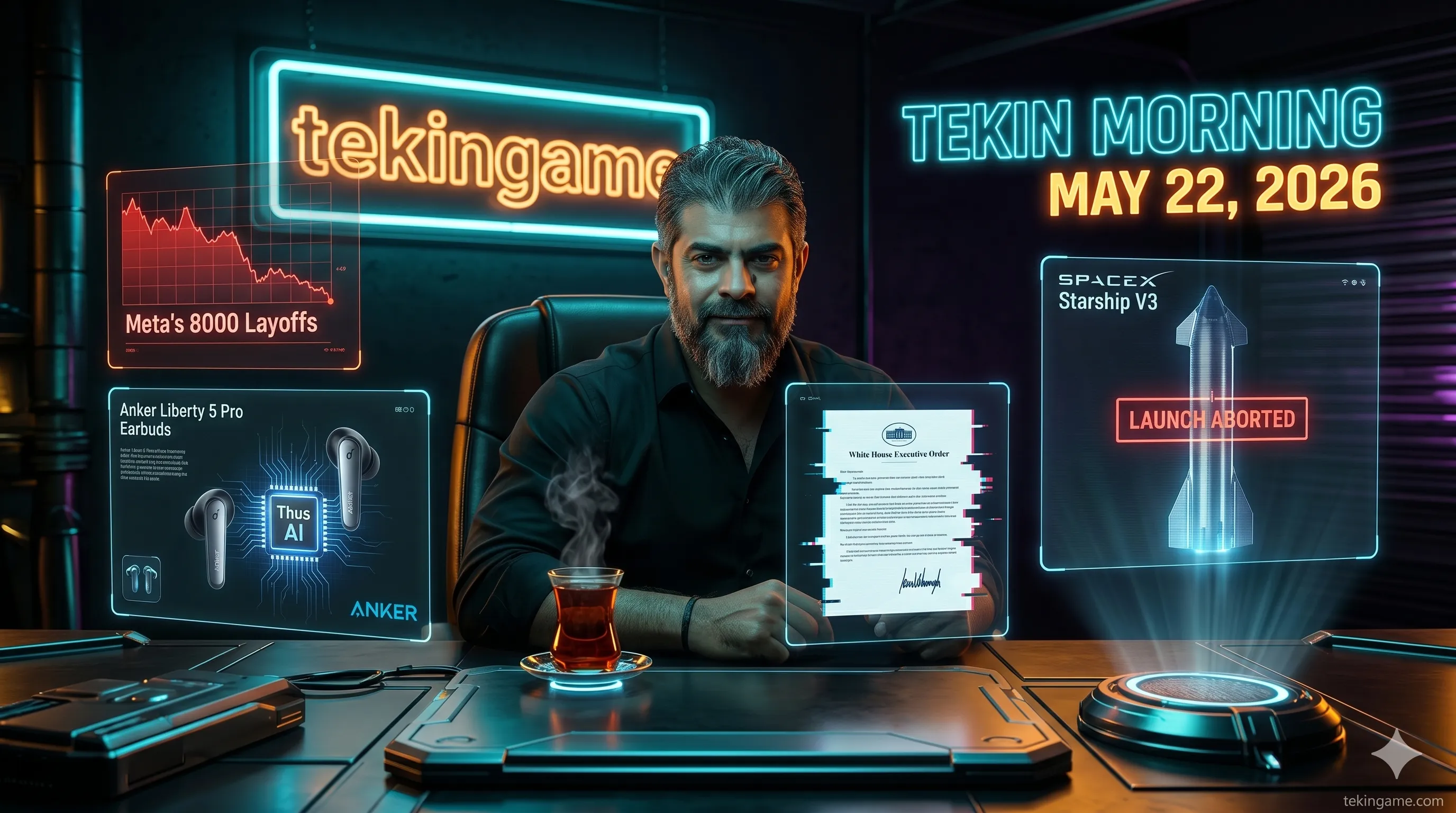
Why it matters: This scale of reallocation signals a decisive, capital-intensive shift in corporate strategy for a major tech incumbent, with immediate labor market impacts and potential ripple effects across the AI hardware ecosystem.
Context: This follows a multi-year pattern of Big Tech layoffs post-pandemic hiring surges, but the specific channeling of personnel and capital into a single, defined technological stack—Nvidia-dominated AI infrastructure—marks an intensification.
"Meta plans to invest $60-65 billion in AI infrastructure in 2026, primarily for Nvidia chips and data center construction." — TEKINGAME
Commentary: The $60-65B figure is the operational core; it represents a staggering capital commitment that will strain supply chains and likely inflate costs for competitors. The simultaneous layoff and transfer of 15,000 employees indicates this is not a cost-cutting exercise but a forced re-skilling and concentration of resources, making Meta’s financial performance directly contingent on its AI monetization timeline. Watch for increased pressure on Nvidia’s production capacity and potential secondary effects on cloud providers and AI startups competing for the same hardware.
Date: May 22, 2026 12:00 AM ET
URL: https://tekingame.com/blog/tekin-morning-may-22-2026-meta-crisis-anker-ai-chip-trump-order-spacex-en
AI Sentiment Score: Negative (71%)
AI Credibility Score: 7.0/10 — Medium
Scores and text generated by AI analysis of the source article indicated.
Weekly Intel – 2026-05-24 – Eric D. Brown, D.Sc. (Ericbrown)
Summary: Minnesota enacted a first-in-the-nation ban on all prediction markets, triggering immediate federal litigation from the Trump administration. In AI infrastructure, Anthropic acquired Stainless, the firm responsible for its Claude SDKs and agent tooling, while Mistral AI purchased Emmi AI for industrial physics simulation. Intuit announced a 17% workforce reduction, framing it as an AI pivot. Separately, GitHub confirmed a significant breach of internal repositories via a malicious VS Code extension, linking it to the broader TanStack npm supply-chain attack.
Why it matters: The Minnesota ban tests the legal perimeter for novel financial instruments and federal preemption, while the acquisitions signal a strategic race to own the tooling and industrial application layers of the AI stack.
Context: Prediction markets face persistent regulatory uncertainty; AI companies are vertically integrating critical development and deployment infrastructure; and supply-chain attacks targeting developer tools represent a high-leverage threat vector.
"Minnesota outlawed prediction markets entirely (Kalshi, Polymarket, all of them) and the Trump administration sued within hours." — ERICBROWN
Commentary: Minnesota’s blanket prohibition creates a direct conflict with federal authority, setting a precedent other states may follow if unchallenged. Anthropic’s acquisition of Stainless is a defensive moat-building move, securing control over the primary interface for its ecosystem. The GitHub breach, stemming from a single employee’s action, underscores the systemic vulnerability when trusted development tools are compromised, potentially accelerating shifts toward more stringent internal tooling policies and supply-chain verification.
Date: May 24, 2026 12:00 AM ET
URL: https://ericbrown.com/weekly-intel-2026-05-24/
AI Sentiment Score: Negative (71%)
AI Credibility Score: 7.0/10 — Medium
Scores and text generated by AI analysis of the source article indicated.
Post ID: 3f8cfb41