

AI and Data-Driven Fashion Retail
AI-Driven Apparel Image Retrieval and Feature Optimization for Smart and Sustainable Textile Manufacturing (Intechopen)
Summary: Integrated impact of image retrieval in textile industry applications. Abstract In response to mounting environmental challenges, excessive resource use, and the rapidly increasing volume of textile waste, the global textile and apparel sector is accelerating its transition toward digital transformation to achieve greater efficiency, sustainability, traceability, and intelligent manufacturing practices. Artificial intelligence (AI) has emerged as a highly transformative enabler for smart and sustainable textile systems, particularly through the use of computer vision, machine learning and deep learning technologies.

Why it matters: This matters for FashionTech because it gives a concrete current signal to track: Integrated impact of image retrieval in textile industry applications.
Context: Integrated impact of image retrieval in textile industry applications. Abstract In response to mounting environmental challenges, excessive resource use, and the rapidly increasing volume of textile waste, the global textile and apparel sector is accelerating its transition toward digital transformation to achieve greater efficiency, sustainability, traceability, and intelligent manufacturing practices. Artificial intelligence (AI) has emerged as a highly transformative enabler for smart and sustainable textile systems, particularly through the use of computer vision, machine learning and deep learning technologies.
"Integrated impact of image retrieval in textile industry applications. Abstract In response to mounting environmental challenges, excessive resource use, and the rapidly increasing volume of textile waste, the global textile and apparel." — INTECHOPEN
Commentary: The immediate implication is operational rather than speculative: watch how this changes budgets, workflows, or risk assumptions over the next cycle.
Date: May 07, 2026 12:00 AM ET
URL: https://www.intechopen.com/online-first/1245305
AI Sentiment Score: Negative (66%)
AI Credibility Score: 10.0/10 — High
Scores and text generated by AI analysis of the source article indicated.
Apparel Size Recommendation Accuracy 2026 — PatSnap Eureka (Patsnap)
Summary: PatSnap’s 2026 analysis of apparel size recommendation patents reveals a shift from static charts to sensor-fused AI, with smartphone LiDAR emerging as the key enabler for accurate 3D body scanning. The field is converging on iterative feedback loops and brand-specific normalization, while India has become the second-most active patent jurisdiction after the US. Key players like Stitch Fix and Amazon hold dense IP in machine learning fit prediction, but brand-specific size translation remains an underprotected white space.

Why it matters: For e-commerce operators and apparel tech developers, these patent trends signal where to allocate R&D and legal resources to reduce fit-related returns, which account for 20-40% of online apparel purchases.
Context: The evolution from rule-based matching (2006-2014) to algorithmic acceleration (2015-2019) has now entered a convergence phase (2020-2026) integrating physical sensing with AI inference.
"Fit-related returns account for an estimated 20–40% of all online apparel purchases." — PATSNAP
Commentary: The operational imperative is clear: integrate smartphone LiDAR into sizing workflows to replace unreliable self-reported measurements. R&D teams must now architect for iterative convergence loops, not single-pass prediction, while legal teams should conduct freedom-to-operate analyses on ML fit prediction claims from Stitch Fix and Amazon. The concentration of recent Indian filings indicates that global patent strategies must now include prosecution in India, not just the US and PCT.
Date: May 06, 2026 12:00 AM ET
URL: https://www.patsnap.com/fr/resources/blog/rd-blog/apparel-size-recommendation-accuracy-2026-patsnap-eureka/
AI Sentiment Score: Negative (50%)
AI Credibility Score: 10.0/10 — High
Scores and text generated by AI analysis of the source article indicated.
Simkhai is building an AI storefront for shoppers who don’t know what to search (Glossy.Co)
Summary: Simkhai is launching a separate, AI-powered e-commerce site, Simkhai.ai, built on Swap’s agentic commerce platform. The site functions as a ‘discovery mode’ stylist, using conversational prompts to curate looks from current inventory, integrated with a virtual try-on tool. The brand retains ownership of customer data and the relationship, positioning the dot-ai site as a digital extension of its in-store styling service rather than a replacement for its main e-commerce site.

Why it matters: This operationalizes high-touch styling at digital scale, testing whether a dedicated AI storefront can improve conversion and reduce returns by collapsing the distance between customer intent and product discovery.
Context: Brands are layering AI assistants onto existing sites; Simkhai’s separate dot-ai storefront represents a more architecturally distinct bet on agentic commerce as a primary channel.
"The goal is to solve a familiar online shopping problem: Customers often know the occasion, mood or styling need they are shopping for before they know what to type into a search bar." — GLOSSY.CO
Commentary: The move shifts the e-commerce workflow from keyword-based search to occasion-based curation, potentially altering the front-end labor model from SEO optimization to prompt engineering for stylist agents. The data ownership clause is a critical vendor term; Swap’s model as infrastructure-only could become a template for brands wary of ceding customer insights. The real test is whether this separate site can drive repeat traffic and higher AOV, or if it remains a novelty feature with high development cost.
Date: Mon, 18 May 2026 04:03:00 +0000
URL: https://www.glossy.co/fashion/luxury/simkhai-is-building-an-ai-storefront-for-shoppers-who-dont-know-what-to-search/
AI Sentiment Score: Positive (42%)
AI Credibility Score: 10.0/10 — High
Scores and text generated by AI analysis of the source article indicated.
Luxury Briefing: Ralph Lauren and LuxExperience turn to AI for styling, search and high-value shoppers (Glossy.Co)
Summary: Ralph Lauren and LuxExperience are expanding AI deployment beyond marketing into core operations and customer experience, linking AI directly to full-price selling and high-value shopper targeting. Ralph Lauren reports using AI to accelerate design iteration of core icons, automate distribution, and inform marketing investment decisions. LuxExperience leverages predictive AI for customer lifetime value targeting and generative AI for personalized content, search, and product copy, supported by a Google Vertex AI partnership. Meanwhile, Louvelle’s invite-only rental platform addresses gaps in traditional brand lending for stylists, offering faster access to archival and current luxury pieces.

Why it matters: AI integration is shifting from experimental to operational, directly impacting design velocity, distribution efficiency, and customer acquisition cost, while new rental models are altering the sourcing pipeline for professional stylists.
Context: Luxury brands and platforms are prioritizing AI to defend margin through full-price selling and personalization, while peer-to-peer rental is evolving to serve professional wardrobe monetization and circumvent slow brand lending processes.
"Among luxury’s more active AI adopters, both Ralph Lauren and LuxExperience are pushing harder into AI to drive full-price selling and better personalization." — GLOSSY.CO
Commentary: The move signifies AI’s transition from a marketing novelty to a core operational lever, with Ralph Lauren using it to harden its repeatable product strategy and LuxExperience embedding it across the customer journey to optimize lifetime value. For practitioners, this means tooling decisions now directly affect design cycle time, distribution center throughput, and the real-time cost of acquiring a high-value customer. Concurrently, platforms like Louvelle are formalizing an alternative sourcing channel, reducing stylists’ dependency on brand approval timelines and creating a new revenue stream for closet assets.
Date: Fri, 22 May 2026 04:03:00 +0000
URL: https://www.glossy.co/fashion/luxury/luxury-briefing-ralph-lauren-and-luxexperience-turn-to-ai-for-styling-search-and-high-value-shoppers/
AI Sentiment Score: Positive (40%)
AI Credibility Score: 10.0/10 — High
Scores and text generated by AI analysis of the source article indicated.
Fashion Draws Closer To Some Fixed Ideas About AI, Just … (Theinterline)
Summary: AWS has codified common generative AI retail applications like virtual try-on and personalized search into a formal playbook. Meanwhile, Google’s agentic checkout for Ulta bypasses traditional e-commerce sites, and Microsoft’s case study with ASOS demonstrates tangible ROI from mature AI integrations across the product journey. The narrative is shifting from speculative hype to operational deployment of AI for defined strategic aims.

Why it matters: For fashion practitioners, this signals a move from experimental pilots to measurable, integrated solutions that directly impact time to market, digital sampling costs, and customer conversion.
Context: The fashion industry’s AI adoption is maturing beyond novelty use-cases into core operational workflows, with vendors now offering packaged solutions for design, production, and sales.
"The deployments that don’t justify excitable-sounding articles, though, are codifying into a much more sensible and recognisable shape." — THEINTERLINE
Commentary: The shift from press-friendly demos to ROI-driven integrations means brands must now evaluate AI vendors on throughput gains and cost reduction, not just innovation potential. Agentic checkouts like Google’s for Ulta threaten to disintermediate brand-owned digital storefronts, altering customer data capture. This maturation forces a reassessment of internal tech stacks and partner ecosystems, prioritizing solutions that plug directly into existing PLM, ERP, and e-commerce pipelines.
Date: May 01, 2026 12:00 AM ET
URL: https://www.theinterline.com/2026/05/01/fashion-draws-closer-to-some-fixed-ideas-about-ai-just-as-the-subsidies-are-running-out/
AI Sentiment Score: Negative (75%)
AI Credibility Score: 10.0/10 — High
Scores and text generated by AI analysis of the source article indicated.
Legit Check: AI Auth Scanner – App Store – Apple (Apps.Apple)
Summary: Apple’s App Store now hosts ‘Legit Check: AI Auth Scanner,’ a consumer-facing tool that uses smartphone photography and AI analysis to assess the authenticity of sneakers, bags, and streetwear. The app scans visible details like stitching, logos, and materials, returning a ‘real or fake’ result with supporting analysis in under a minute. It is positioned as an aid for secondary market transactions on resale apps, in consignment shops, or during peer-to-peer trades.

Why it matters: This shifts authentication labor and risk from centralized platforms and professional authenticators onto individual buyers, potentially altering secondary market dynamics and trust mechanisms.
Context: The luxury and sneaker resale markets are plagued by counterfeits, creating demand for reliable, scalable authentication. Historically, this has been the domain of trained human experts or proprietary platform services.
"Our AI scanner reviews visible details, stitching patterns, logo placement, label fonts, material textures, shape, and finishing quality and returns a real or fake style result with an explanation of what it found." — APPS.APPLE
Commentary: The launch signals a commodification of visual authentication, moving it from a specialized service to a downloadable utility. For practitioners, this pressures the business model of third-party authentication services and may increase dispute volume on peer-to-peer platforms as users treat the app’s output as authoritative. It also creates a new data pipeline for training counterfeit detection models, potentially benefiting brands’ anti-fraud efforts but raising questions about data ownership and liability for erroneous calls.
Date: April 22, 2026 12:00 AM ET
URL: https://apps.apple.com/ca/app/legit-check-ai-auth-scanner/id6761913359
AI Sentiment Score: Negative (57%)
AI Credibility Score: 10.0/10 — High
Scores and text generated by AI analysis of the source article indicated.
How Larroudé’s CEO built an AI system to improve and expedite business operations (Glossy.Co)
Summary: Larroudé CEO Ricardo Larroudé personally used AI coding tools to build an integrated data system linking Shopify, factory, inventory, and marketing data, replacing manual reconciliation. The system identified and fixed site performance issues, boosting conversion from 0.3% to 1.7% within 45 minutes. It also enabled granular supply chain visibility, linking sales to specific components, and shifted hiring toward ‘agentic’ workers who can oversee dynamic software. Build costs peaked around $20,000 monthly, but Larroudé claims this is below prior programming staff expenses.
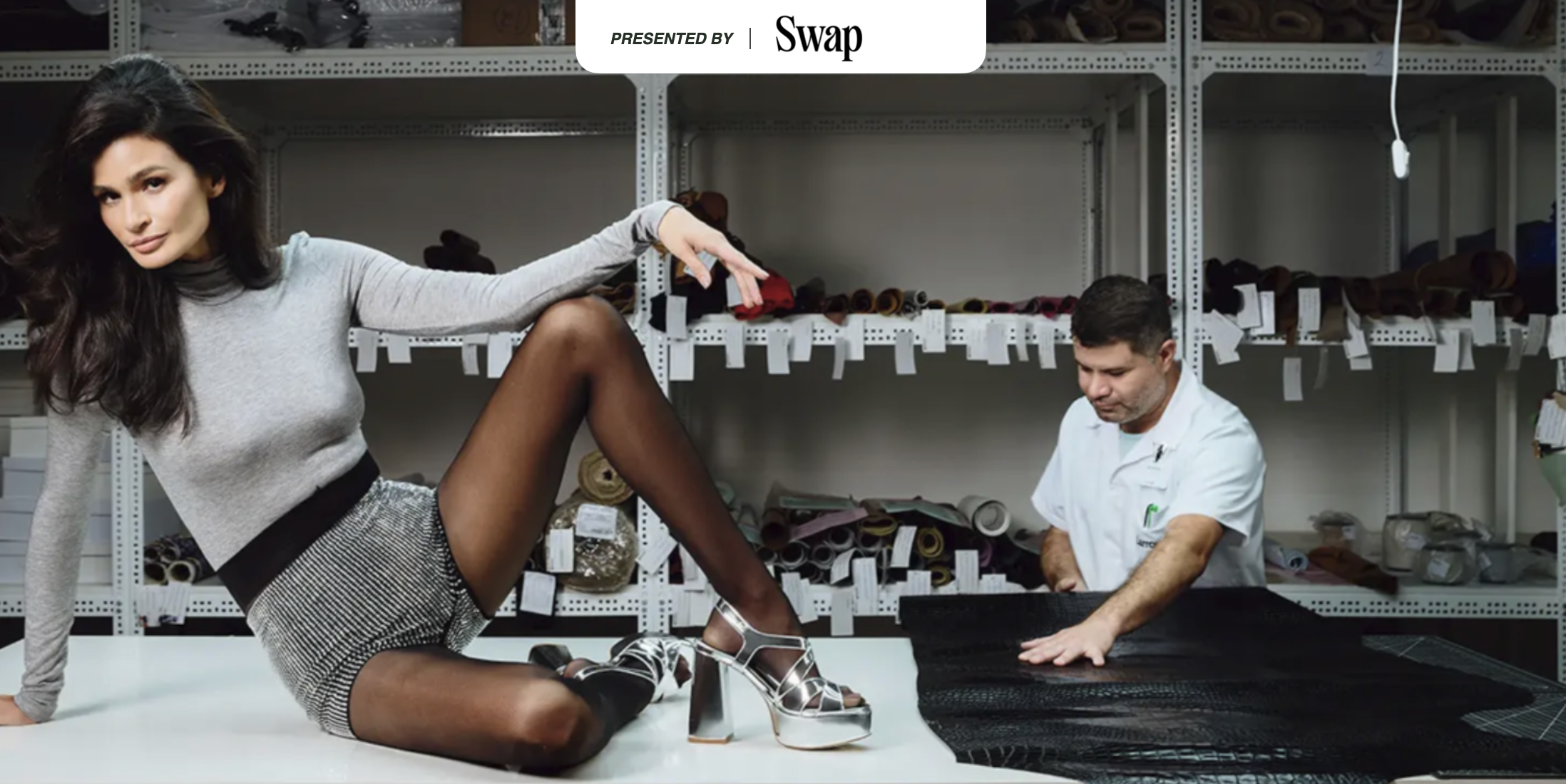
Why it matters: It demonstrates a CEO-driven, pragmatic AI integration that directly alters staffing models, reduces time-to-insight, and redefines technical roles in mid-sized fashion operations.
Context: Mid-sized brands face escalating data integration costs and operational lag; AI-assisted coding lowers the barrier for non-technical leaders to orchestrate custom tooling, but introduces new governance and cost-control challenges.
"After cleaning up the code, he said conversion jumped from 0.3% to 1.7% within 45 minutes. Checkout completion, he said, improved from 25% to 75%." — GLOSSY.CO
Commentary: The case shifts the competitive pressure from buying enterprise software to building bespoke, CEO-architected systems, forcing a reevaluation of in-house technical talent toward oversight roles. It validates AI coding as a force multiplier for operational velocity but ties success to the leader’s grasp of process, not just code. The ‘agentic’ hiring pivot explicitly trades manual reconciliation jobs for system-savvy reviewers, altering studio and planning team compositions. For vendors, this signals demand for modular, API-first platforms that can slot into such custom architectures.
Date: Wed, 13 May 2026 04:04:00 +0000
URL: https://www.glossy.co/fashion/how-larroudes-ceo-built-an-ai-system-to-run-the-business-faster/
AI Sentiment Score: Negative (66%)
AI Credibility Score: 10.0/10 — High
Scores and text generated by AI analysis of the source article indicated.
ASOS: Redesigning online fashion at the speed of AI (Ukstories.Microsoft)
Summary: ASOS is deploying Microsoft’s Azure, AI agents, and Copilot across its value chain to compress design-to-shelf timelines to three weeks and automate half of customer service. The partnership centralizes data to accelerate trend-scouting from social media and internal analytics, while 3D design reduces physical sampling. The core shift is from a transactional e-commerce model to a conversational, continuously adaptive digital storefront powered by fine-tuned large language models.

Why it matters: It demonstrates a full-stack operational playbook for fashion retailers, where AI integration targets throughput, labor allocation, and inventory velocity rather than just front-end novelty.
Context: Fast fashion’s competitive edge hinges on shortening the feedback loop between trend identification and stocked product, a process increasingly mediated by AI analytics and agentic automation.
"ASOS: Redesigning online fashion at the speed of AI Fashion retailer ASOS is applying artificial intelligence and cloud services throughout its whole value chain in a frontier AI transformation partnership with Microsoft,." — UKSTORIES.MICROSOFT
Commentary: The three-week timeline resets expectations for fast-fashion cycle speed, directly linking AI-driven trend scouting to designer output. Automating 50% of customer service and 15% of code production reallocates labor from repetitive tasks to trend and inventory response, making the operation more reactive to real-time signals. The heavy reliance on a single cloud and AI partner (Microsoft) indicates a strategic bet on integrated tooling over best-of-breed, trading vendor lock-in for accelerated deployment velocity.
Date: April 30, 2026 12:00 AM ET
URL: https://ukstories.microsoft.com/features/asos-redesigning-online-fashion-at-the-speed-of-ai/
AI Sentiment Score: Neutral (33%)
AI Credibility Score: 9.6/10 — High
Scores and text generated by AI analysis of the source article indicated.
Former Nordstrom execs descend on Rent the Runway (Retaildive)
Summary: Rent the Runway’s executive suite is now dominated by former Nordstrom leadership, with Teri Bariquit as interim CEO, Paige Thomas as Chief Commercial Officer, and Dave Loretta as interim CFO. The appointments coincide with Q1 earnings showing revenue growth of over 29% to nearly $90 million and a narrowed net loss. The company is emphasizing AI-driven discovery tools and a new B2B dry cleaning service as strategic initiatives.

Why it matters: For FashionTech practitioners, this signals a pivot from founder-led vision to operational scaling, with implications for merchandising strategy, vendor relationships, and capital allocation.
Context: This follows co-founder Jennifer Hyman’s departure and reflects a broader trend of rental platforms maturing by importing traditional retail expertise to optimize inventory, finance, and customer retention.
"Dive Brief: – Following co-founder Jennifer Hyman’s exit, former Nordstrom Chief Merchandising Officer Teri Bariquit has officially taken over as Rent the Runway’s interim CEO. She led her first earnings call for." — RETAILDIVE
Commentary: The Nordstrom cohort suggests a focus on inventory efficiency and brand-partner management over pure growth hacking. The AI push for discovery aims to reduce return rates and increase subscriber lifetime value, while the B2B dry cleaning service represents a tangible operational investment to control quality and create a standalone revenue stream, altering the unit economics of rental.
Date: Thu, 04 Jun 2026 11:14:00 -0400
URL: https://www.retaildive.com/news/nordstrom-execs-join-rent-the-runway-q1-earnings-growth/821933/
AI Sentiment Score: Positive (50%)
AI Credibility Score: 10.0/10 — High
Scores and text generated by AI analysis of the source article indicated.
Arts University Bournemouth takes AI and VR fashion tech … (Edtechinnovationhub)
Summary: Arts University Bournemouth is leveraging Fashion SVP 2026 to reposition itself as a commercial partner to the fashion industry, not just a talent pipeline. Its Innovation Hub showcases AI pattern engineering tools, Digital Product Passport systems, and VR design workflows already in commercial use. Concurrently, it is soft-launching the AUB Agency, a model for direct industry access to student talent via live briefs and consultancy, with a full launch slated for Summer 2026.

Why it matters: This signals a structural shift in how fashion brands can source innovation and talent, moving from passive recruitment to active, project-based partnerships with educational institutions.
Context: Fashion brands face pressure to accelerate time-to-market and integrate traceability tech like DPPs, while universities seek more direct, funded pathways for graduate employment and research commercialization.
"#### Arts University Bournemouth arrives at Fashion SVP 2026 in London with AI pattern tools, VR design workflows, and a new commercial agency model that puts student talent directly inside brand briefs." — EDTECHINNOVATIONHUB
Commentary: The move operationalizes academic R&D into a vendor-like service, potentially shortening the adoption curve for AI pattern tools and DPPs by embedding them directly in brand briefs. For studios and in-house teams, this creates a new, lower-risk channel for piloting advanced digital workflows without full capital commitment. The success of the AUB Agency model will hinge on its ability to deliver at commercial speed and scale, setting a precedent for other institutions.
Date: April 28, 2026 12:00 AM ET
URL: https://www.edtechinnovationhub.com/news/arts-university-bournemouth-takes-ai-and-vr-fashion-tech-to-olympia-london-this-week
AI Sentiment Score: Negative (57%)
AI Credibility Score: 7.0/10 — Medium
Scores and text generated by AI analysis of the source article indicated.
Fast fashion inventory AI and IoT landscape 2026 (Patsnap)
Summary: Patent and literature analysis through 2026 shows a sparse but evolving IP landscape for fashion-specific supply chain automation. Core academic work from 2019-2022 focused on hybrid optimization algorithms for SKU replenishment, while recent filings from 2023-2025 signal a pivot toward integrating sustainability compliance and live-stream retail channels. The sole platform-level patent, Refashiond OS’s 2022 filing, remains active, indicating a potential first-mover advantage in orchestration software.
Why it matters: For supply chain practitioners and tech vendors, the underpopulated IP field suggests a window for platform development, but the convergence with circularity mandates means new tools must solve for both inventory efficiency and traceability.
Context: Fast fashion inventory optimization has historically relied on generic retail algorithms; the emergence of fashion-specific patents marks a shift toward specialized tooling that accounts for the industry’s unique design cycles, perishable trends, and sustainability pressures.
"With only one WO patent (Refashiond OS Inc., 2022) explicitly targeting fashion industry supply chain automation as a platform OS, the IP landscape for fashion-specific demand-supply orchestration platforms remains substantially underpopulated as of 2026." — PATSNAP
Commentary: The scarcity of platform patents creates a near-term opportunity for vendors to build integrated OS solutions without dense prior-art thickets. However, the cited 2023 study linking blockchain/IoT to reduced misalignment implies that any new platform must embed traceability and audit trails as core features, not just optimization engines. This moves the vendor value proposition from pure inventory cost reduction to enabling compliance and consumer-facing transparency.
Date: May 01, 2026 12:00 AM ET
URL: https://www.patsnap.com/resources/blog/articles/fast-fashion-inventory-ai-and-iot-landscape-2026/
AI Sentiment Score: Negative (83%)
AI Credibility Score: 10.0/10 — High
Scores and text generated by AI analysis of the source article indicated.
AI Turns Thrift Into Profitable Fashion Marketplace (Letsdatascience)
Summary: AI has moved from a peripheral tool to the operational core of the secondhand fashion market, enabling scalability by solving the unique-item problem. Platforms now use computer vision and generative models to automate cataloging, pricing, and discovery, converting fragmented inventory into a structured, searchable asset. This technical shift underpins the sector’s growth to $289 billion in 2025 and its projected expansion to $393 billion.

Why it matters: For resale operators and brands entering the channel, this changes the fundamental economics of handling non-standard inventory, turning a high-touch, labor-intensive process into a scalable, high-margin pipeline.
Context: Traditional retail systems fail with one-off goods because every SKU is unique; resale historically relied on manual tagging and inconsistent metadata, limiting growth and profitability.
"AI has converted secondhand apparel from a logistical headache into a high-margin retail channel. … Platforms solved the core technical challenge of uniqueness by applying computer vision and generative models to discovery,." — LETSDATASCIENCE
Commentary: The operational consequence is a shift from manual, artisanal listing to automated, industrial-scale catalog management. This reduces time-to-list, increases listing accuracy, and lowers return rates through better visual matching. For studios and photographers, it means standardized product photography pipelines; for vendors, it enables cross-platform arbitrage via tools like Beni Lens. The margin expansion comes from collapsing the cost of uniqueness.
Date: April 21, 2026 12:00 AM ET
URL: https://letsdatascience.com/news/ai-turns-thrift-into-profitable-fashion-marketplace-81e30183
AI Sentiment Score: Positive (57%)
AI Credibility Score: 10.0/10 — High
Scores and text generated by AI analysis of the source article indicated.
Photo-Based Authentication for Luxury Resale Power Sellers (Startupheist)
Summary: The luxury resale market’s growth and mainstreaming, with Walmart and Amazon entering via partnerships, has shifted authentication from a boutique service to a prerequisite infrastructure layer. The current landscape, dominated by Entrupy, Real Authentication, and platform-specific systems like TheRealReal’s Athena AI, leaves a gap for a low-cost, API-first, seller-native authentication product that operates pre-sale. This gap is defined by the need for portable trust that helps sellers list confidently and close sales, not just post-sale buyer protection.

Why it matters: For practitioners, this signals a shift in operational requirements: authentication is becoming a mandatory, integrated tool for sellers and platforms, altering listing workflows, pricing confidence, and marketplace integration costs.
Context: The counterfeit risk is escalating with ‘superfakes,’ and major retail channels are now demanding authenticated inventory, turning trust into a scalable, pluggable service.
"When the largest retail pipes in the country decide they want authenticated luxury inventory flowing through their marketplaces, authentication stops being a boutique service and becomes a prerequisite layer. Somebody is going to build the API that non-specialist channels plug into. Right now, nobody owns that seat." — STARTUPHEIST
Commentary: The operational consequence is a new vendor category: authentication-as-a-service APIs that must be fast, cheap, and brand-specific to integrate into seller listing tools and major marketplace backends. This could pressure incumbents like Entrupy to open their APIs and lower costs, while creating a new compliance layer for power sellers who must now factor authentication into their unit economics and listing velocity.
Date: May 08, 2026 12:00 AM ET
URL: https://www.startupheist.com/photo-based-authentication-for-luxury-resale-power-sellers/
AI Sentiment Score: Negative (50%)
AI Credibility Score: 7.0/10 — Medium
Scores and text generated by AI analysis of the source article indicated.
Virtual Try-On Technology for Ecommerce 2026 (Claimlane)
Summary: Virtual try-on technology, integrating AR, AI body mapping, and 3D rendering, is now a standard ecommerce tool aimed at reducing returns and boosting conversion. The primary operational bottleneck is no longer the AR runtime but the creation of 3D product assets, with AI-generated models from photos becoming the scalable solution for large catalogs. Implementation is modular, with SDKs for custom builds and plug-and-play apps for platforms like Shopify, enabling a targeted rollout starting with high-return SKUs.

Why it matters: For fashion ecommerce operators, this shifts capital and labor from generic marketing tech to a specific, measurable production pipeline centered on 3D asset creation and integration.
Context: The push for virtual try-on follows a decade of AR experiments, now converging on a standardized stack where ROI is proven through reduced return rates and the constraint has moved upstream to asset production.
"Virtual try-on technology attacks this problem directly. Using augmented reality (AR), AI body mapping, and 3D rendering, customers can see how a product looks on them before placing an order. Glasses on." — CLAIMLANE
Commentary: The maturation of virtual try-on reframes it from an innovation project to a supply-chain problem. Brands must now manage a new vendor category for 3D modeling and a data pipeline for body measurements, with cost-per-SKU and model accuracy becoming key procurement metrics. This also pressures brands to standardize product photography for AI 3D generation, potentially consolidating creative and technical pre-production workflows.
Date: May 04, 2026 12:00 AM ET
URL: https://www.claimlane.com/resources/blog/virtual-try-on-technology-ecommerce
AI Sentiment Score: Negative (60%)
AI Credibility Score: 7.0/10 — Medium
Scores and text generated by AI analysis of the source article indicated.
Retailers turn to AI for productivity, personalized shopping (Retaildive)
Summary: Major retailers Best Buy, Gap, and Dick’s Sporting Goods are detailing specific AI deployments in earnings calls, moving beyond generic promises to operational integration. Gap is using AI for product traceability via Inspectorio’s Paramo and design workflows, while Dick’s is launching an agentic AI shopping advisor. Best Buy frames AI as a tool to augment employee productivity and customer experience. Investment data suggests a material shift, with 39% of retailers expecting AI to account for over 10% of tech spend by 2028.
Why it matters: For practitioners, this signals a shift from pilot projects to core operational and customer-facing tooling, requiring new vendor relationships, internal workflow changes, and data infrastructure investments.
Context: The push aligns with broader industry projections, like ICSC/McKinsey forecasting agentic commerce reaching $1 trillion by 2030, but the earnings call specifics reveal concrete implementation paths.
"Gap is deploying AI across its corporate workflows to drive productivity, Dickson said. He’ll share more in upcoming quarters about their internal tech strategy, he said." — RETAILDIVE
Commentary: The focus on traceability (Gap/Inspectorio) and agentic advisors (Dick’s/Adobe) indicates AI’s primary near-term value is in reducing operational friction—cutting sampling cycles, improving allocation accuracy, and lowering return rates—rather than pure marketing spectacle. For vendors, this creates a market for integrated, workflow-specific AI layers over legacy systems.
Date: Thu, 04 Jun 2026 11:50:00 -0400
URL: https://www.retaildive.com/news/gap-best-buy-dicks-retailers-ai-personalization/821843/
AI Sentiment Score: Negative (50%)
AI Credibility Score: 10.0/10 — High
Scores and text generated by AI analysis of the source article indicated.
Fashion Digital Twins: How Virtual Garments Are Transforming the … (Pixofix)
Summary: Fashion digital twins are evolving from static 3D mockups into dynamic, data-rich models that simulate fabric behavior, manufacturing details, and user interaction. The Pixofix article outlines a production pipeline requiring high-fidelity scanning, physics-based simulation, and rigorous cross-departmental quality checks. It emphasizes establishing a locked visual language and a disciplined retouching and documentation workflow to maintain brand consistency.

Why it matters: For practitioners, this shifts the operational center of gravity from physical sampling to a digital-first pipeline, altering timelines, vendor dependencies, and internal skill requirements.
Context: The push for digital twins aligns with industry pressure to reduce sampling waste, accelerate time-to-market, and improve e-commerce conversion through better online visualization.
"Treat your twins like living products, not one-off files." — PIXOFIX
Commentary: This framing mandates continuous asset management, turning a one-time creative output into an operational system requiring audits, library refreshes, and integrated customer feedback. It implies new roles for pipeline managers and shifts post-production from retouching static images to maintaining dynamic 3D assets. The call for ‘generative styling’ and ‘AI previews’ layered with human QA suggests a hybrid workflow where automation handles volume, but brand control remains a manual, high-stakes function.
Date: May 04, 2026 12:00 AM ET
URL: https://www.pixofix.com/blog/fashion-digital-twins-how-virtual-garments-are-transforming-the-future-of-e-commerce
AI Sentiment Score: Negative (50%)
AI Credibility Score: 10.0/10 — High
Scores and text generated by AI analysis of the source article indicated.
2026: Why Virtual Try-On is Killing the Fashion Photoshoot (Weshop.Ai)
Summary: The 2026 fashion tech landscape is defined by the maturation of Virtual Try-On (VTON) from a gimmick to a core operational tool. The shift is driven by high-fidelity physics models like ‘nanobanana pro,’ which use dual neural networks to simulate fabric behavior and human interaction with single-button API integration. This eliminates the need for manual 3D mapping or prompt engineering, making it a standard infrastructure component. The primary impact is moving upstream: VTON now generates marketing assets before physical production and fundamentally reshapes influencer outreach and user-generated content pipelines.

Why it matters: For practitioners, this changes the cost structure and timeline of product launches, reduces sample and logistics overhead, and redefines the skills and tools required for marketing and content creation.
Context: Virtual Try-On has evolved through GANs and diffusion models, but persistent issues with accuracy and integration friction limited its operational utility. The 2026 standard addresses these with automated, physics-accurate simulation.
"To understand why 2026 is the tipping point, we have to look at the “Uncanny Valley” of fashion AI. For years, Virtual Try-On felt like a cheap digital sticker. Today, it operates." — WESHOP.AI
Commentary: The operational consequence is the decoupling of marketing and content creation from physical supply chains, compressing time-to-market and reducing capital tied up in sample inventory. For studios and photographers, the demand shifts from traditional shoots to technical roles managing digital garment libraries and AI model outputs. The assertion that ‘the camera is no longer the most important tool’ signals a reallocation of budget from production crews to software licensing and data science teams.
Date: April 22, 2026 12:00 AM ET
URL: https://www.weshop.ai/blog/why-2026-is-the-year-the-professional-photoshoot-dies-thanks-to-virtual-try-on/
AI Sentiment Score: Neutral (33%)
AI Credibility Score: 10.0/10 — High
Scores and text generated by AI analysis of the source article indicated.
Podcast: Will A Drive For Shared Truth Bring Fashion Back … (Theinterline)
Summary: The push for digital product passports, driven by EU regulations like ESPR, is creating a market for enterprise-grade traceability infrastructure. Companies like TextileGenesis are building fiber-forward systems on blockchain principles, while consultancies like EY offer provenance services. The core function is to make product-level data durable, standardized, and enforceable across supply chains.

Why it matters: For fashion brands and their vendors, this mandates new data plumbing that extends beyond enterprise control, directly impacting sourcing, compliance, and product lifecycle management workflows.
Context: Digital product passports are transitioning from pilot projects to regulatory requirements in key markets, creating a rush for compliant, scalable solutions.
"You have serious companies like TextileGenesis who are architecting fibre-forward traceability on top of blockchain principles, even if they don’t describe themselves as blockchain companies. A massive panel of companies right now." — THEINTERLINE
Commentary: The shift from voluntary transparency to enforceable compliance redefines traceability as a core operational cost, not a marketing feature. It forces brands to integrate new vendor data pipelines and audit trails, likely consolidating power with a few large platform providers who can manage cross-enterprise data flows. This creates a new layer of enterprise software and consulting spend focused on regulatory data logistics.
Date: April 21, 2026 12:00 AM ET
URL: https://www.theinterline.com/2026/04/21/podcast-will-a-drive-for-shared-truth-bring-fashion-back-around-to-blockchain/
AI Sentiment Score: Negative (50%)
AI Credibility Score: 10.0/10 — High
Scores and text generated by AI analysis of the source article indicated.
Fit Analyzer vs Size Chart: Which Cuts Returns More? (Alhena.Ai)
Summary: Alhena.Ai’s analysis positions AI-powered fit analyzers as a direct upgrade to static size charts, citing a 20-35% reduction in size-related returns versus 5-10% for charts. The core argument is that fit analyzers shift the decision burden from the shopper to the AI, which interprets chart data against individual inputs like cross-brand sizing and fit preference. This operational shift is shown to directly impact conversion and return rates for brands like Mammut and Tatcha.
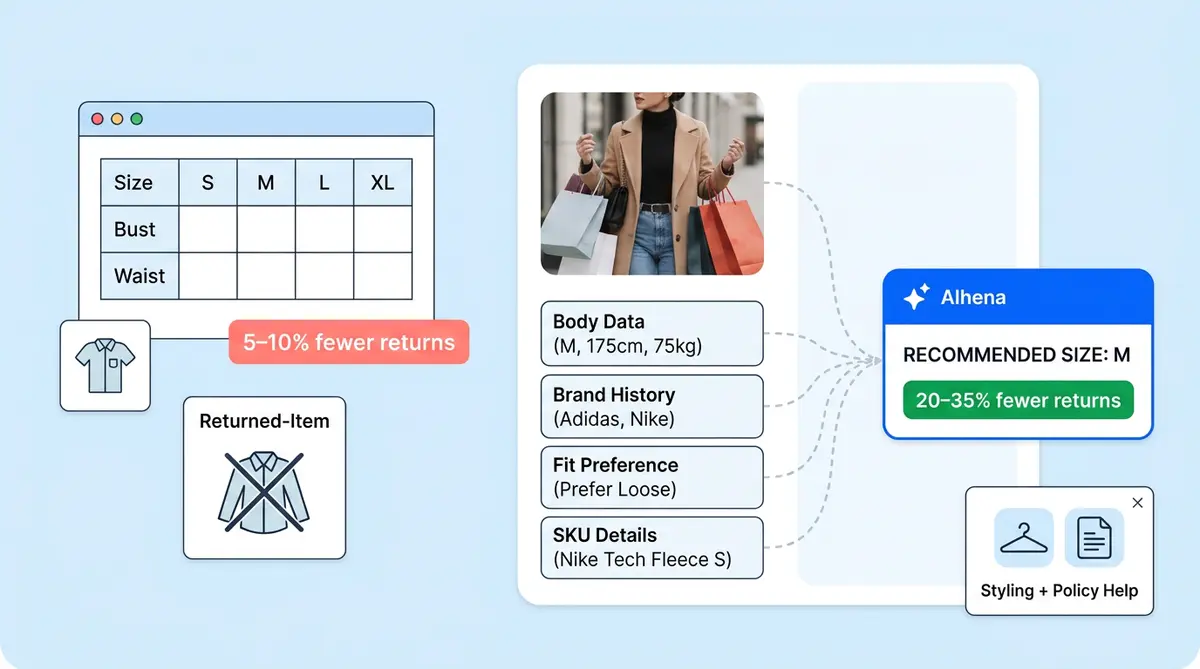
Why it matters: For fashion e-commerce operators, the choice between deploying a fit analyzer or relying on a size chart is a direct lever on logistics cost and conversion rate, with clear, quantified performance differentials.
Context: The high rate of returns driven by fit issues persists despite near-universal use of size charts, indicating a systemic failure in customer decision support rather than a lack of data.
"A size chart is a dictionary. A fit analyzer is a translator for apparel sizing. Both give you sizing information, but only one shows what the fit will look like on the." — ALHENA.AI
Commentary: The implication is a reallocation of labor: from customer service and logistics handling returns to tech ops managing the AI agent. The integration claim—no developer resources, leveraging existing metadata—lowers the activation energy for brands to test this, potentially accelerating adoption and making it a table-stakes feature for competitive platforms. The inventory-checking function also nudges the tool from pure sizing into stock management, affecting fulfillment workflows.
Date: April 24, 2026 12:00 AM ET
URL: https://alhena.ai/blog/fit-analyzer-vs-size-chart-returns/
AI Sentiment Score: Negative (66%)
AI Credibility Score: 9.7/10 — High
Scores and text generated by AI analysis of the source article indicated.
3D retail’s last barrier isn’t creation. It’s delivery. | Miris (Miris)
Summary: The barrier to scaling 3D visualization in retail has shifted from asset creation to delivery infrastructure. While AI pipelines have drastically reduced creation costs and format wars are resolving, delivering high-fidelity 3D at scale forces a tradeoff between speed, fidelity, cost, and concurrency using existing methods like WebGL or pixel streaming. Adaptive spatial streaming architectures, which stream optimized spatial data for client-side reconstruction, are emerging as a solution to this delivery bottleneck. Retailers like Lowe’s, Amazon, and Home Depot are now operationalizing 3D as baseline infrastructure, moving beyond pilot projects.

Why it matters: For retail operators and e-commerce teams, the choice of delivery architecture now determines whether 3D investments translate into lower returns, higher conversion, and scalable operations or become a cost center that fails under peak load.
Context: 3D visualization is proven to reduce returns and increase conversion, but enterprise deployment has been hindered by creation costs, format fragmentation, and, most critically, the inability to deliver high-fidelity assets at scale without prohibitive cost or performance loss.
"Investing in beautiful 3D assets is meaningless if you cannot get them to customers at scale. And here, retailers face an old tradeoff in new clothes." — MIRIS
Commentary: The operational focus moves from R&D to infrastructure procurement. Teams must evaluate delivery platforms on bandwidth scaling, not just visual output, as the concurrency math for peak sales events breaks traditional models. This shifts vendor selection from creative studios to engineering-led platforms capable of conditioning assets for adaptive streaming, making CDN-like cost behavior a key requirement.
Date: May 06, 2026 12:00 AM ET
URL: https://www.miris.com/blog/3d-retails-last-barrier-isnt-creation-its-delivery
AI Sentiment Score: Positive (54%)
AI Credibility Score: 9.4/10 — High
Scores and text generated by AI analysis of the source article indicated.
Post ID: 7e678a6b