AI Development Tools & Model Releases
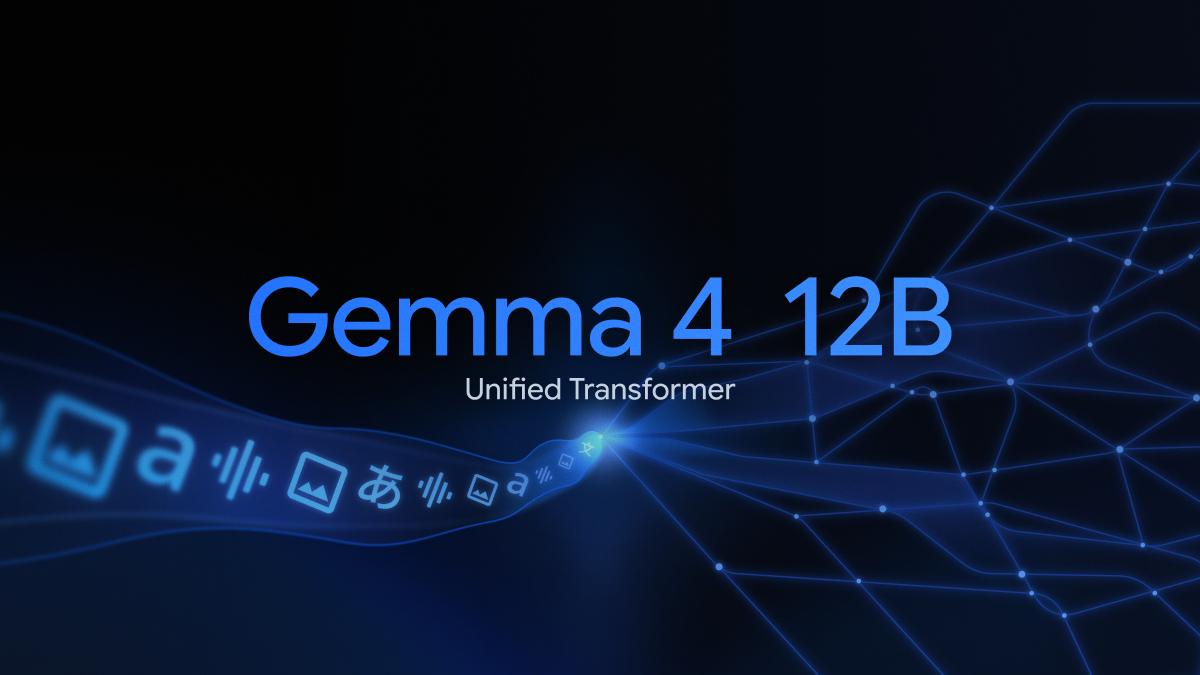
Gemma 4 12B: A unified, encoder-free multimodal model (Blog.Google)
Summary: Google’s Gemma 4 12B model introduces an encoder-free, unified architecture for processing vision and audio inputs directly within the LLM backbone, eliminating separate encoders. It is designed to run locally on laptops with 16GB of VRAM, offering benchmark performance approaching its larger 26B sibling. The model is released under Apache 2.0 and includes features like drafters for latency reduction and a skills repository for agentic development.
Why it matters: This shifts the cost curve and deployment envelope for advanced multimodal AI, moving powerful agentic capabilities from cloud-only to local, consumer-grade hardware.
Context: The trend is toward smaller, more efficient models that retain the capabilities of larger predecessors, with architectural innovations focused on reducing latency and memory overhead for multimodal tasks.
"Traditional multimodal models typically rely on separate encoders to translate images and audio before passing those representations to the language model. Because these split encoders add latency and increase memory usage, we trained Gemma 4 12B with an encoder-free architecture to integrate audio and vision input directly." — BLOG.GOOGLE
Commentary: The removal of dedicated encoders is a significant architectural bet that trades specialized preprocessing for raw LLM compute, potentially simplifying the multimodal stack and reducing inference overhead. If the performance claims hold, it pressures other model families to justify their encoder complexity. The ‘laptop-ready’ positioning accelerates the consumerization of agentic AI, shifting development and testing workflows closer to the edge and away from pure cloud dependency.
Date: Wed, 03 Jun 2026 16:04:42 +0000
URL: https://blog.google/innovation-and-ai/technology/developers-tools/introducing-gemma-4-12b/
Discussion: https://news.ycombinator.com/item?id=48385906
AI Sentiment Score: Positive (50%)
AI Credibility Score: 10.0/10 — High
Scores and text generated by AI analysis of the source article indicated.
ZeroGPU (Producthunt)
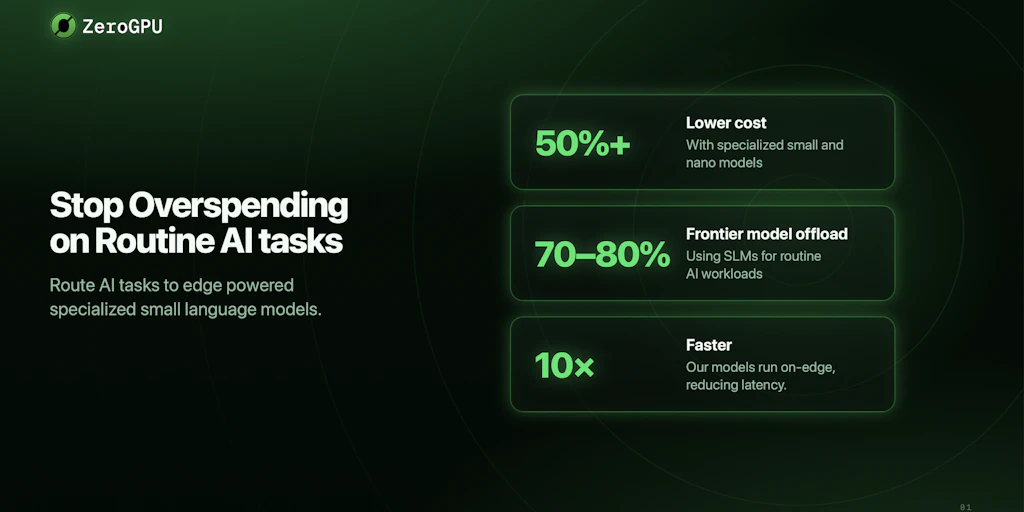
Summary: ZeroGPU launches as a specialized inference layer targeting the high-volume, routine tasks currently routed to frontier models. It claims 10x lower latency and 50%+ lower cost versus GPT-5.4 Nano for classification, extraction, and moderation by running optimized small models on edge compute. The service offers an OpenAI-compatible API and is already in production with customer Dappier reporting 6x cost reductions. The thesis is that 70-80% of inference workloads are structured, repetitive tasks that do not require expensive frontier model capabilities.
Why it matters: This signals a maturation in AI infrastructure, moving from a one-model-fits-all approach to a cost- and latency-optimized layered architecture, which could pressure frontier model economics and reshape developer workflows.
Context: Enterprise AI costs are scaling unsustainably, prompting leaders like Salesforce’s Benioff and Coinbase’s Armstrong to advocate for routing routine tasks off frontier models. The market is shifting toward specialized, efficient inference for deterministic workloads.
"Our thesis is simple. Frontier models are great for reasoning. ZeroGPU is built for repeatable execution: classification, moderation, summarization, routing, extraction, signal detection, and the high-volume calls that run constantly inside apps and agent loops." — PRODUCTHUNT
Commentary: ZeroGPU operationalizes the emerging consensus that frontier model inference is economically untenable for routine tasks. Its edge-based, GPU-free architecture targets the cost curve and latency floor of high-volume production, forcing a reevaluation of cloud GPU dependency. The BYO-model roadmap and OpenAI-compatible API lower switching friction, accelerating the bifurcation of the inference stack. This pressures incumbent providers to unbundle pricing or risk ceding the volume layer to specialists.
Date: June 05, 2026 03:45 PM ET
URL: https://www.producthunt.com/products/zerogpu
AI Sentiment Score: Negative (72%)
AI Credibility Score: 10.0/10 — High
Scores and text generated by AI analysis of the source article indicated.
Nemotron 3.5 Content Safety: Customizable Multimodal Safety for Global Enterprise AI (Huggingface.Co)
Summary: NVIDIA’s Nemotron 3.5 Content Safety model introduces three significant shifts for enterprise AI guardrails: unified multimodal evaluation that scores user prompt, image, and assistant response in a single pass; dynamic enforcement of custom, domain-specific safety policies defined in natural language at inference time; and auditable reasoning traces via an optional THINK mode. It maintains the 4B-parameter efficiency of its predecessor while leveraging the Gemma 3 base for strong zero-shot coverage across ~140 languages. The release includes the model’s multimodal safety dataset, a notable move in a field where training data is often restricted.

Why it matters: It moves safety from a static, one-size-fits-all filter to a programmable, auditable component that can adapt to specific enterprise risk profiles, which is a prerequisite for regulated and global deployments.
Context: Most open-source safety models are English-centric, text-only, or lack transparency into their decision logic, creating a gap for production systems needing consistent, explainable moderation across languages and modalities.
"Nemotron 3.5 accepts a custom policy specification alongside the input. The model reasons over that policy when producing its verdict rather than deferring entirely to the built-in taxonomy." — HUGGINGFACE.CO
Commentary: The pivot to policy-as-input transforms the safety model from a classifier into a runtime interpreter, shifting the engineering burden from model retraining to policy drafting. This directly enables compliance workflows in finance or healthcare, but it also introduces a new attack surface: adversarial policy prompts. The concurrent dataset release, emphasizing real over synthetic images, pressures other vendors to address the benchmark gap between research artifacts and production content.
Date: June 04, 2026 02:57 PM ET
URL: https://huggingface.co/blog/nvidia/nemotron-3-5-content-safety
AI Sentiment Score: Negative (83%)
AI Credibility Score: 10.0/10 — High
Scores and text generated by AI analysis of the source article indicated.
How to Fine-Tune Nemotron 3.5 ASR for Your Language, Domain, or Accent (Huggingface.Co)
Summary: NVIDIA’s Nemotron 3.5 ASR model collapses multilingual speech recognition into a single 600M-parameter checkpoint, supporting 40 language-locales with native punctuation and a cache-aware streaming architecture that processes audio frames only once. The model’s performance can be significantly sharpened for under-resourced languages or specialized domains through fine-tuning, as demonstrated by a 31-32% relative reduction in Word Error Rate for Bulgarian and Greek. It exposes a tunable latency-accuracy tradeoff via the att_context_size parameter, allowing the same checkpoint to serve use cases from ultra-low-latency voice agents to high-accuracy offline transcription.

Why it matters: This shifts the cost curve and architectural complexity for deploying multilingual speech recognition at scale, moving from a patchwork of per-language models and post-processing pipelines to a single, tunable system.
Context: Multilingual ASR has historically required stitching together disparate models or vendor APIs, creating integration overhead and latency bottlenecks, especially for real-time applications.
"Fine-tuning is transformative for under-resourced languages — the biggest wins came where the base model was weakest." — HUGGINGFACE.CO
Commentary: The fine-tuning results validate a path to commoditizing high-quality ASR for long-tail languages, reducing reliance on proprietary, region-specific vendors. The cache-aware streaming architecture directly attacks the compute inefficiency that has made real-time, accurate transcription expensive. By decoupling the checkpoint from a fixed latency-accuracy operating point, NVIDIA is enabling a single model to serve a wider range of deployment scenarios, from edge devices to data centers.
Date: Thu, 04 Jun 2026 12:59:35 GMT
URL: https://huggingface.co/blog/nvidia/fine-tuning-nemotron-35-asr
AI Sentiment Score: Neutral (33%)
AI Credibility Score: 10.0/10 — High
Scores and text generated by AI analysis of the source article indicated.
AI can now coach amateur virologists, and top tech leaders want Congress to act on DNA security (The-Decoder)
Summary: A coalition of leading AI executives and scientists, including Sam Altman, Dario Amodei, and Demis Hassabis, has petitioned Congress to mandate universal screening and recordkeeping for synthetic DNA orders. The call to action is driven by the convergence of two trends: the long-standing technical feasibility of reconstructing viruses from synthetic DNA and the newly demonstrated capability of AI systems to coach non-experts through complex virology lab procedures, effectively lowering the knowledge barrier to potential misuse.

Why it matters: This signals a shift from voluntary, industry-led biosecurity measures to a push for legally enforced, uniform standards, directly linking AI capability advancements to concrete policy demands in a critical domain.
Context: Synthetic DNA screening has been a voluntary biosecurity practice for years, but the rapid advancement of AI in scientific reasoning creates a new pressure point, transforming a managed risk into a perceived urgent vulnerability.
"Scientists have known for more than 20 years that viruses can be reconstructed from synthetic DNA. AI systems now outperform PhD-level virologists on questions about lab procedures, raising the risk of misuse." — THE-DECODER
Commentary: The letter frames AI not as the direct threat but as the catalyst that erodes the primary historical defense: specialized knowledge. This reframes the policy debate from controlling a novel technology to regulating a foundational supply chain whose risk profile has been fundamentally altered by that technology. The unified stance from typically competitive AI leaders is itself a signal, indicating they assess the capability shift as sufficiently concrete to warrant preemptive, collective action.
Date: Thu, 04 Jun 2026 10:07:51 +0000
URL: https://the-decoder.com/ai-can-now-coach-amateur-virologists-and-top-tech-leaders-want-congress-to-act-on-dna-security/
AI Sentiment Score: Negative (83%)
AI Credibility Score: 10.0/10 — High
Scores and text generated by AI analysis of the source article indicated.
When AI Builds Itself: Our progress toward recursive self-improvement (Anthropic)
Summary: Anthropic’s internal data shows AI-driven development is accelerating, with Claude now authoring over 80% of merged production code and engineers shipping 8x more code per day than in 2024. The system’s success rate on open-ended engineering tasks has risen from 26% to 76% in six months, and it demonstrates improving research judgment, narrowing the gap to autonomous direction-setting. This progression suggests a path toward recursive self-improvement, where AI could eventually design and train its own successors, fundamentally altering the development cycle.

Why it matters: The shift from AI as a tool to AI as a primary developer changes the cost structure, velocity, and potential control dynamics of the entire industry.
Context: This follows a pattern of AI labs increasingly using AI to accelerate their own R&D, moving from code suggestion to autonomous agentic workflows, with the bottleneck shifting from execution to human oversight.
"For most of AI’s history, humans drove every step in its development cycle. But at Anthropic, we are delegating a growing share of AI development to AI systems themselves, which is speeding." — ANTHROPIC
Commentary: The operational data suggests Amdahl’s law is already manifesting, with human review becoming the new bottleneck. This creates pressure to automate oversight itself, which is the critical juncture for recursive self-improvement. The call for a coordinated pause is an institutional acknowledgment that the development feedback loop is tightening faster than governance mechanisms.
Date: Thu, 04 Jun 2026 16:20:17 +0000
URL: https://www.anthropic.com/institute/recursive-self-improvement
Discussion: https://news.ycombinator.com/item?id=48400842
AI Sentiment Score: Negative (60%)
AI Credibility Score: 10.0/10 — High
Scores and text generated by AI analysis of the source article indicated.
The ways we contain Claude across products (Anthropic)
Summary: Anthropic details its evolving containment strategies for Claude agents across three products: claude.ai, Claude Code, and Claude Cowork. The post reveals a shift from human-in-the-loop approval to layered environmental controls like sandboxes and VMs, driven by incidents like approval fatigue, pre-consent hook exploits, and credential exfiltration via prompt injection. It emphasizes that model-layer defenses are probabilistic and must be backed by deterministic environmental boundaries to cap the blast radius.

Why it matters: This is a rare, detailed look at the real-world security failures and architectural trade-offs of deploying powerful AI agents, providing a blueprint for enterprise risk assessment and a warning about novel attack vectors.
Context: As AI agents move from chat interfaces to tools with filesystem and network access, the industry is grappling with how to grant capability without catastrophic risk, moving beyond prompt engineering to system-level containment.
"The risk of these deployments has two components: how likely a failure is, and how much damage one could do. Progress on safeguards and model training has steadily driven down the first; the second—the theoretical blast radius—only grows as capabilities and access expand." — ANTHROPIC
Commentary: Anthropic’s post signals that agent security is entering a systems engineering phase, where probabilistic alignment is insufficient and deterministic boundaries are paramount. The disclosed incidents—especially the credential exfiltration that succeeded 24 out of 25 times—demonstrate that prompt injection against a user is now a reliable attack method, forcing a re-evaluation of egress controls and trust boundaries. The admission that custom proxies, not battle-tested hypervisors, were the weakest links should redirect industry focus toward hardening orchestration layers and identity management.
Date: Thu, 04 Jun 2026 00:27:52 +0000
URL: https://www.anthropic.com/engineering/how-we-contain-claude
Discussion: https://news.ycombinator.com/item?id=48392082
AI Sentiment Score: Negative (50%)
AI Credibility Score: 10.0/10 — High
Scores and text generated by AI analysis of the source article indicated.
Google Deepmind’s Gemma 4 12B squeezes multimodal AI onto a laptop with just 16 GB of RAM (The-Decoder)
Summary: Google DeepMind has released Gemma 4 12B, a 12-billion-parameter open model that performs multimodal processing of text, images, and audio natively on consumer hardware. It is engineered to run locally on laptops with 16 GB of RAM, reportedly matching the performance of a model twice its size across benchmarks. The release includes native audio processing and the ability to analyze multi-minute video clips by jointly processing frames and audio.

Why it matters: It signals a tangible compression of multimodal AI capability into a form factor that bypasses cloud dependency and cost, altering the deployment landscape for developers and applications.
Context: The trend in frontier AI has been toward larger, cloud-hosted models, creating a counter-movement toward efficient, locally-runnable models that preserve advanced capabilities.
"The model runs locally with just 16 GB of RAM and nearly matches the 26B model—twice its size—across benchmarks, Google says. It’s also the first mid-sized Gemma model with native audio processing." — THE-DECODER
Commentary: This is less about a performance breakthrough and more about an engineering threshold: native multimodal inference on standard hardware redefines the accessibility and privacy calculus for a swath of applications. If the benchmark claims hold, it pressures other model families to justify their size and cloud overhead. The Apache 2.0 license and broad platform availability suggest Google is prioritizing developer adoption and ecosystem integration over controlled monetization, for now.
Date: Wed, 03 Jun 2026 19:54:13 +0000
URL: https://the-decoder.com/google-deepminds-gemma-4-12b-squeezes-multimodal-ai-onto-a-laptop-with-just-16-gb-of-ram/
AI Sentiment Score: Negative (50%)
AI Credibility Score: 10.0/10 — High
Scores and text generated by AI analysis of the source article indicated.
xAI updates Grok Imagine to 1.5 with image-to-video generation at 720p resolution (The-Decoder)
Summary: xAI has launched Grok Imagine Video 1.5 in preview, an image-to-video model capable of animating a single still image into a short 720p video based on text prompts describing camera movement and atmosphere. The release positions xAI as a direct competitor to established video AI providers like Seedance and Google’s Veo, entering a market where OpenAI recently withdrew its Sora model. The model is accessible via API, emphasizing ease of integration.

Why it matters: This signals a new competitive front in generative video, where ease of use and API-first deployment could lower the barrier to entry for developers and accelerate practical application testing.
Context: The generative video space is consolidating around a few key players, with commercial viability and resource constraints becoming decisive factors, as evidenced by OpenAI’s Sora withdrawal.
"The model turns a single still image into a short video at up to 720p resolution. Users describe camera movements, pacing, and atmosphere through text prompts, and the model animates the scene while keeping the original image’s details and lighting intact, according to xAI." — THE-DECODER
Commentary: xAI’s move is tactically shrewd, launching a functional, API-accessible product into a vacuum left by Sora. The focus on preserving input image details and lighting suggests a prioritization of coherence over pure novelty, which may appeal to professional workflows. However, the 720p ceiling and preview status indicate this is a capability demonstration aimed at securing developer mindshare before the technical race intensifies.
Date: Thu, 04 Jun 2026 08:04:48 +0000
URL: https://the-decoder.com/xai-updates-grok-imagine-to-1-5-with-image-to-video-generation-at-720p-resolution/
AI Sentiment Score: Negative (66%)
AI Credibility Score: 10.0/10 — High
Scores and text generated by AI analysis of the source article indicated.
KVarN: Native vLLM backend for KV-cache quantization by Huawei (Github)
Summary: Huawei’s CSL group has released KVarN, a native backend for vLLM that quantizes the KV-cache to 4-bit keys and 2-bit values. The method claims to deliver a 3-5x increase in KV-cache capacity while maintaining FP16-level accuracy and achieving throughput equal to or slightly better than FP16. It is presented as a calibration-free, drop-in replacement for the standard vLLM attention backend, directly addressing the throughput and accuracy trade-offs that have limited production adoption of KV-cache quantization. The release includes a full vLLM fork and benchmarks positioning it against methods like TurboQuant.
Why it matters: This directly tackles the primary barrier to deploying KV-cache quantization in production—the throughput penalty—potentially enabling longer contexts and higher concurrency for existing models without a performance hit.
Context: KV-cache quantization is a critical technique for scaling long-context inference, but existing methods typically sacrifice throughput for capacity, as documented in vLLM’s own TurboQuant analysis. A solution that preserves throughput while expanding capacity would change the cost-benefit calculus for production deployments.
"KVarN stays in the upper-right corner the blog’s methods can’t reach: FP16-level accuracy, FP16-or-better throughput, and several times the context." — GITHUB
Commentary: If KVarN’s claims hold under independent scrutiny, it represents a shift from a trade-off to a Pareto improvement for a key inference bottleneck. The technical approach—Hadamard rotation and iterative variance normalization—suggests the field is moving beyond simple linear quantization to more sophisticated, mathematically grounded compression. Its integration as a native vLLM backend, requiring only a flag change, lowers the adoption friction significantly, making it a practical near-term option for teams already on that stack. The focus on matching FP16 accuracy for ‘the most demanding production deployments’ indicates a target on reliability-critical, not just experimental, use cases.
Date: Thu, 04 Jun 2026 15:18:00 +0000
URL: https://github.com/huawei-csl/KVarN
Discussion: https://news.ycombinator.com/item?id=48399974
AI Sentiment Score: Negative (60%)
AI Credibility Score: 10.0/10 — High
Scores and text generated by AI analysis of the source article indicated.
datasette-agent-edit 0.1a0 (Simonwillison.Net)
Summary: Simon Willison has released datasette-agent-edit 0.1a0, a foundational plugin for his Datasette Agent framework. It abstracts a specific pattern for agentic text editing—view, str_replace, insert—originally documented for the Claude text editor. This provides a reusable toolkit for building plugins that require precise, programmatic editing of structured text like Markdown, SQL, or SVG.

Why it matters: It signals a move towards standardizing core interaction patterns for AI agents working with code and structured documents, which could accelerate development and improve reliability in agent-assisted editing workflows.
Context: The pattern mirrors tooling emerging in AI-native developer environments, where deterministic, idempotent editing operations are critical for agent reliability. Willison is applying this to a broader, plugin-based ecosystem for data interaction.
"7th June 2026 I’m planning several plugins for Datasette Agent which can make edits to existing pieces of text – things like collaborative Markdown editing, updating large SQL queries, and editing SVG." — SIMONWILLISON.NET
Commentary: This formalizes a low-level, deterministic primitive for AI-assisted editing, moving beyond one-off prompts. By packaging it as a reusable component, Willison is enabling a class of more reliable, collaborative editing agents within the Datasette ecosystem, potentially influencing how similar frameworks structure their own tooling. The focus on exact string replacement and unique failure conditions addresses a key pain point in programmatic text generation.
Date: June 07, 2026 07:56 PM ET
URL: https://simonwillison.net/2026/Jun/7/datasette-agent-edit/
AI Sentiment Score: Negative (50%)
AI Credibility Score: 10.0/10 — High
Scores and text generated by AI analysis of the source article indicated.
Post ID: 9a3ddd1e