
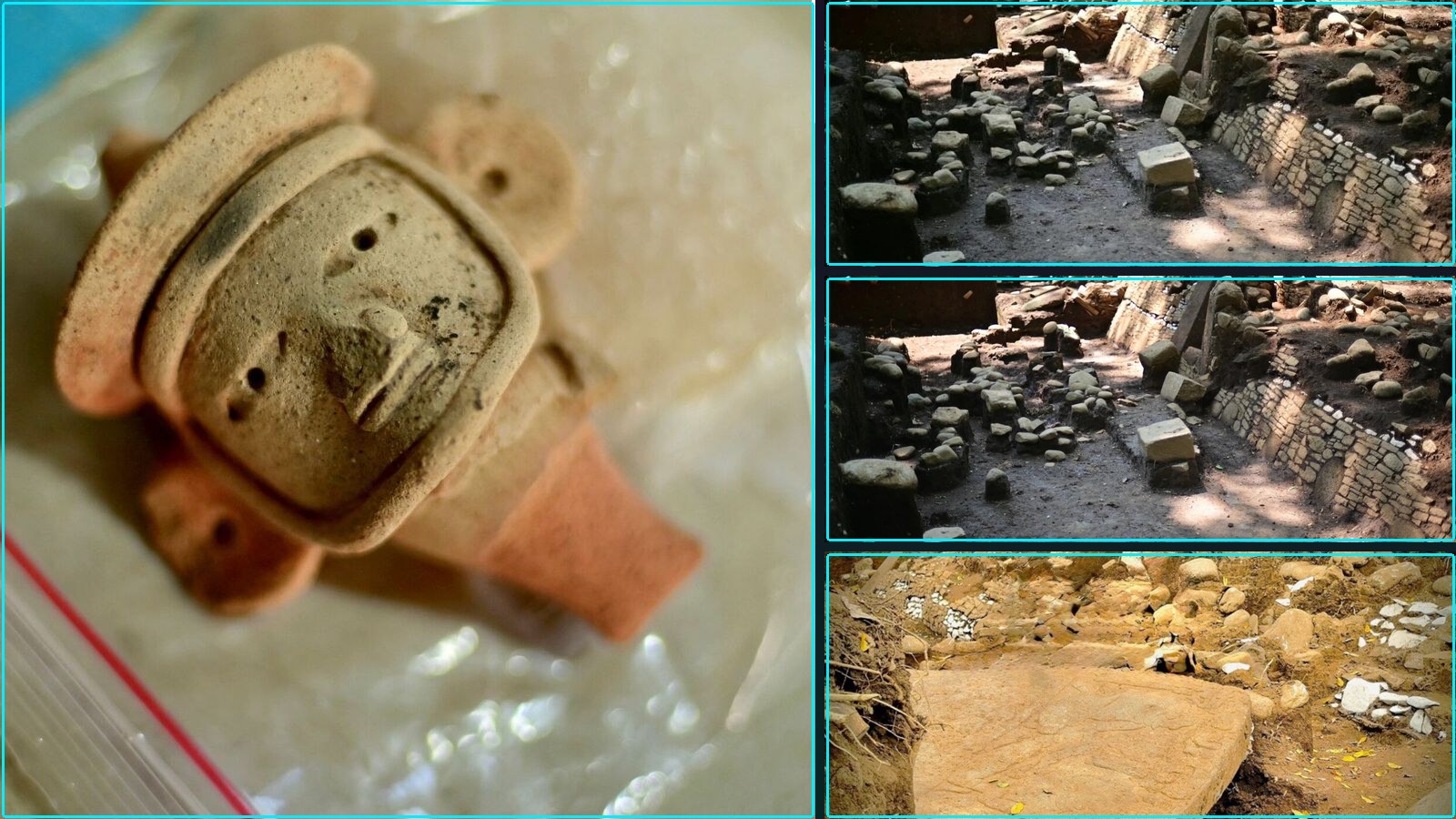
Pre-Hispanic ruins and artifacts in Mexico
Archaeologists discover ‘never-before-seen’ pre-Hispanic ruins in Mexico | Today News (Livemint)
Summary: Archaeologists in Veracruz, Mexico, have uncovered a pre-Hispanic site with a circular stone platform and a carved monolith showing elite figures receiving liquid from a divine entity. The structures, dating to 200–600 AD, display both Mayan influences and features never before recorded in the region. Researchers interpret the monolith as a possible ritual response to a severe drought. The Mexican government has pledged support for further excavation and restoration.

Why it matters: This discovery challenges existing models of cultural exchange and political authority in Early Classic Mesoamerica, suggesting previously unknown architectural traditions and ritual responses to climate stress.
Context: The site, Campo Viejo near Coatepec, lies in a region where Mayan and central Mexican influences overlapped, but no circular platform of this type has been documented there before.
""It’s a unique, unprecedented finding," said Lino Espinoza Garcia, an archaeologist for the INAH and one of the coordinators for the Campo Viejo site near the town of Coatepec." — LIVEMINT
Commentary: The circular platform breaks the expected architectural grammar for the region, implying either a distinct local innovation or a connection to a yet-unknown cultural network. The monolith’s drought narrative, if confirmed by paleoclimate data, would provide rare direct iconographic evidence of how elite ritual authority was legitimated during environmental crisis. This site may force a revision of the cultural geography of Early Classic Veracruz.
Date: June 19, 2026 09:30 PM ET
URL: https://www.livemint.com/news/world/archaeologists-discover-never-before-seen-pre-hispanic-ruins-in-mexico-11781917791655.html
AI Sentiment Score: Negative (50%)
AI Credibility Score: 10.0/10 — High
Scores and text generated by AI analysis of the source article indicated.
Archaeologists discover ‘never before seen’ pre-Hispanic ruins in Mexico (Yahoo)
Summary: Archaeologists in Veracruz, Mexico, have uncovered a pre-Hispanic site with a circular stone platform and a monolith depicting elite figures receiving liquid from a divine entity. The find is unprecedented in the region and may reflect a response to a great drought during the Early Classic period (200–600 AD). The monolith shows one figure with Mayan traits, suggesting cultural exchange or influence. President Sheinbaum has pledged state resources for further investigation and restoration.
Why it matters: This discovery challenges existing models of Classic-period cultural boundaries in eastern Mexico, potentially rewriting the map of Mayan influence and regional responses to climate stress.
Context: The site lies near Coatepec, in a zone historically considered a frontier between Maya and central Mexican traditions. Circular platforms are known from other Mesoamerican regions but not previously recorded in Veracruz.
""It’s a unique, unprecedented finding," said Lino Espinoza Garcia, an archaeologist for the INAH and one of the coordinators for the Campo Viejo site near the town of Coatepec." — YAHOO
Commentary: The monolith’s iconography—elites receiving liquid from a divine source—may be a rare direct material record of drought-era ritual adaptation. If the Mayan traits are confirmed, this site could become a key data point for understanding how political authority was legitimated through control of water during climate crisis. The state’s commitment to funding is notable, as it signals a shift toward treating archaeological heritage as a national priority rather than a local or academic concern.
Date: June 19, 2026 08:04 PM ET
URL: https://www.yahoo.com/news/science/articles/archaeologists-discover-never-seen-pre-000438139.html
AI Sentiment Score: Negative (60%)
AI Credibility Score: 10.0/10 — High
Scores and text generated by AI analysis of the source article indicated.
Mexican archaeologists unearth ‘unprecedented’ ancient ruins with Mayan features (France24)
Summary: Mexican archaeologists have discovered ancient ruins in Veracruz featuring a circular stone platform and a carved monolith with Mayan traits, dating to the Early Classic period (200–600 AD). The site, called Campo Nuevo, includes architectural elements never before seen in the region, prompting officials to describe it as ‘unprecedented.’ President Sheinbaum has pledged state resources for further investigation and restoration. The monolith depicts two figures receiving a liquid, possibly water, which researchers interpret as a ritual response to a historical drought.

Why it matters: This find challenges existing assumptions about the geographic reach and cultural interactions of Classic Maya civilization, potentially rewriting the map of Mesoamerican influence.
Context: Veracruz is traditionally considered a region dominated by the Gulf Coast cultures such as the Olmecs and Totonacs, with Maya presence thought to be limited to the Yucatán and southern lowlands.
""It’s a unique, unprecedented finding," said Lino Espinoza Garcia, an archaeologist for the INAH and one of the coordinators for the Campo Viejo site near the town of Coatepec." — FRANCE24
Commentary: The circular platform and the iconography of elite figures receiving water from a divine source during a drought period suggest a ritual technology previously unattested in this region. If the monolith indeed depicts Maya elites, it implies either direct Maya settlement or a deeper network of exchange and influence than currently modeled. The state’s commitment to funding further excavation indicates that this site may yield stratigraphic data capable of recalibrating the chronology of Maya expansion into central Veracruz.
Date: June 19, 2026 08:00 PM ET
URL: https://www.france24.com/en/americas/20260620-mexican-archaeologists-unearth-ancient-ruins-with-unique-mayan-features
AI Sentiment Score: Negative (66%)
AI Credibility Score: 10.0/10 — High
Scores and text generated by AI analysis of the source article indicated.
Ancient ceremonial complex and rare sculpture uncovered in Veracruz (Heritagedaily)
Summary: Archaeologists from Mexico’s National Institute of Anthropology and History (INAH) have uncovered a pre-Hispanic ceremonial complex and a large carved stone monument in Veracruz, dating to the Early Classic period (AD 200–600). The site includes a 30-meter-long rectangular platform with previously undocumented architectural features and a 1.88-meter-tall monolithic sculpture depicting elite figures receiving sacred fluid from a divine being, one figure showing possible Mayan characteristics. The discovery suggests a previously unknown local culture with its own traditions but connected to broader Gulf Coast networks, distinct from the Totonac civilization typically associated with the region. Excavations also yielded ceremonial offerings including charred maize, pottery, and a greenstone bead, with fieldwork continuing until August 2026 and analysis expected by early 2027.

Why it matters: This find challenges existing cultural maps of Classic-period Veracruz, revealing a distinct local polity with its own architectural and iconographic traditions, while the Mayan stylistic element indicates cross-regional elite interaction that complicates narratives of isolated Gulf Coast development.
Context: The discovery is part of INAH’s salvage project at a residential development site near the Campo Viejo archaeological zone, where ongoing excavations since 2000 have been refining understanding of pre-Hispanic social complexity in central Veracruz.
"The monument depicts a symbolic scene involving two elaborately dressed elite figures receiving a sacred fluid from a divine being positioned above them. Researchers noted that one of the individuals appears to display possible Mayan characteristics, suggesting cultural interactions across a wider area of Mesoamerica." — HERITAGEDAILY
Commentary: The presence of Mayan stylistic traits on a monument in central Veracruz, far from the Maya heartland, suggests that elite networks during the Classic period were more extensive and ideologically integrated than often assumed. The absence of Totonac links implies that this was a distinct cultural entity, possibly a small polity that leveraged its position between highland and coastal zones to broker prestige goods and ritual knowledge. The well-preserved state of the sculpture and platform indicates rapid burial or abandonment, which may hint at a deliberate termination ritual or a sudden sociopolitical collapse. Continued excavation and analysis of the offerings will be critical for dating and for reconstructing the ceremonial economy of this previously unknown group.
Date: June 17, 2026 05:46 PM ET
URL: https://heritagedaily.com/2026/06/ancient-ceremonial-complex-and-rare-sculpture-uncovered-in-veracruz/158396
AI Sentiment Score: Negative (75%)
AI Credibility Score: 10.0/10 — High
Scores and text generated by AI analysis of the source article indicated.
Rare Pre-Hispanic Structure and Symbolic Monolith Uncovered in Veracruz (Ancient-Origins.Net)
Summary: Archaeologists from Mexico’s INAH have uncovered a pre-Hispanic ceremonial complex and a carved monolithic stela in Coatepec, Veracruz, dating to the Early Classic period (AD 200–600). The site features a 30-meter-long rectangular platform with unique engraved geometric motifs and circular stone ornaments previously unknown in the region. The stela depicts two elite figures receiving a sacred fluid from a divine entity, with one figure showing Maya-like characteristics, suggesting cultural exchange. The discovery challenges assumptions about local cultural identity, as it does not directly link to the better-known Totonac civilization.
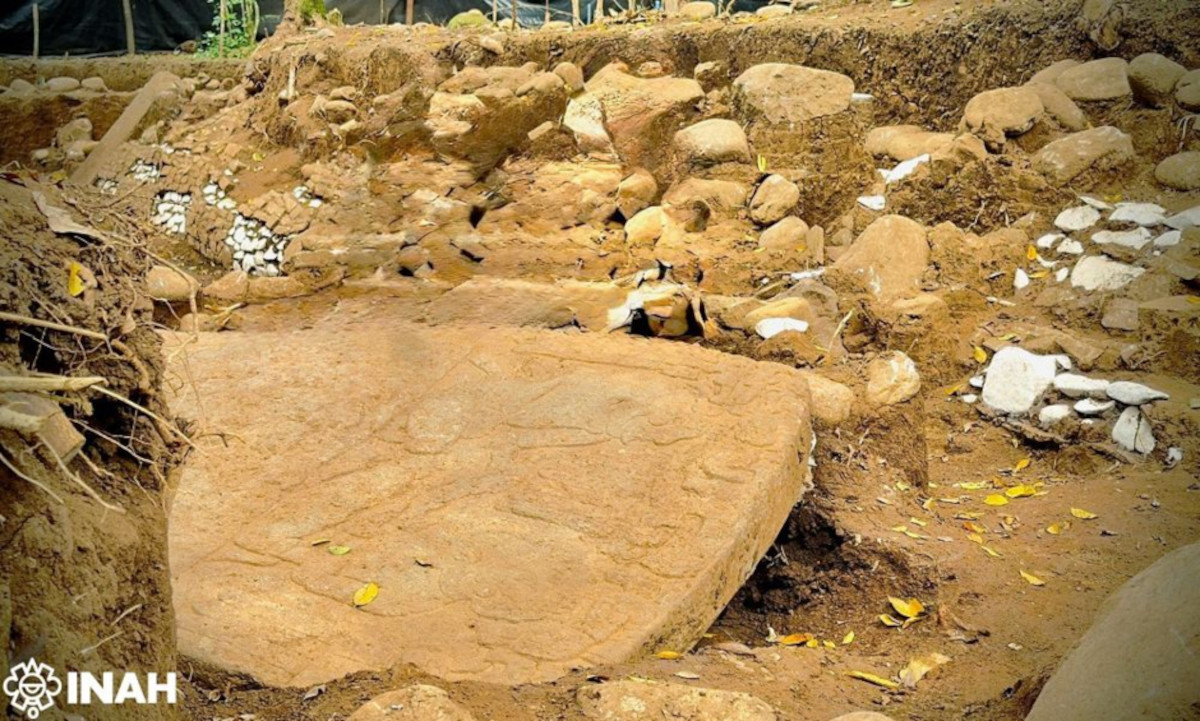
Why it matters: This find provides concrete evidence of a distinct local culture in central Veracruz during the Early Classic period, expanding our understanding of regional diversity and interregional influence in Mesoamerica.
Context: The site was discovered during a salvage project on private land slated for residential development, part of a broader INAH research program around the Campo Viejo archaeological site.
"The centerpiece of the discovery is a rectangular platform measuring 30 meters (98 feet) long and 12 meters (39 feet) wide. Built using flagstones and white limestone with a plaster-like texture, the structure was likely treated with an induced firing process to decorate its walls. What makes the platform truly unique are its ornamental features, which include engraved geometric motifs resembling squares and circular stones embedded along two of its sides." — ANCIENT-ORIGINS.NET
Commentary: The stela’s depiction of a divine entity dispensing a sacred fluid to elite figures, combined with Maya-like iconography, suggests that this local culture was not isolated but participated in broader Mesoamerican symbolic networks. The absence of Totonac links implies that the Gulf Coast’s cultural landscape was more fragmented and locally varied than previously assumed, with distinct traditions coexisting alongside major civilizations. The induced firing technique for wall decoration is a rare technological detail that may indicate specialized knowledge or ritual practices unique to this community.
Date: June 20, 2026 03:24 PM ET
URL: https://ancient-origins.net/news-history-archaeology/veracruz-archaeology-00102899
AI Sentiment Score: Negative (66%)
AI Credibility Score: 10.0/10 — High
Scores and text generated by AI analysis of the source article indicated.
Lasers penetrate the dense forest of the Chocó Andino and reveal more than 200 mounds, 100 terraces, and ancient roads in just 600 hectares, suggesting a much larger pre-Hispanic landscape hidden near Quito. (En.Clickpetroleoegas.Br)
Summary: LiDAR surveys in Ecuador’s Chocó Andino have revealed over 200 mounds, 100 terraces, and ancient roads in a 600-hectare area near Quito, far exceeding the previously known 40 mounds and 10 terraces. The findings, released by the Metropolitan Institute of Heritage (IMP) in December 2025, suggest a pre-Hispanic cultural landscape linked to the Yumbo culture, with sunken rectangular structures near the San Francisco River resembling those at the Tulipe complex. The mapped area is a tiny fraction of the 280,000-hectare Andean Chocó, implying that the true scale of occupation remains unknown. The research underscores how LiDAR is transforming archaeological discovery in dense, biodiverse terrain, but absolute dating and full extent still await further study.

Why it matters: This discovery dramatically expands the known pre-Hispanic footprint in the Andean northwest, challenging assumptions about settlement density and territorial organization in a region long considered marginal to major Andean civilizations.
Context: LiDAR has revolutionized archaeology in forested regions, from the Maya lowlands to the Amazon, by revealing hidden urban and agricultural landscapes. The Chocó Andino’s rugged terrain and biodiversity have historically limited survey, making this a frontier for understanding Yumbo and related societies.
"LiDAR Technology exposes pre-Hispanic remains under the Chocó Andino forest and expands the archaeological record in a region of difficult access, marked by biodiversity, rugged terrain, and ancient occupations still little documented." — EN.CLICKPETROLEOEGAS.BR
Commentary: The fivefold increase in documented structures within a single survey block signals that the Yumbo occupation was far more complex than previously modeled, with deliberate landscape engineering for productive, social, and ceremonial purposes. The comparison to Tulipe’s hydraulic architecture hints at sophisticated water management, but without published chronologies or material culture analysis, the cultural attribution remains provisional. The real prize lies in the 99.8% of the Andean Chocó still unmapped—if this density holds, the region could rival better-known pre-Columbian landscapes. The IMP’s framing as a ‘cultural landscape’ is a deliberate policy move to strengthen heritage protections before development or looting erodes the evidence.
Date: June 18, 2026 10:38 PM ET
URL: https://en.clickpetroleoegas.com.br/lasers-penetrate-the-dense-forest-of-the-choco-andino-and-reveal-more-than-200-mounds-100-terraces-and-ancient-roads-in-just-600-hectares-su-asaf04/
AI Sentiment Score: Negative (50%)
AI Credibility Score: 10.0/10 — High
Scores and text generated by AI analysis of the source article indicated.
Post ID: 57d57f06