

Design & Architecture Highlights
Material crafted from plant waste among projects from Lucerne University of Applied Sciences and Arts (Dezeen)
Summary: Lucerne University of Applied Sciences and Arts has showcased a series of design projects, including a material fabricated from floral waste sourced from florists and funeral services. The work is presented alongside a de-escalation tool for gender-based violence and a sensory retreat for autistic children, indicating a programmatic focus on applied, socially engaged design.

Why it matters: For practitioners in interactive art and experience design, this signals a shift in material sourcing and narrative framing, moving waste-stream utilization into public-facing installations with embedded social commentary.
Context: Design schools are increasingly functioning as R&D labs for sustainable materials and social tools, with graduate projects often serving as proof-of-concept for industry adoption or institutional partnership.
"material made from florists’ waste and floral remains from funeral services is among the projects from Lucerne School of Design, Film and Art." — DEZEEN
Commentary: The specific sourcing from funeral services introduces a potent, pre-loaded narrative material into the design pipeline, complicating the curator’s or experience designer’s role. This moves material innovation beyond technical performance into the fraught territory of public memory and ritual, requiring institutions to develop new protocols for audience engagement and consent.
Date: June 28, 2026 04:00 PM ET
URL: https://www.dezeen.com/2026/06/28/material-plant-waste-projects-the-lucerne-university-of-applied-sciences-and-arts-schoolshows/
AI Sentiment Score: Negative (66%)
AI Credibility Score: 10.0/10 — High
Scores and text generated by AI analysis of the source article indicated.
Dezeen Agenda features a mesh-covered Miami building by Snøhetta (Dezeen)
Summary: Snøhetta has released plans for a mixed-use building in Miami’s Design District featuring a bulbous, stainless steel mesh facade. The design, described as a ‘sunscreen’, represents a continued push for performative, climate-responsive architectural skins in high-sun environments. The project is noted in Dezeen’s weekly industry newsletter alongside other trade updates.
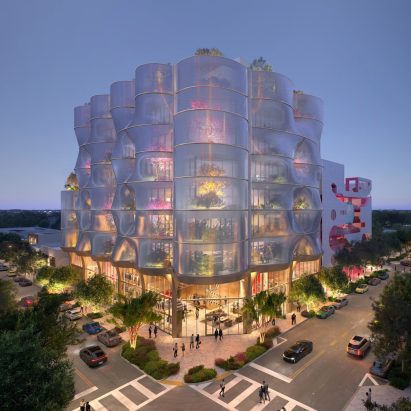
Why it matters: For architects, fabricators, and developers, this signals ongoing demand for complex, custom-fabricated exterior systems that merge environmental performance with distinct aesthetic branding.
Context: High-design districts like Miami’s have become testing grounds for material innovation and bespoke facade systems, where the capital expenditure for unique cladding is justified by branding and tenant appeal.
"<p>The latest edition of our weekly Dezeen Agenda newsletter features Snøhetta’s designs for a mesh-covered office building in Miami. Subscribe to Dezeen Agenda now. Architecture studio Snøhetta revealed plans for a mixed-use." — DEZEEN
Commentary: The project reinforces a pipeline where signature architecture firms drive specialized subcontracting for metalwork and engineering. It pressures local permitting and construction teams to handle non-standard assemblies, while setting a visual benchmark that competing developments in the district will need to address or differentiate from.
Date: June 25, 2026 02:00 PM ET
URL: https://www.dezeen.com/2026/06/25/snohetta-miami-design-district-sweetbird-north-dezeen-debate/
AI Sentiment Score: Positive (66%)
AI Credibility Score: 10.0/10 — High
Scores and text generated by AI analysis of the source article indicated.
Call It a Day lighting by Tongqi Lu Design (Dezeen)
Summary: Shanghai-based Tongqi Lu Design has released the Call It a Day lighting collection, which eliminates physical switches in favor of intuitive gesture controls. The collection includes table, floor, and pendant lamps with translucent silicone shades designed to invite touch. This represents a shift in user interface design for a common consumer product category.

Why it matters: For designers and manufacturers, this signals a move towards more integrated, sensor-driven interfaces that change product assembly, user manuals, and after-sales support.
Context: Gesture control is migrating from high-tech sectors into mainstream consumer goods, challenging traditional electromechanical component suppliers and redefining ‘user-friendly’ as a software and sensor calibration problem.
"intuitive gestures rather than switches control lights in the Call It a Day collection." — DEZEEN
Commentary: The operational consequence is a transfer of complexity from the user’s physical interaction to the manufacturer’s embedded systems engineering and quality control. Maintenance shifts from replacing a switch to diagnosing sensor arrays and firmware, altering the skills required for installation and repair crews. For distributors, it creates a new category of ‘connected’ product without the app, potentially simplifying retail messaging but complicating technical support.
Date: June 26, 2026 05:30 AM ET
URL: https://www.dezeen.com/2026/06/26/call-it-a-day-lighting-tongqi-lu-dezeen-showroom/
AI Sentiment Score: Positive (60%)
AI Credibility Score: 10.0/10 — High
Scores and text generated by AI analysis of the source article indicated.
Post ID: 909e7ebf