

Alzheimer’s Disease and Frontal Temporal Dementia
What Biogen’s anti-tau Alzheimer’s drug means for treatment (Bostonglobe)
Summary: Biogen’s Phase 2 trial of an anti-tau therapy, BIIB080, showed a 26% reduction in cognitive decline at the lowest dose in early-stage Alzheimer’s patients, marking the first successful targeting of tau in living humans. The drug, administered as a spinal injection twice yearly, lowered tau protein levels but did not improve functional outcomes. Side effects included injection-site pain and temporary confusion, without the brain inflammation seen with anti-amyloid drugs. The company plans a larger Phase 3 trial in 2027, while experts emphasize that combination therapies and earlier diagnosis via blood biomarkers like p-tau217 will be critical for future treatment.

Why it matters: This is the first clinical evidence that targeting tau, not just amyloid, can slow cognitive decline, opening a second therapeutic axis for Alzheimer’s and moving the field toward combination treatment strategies analogous to cancer care.
Context: Two approved anti-amyloid drugs (including Biogen’s own) show modest benefits, but tau has long been hypothesized as the direct driver of neuronal damage; previous anti-tau attempts failed to show clinical effect.
"For decades, there’s been the hypothesis that amyloid might be the match, but tau is really the fire that destroys the synapses and the neurons that cause the symptoms of Alzheimer’s disease,” Boxer said. “But that had never really been shown convincingly in living humans before." — BOSTONGLOBE
Commentary: The dose-response inversion—lowest dose outperforming higher doses—raises questions about mechanism and trial design that Biogen must resolve before Phase 3. The lack of functional improvement tempers enthusiasm, but the cognitive signal is real and statistically significant. If combined with anti-amyloid therapies in upcoming cocktail trials, the effect could compound, though the spinal injection route limits scalability. The p-tau217 blood biomarker data from Mass General Brigham adds urgency: early detection before symptom onset may be the only way to maximize these modest gains.
Date: July 17, 2026 03:01 PM ET
URL: https://bostonglobe.com/2026/07/17/metro/alzheimers-drug-tau-amyloid-treatment-biogen
AI Sentiment Score: Negative (55%)
AI Credibility Score: 10.0/10 — High
Scores and text generated by AI analysis of the source article indicated.
AAIC 2026: Bold approaches to tackling dementia research – Alzheimer’s Research UK (Alzheimersresearchuk)
Summary: At AAIC 2026 in London, researchers presented advances in Alzheimer’s treatment and prevention, including an FDA-approved injectable lecanemab for at-home use, promising results from the trontinemab ‘brain shuttle’ trial, and blood test data showing p-tau217 levels correlate with a 78% 10-year cognitive impairment risk. The conference also highlighted the Dementia Frontiers Fund, which selected five international teams for high-risk, high-reward research, and emphasized the need to address gender and community-based inequalities in brain health.

Why it matters: These developments signal a shift toward scalable, preventive Alzheimer’s care, but the gap between biomarker promise and clinical utility remains a critical challenge for health systems and patients.
Context: The field is moving from symptom-focused treatment to early intervention, with blood tests and novel drug delivery methods aiming to democratize access, though validation and implementation hurdles persist.
"AAIC 2026: Bold approaches to tackling dementia research Feature Alzheimer’s Research UK | On 17 July 2026 More than 10,000 international dementia researchers gathered in London this week for the world’s largest." — ALZHEIMERSRESEARCHUK
Commentary: The p-tau217 data is a double-edged sword: it offers a powerful risk stratification tool but also underscores the danger of over-reliance on a single biomarker. The 25% false-negative rate means that clinical judgment and multimodal assessment remain indispensable. The Dementia Frontiers Fund’s focus on resilience and multi-pathology modeling is a welcome corrective to the amyloid-centric narrative, but the two-year, £1.5 million grants are modest for the ambitious questions posed.
Date: July 17, 2026 04:00 AM ET
URL: https://alzheimersresearchuk.org/news/aaic-2026-bold-approaches-to-tackling-dementia-research
AI Sentiment Score: Negative (80%)
AI Credibility Score: 10.0/10 — High
Scores and text generated by AI analysis of the source article indicated.
Tau Therapy Slows Alzheimer’s Decline in First Human Trial as AAIC 2026 Wraps in London (Techtimes)
Summary: AAIC 2026 in London produced a structural convergence across three fronts: tau-targeting therapy showed its first Phase 2 human signal in Biogen’s diranersen trial, lecanemab received FDA approval for home self-injection, and blood-based p-tau217 biomarkers moved closer to routine primary care with expanding Medicare reimbursement. Diranersen failed its primary dose-response endpoint but demonstrated a 26% slowing of cognitive decline at the lowest dose, with 50-65% CSF tau reduction and no ARIA. Real-world LEADER data showed 83% of lecanemab patients stable or improved across demographics. The field now faces a widening gap between early detection via blood tests and approved treatments for pre-symptomatic patients.

Why it matters: For the first time, two hallmark Alzheimer’s proteins—amyloid and tau—have been therapeutically addressed in human trials, while treatment delivery shifts toward home administration and diagnostics move into primary care, creating both new treatment pathways and a pressing obligation to treat patients identified earlier than current drugs can reach.
Context: Tau has been treated as a downstream consequence of amyloid for decades; prior tau antibody trials largely failed. Diranersen is an antisense oligonucleotide that reduces tau production at the mRNA level, distinct from antibody approaches targeting extracellular aggregates.
"The 60 mg arm cut CSF tau by 50 to 65 percent; the higher doses cut it further. But clinical benefit did not follow the biomarker. This could mean that there is a ceiling effect — a threshold of tau reduction above which additional suppression does not add clinical benefit." — TECHTIMES
Commentary: The absence of a dose-response curve in CELIA is the most scientifically consequential finding of the week: it suggests tau reduction may have a therapeutic ceiling, or that the relationship between biomarker suppression and clinical outcome is nonlinear. Phase 3 will need to resolve whether the 60 mg signal is real or a statistical artifact, while the tau pipeline’s diversity—ASO, antibody, transport vehicle, gene therapy—reflects a field that has learned the hard way that mechanism of intervention matters as much as target selection.
Date: July 15, 2026 11:50 AM ET
URL: https://techtimes.com/articles/320591/20260715/tau-therapy-slows-alzheimers-decline-first-human-trial-aaic-2026-wraps-london.htm
AI Sentiment Score: Negative (50%)
AI Credibility Score: 10.0/10 — High
Scores and text generated by AI analysis of the source article indicated.
Cell-type signatures of Alzheimer’s disease shared across population groups – Nature (Nature)
Summary: Abstract Genomic studies at single-cell resolution have identified several cell types associated with clinical and pathological traits in Alzheimer’s disease1,2,3,4,5,6,7,8,9, but have not examined associations that are shared across populations. To bridge this gap, here we use single-nucleus RNA sequencing and assay for transposase-accessible chromatin with sequencing to profile cortical and subcortical regions in post-mortem brain-tissue samples from Latin, white (excluding Latin) and African American (excluding Latin) individuals. Using discrete and continuous dissections of molecular programs, we identify cell-type-specific clusters associated with Alzheimer’s disease in a region-specific manner across all three population groups, including microglial (GPNMB+ and CD74+ subgroups), astrocytic (SERPINH1+, CD44+ and WIF1+ subgroups) and neuronal (SST+ GABAergic and superficial-layer glutamatergic) signatures.
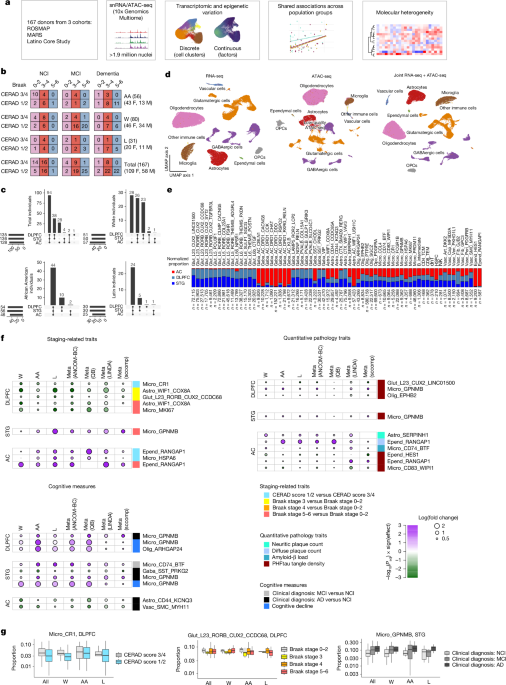
Why it matters: This matters for Alzheimer’s Disease and Frontal Temporal Dementia because it gives a concrete current signal to track: Abstract Genomic studies at single-cell resolution have identified several cell types associated with clinical and pathological traits in Alzheimer’s disease1,2,3,4,5,6,7,8,9, but have not examined associations that are shared across populations.
Context: Abstract Genomic studies at single-cell resolution have identified several cell types associated with clinical and pathological traits in Alzheimer’s disease1,2,3,4,5,6,7,8,9, but have not examined associations that are shared across populations. To bridge this gap, here we use single-nucleus RNA sequencing and assay for transposase-accessible chromatin with sequencing to profile cortical and subcortical regions in post-mortem brain-tissue samples from Latin, white (excluding Latin) and African American (excluding Latin) individuals. Using discrete and continuous dissections of molecular programs, we identify cell-type-specific clusters associated with Alzheimer’s disease in a region-specific manner across all three population groups, including microglial (GPNMB+ and CD74+ subgroups), astrocytic (SERPINH1+, CD44+ and WIF1+ subgroups) and neuronal (SST+ GABAergic and superficial-layer glutamatergic) signatures.
"Abstract Genomic studies at single-cell resolution have identified several cell types associated with clinical and pathological traits in Alzheimer’s disease1,2,3,4,5,6,7,8,9, but have not examined associations that are shared across populations. To bridge." — NATURE
Commentary: The immediate implication is operational rather than speculative: watch how this changes budgets, workflows, or risk assumptions over the next cycle.
Date: July 14, 2026 08:00 PM ET
URL: https://www.nature.com/articles/s41586-026-10793-0
AI Sentiment Score: Negative (75%)
AI Credibility Score: 10.0/10 — High
Scores and text generated by AI analysis of the source article indicated.
Post ID: 7303eef5