
Space Exploration
Scientists told them, ‘No, it’s too dangerous,’ but they did it anyway: Inside Japan’s super-close asteroid flyby (Space)
Summary: Japan’s Hayabusa2 spacecraft executed a daring flyby of the near-Earth asteroid Torifune on July 5, passing just 800 meters from its surface—far closer than the standard 100-kilometer flyby distance. The maneuver, approved after heated debate between science and engineering teams, revealed Torifune as a contact binary and returned unexpectedly large, high-resolution images. The flyby also demonstrated a fast reconnaissance capability for planetary defense, with JAXA now claiming the technology to collide spacecraft with small celestial bodies. Hayabusa2 continues its extended mission toward a 2031 rendezvous with asteroid 1998 KY26.
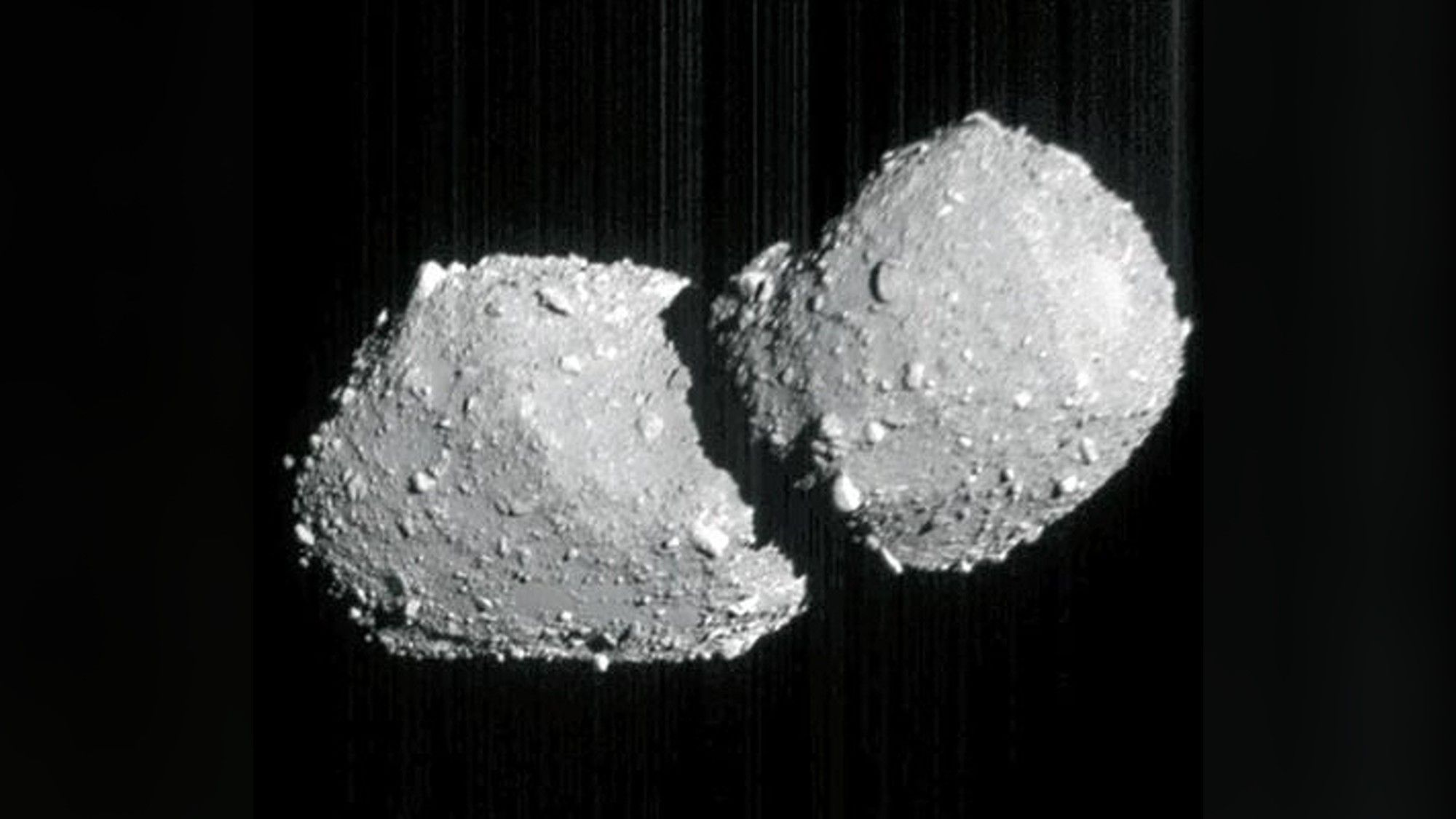
Why it matters: This flyby validates a high-risk, close-proximity reconnaissance technique that could be critical for future planetary defense missions, proving that aging spacecraft can be repurposed for fast, precise characterization of unknown near-Earth objects.
Context: Hayabusa2 completed its primary sample-return mission from Ryugu in 2020; the Torifune flyby was a last-minute addition to its extended mission, requiring new onboard guidance software and pushing the spacecraft beyond its original design parameters.
"The distance fixed is 800 meters," Yoshikawa said, "but this is quite a big challenge for us." — SPACE
Commentary: The engineering achievement here is the navigation precision: a 200-meter targeting error ellipse at 5.3 km/s relative velocity, using dust-degraded optics and last-minute software uploads, is remarkable. The planetary defense implication is direct—this is the first demonstration of a fast flyby characterization that could precede an impactor mission like DART, but with a fraction of the lead time. The 300 MB of data still awaiting downlink, delayed by ion engine burns, is a reminder that deep-space operations remain constrained by bandwidth and power budgets.
Date: July 19, 2026 06:00 AM ET
URL: https://space.com/space-exploration/asteroid-comet-missions/scientists-told-them-no-its-too-dangerous-but-they-did-it-anyway-inside-japans-super-close-asteroid-flyby
AI Sentiment Score: Positive (42%)
AI Credibility Score: 10.0/10 — High
Scores and text generated by AI analysis of the source article indicated.
China’s first recovered booster returns to port as LandSpace aims for first land recovery (Nasaspaceflight)
Summary: China achieved its first orbital-class booster recovery on July 10, 2026, using a cable-net catch system on the droneship Linghangzhe. The Chang Zheng 10B first stage returned to port on July 14, validating a reusable architecture shared with the crew-rated CZ-10A. LandSpace aims to secure China’s first propulsive land landing with its ZhuQue-3 in August, while iSpace and OrienSpace advance their own recovery and launch capabilities. The milestone positions China to address launcher shortages for megaconstellations and lunar campaign needs.

Why it matters: This recovery demonstrates a viable alternative to Falcon 9-style landing legs and opens a path to rapid reusability for China’s next-generation launch family, directly impacting the pace of megaconstellation deployment and lunar program schedules.
Context: China’s previous two recovery attempts in December 2025 failed, with a CZ-12A and a LandSpace ZQ-3 both crashing during landing burns. The CZ-10B’s success follows a suborbital prototype test in February 2026.
"The mission demonstrated the effectiveness of the net catch system, in which four arresting hooks attached to the booster snag the cables as it descends between them. These cables are guided by a Light Detection and Ranging (LIDAR) system situated in the corners of the framework, communicating with actuators to reposition the cables." — NASASPACEFLIGHT
Commentary: The cable-net approach eliminates landing leg mass and deck footprint constraints, but the prolonged hover observed on this flight will cut payload margin until the landing profile is tightened. CAST’s declared intent to refly this stage before year-end signals confidence in the hardware, but the real test will be turnaround time and reusability cost. LandSpace’s upcoming ZQ-3 land landing attempt will determine whether China’s commercial sector can match the state-owned enterprise’s recovery pace.
Date: July 15, 2026 02:57 PM ET
URL: https://www.nasaspaceflight.com/2026/07/china-update-20261507/
AI Sentiment Score: Negative (50%)
AI Credibility Score: 10.0/10 — High
Scores and text generated by AI analysis of the source article indicated.
Soyuz MS-29 launches new crew to ISS from Baikonur (Nasaspaceflight)
Summary: Soyuz MS-29 launched from Baikonur on July 14, 2026, carrying Roscosmos cosmonauts Pyotr Dubrov and Anna Kikina alongside NASA astronaut Anil Menon to the ISS. The spacecraft docked in just over three hours, the fastest available rendezvous profile. The crew will spend eight months on station, overlapping with the departing Soyuz MS-28 crew for a 12-day handover. This is the only crewed Soyuz launch from Baikonur in 2026, with MS-30 and MS-31 scheduled for 2027.

Why it matters: The extension of the NASA-Roscosmos barter agreement to at least 2027 and the shift to eight-month Soyuz missions reflect ongoing budget pressures at Roscosmos, while the crew swap pattern confirms the continued reliance on cross-agency seat exchanges for assured ISS access.
Context: Soyuz MS-29’s prime crew originally trained as backups for MS-28, following the standard pattern where backups become prime for the next flight. The mission marks the fifth crewed spaceflight of 2026 and the fourth orbital crewed flight.
"The barter agreement between NASA and Roscosmos has been extended to at least 2027, and each Soyuz mission now lasts eight months instead of six due to Roscosmos’s budget constraints." — NASASPACEFLIGHT
Commentary: The eight-month Soyuz tour is a direct consequence of Roscosmos stretching its limited launch cadence, not a technical improvement. Anil Menon’s flight—following his wife Anna Menon’s Polaris Dawn mission—makes them the first married couple to both fly in space, but the operational signal is the continued normalization of SpaceX and Soyuz as complementary, not competing, crew transport systems through at least 2027.
Date: July 14, 2026 09:49 AM ET
URL: https://www.nasaspaceflight.com/2026/07/soyuz-ms-29-launch/
AI Sentiment Score: Negative (66%)
AI Credibility Score: 10.0/10 — High
Scores and text generated by AI analysis of the source article indicated.
Starship Flight 13: Booster 20 Aborts During Ignition (Nasaspaceflight)
Summary: SpaceX’s Starship Flight 13 aborted at T-0 on July 16 after only 29 of 33 Raptor engines ignited, triggering an automatic launch abort. The stack—Booster 20 and Ship 40—will be rolled back for engine replacements, with two Raptors to be removed and swapped. This marks the first full-stack ignition abort in the Starship program. SpaceX is targeting a second attempt on July 23, pending inspections and repairs. The flight was intended to set a record for fastest stack-to-launch turnaround and to deploy 20 operational Starlink V3 satellites.

Why it matters: This abort delays the first operational Starlink V3 deployment and the transition from suborbital to orbital flights, which SpaceX had hoped to achieve on Flight 14. Engine relight reliability remains the critical path for Starship’s reuse and rapid launch cadence.
Context: Flight 12 (May 22) experienced a booster flip anomaly and engine failures during boost-back, leading to a mishap investigation that closed on July 13. Booster 20 includes hardware and software upgrades to address those issues, including modified engine alarms and relight sequencing.
"After pushing hard for a launch on July 16 at 5:45 pm CDT, and attempting to set the record for the fastest stack to launch so far in the Starship program. Starship." — NASASPACEFLIGHT
Commentary: The T-0 abort, while a setback, demonstrates the abort system working as designed—preferable to an in-flight failure. The need for engine swaps suggests the root cause may be ignition-side hardware rather than software timing alone. With two Raptors to replace, the July 23 target is aggressive but plausible given SpaceX’s engine production rate. The real signal will be whether Booster 20 can complete a full boost-back burn on the next attempt, as that was the primary failure mode on Flight 12.
Date: July 15, 2026 10:43 PM ET
URL: https://www.nasaspaceflight.com/2026/07/starship-flight-13-flight/
AI Sentiment Score: Negative (87%)
AI Credibility Score: 10.0/10 — High
Scores and text generated by AI analysis of the source article indicated.
Launch Preview: Soyuz to launch crew to ISS, Starship to fly another test flight (Nasaspaceflight)
Summary: This week features seven launches globally, including SpaceX’s 13th Starship flight test and a Soyuz crew rotation to the ISS. Starship Flight 13 will attempt to repeat the suborbital profile of Flight 12, with Booster 20 and Ship 40 both planned for controlled destruction after splashdown. The Soyuz MS-29 mission will deliver NASA astronaut Anil Menon and Roscosmos cosmonauts Pyotr Dubrov and Anna Kikina to the station via a two-orbit, three-hour rendezvous. India’s Skyroot Aerospace aims for the maiden flight of its Vikram-I rocket, a four-stage small-lift vehicle, after repeated delays.

Why it matters: Starship’s flight cadence and booster abort recovery from Flight 12 are critical signals for SpaceX’s iterative development timeline, while Vikram-I’s debut tests India’s commercial small-launch capability against established players.
Context: Starship has flown only two test flights in 2026, with Flight 12 experiencing a booster abort after stage separation; this flight aims to validate fixes and advance in-space operations. Soyuz MS-29 is the 91st Soyuz 2.1a mission and the fourth crew rotation of the year, maintaining ISS staffing continuity.
"SpaceX hopes that the various issues that led to a booster abort following stage separation on Flight 12 will be overcome, and that Ship 40 can build on Ship 39’s successful in-space operations, reentry, and landing during Flight 12." — NASASPACEFLIGHT
Commentary: The Starship flight is the week’s highest-risk event: a second consecutive booster abort would raise questions about stage separation reliability, while a clean repeat of Flight 12’s ship performance would validate the vehicle’s reentry thermal protection. Vikram-I’s launch, if successful, would mark India’s first orbital attempt by a private company, directly challenging the small-launch market currently dominated by Rocket Lab and Firefly. The Soyuz crew launch is routine but underscores the ISS’s continued dependence on Russian crew transport amid ongoing geopolitical tensions.
Date: July 13, 2026 04:29 PM ET
URL: https://www.nasaspaceflight.com/2026/07/launch-preview-071326/
AI Sentiment Score: Negative (66%)
AI Credibility Score: 10.0/10 — High
Scores and text generated by AI analysis of the source article indicated.
SpaceX will launch Starship, the world’s largest rocket, on critical Flight 13 test on July 23. Here’s what to expect. (Space)
Summary: SpaceX’s Starship Flight 13 is scheduled for July 23, 2026, after a last-second abort on July 16. The mission will deploy 20 V3 Starlink satellites—the first operational next-gen units—on a suborbital trajectory, with six carrying cameras to inspect Ship’s heat shield. Super Heavy will target a controlled Gulf splashdown rather than a catch, following engine issues on Flight 12. The test marks a step toward operational Starship V3, which is slated for NASA’s Artemis III in 2027.

Why it matters: This flight transitions Starship from experimental to operational payload deployment, directly testing the hardware and logistics needed for the planned 100,000-satellite V3 Starlink constellation and lunar missions.
Context: Flight 12 in May 2026 was the first V3 launch, successfully deploying 22 payloads but suffering Super Heavy engine problems during return. SpaceX has not attempted a booster catch since Flight 8 in March 2025.
"SpaceX will launch Starship, the world’s largest rocket, on critical Flight 13 test on July 23. Here’s what to expect. SpaceX’s Starship megarocket will take to the skies again on Thursday (July." — SPACE
Commentary: The shift from dummy payloads to functional V3 satellites, even on a suborbital arc, signals that SpaceX is validating end-to-end deployment and laser crosslinking ahead of orbital insertion. The heat-shield instrumentation—load-sensing tiles and camera-equipped satellites—suggests the company is systematically retiring reentry risk before attempting a Ship catch. The booster’s continued inability to land cleanly after Flight 12’s failure indicates the engine or control issues are not yet fully resolved, making the Gulf splashdown a conservative but necessary fallback.
Date: July 16, 2026 06:00 AM ET
URL: https://space.com/space-exploration/launches-spacecraft/spacex-starship-flight-13-starlink-v3-satellites
AI Sentiment Score: Negative (83%)
AI Credibility Score: 10.0/10 — High
Scores and text generated by AI analysis of the source article indicated.
Post ID: b0300a3f