Deep Space & Exoplanets
Lab instrument now on two-billion-mile journey to the metallic … (Llnl.Gov)
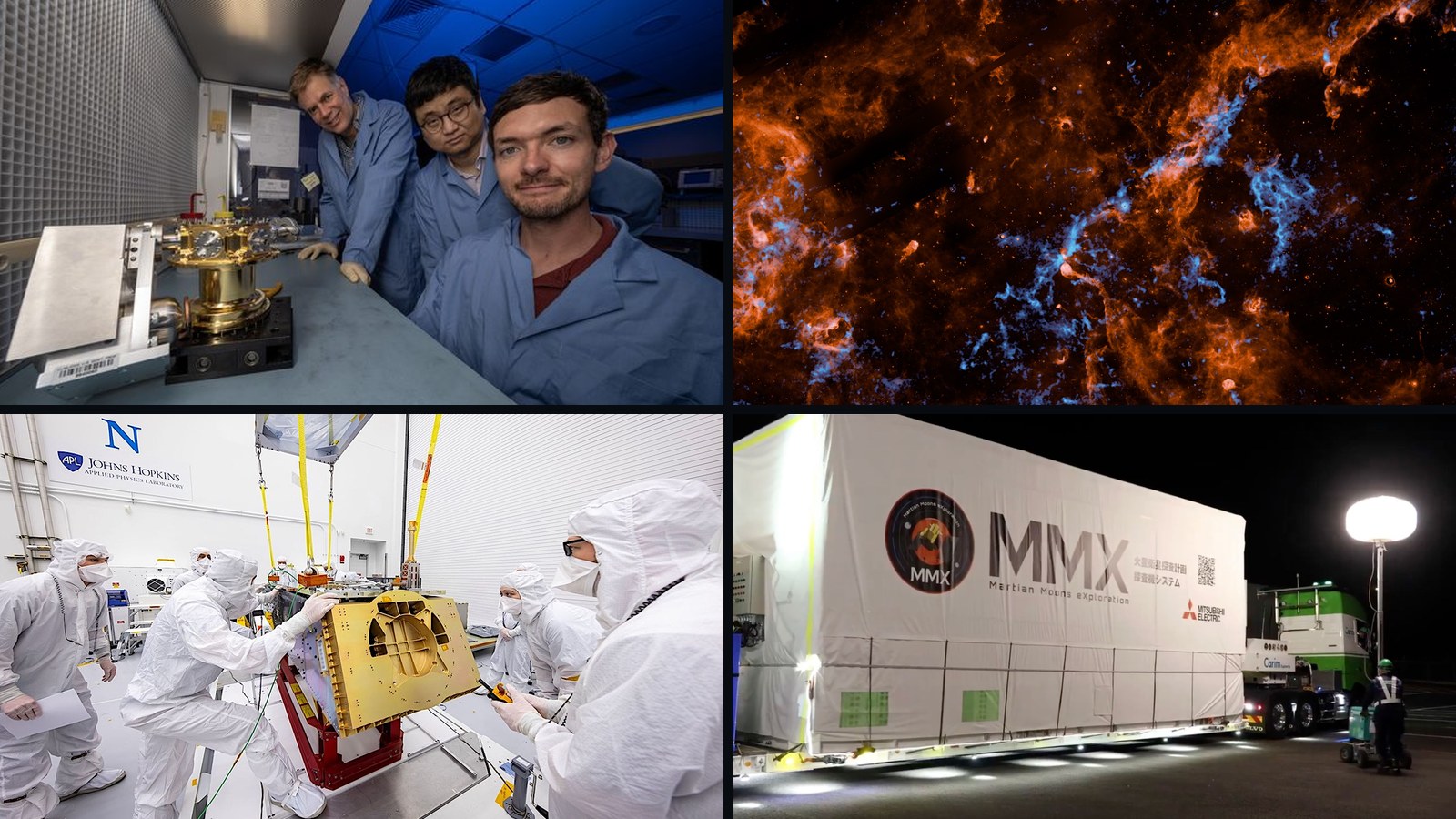
Summary: NASA’s Psyche spacecraft, launched via SpaceX Falcon Heavy, is currently en route to the solar system’s largest metallic asteroid. The mission features a high-purity germanium (HPGe) gamma-ray sensor developed by Lawrence Livermore National Laboratory (LLNL) and Johns Hopkins Applied Physics Laboratory. After a Mars gravity assist in May 2026, the craft is scheduled to arrive at the asteroid in August 2029 for a 26-month orbital study. The mission aims to analyze the asteroid’s iron-nickel composition to simulate the study of a planetary core.
Why it matters: Directly sampling a metallic asteroid provides a proxy for planetary cores that are otherwise inaccessible, potentially redefining models of terrestrial planet formation.
Context: The LLNL sensor leverages heritage from the MESSENGER mission to Mercury, signaling a shift toward using specialized gamma-ray spectrometers for high-resolution elemental mapping of deep-space bodies.
"The Livermore high-purity germanium (HPGe) gamma-ray sensor is an essential part of a larger gamma-ray spectrometer (GRS) built in collaboration with researchers from Johns Hopkins Applied Physics Laboratory (JHAPL) in Laurel, Maryland." — LLNL.GOV
Commentary: The deployment of HPGe sensors across multiple upcoming missions—including JAXA’s Phobos lander and a Saturnian moon mission—indicates a strategic institutional pivot toward high-precision isotopic analysis. By treating Psyche as a ‘exposed core,’ NASA is moving from general survey work to targeted forensic geology of the early solar system. The reliance on gravity assists and long-duration transit underscores the continued engineering constraint of propellant mass versus instrument payload.
Date: April 26, 2026 12:00 AM ET
URL: https://www.llnl.gov/article/50476/lab-instrument-now-two-billion-mile-journey-metallic-asteroid-psyche
AI Sentiment Score: Negative (57%)
AI Credibility Score: 10.0/10 — High
Scores and text generated by AI analysis of the source article indicated.
‘Interstellar Glaciers’: NASA’s SPHEREx Maps Vast Galactic Ice Regions (Jpl.Nasa.Gov)
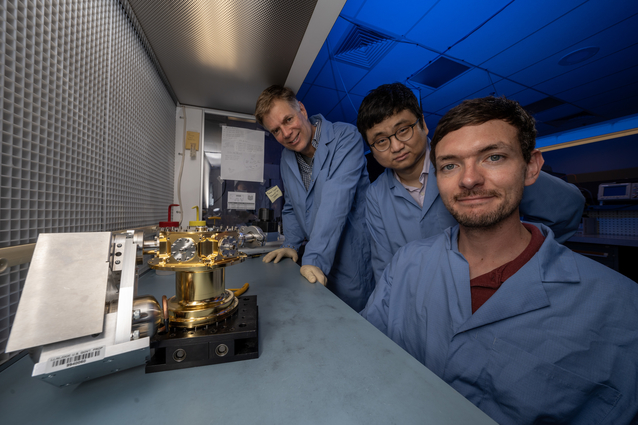
Summary: NASA’s SPHEREx mission has mapped interstellar ice across molecular clouds spanning over 600 light-years in the Milky Way. By utilizing a 102-color infrared spectral survey, the observatory identified the spatial distribution of water, carbon dioxide, and carbon monoxide attached to dust grains. The findings, published in The Astrophysical Journal, highlight the role of these ‘interstellar glaciers’ in delivering essential volatiles to nascent solar systems.
Why it matters: It shifts the study of interstellar volatiles from targeted, point-source observations (single stars) to large-scale spatial mapping, providing a systemic view of how water is distributed before planet formation.
Context: While the James Webb Space Telescope and Spitzer provided high-resolution snapshots of specific icy molecules, SPHEREx is the first infrared mission designed for an all-sky spectral survey of this nature.
"When looking along the galactic plane — where most of the stars, gas, and dust of our galaxy are concentrated — there’s a lot of diffuse background light shining through entire dust clouds, and SPHEREx can see the spatial distribution of the ices they contain in incredible detail." — JPL.NASA.GOV
Commentary: The ability to distinguish between water and carbon dioxide abundances across vast regions allows researchers to map the influence of ultraviolet radiation and thermal heating on a galactic scale. This operational shift from ‘zooming in’ to a ‘big picture’ survey transforms our understanding of the interstellar medium’s chemistry from anecdotal to statistical. The data provides a concrete baseline for the chemical inventory available to any new planetary system forming in these regions.
Date: Wed, 15 Apr 2026 08:00:00 -0700
URL: https://www.jpl.nasa.gov/news/interstellar-glaciers-nasas-spherex-maps-vast-galactic-ice-regions
AI Sentiment Score: Negative (60%)
AI Credibility Score: 8.2/10 — High
Scores and text generated by AI analysis of the source article indicated.
Astrobiology Exploration: Dragonfly Rotorcraft Hardware Integration and Parachute Test – Astrobiology (Astrobiology)
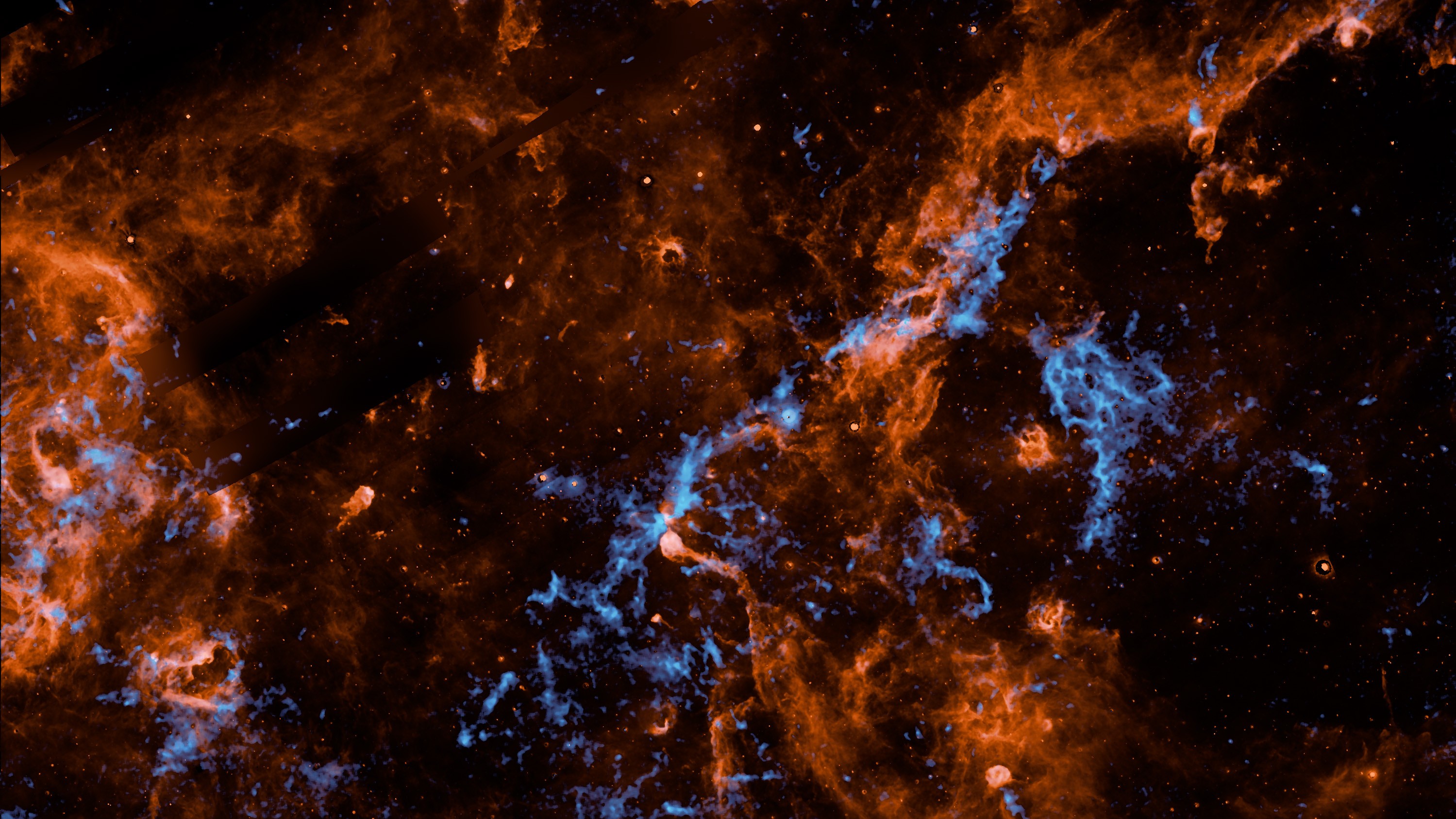
Summary: NASA’s Dragonfly mission has transitioned from design to hardware integration, receiving the primary honeycomb structure manufactured by Lockheed Martin. In February 2026, the project successfully completed its first full-scale parachute drop tests in Arizona, validating the drogue and main decelerator elements for Titan’s atmosphere. Simultaneously, the Dragonfly Mass Spectrometer (DraMS) is entering final integration at Goddard Space Flight Center.
Why it matters: The shift from conceptual modeling to full-scale hardware testing—specifically the EDL (Entry, Descent, and Landing) system—reduces the primary mission risk associated with landing a complex rotorcraft on a distant moon.
Context: Dragonfly represents a significant leap in planetary exploration, moving beyond static landers to a mobile, aerial platform capable of multi-site sampling in a cryogenic environment.
"NASA’s Dragonfly rotorcraft is beginning to take shape – literally – with the delivery of the panels that make up the rotorcraft lander’s body. Built from ultra‑lightweight honeycomb panels designed at the." — ASTROBIOLOGY
Commentary: The successful parachute trials and the delivery of the airframe signal that the mission is moving out of the high-risk design phase and into qualification. With the DraMS payload nearing completion, the critical path now shifts to the May vibration and static-load tests to ensure launch survivability. A 2028 launch window remains viable provided the October design-qualification tests maintain this momentum.
Date: April 24, 2026 12:00 AM ET
URL: https://astrobiology.com/2026/04/astrobiology-exploration-dragonfly-rotorcraft-hardware-integration-and-parachute-test.html
AI Sentiment Score: Negative (57%)
AI Credibility Score: 7.0/10 — Medium
Scores and text generated by AI analysis of the source article indicated.
Japan’s audacious sample-return mission to the Mars moon Phobos has made it to the launch pad (Space)
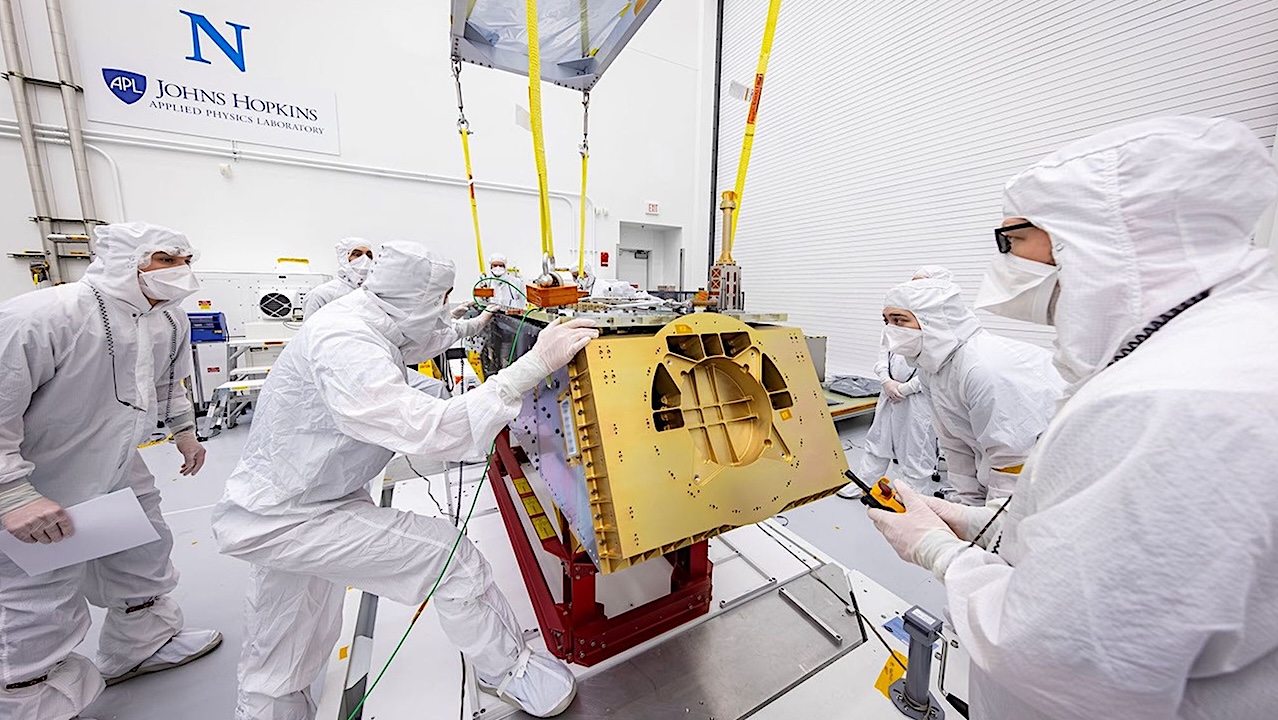
Summary: JAXA’s Martian Moons eXploration (MMX) spacecraft has arrived at the Tanegashima spaceport for a scheduled late-2026 launch. The mission aims to map Phobos and Deimos, land on Phobos in 2029, and return 10 grams of regolith to Earth by 2031. The spacecraft will be supported by the IDEFIX rover, a joint DLR and CNES project designed for ultra-low gravity operations.
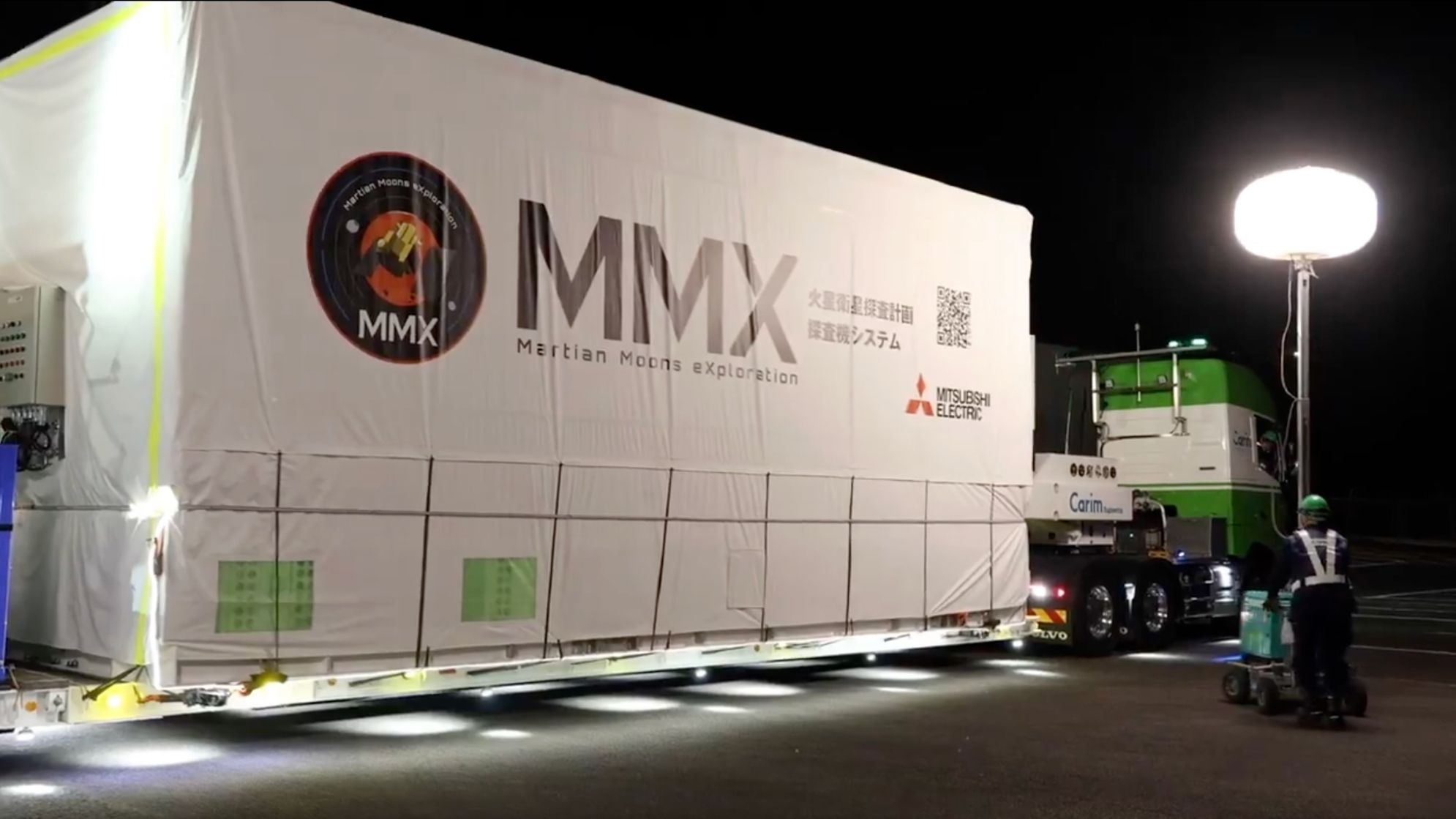
Why it matters: A successful return would provide the first direct evidence to resolve whether Phobos is a captured asteroid or a remnant of a giant impact, fundamentally altering models of Martian evolution.
Context: The mission follows JAXA’s established lineage of asteroid sample returns via Hayabusa and Hayabusa2, though it faces higher operational risks due to the H3 rocket’s recent reliability issues.
"There had been doubt over the 2026 launch following the second failure of the H3 in seven tries in December 2025, but the issue was soon isolated as a payload fairing separation anomaly, clearing the way for MMX to proceed." — SPACE
Commentary: The transition from the H3’s fairing anomalies to a flight-ready state suggests a critical stabilization of Japan’s heavy-lift capability. By deploying the IDEFIX rover as a precursor to the main lander, JAXA is mitigating the extreme risks of Phobos’s negligible gravity. The 2031 return date marks a high-stakes test of long-duration sample chain custody across interplanetary distances.
Date: April 23, 2026 12:00 AM ET
URL: https://www.space.com/astronomy/mars/japans-audacious-sample-return-mission-to-the-mars-moon-phobos-has-made-it-to-the-launch-pad
AI Sentiment Score: Negative (50%)
AI Credibility Score: 10.0/10 — High
Scores and text generated by AI analysis of the source article indicated.
🌱 Patch AM: How Greenbelt engineers are helping a robot fly on Titan (Patch)
Summary: NASA Goddard engineers in Greenbelt are currently finalizing the hardware integration for the Dragonfly rotorcraft’s portable chemistry lab. The team is specifically focusing on the integration and testing of the Dragonfly Mass Spectrometer. These efforts are part of the broader assembly process for the rotorcraft and parachute systems ahead of a planned 2028 launch to Saturn’s moon Titan.

Why it matters: The transition from design to hardware integration of the mass spectrometer marks a critical shift toward operational readiness for one of NASA’s most complex planetary missions.
Context: Dragonfly represents a departure from traditional rover missions, utilizing aerial mobility to sample diverse prebiotic chemistry across Titan’s surface.
"In today’s newsletter: How Greenbelt engineers are helping a robot fly on Titan … • Astrobiology Exploration: Dragonfly Rotorcraft Hardware Integration and Parachute Test (astrobiology.com) — Work happening now at NASA Goddard." — PATCH
Commentary: The focus on mass spectrometer integration suggests the mission is moving past conceptual architecture into the high-risk phase of instrument calibration and environmental hardening. Success here is prerequisite to the 2028 launch window, as the chemistry lab is the primary payload for identifying prebiotic signatures. Any delays in this specific hardware integration would ripple through the entire assembly timeline for the rotorcraft.
Date: April 26, 2026 12:00 AM ET
URL: https://patch.com/maryland/greenbelt/patch-am-how-greenbelt-engineers-are-helping-robot-fly-titan-nodx-20260426
AI Sentiment Score: Negative (57%)
AI Credibility Score: 10.0/10 — High
Scores and text generated by AI analysis of the source article indicated.
A pair of planet-forming discs (Esa.Int)
Summary: NASA, ESA, and CSA have released multi-instrument imagery of two protoplanetary discs, Tau 042021 and Oph 163131, located in Taurus and Ophiuchus. By combining NIRCam and MIRI infrared data with Hubble’s visible light and ALMA’s millimeter-wave observations, researchers are mapping dust grain distribution across different scales. The edge-on orientation of these discs allows for a precise analysis of dust verticality and composition, including hydrogen, carbon monoxide, and polycyclic aromatic hydrocarbons.

Why it matters: The ability to correlate micron-sized dust (Webb/Hubble) with millimeter-sized grains (ALMA) in the same system provides a direct empirical look at the transition from dust to planetesimals.
Context: Observing edge-on discs is a specific geometric advantage that minimizes stellar glare, enabling the study of the disc’s vertical structure and the ‘clearing’ effects of nascent planets.
"Indeed, the ALMA data for Oph 163131 shows a gap in the inner disc, which may already be evidence of a planet forming and clearing out the dust around it." — ESA.INT
Commentary: The identification of a gap in Oph 163131 shifts the observation from general morphology to specific planetary detection. This multi-wavelength approach—integrating ALMA’s sensitivity to larger grains with Webb’s molecular tracking—is the current gold standard for validating planet-formation models. The operational synergy between these instruments transforms these images from aesthetic captures into high-resolution structural maps of early solar systems.
Date: Fri, 03 Apr 2026 10:00:00 +0200
URL: https://www.esa.int/ESA_Multimedia/Images/2026/04/A_pair_of_planet-forming_discs
AI Sentiment Score: Positive (50%)
AI Credibility Score: 8.2/10 — High
Scores and text generated by AI analysis of the source article indicated.
Titan Archives – Astrobiology (Astrobiology)
Summary: NASA’s Dragonfly mission has transitioned into the rotorcraft integration and testing phase, marking a shift from conceptual design to hardware verification. Concurrent research into the Selk Crater region suggests that the thermodynamic conditions on Titan may favor the spontaneous formation of nucleobases, ribose, and fatty acids. Additionally, updated impact simulations suggest a ‘youthful’ Titan, potentially altering the timeline for prebiotic chemical evolution.
Why it matters: The transition to integration testing signals that the mission’s engineering risks are being addressed, while the prebiotic chemistry findings refine the high-priority targets for the DragonCam’s microscopic analysis.
Context: Dragonfly is a rotorcraft lander designed to explore Titan’s prebiotic chemistry, moving beyond static landers to sample multiple geologically diverse sites.
"Dragonfly Astrobiology Mission Begins Rotorcraft Integration, Testing Stage." — ASTROBIOLOGY
Commentary: The move to integration testing is the critical path for mission success, shifting the focus from theoretical payloads to operational reliability in a cryogenic environment. The thermodynamic modeling of Selk Crater provides a concrete chemical roadmap for the DragonCam’s instrumentation. If the ‘youthful Titan’ simulations hold, the window for prebiotic synthesis may be narrower and more volatile than previously modeled.
Date: April 24, 2026 12:00 AM ET
URL: https://astrobiology.com/titan
AI Sentiment Score: Positive (40%)
AI Credibility Score: 7.3/10 — Medium
Scores and text generated by AI analysis of the source article indicated.
NASA Research Proposes Technology to Seek Earth-Like Exoplanets (Jpl.Nasa.Gov)
Summary: NASA is advancing the Hybrid Observatory for Earth-like Exoplanets (HOEE) concept to overcome the luminosity gap between stars and their orbiting planets. The proposed architecture pairs an orbiting starshade with a large ground-based telescope to suppress starlight. This configuration aims to enable the direct imaging of exoplanets by capturing reflected light, which can be analyzed for atmospheric markers like water and oxygen.
Why it matters: Direct imaging of Earth-sized planets requires a level of contrast that current monolithic telescopes cannot achieve alone; the HOEE concept proposes a structural workaround to this engineering bottleneck.
Context: The transition from indirect detection (transit/radial velocity) to direct imaging is the primary hurdle in confirming habitable atmospheric compositions.
"NASA’s Hybrid Observatory for Earth-like Exoplanets (HOEE) concept presents a potential solution by combining an orbiting starshade with a large ground-based telescope to suppress starlight and enable direct imaging of exoplanets." — JPL.NASA.GOV
Commentary: The HOEE concept shifts the burden of starlight suppression from internal telescope optics to an external orbital asset. While conceptually sound, the operational reality depends on the precise formation-flying capabilities required to align a starshade with a ground-based aperture. If viable, this hybrid approach could bypass the cost and launch constraints of massive, single-mirror space telescopes.
Date: Wed, 25 Mar 2026 17:00:00 -0700
URL: https://www.jpl.nasa.gov/news/nasa-research-proposes-technology-to-seek-earth-like-exoplanets
AI Sentiment Score: Negative (75%)
AI Credibility Score: 8.2/10 — High
Scores and text generated by AI analysis of the source article indicated.
Post ID: e3b8e5bf