AI coding agents and their quirks
Ornith-1.0: self-improving open-source models for agentic coding (Github)
Summary: Aloha! 🌺 Ornith-1.0 is a self-improving open-source models for agentic coding. Highlights: – State-of-the-Art Coding Agents: Available in 9B-Dense, 31B-Dense, 35B-MoE, and 397B-MoE (post-trained on top of Gemma 4 and Qwen 3.5), achieving state-of-the-art performance among open-source models of comparable size on coding benchmarks such as Terminal-Bench 2.1, SWE-Bench, NL2Repo and OpenClaw.
Why it matters: This matters for Emerging Tech Signals (Pre-Mainstream) because it gives a concrete current signal to track: Aloha!
Context: Aloha! 🌺 Ornith-1.0 is a self-improving open-source models for agentic coding. Highlights: – State-of-the-Art Coding Agents: Available in 9B-Dense, 31B-Dense, 35B-MoE, and 397B-MoE (post-trained on top of Gemma 4 and Qwen 3.5), achieving state-of-the-art performance among open-source models of comparable size on coding benchmarks such as Terminal-Bench 2.1, SWE-Bench, NL2Repo and OpenClaw.
"Aloha! 🌺 Ornith-1.0 is a self-improving open-source models for agentic coding. Highlights: – State-of-the-Art Coding Agents: Available in 9B-Dense, 31B-Dense, 35B-MoE, and 397B-MoE (post-trained on top of Gemma 4 and Qwen 3.5),." — GITHUB
Commentary: The immediate implication is operational rather than speculative: watch how this changes budgets, workflows, or risk assumptions over the next cycle.
Date: June 29, 2026 01:16 PM ET
URL: https://github.com/deepreinforce-ai/Ornith-1
Discussion: https://news.ycombinator.com/item?id=48722052
AI Sentiment Score: Negative (50%)
AI Credibility Score: 10.0/10 — High
Scores and text generated by AI analysis of the source article indicated.
Memorizing session transcripts isn’t useful (12Gramsofcarbon)
Summary: A practitioner reports that after extensive testing, providing coding agents with search access to previous session transcripts yields zero performance benefit on SWE tasks and may even degrade model quality. The core issue is that agents cannot distinguish valuable context from noise, and they treat all input as ground truth, leading to intent drift and wasted tokens. The author argues that the real value lies in well-maintained coding artifacts (commit messages, PRs, documentation) rather than raw transcripts, and that automatic memory curation without human oversight is counterproductive.

Why it matters: This challenges a widely held assumption in the agentic coding space that session transcripts are a goldmine for context, and suggests that current memory architectures may be adding cost and noise without improving outcomes.
Context: Many teams have built products and features around indexing session transcripts for agent memory, including Claude Code itself. The author’s company previously built an entire product on this premise before discovering the lack of benefit.
"We have found zero performance benefit on SWE tasks when agents have search access to their previous transcript sessions, provided they have access to other forms of context. We also have not found much benefit in trying to automatically trawl through session transcripts to improve agent context, unless there is a human in the loop." — 12GRAMSOFCARBON
Commentary: The finding that agents cannot effectively prune their own memory—and that automatic updates are accepted less than 20% of the time—suggests a fundamental limitation in current agent architectures. This implies that the path to better agent context lies not in more data ingestion, but in better human-guided curation and artifact discipline. The result also raises questions about the viability of fully autonomous agent loops that rely on self-generated memory.
Date: July 03, 2026 11:32 AM ET
URL: https://12gramsofcarbon.com/p/agentics-memorizing-session-transcripts
Discussion: https://news.ycombinator.com/item?id=48776232
AI Sentiment Score: Negative (50%)
AI Credibility Score: 10.0/10 — High
Scores and text generated by AI analysis of the source article indicated.
Does code cleanliness affect coding agents? A controlled minimal-pair study (Arxiv)
Summary: A controlled study using minimal-pair repositories found that code cleanliness does not affect the pass rate of coding agents (specifically Claude Code) on 33 tasks across six pairs, but it does reduce operational costs: agents on cleaner code use 7–8% fewer tokens and reduce file revisitations by 34%. The study controlled for architecture, dependencies, and external behavior, isolating cleanliness as the variable. This suggests that while agent capability is unaffected by code quality, the efficiency and computational cost of autonomous coding are materially improved by maintainability practices.

Why it matters: This finding shifts the conversation from whether AI agents can work with messy code to how much it costs them to do so, making code hygiene a factor in operational budgets and latency for agent-driven development pipelines.
Context: Prior evaluations of coding agents focused on task completion rates with fixed codebases, ignoring the impact of code quality on agent behavior.
"Across 660 trials with Claude Code, code cleanliness does not change the agent’s pass rate. However, it substantially alters the agent’s operational footprint: agents working on cleaner code use 7 to 8% fewer tokens and reduce file revisitations by 34%." — ARXIV
Commentary: The token savings and reduced file revisitations are the real signal here—they translate directly to lower API costs and faster iteration cycles in production. For teams deploying agents at scale, this makes code quality a cost optimization lever, not just a maintainability nicety. Expect engineering organizations to start measuring and incentivizing cleanliness as a factor in agent operational efficiency.
Date: July 05, 2026 07:03 PM ET
URL: https://arxiv.org/abs/2605.20049
Discussion: https://news.ycombinator.com/item?id=48798815
AI Sentiment Score: Negative (66%)
AI Credibility Score: 10.0/10 — High
Scores and text generated by AI analysis of the source article indicated.
Have your agent record video demos of its work with shot-scraper video (Simonwillison.Net)
Summary: Have your agent record video demos of its work with shot-scraper video 30th June 2026 shot-scraper video is a new command introduced in today’s shot-scraper 1.10 release which accepts a storyboard.yml file defining a routine to run against a web application and uses Playwright to record a video of that routine. I’ve written before about the importance of having coding agents produce demos of their work; this is my latest attempt at enabling them to do that. Here’s an example video created using shot-scraper video , exercising a still in development feature adding the ability to create new tables in Datasette from pasted CSV, TSV or JSON data: That video was created by running this command: shot-scraper video datasette-bulk-insert-storyboard.yml \ –auth datasette-demo-auth.json –mp4 (That –auth JSON file contains a cookie, as described here in the documentation.) Here’s the datasette-bulk-insert-storyboard.yml file: output: /tmp/datasette-bulk-insert-demo.webm server: – uv – –directory – /Users/simon/Dropbox/dev/datasette – run – datasette – -p – 6419 – –root – –secret – "1" – /tmp/demo.db url: http://127.0.0.1:6419/demo/tasks viewport: width: 1280 height: 720 cursor: true wait_for: ‘button[data-table-action="insert-row"]’ javascript: | (() => { let clipboardText = ""; Object.defineProperty(navigator, "clipboard", { configurable: true, get: () => ({ writeText: async (text) => { clipboardText = String(text); }, readText: async () => clipboardText, }), }); })(); scenes: – name: Bulk insert existing table rows do: – pause: 0.8 – click: ‘button[data-table-action="insert-row"]’ – wait_for: "#row-edit-dialog[open]" – pause: 0.5 – click: ".row-edit-bulk-insert" – wait_for: ".row-edit-bulk-textarea" – pause: 0.5 – click: ".row-edit-copy-template" – wait_for: "text=Copied" – pause: 0.8 – fill: into: ".row-edit-bulk-textarea" text: | title,owner,status,priority,notes Prepare release video,Ana,doing,1,Recorded with shot-scraper Check pasted CSV import,Ben,review,3,Previewed before inserting Share the branch demo,Chen,queued,2,Bulk insert creates three rows – pause: 0.8 – click: ".row-edit-save" – wait_for: "text=Previewing 3 rows." – pause: 1.2 – click: ".row-edit-save" – wait_for: "text=3 rows inserted." – pause: 1.0 – click: ".row-edit-cancel" – wait_for: "text=Prepare release video" – pause: 1.0 – name: Create a table from pasted CSV open: http://127.0.0.1:6419/demo wait_for: ‘details.actions-menu-links summary’ do: – pause: 0.8 – click: ‘details.actions-menu-links summary’ – click: ‘button[data-database-action="create-table"]’ – wait_for: "#table-create-dialog[open]" – pause: 0.5 – fill: into: ".table-create-table-name" text: "launch_metrics" – click: ".table-create-from-data" – wait_for: ".table-create-data-textarea" – pause: 0.5 – fill: into: ".table-create-data-textarea" text: | metric_id,name,score,recorded_on m001,Activation rate,87.5,2026-06-29 m002,Retention check,72.25,2026-06-30 m003,CSV import health,95,2026-07-01 – pause: 0.8 – click: ".table-create-save" – wait_for: "text=Previewing 3 rows." – pause: 1.2 – click: ".table-create-save" – wait_for_url: "**/demo/launch_metrics" – wait_for: "text=Activation rate" – pause: 1.2 The video command documentation includes simpler examples, but for the purpose of this post I thought I’d go with something more comprehensive.
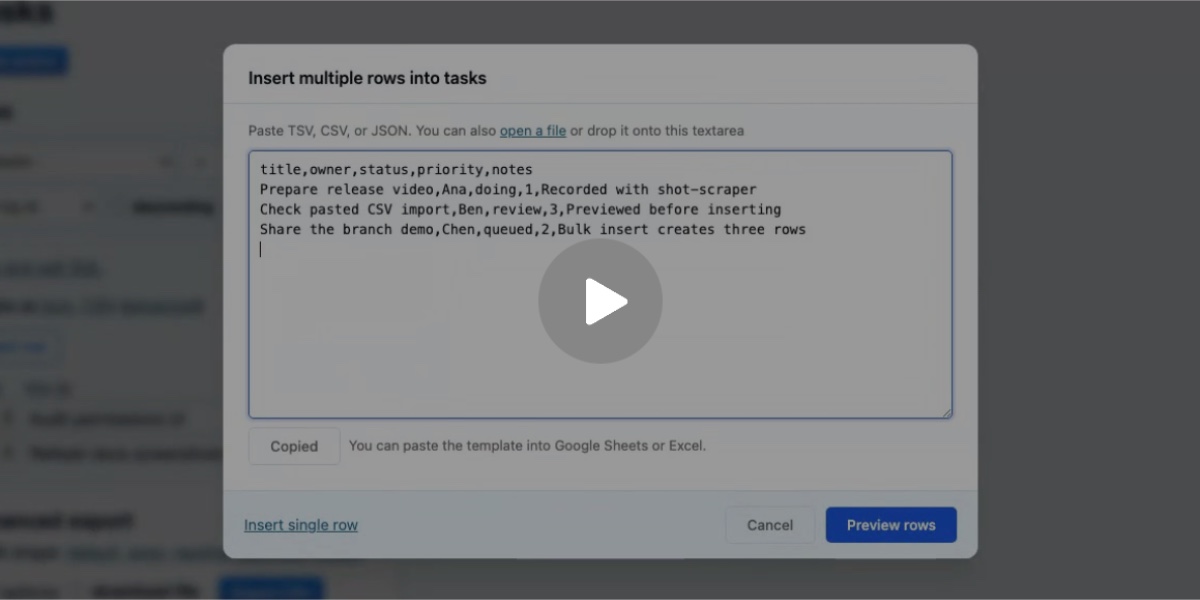
Why it matters: This matters for Emerging Tech Signals (Pre-Mainstream) because it gives a concrete current signal to track: Have your agent record video demos of its work with shot-scraper video 30th June 2026 shot-scraper video is a new command introduced in today’s shot-scraper 1.10 release which accepts a storyboard.yml file defining a routine to run against a web application and uses Playwright to record a video of that routine.
Context: Have your agent record video demos of its work with shot-scraper video 30th June 2026 shot-scraper video is a new command introduced in today’s shot-scraper 1.10 release which accepts a storyboard.yml file defining a routine to run against a web application and uses Playwright to record a video of that routine. I’ve written before about the importance of having coding agents produce demos of their work; this is my latest attempt at enabling them to do that. Here’s an example video created using shot-scraper video , exercising a still in development feature adding the ability to create new tables in Datasette from pasted CSV, TSV or JSON data: That video was created by running this command: shot-scraper video datasette-bulk-insert-storyboard.yml \ –auth datasette-demo-auth.json –mp4 (That –auth JSON file contains a cookie, as described here in the documentation.) Here’s the datasette-bulk-insert-storyboard.yml file: output: /tmp/datasette-bulk-insert-demo.webm server: – uv – –directory – /Users/simon/Dropbox/dev/datasette – run – datasette – -p – 6419 – –root – –secret – "1" – /tmp/demo.db url: http://127.0.0.1:6419/demo/tasks viewport: width: 1280 height: 720 cursor: true wait_for: ‘button[data-table-action="insert-row"]’ javascript: | (() => { let clipboardText = ""; Object.defineProperty(navigator, "clipboard", { configurable: true, get: () => ({ writeText: async (text) => { clipboardText = String(text); }, readText: async () => clipboardText, }), }); })(); scenes: – name: Bulk insert existing table rows do: – pause: 0.8 – click: ‘button[data-table-action="insert-row"]’ – wait_for: "#row-edit-dialog[open]" – pause: 0.5 – click: ".row-edit-bulk-insert" – wait_for: ".row-edit-bulk-textarea" – pause: 0.5 – click: ".row-edit-copy-template" – wait_for: "text=Copied" – pause: 0.8 – fill: into: ".row-edit-bulk-textarea" text: | title,owner,status,priority,notes Prepare release video,Ana,doing,1,Recorded with shot-scraper Check pasted CSV import,Ben,review,3,Previewed before inserting Share the branch demo,Chen,queued,2,Bulk insert creates three rows – pause: 0.8 – click: ".row-edit-save" – wait_for: "text=Previewing 3 rows." – pause: 1.2 – click: ".row-edit-save" – wait_for: "text=3 rows inserted." – pause: 1.0 – click: ".row-edit-cancel" – wait_for: "text=Prepare release video" – pause: 1.0 – name: Create a table from pasted CSV open: http://127.0.0.1:6419/demo wait_for: ‘details.actions-menu-links summary’ do: – pause: 0.8 – click: ‘details.actions-menu-links summary’ – click: ‘button[data-database-action="create-table"]’ – wait_for: "#table-create-dialog[open]" – pause: 0.5 – fill: into: ".table-create-table-name" text: "launch_metrics" – click: ".table-create-from-data" – wait_for: ".table-create-data-textarea" – pause: 0.5 – fill: into: ".table-create-data-textarea" text: | metric_id,name,score,recorded_on m001,Activation rate,87.5,2026-06-29 m002,Retention check,72.25,2026-06-30 m003,CSV import health,95,2026-07-01 – pause: 0.8 – click: ".table-create-save" – wait_for: "text=Previewing 3 rows." – pause: 1.2 – click: ".table-create-save" – wait_for_url: "**/demo/launch_metrics" – wait_for: "text=Activation rate" – pause: 1.2 The video command documentation includes simpler examples, but for the purpose of this post I thought I’d go with something more comprehensive.
"Have your agent record video demos of its work with shot-scraper video 30th June 2026 shot-scraper video is a new command introduced in today’s shot-scraper 1.10 release which accepts a storyboard.yml file." — SIMONWILLISON.NET
Commentary: The immediate implication is operational rather than speculative: watch how this changes budgets, workflows, or risk assumptions over the next cycle.
Date: June 30, 2026 12:54 PM ET
URL: https://simonwillison.net/2026/Jun/30/shot-scraper-video/
AI Sentiment Score: Negative (75%)
AI Credibility Score: 10.0/10 — High
Scores and text generated by AI analysis of the source article indicated.
The short leash AI coding method for beating Fable (Blog.Okturtles)
Summary: This post is the culmination of over a year of research into how to properly use AI agents to write high-quality software in security-critical systems. I will be writing this post primarily from my perspective as a software developer, protocol developer, and maintainer of security-critical software. Over the past year I dove deep into AI agents.
Why it matters: This matters for Emerging Tech Signals (Pre-Mainstream) because it gives a concrete current signal to track: This post is the culmination of over a year of research into how to properly use AI agents to write high-quality software in security-critical systems.
Context: This post is the culmination of over a year of research into how to properly use AI agents to write high-quality software in security-critical systems. I will be writing this post primarily from my perspective as a software developer, protocol developer, and maintainer of security-critical software. Over the past year I dove deep into AI agents.
"This post is the culmination of over a year of research into how to properly use AI agents to write high-quality software in security-critical systems. I will be writing this post primarily." — BLOG.OKTURTLES
Commentary: The immediate implication is operational rather than speculative: watch how this changes budgets, workflows, or risk assumptions over the next cycle.
Date: July 02, 2026 03:11 PM ET
URL: https://blog.okturtles.org/2026/07/short-leash-ai-method/
Discussion: https://news.ycombinator.com/item?id=48766026
AI Sentiment Score: Positive (40%)
AI Credibility Score: 7.0/10 — Medium
Scores and text generated by AI analysis of the source article indicated.
GPT-5.5 Codex reasoning-token clustering may be leading to degraded performance (Github)
Summary: A GitHub issue reports that GPT-5.5 Codex responses exhibit anomalous clustering at exactly 516, 1034, and 1552 reasoning tokens, with the 516-boundary spike rising from 0.11% of responses in February 2026 to 35.84% in June 2026. This pattern is model-specific: GPT-5.5 accounts for 19.3% of all responses but 82.0% of exact-516 events, and its exact-516 to >=516 ratio is 44.0% versus a 1.3% baseline for other models. The clustering coincides with a sharp decline in mean and P90 reasoning token counts, suggesting a possible thresholded reasoning budget or truncation mechanism that may degrade performance on complex tasks. The issue links to a prior report where a GPT-5.5 run ending at exactly 516 tokens returned a wrong answer, adding aggregate evidence across a five-month window.
Why it matters: If confirmed, this indicates a systematic, model-specific reasoning budget cap that silently truncates chain-of-thought on complex tasks, undermining reliability for high-stakes Codex use cases and raising questions about deployment quality control.
Context: The pattern of fixed-boundary token counts (516, 1034, 1552) resembles thresholded resource allocation rather than natural variance, and the sharp increase from February to May suggests a recent change in model behavior or routing logic.
"- Notifications You must be signed in to change notification settings – Fork 14.2k GPT-5.5 Codex reasoning-token clustering at 516/1034/1552 may be leading to degraded performance on complex tasks #30364 Description Summary." — GITHUB
Commentary: The data strongly suggests an engineered threshold, not a stochastic artifact—the 33.6x higher exact-516 ratio for GPT-5.5 versus other models is too large to be coincidental. If this is a budget cap, it implies a deliberate trade-off between cost and quality that was not disclosed to users. The timing of the spike (May-June) may correlate with a deployment change or load-shedding policy, and the Codex team should prioritize internal validation checks to rule out silent degradation on complex tasks.
Date: July 04, 2026 05:51 PM ET
URL: https://github.com/openai/codex/issues/30364
Discussion: https://news.ycombinator.com/item?id=48789428
AI Sentiment Score: Positive (60%)
AI Credibility Score: 10.0/10 — High
Scores and text generated by AI analysis of the source article indicated.
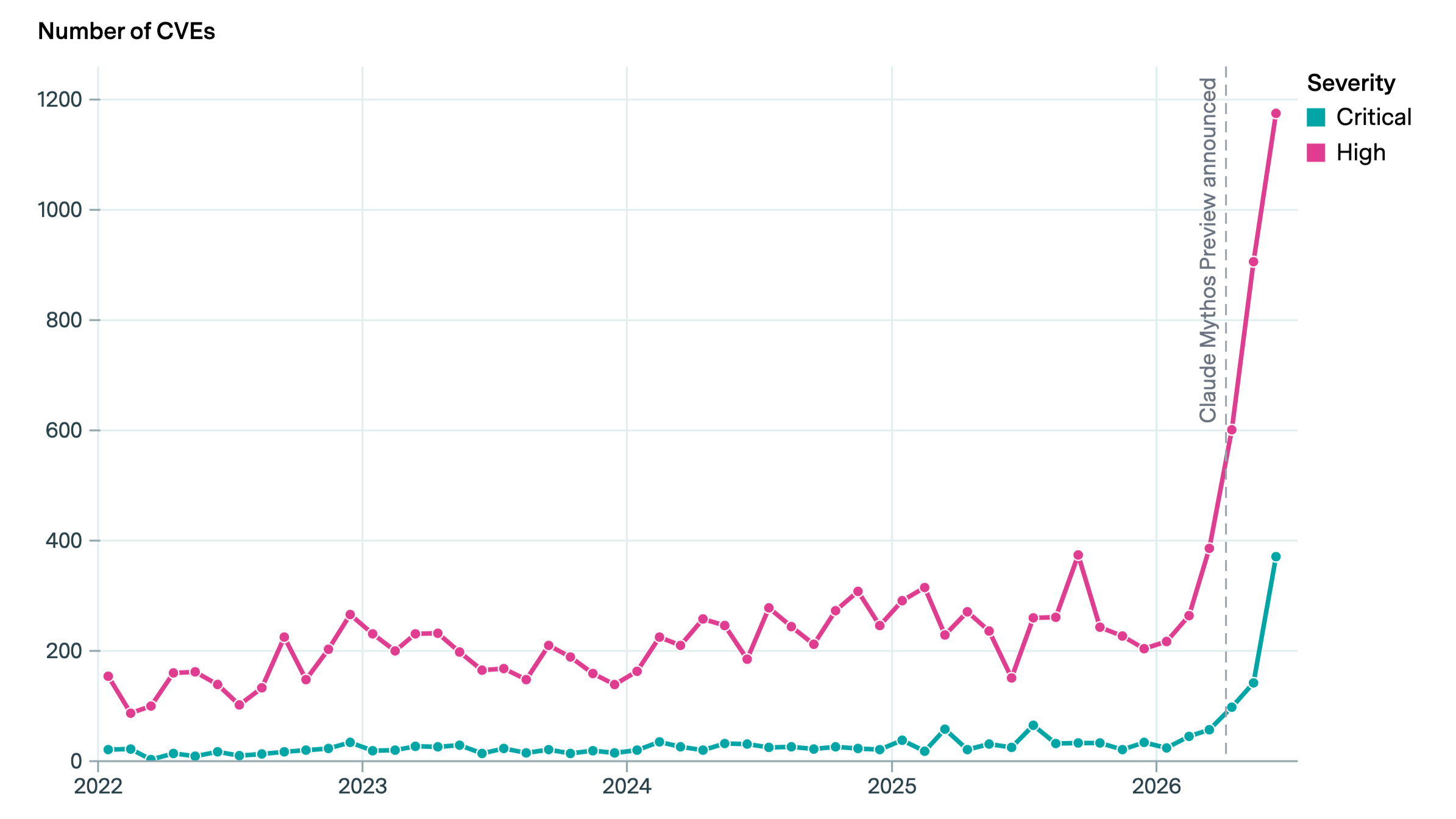
New serious vulnerabilities spiked around release of Claude Mythos Preview (Epoch.Ai)
Summary: In April 2026, Anthropic announced that its Claude Mythos Preview model could autonomously discover and exploit cybersecurity vulnerabilities. Since then, both Anthropic and OpenAI have deployed frontier models to harden critical software. The number of high- and critical-severity CVEs surged more than 3.5x in June compared to the previous monthly record. This spike suggests that automated vulnerability discovery by AI is now a practical reality, not just a theoretical risk.
Why it matters: This marks a shift from AI as a defensive tool to AI as an active vulnerability generation engine, compressing the timeline for patch cycles and forcing a re-evaluation of software supply chain security.
Context: The CVE system tracks publicly disclosed vulnerabilities; a 3.5x increase in high-severity CVEs in a single month is unprecedented outside of major zero-day waves or disclosure policy changes.
"Epoch’s work is free to use, distribute, and reproduce provided the source and authors are credited under the Creative Commons BY license. Learn more about this graph In April 2026, Anthropic announced." — EPOCH.AI
Commentary: The timing strongly implies that frontier models are now finding vulnerabilities faster than human researchers can responsibly disclose them. This creates a new operational tempo for security teams: if AI can find and exploit flaws at this rate, the window between discovery and patch must shrink from weeks to days. Expect pressure on CVE numbering authorities and a push for automated patching pipelines.
Date: July 03, 2026 05:16 PM ET
URL: https://epoch.ai/data-insights/cve-severity-spike
Discussion: https://news.ycombinator.com/item?id=48780056
AI Sentiment Score: Negative (62%)
AI Credibility Score: 10.0/10 — High
Scores and text generated by AI analysis of the source article indicated.
Post ID: 81b4c468