Audience Behavior & Distribution Shifts
How Film Distribution Rights Work for Indie Filmmakers (Thoolie)
Summary: This piece breaks down the mechanics of film distribution rights, emphasizing that rights are divisible by window (theatrical, SVOD, AVOD, etc.) and territory, and that smart producers negotiate each slice separately rather than selling all rights in a single deal. It argues that the strongest distribution strategies begin during development, not after the film is finished, and warns that losing track of who controls which territory can kill future licensing opportunities. The article provides a typical windowing sequence and advises pushing for non-exclusive or time-limited grants when a distributor demands ‘all rights.’
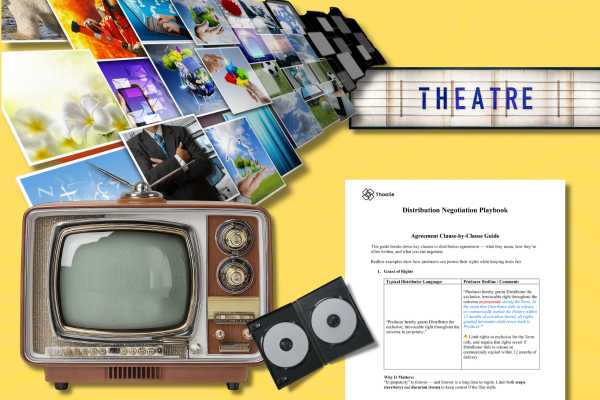
Why it matters: For indie filmmakers and investors, this is a practical reminder that distribution is a portfolio of assets, not a single transaction — and that poor windowing or territory management can permanently cap a film’s revenue potential.
Context: The article reflects a broader industry shift toward fragmented, platform-specific licensing as streaming services compete for content, making windowing strategy more critical than ever for independent productions.
"Distribution rights determine who sees your film, where, on which platforms, for how long, and how much money flows back to you. … Think of them as slices of a pie —." — THOOLIE
Commentary: The immediate implication is operational rather than speculative: watch how this changes budgets, workflows, or risk assumptions over the next cycle.
Date: June 16, 2026 08:00 PM ET
URL: https://thoolie.com/creator_resource/ultimate-guide-to-film-distribution-rights-agreements/
AI Sentiment Score: Negative (50%)
AI Credibility Score: 10.0/10 — High
Scores and text generated by AI analysis of the source article indicated.
Why streaming viewers are choosing ads over … (Ppc.Land)
Summary: The Video Advertising Bureau’s June 2026 report documents four behavioral shifts in U.S. streaming: intentional multi-service use, strong long-form engagement, a decisive migration to ad-supported tiers, and growing consumer comfort with targeted and interactive ads. The headline finding is that 89% of paid streaming subscribers now use at least one ad-supported service, with 44% exclusively on ad-supported plans and only 11% remaining ad-free. Among AVOD subscribers, 61% actively chose ads rather than defaulting, citing cost savings and the value of natural breaks. FAST sports channels have more than doubled since 2022, and unscripted dominates due to favorable production economics.

Why it matters: The ad-supported model has become the default, not a compromise, reshaping how platforms price tiers, how advertisers allocate budgets, and how content libraries are built.
Context: Streaming services have been pushing ad tiers for years, but this data shows the shift is now consumer-driven rather than platform-imposed, with implications for premium content investment and ad-tech integration.
"The Video Advertising Bureau today published its June 2026 edition of "Staying Current on Streaming," a Fast Facts briefing that maps four behavioral shifts now reshaping connected television for advertisers and media." — PPC.LAND
Commentary: The finding that 61% of AVOD subscribers actively chose ads signals a structural change in consumer value perception: ads are now a feature, not a penalty. This gives platforms pricing power to raise ad-tier rates and justifies heavier investment in ad-tech and targeting. For content owners, the dominance of unscripted on FAST channels suggests a bifurcation where premium scripted content remains behind paywalls while lower-cost library content fuels ad-supported growth. The 11% exclusively ad-free cohort is now a niche, not a market segment worth optimizing for.
Date: June 14, 2026 08:00 PM ET
URL: https://ppc.land/why-streaming-viewers-are-choosing-ads-over-subscriptions-in-2026/
AI Sentiment Score: Negative (60%)
AI Credibility Score: 10.0/10 — High
Scores and text generated by AI analysis of the source article indicated.
The 2026 TV Industry Trends & Predictions Report | 3Vision (3Vision.Tv)
Summary: The 2026 TV Industry Trends & Predictions Report from 3Vision finds that media consolidation is expected to have the greatest impact on content markets this year, followed by YouTube, AI, and global streamers. Netflix’s dominance has strengthened significantly, with 68% of industry executives ranking it the top growth streamer, up from 43% last year. Sports rights remain a critical battleground, with 93% expecting streamers to acquire more. Meanwhile, FAST investment is focusing on monetisation and live content, while micro dramas are emerging but face monetisation uncertainty.

Why it matters: This report signals a decisive shift in power toward Netflix and a consolidation-driven market, forcing studios, distributors, and advertisers to recalibrate their strategies around sports rights, FAST monetisation, and local partnerships.
Context: The survey was conducted from December 2025 to January 2026 among a global network of industry executives, capturing sentiment amid ongoing economic and geopolitical uncertainty.
"Netflix was again ranked the #1 streamer for growth — 68% ranked them #1, significantly up from 43% last year." — 3VISION.TV
Commentary: Netflix’s leap from 43% to 68% in just one year is a striking consolidation of perceived market leadership, likely accelerating deal-making and content investment around its platform. The near-universal expectation of more sports rights acquisitions suggests a bidding war that could reshape both linear and digital sports distribution. Meanwhile, the uncertainty around micro dramas indicates that while formats are proliferating, the monetisation models remain unproven, creating both opportunity and risk for studios and platforms alike.
Date: June 18, 2026 08:00 PM ET
URL: https://www.3vision.tv/reports/the-2024-tv-industry-trends-predictions-report
AI Sentiment Score: Negative (83%)
AI Credibility Score: 10.0/10 — High
Scores and text generated by AI analysis of the source article indicated.
Podcast reach hits record highs as video viewing grows (Digitalcontentnext)
Summary: Podcast consumption in the U.S. has hit record highs, with 58% of Americans aged 12+ now listening monthly—up from 55% in 2025—and 45% tuning in weekly. The growth is fueled by a structural shift: video podcast consumption surpassed audio-only in late 2025, and 57% of listeners now engage with both formats. Demographic expansion is also driving the surge, with Black and Hispanic audiences exceeding the national average at 66% and 60% monthly reach respectively. Edison Research and SiriusXM Media’s The Podcast Consumer report underscores that this is not a pandemic echo but a sustained behavioral change with direct implications for ad spend and platform strategy.

Why it matters: For media buyers and platform strategists, the crossover of video and audio consumption signals that podcasting is no longer a niche audio format but a visual medium competing for screen time, forcing a re-evaluation of production costs, ad formats, and distribution partnerships.
Context: The report marks the first time video podcast consumption has overtaken audio-only in Edison’s Podcast Metrics data, a tipping point that aligns with Spotify and YouTube’s aggressive video podcast investments.
"New research from Edison Research and SiriusXM Media, The Podcast Consumer , finds that podcast consumption has reached record highs in the U.S., driven by growth across demographic groups, rising video engagement,." — DIGITALCONTENTNEXT
Commentary: The video-audio crossover is the real story here, not just the topline growth. It means podcasters must now compete for screen time, not just ear time, which changes production economics and ad placement strategies. The demographic breadth—especially above-average reach among Black and Latino audiences—also suggests that podcasting is becoming a primary medium for culturally specific content, which could reshape how advertisers allocate multicultural budgets. Expect platforms to double down on video-first podcast tools and for audio-only shows to face increasing pressure to add a visual layer or risk losing share.
Date: June 15, 2026 08:00 PM ET
URL: https://digitalcontentnext.org/blog/2026/06/16/podcast-reach-hits-record-highs-as-video-viewing-grows/
AI Sentiment Score: Negative (75%)
AI Credibility Score: 10.0/10 — High
Scores and text generated by AI analysis of the source article indicated.
Perry Sook: Big Tech Poses `Very Urgent’ Threat to Broadcast Stations (Tvtechnology)
Summary: Nexstar CEO Perry Sook published an op-ed in Fortune arguing that the Nexstar/Tegna merger is essential to prevent local broadcast news from collapsing like newspapers did. The deal is stalled by a federal injunction in California while an antitrust suit from state attorneys general and DirecTV proceeds. Sook frames the merger as a necessary response to Big Tech’s dominance, warning that without scale, local stations cannot compete for audiences or advertising. He explicitly ties the deal’s failure to a future of algorithm-driven misinformation and diminished local journalism.

Why it matters: This frames the consolidation debate around existential survival rather than market power, potentially shifting regulatory and public perception of media mergers.
Context: The Nexstar/Tegna deal was approved by the FCC and DOJ but halted by a California district court in April amid antitrust litigation. Sook’s op-ed is a direct appeal to public and political sentiment as the legal battle continues.
"Without the ability to grow, local broadcasters will struggle to compete for audiences, attract advertising, and invest in the journalism that is vital to our communities." — TVTECHNOLOGY
Commentary: Sook’s argument weaponizes the newspaper industry’s collapse as a cautionary tale, but it sidesteps the core antitrust concern: that further consolidation reduces local ownership diversity. The real test will be whether courts accept scale as a defense against platform power or see it as accelerating the very concentration that hollows out local news. For investors, the outcome signals whether consolidation or fragmentation defines the next decade of local media.
Date: June 15, 2026 01:09 PM ET
URL: https://www.tvtechnology.com/regulatory-legal/perry-sook-big-tech-poses-very-urgent-threat-to-broadcast-stations
AI Sentiment Score: Negative (85%)
AI Credibility Score: 10.0/10 — High
Scores and text generated by AI analysis of the source article indicated.
Post ID: 0d14b7b7