

Virtual Production & Real-Time VFX
Virtual Production for Beginners – New MZed Course on Green Screen Stages, Unreal Engine, and Real-Time Compositing | CineD (Cined)
Summary: MZed’s new course ‘Virtual Production for Beginners,’ taught by Biro Florin of Masterwork Films, explicitly rejects the LED volume-centric narrative to focus on accessible green screen workflows. It provides a ten-hour, systems-engineering curriculum for building and operating a real-time compositing studio using Unreal Engine, hardware keyers, and tracking systems. The course targets commercial producers, indie filmmakers, and studio operators who need multi-camera flexibility and cannot justify LED stage costs, structuring lessons around tested, operational configurations from Florin’s own facility.

Why it matters: It signals a pragmatic, cost-driven pivot in virtual production adoption, offering a scalable operational blueprint that directly impacts staffing models, vendor selection, and the economics of mid-tier and high-volume content production.
Context: Industry discourse has been dominated by high-end LED volume workflows since ‘The Mandalorian,’ creating a perceived barrier to entry. Concurrently, the rise of generative AI and accessible 3D environments has increased demand for reliable, real-time compositing.
"Florin argues that the LED route has priced out the very filmmakers most likely to put virtual production to work in everyday output: commercial producers, podcast operators, brand teams, indie filmmakers, and YouTube studios that want to drop real talent into Unreal Engine, AI-generated, or video-plate environments without renting a volume." — CINED
Commentary: The course crystallizes a market segmentation within virtual production, validating green screen as the throughput and multi-camera workhorse for commercial and episodic content. This shifts leverage from large volume vendors to integrators specializing in signal routing, keying, and tracking systems, and pressures post-production roles to absorb real-time compositing skills. It also provides a concrete labor pathway for technical engineers, creating a new class of on-set virtual production operators distinct from traditional VFX supervision.
Date: May 22, 2026 12:00 AM ET
URL: https://www.cined.com/virtual-production-for-beginners-new-mzed-course-on-green-screen-stages-unreal-engine-and-real-time-compositing/
AI Sentiment Score: Negative (63%)
AI Credibility Score: 10.0/10 — High
Scores and text generated by AI analysis of the source article indicated.
Virtual Production & LED Volumes In 2026 Guide (Vitrina.Ai)
Summary: Virtual production via LED volumes has matured from a high-end novelty into a $3.7B market growing at 16% annually, with in-camera VFX (ICVFX) as the core operational innovation. Adoption now spans episodic streaming, advertising, and independent filmmaking, not just blockbuster features. The shift reconfigures pre-production timelines, capital deployment for stage infrastructure, and competitive positioning for producers and studios.
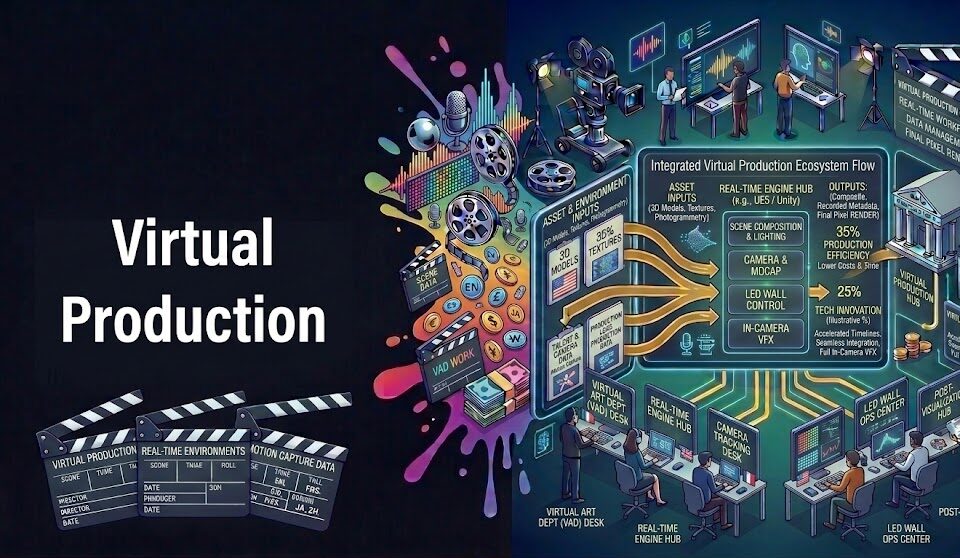
Why it matters: This determines capital allocation for facilities, reshuffles vendor and crew dependencies, and alters the risk calculus for scheduling and budgeting high-value shoots.
Context: LED volume stages initially concentrated capital and capability with top-tier VFX vendors and major studios, creating a two-tier market.
"Virtual production powered by LED volume stages is no longer the exclusive territory of Disney and ILM. It’s a $3.7 billion market in 2026 growing at 16% annually, and it’s reshaping not." — VITRINA.AI
Commentary: The democratization of access shifts leverage from pure-post VFX houses to integrated pre-vis and virtual art departments, locking in creative decisions earlier. For line producers, the critical path now runs through virtual art department lead times (8-12 weeks), making parallelization a key scheduling discipline. The aggressive adoption in advertising and episodic underscores a reallocation of studio capex toward owned volume facilities as a hedge against location volatility and post-production overruns.
Date: May 21, 2026 12:00 AM ET
URL: https://vitrina.ai/blog/virtual-production-led-volume-stages-2026/
AI Sentiment Score: Negative (66%)
AI Credibility Score: 10.0/10 — High
Scores and text generated by AI analysis of the source article indicated.
Virtual Production is Production – Part 2 – Producing, Budgeting, Scheduling & Crewing (Youtube)
Summary: The Visual Effects Society and Producers Guild of America are formalizing budgeting, scheduling, and crewing frameworks for virtual production. The core argument is that virtual production is not a post-production cost center but a fundamental production methodology that must be integrated from the earliest script breakdown and concept design stages. This requires shifting significant budget and decision-making authority into pre-production to develop ideas and environments for in-camera capture. The approach is framed as ‘uplifting the visual effects process,’ promising downstream cost savings on complex shots.

Why it matters: This signals a structural shift in production finance and pipeline control, moving VFX from a post-cost to a pre-production investment and altering the leverage and workflow between producers, directors, and VFX vendors.
Context: Industry guilds are attempting to codify best practices as virtual production moves from experimental to mainstream, seeking to stabilize unpredictable budgets and schedules that have plagued early LED wall and hybrid productions.
"##### May 21, 2026 (1:30:28) The Visual Effects Society (VES) and Producers Guild of America (PGA) join together for a second event to analyze scheduling and budgeting for virtual production. In this." — YOUTUBE
Commentary: The guild-led push to formalize ‘virtual production as production’ directly attacks the traditional vendor-client model by embedding VFX decision-making at the producer level earlier. This could pressure VFX houses to offer pre-vis and asset creation as upstream, fixed-cost services, potentially compressing margins but securing earlier buy-in. The promised ‘cost savings’ on final shots come with a higher, riskier front-loaded investment, shifting financial exposure earlier in the production cycle. Crewing implications point toward a new hybrid role—a ‘virtual production supervisor’—with authority over both creative vision and technical budgeting from day one.
Date: May 21, 2026 12:00 AM ET
URL: https://www.youtube.com/watch?v=BRF-hczWh1Y
AI Sentiment Score: Negative (62%)
AI Credibility Score: 10.0/10 — High
Scores and text generated by AI analysis of the source article indicated.
Navigating the Changing Landscape of Virtual Production (Youtube)
Summary: A VES and Netflix-led panel frames virtual production’s ongoing evolution as a methodological shift, not merely a hardware upgrade. The discussion argues that adoption is accelerating and that the core change is moving creative and technical decisions earlier into pre-production. The central claim is that pre-vis is now the true start of production, fundamentally reordering the traditional pipeline.
Why it matters: This redefinition directly impacts budgeting, crew assembly, vendor selection, and intellectual property management by collapsing pre-pro, principal photography, and post into a more concurrent, front-loaded process.
Context: The industry is grappling with the operational and financial realities of VP after an initial hype cycle focused on LED volumes. The conversation is moving from capex on gear to opex on pipeline redesign and skills retraining.
"##### May 21, 2026 (1:34:55) Join the VES Technology Committee and the Virtual Production Committee as we collaborate with Netflix to lead a series of conversations around Virtual Production. This first online." — YOUTUBE
Commentary: This signals a consolidation of vendor power towards pre-vis and real-time engine specialists, while marginalizing traditional on-set VFX supervision roles. The economic consequence is a transfer of budget and decision-making authority from the physical shoot to the digital pre-build phase, altering leverage for VFX houses and demanding new hybrid skill sets from crews.
Date: May 21, 2026 12:00 AM ET
URL: https://www.youtube.com/watch?v=-p9bjvx7Oqo
AI Sentiment Score: Negative (50%)
AI Credibility Score: 10.0/10 — High
Scores and text generated by AI analysis of the source article indicated.
Virtual Production Market Size, Share & Forecast by 2035 (Consegicbusinessintelligence)
Summary: The virtual production market is projected to reach USD 12.22 billion by 2035, growing at a CAGR of 14.60%. This expansion is driven by demand for streaming content, the integration of game engine technology, and pressure for faster production timelines. However, high capital costs for LED walls and rendering infrastructure remain a significant barrier to entry for new studio development.

Why it matters: For VFX supervisors, line producers, and studio operations heads, this forecast signals a continued capital-intensive shift in production infrastructure, directly impacting budgeting, vendor selection, and crew skill requirements.
Context: The pivot to virtual production, accelerated by pandemic-era constraints, is maturing from an experimental workflow to a core studio capability, with permanent LED stages becoming strategic assets.
"## Virtual Production Market Scope & Overview:onVirtual production can be described as the use of real-time digital technologies to create and integrate visual environments during the filmmaking and content creation process. This." — CONSEGICBUSINESSINTELLIGENCE
Commentary: The projected growth consolidates power among major studios and a few large-scale vendors who can absorb the capex, potentially marginalizing smaller shops and independent producers. This will accelerate the bifurcation of the VFX labor market into high-cost, on-set real-time roles and lower-cost, remote post-production roles, while making complex shots more predictable but also more economically centralized.
Date: May 18, 2026 12:00 AM ET
URL: https://www.consegicbusinessintelligence.com/virtual-production-market
AI Sentiment Score: Negative (57%)
AI Credibility Score: 7.0/10 — Medium
Scores and text generated by AI analysis of the source article indicated.
Virtual production in 2026: Did the industry predictions come true? (Gardenstudios.Io)
Summary: A 2026 retrospective finds virtual production (VP) has achieved partial normalization, becoming a standard tool for specific high-efficiency applications like driving scenes in high-end TV and features, but has not triggered the wholesale pipeline transformation once predicted. The market is projected for significant growth, yet adoption is constrained by a persistent skills shortage and remains tactical rather than systemic.

Why it matters: For VFX supervisors, line producers, and stage operators, this signals a shift from speculative capital expenditure on bespoke LED volumes to a more pragmatic, rental-based model focused on discrete shot economics, altering vendor leverage and crew skill requirements.
Context: Initial VP hype centered on revolutionizing entire productions through in-camera VFX; reality has seen it slot into existing pipelines as a cost- and time-saving tool for specific, repeatable shot types, validating a narrower use case.
"Virtual production (VP) is a filmmaking technology that combines digital environments with physical sets, allowing actors and filmmakers to see the end result in real-time, also known as in-camera visual effects. Early." — GARDENSTUDIOS.IO
Commentary: The concentration on driving scenes reveals VP’s current value proposition: it optimizes a known, labor-intensive, and logistically cumbersome production bottleneck. This specialization boosts throughput for these shots but does not inherently ‘re-empower artistic collaboration’ across departments as forecast. The growth projections hinge on expanding beyond these niche applications, which the skills shortage directly impedes, creating a bottleneck in labor rather than technology.
Date: May 21, 2026 12:00 AM ET
URL: https://gardenstudios.io/news/virtual-production-in-2026-did-the-industry-predictions-come-true/
AI Sentiment Score: Negative (50%)
AI Credibility Score: 7.0/10 — Medium
Scores and text generated by AI analysis of the source article indicated.
The virtual production stage (VP Stage) of the CJ ENM Studio Center in Paju, Gyeonggi-do. It may be .. (Mk.Co.Kr)
Summary: CJ ENM’s Studio Center in Paju has deployed a virtual production stage where a film, ‘Apartment,’ was shot in four days at a cost of approximately 500 million won. The production method, termed ‘AI hybrid,’ involves actors performing against an LED wall displaying AI-generated background imagery and visual effects, eliminating location shoots and extensive post-production VFX work. The studio claims this process reduced costs by more than five times compared to traditional methods.

Why it matters: This demonstrates a concrete, scaled implementation where AI generation directly substitutes for labor-intensive VFX and location work, materially altering production economics and vendor dependencies.
Context: Virtual production stages using LED volumes have gained traction, but typically rely on pre-rendered or game-engine assets; the integration of real-time AI image generation represents a next-stage evolution in reducing asset creation time and cost.
"When I went to the ‘CJ ENM Studio Center’ virtual production stage, I saw that only the actors did their live action and background were all AI … The film was produced." — MK.CO.KR
Commentary: The five-fold cost reduction, if replicable, shifts the break-even point for mid-budget genre projects and pressures traditional VFX vendors reliant on complex compositing and environment builds. This model prioritizes speed and cost over bespoke artistry, potentially redefining crew requirements on set and in post, while concentrating leverage with studios controlling the AI toolchain. The four-day shoot for a feature-length project indicates a fundamental compression of the production pipeline, with implications for scheduling, stage rentals, and above-the-line talent deals.
Date: May 23, 2026 12:00 AM ET
URL: https://www.mk.co.kr/en/it/12056376
AI Sentiment Score: Negative (83%)
AI Credibility Score: 10.0/10 — High
Scores and text generated by AI analysis of the source article indicated.
How ICVFX Works: Real-Time VFX Tools for LED Volume Studios (Forgevirtualstudios)
Summary: The article describes the core technical components of In-Camera Visual Effects (ICVFX), focusing on the integration of high-resolution LED volumes and real-time game engines like Unreal Engine. It explains how LED walls provide dynamic, emissive backgrounds that generate realistic on-set lighting and reflections, while the game engine acts as the rendering and simulation hub, updating the scene in real-time based on camera movement.
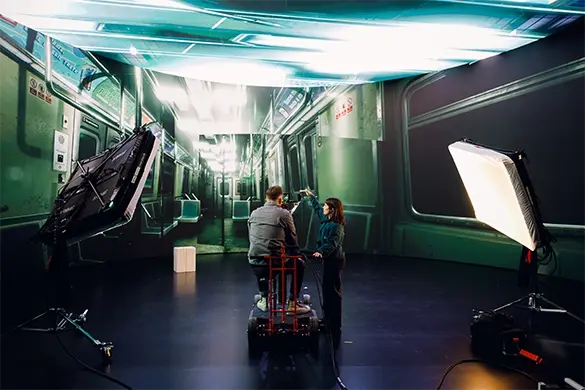
Why it matters: This operational blueprint clarifies the foundational technology shifting VFX from a post-production cost center to an on-set, real-time discipline, directly impacting production scheduling, crew skillsets, and vendor service offerings.
Context: ICVFX represents a move toward ‘virtual production,’ aiming to reduce post-production VFX costs and iteration time by capturing complex environments and lighting in-camera, a trend accelerated by productions like ‘The Mandalorian.’
"Because the LED panels emit actual light, they introduce realistic reflections, accurate color interplay, and lighting that blends with real world elements." — FORGEVIRTUALSTUDIOS
Commentary: The shift to emissive LED volumes fundamentally alters the economics of complex shots by collapsing lighting and compositing into a single on-set capture event, reducing downstream vendor work but increasing the capital and technical expertise required during principal photography. This pressures VFX vendors to move upstream into on-set technical supervision and real-time content creation, while cinematographers and gaffers must master a new, software-integrated lighting paradigm.
Date: May 22, 2026 12:00 AM ET
URL: https://forgevirtualstudios.com/blog/real-time-vfx-in-led-volume-studios-tools-and-techniques
AI Sentiment Score: Negative (50%)
AI Credibility Score: 10.0/10 — High
Scores and text generated by AI analysis of the source article indicated.
Finland’s Fireframe Studios Launches Slate of Immersive-First Films (Variety)
Summary: Finland’s Fireframe Studios, founded by Supercell co-founder Mikko Kodisoja, is launching a slate of original feature films designed from inception for immersive formats. The slate includes Kodisoja’s directorial debut ‘Puzzle Box,’ alongside projects from David Sandberg and the Higton Brothers, all leveraging the studio’s Helsinki-based virtual production facility with LED volumes and custom workflows. The company’s approach treats cinematic storytelling and real-time technology as a unified ecosystem, aiming to create IP that functions natively across film, games, and immersive experiences.

Why it matters: This signals a new, well-capitalized production model that treats immersive formats as a primary distribution target rather than a post-hoc conversion, potentially reshaping the economics and creative pipeline for high-concept genre films.
Context: Virtual production volumes have largely been used as a cost-control and scheduling tool for traditional filmmaking; Fireframe’s ‘immersive-first’ mandate represents a pivot toward designing IP for premium experiential formats from the script stage.
"Finland’s Fireframe Studios, a virtual production studio founded by gaming giant Supercell co-founder Mikko Kodisoja, is launching a full slate of immersive-first features that includes new films from David Sandberg (“Kung Fury”),." — VARIETY
Commentary: Fireframe’s model, backed by gaming capital and a pipeline built to capture native data for multiple formats, could pressure traditional studios and VFX vendors to integrate format-specific design earlier. If successful, it shifts leverage from post-production adaptation to pre-production world-building, potentially altering staffing models toward real-time engine expertise and changing the economics of complex shots by baking immersive-ready assets into the initial capture.
Date: 2 weeks ago
URL: https://variety.com/2026/film/global/kung-fury-dead-of-night-supercell-fireframe-studios-1236739097/
AI Sentiment Score: Negative (50%)
AI Credibility Score: 10.0/10 — High
Scores and text generated by AI analysis of the source article indicated.
EP.05 – This Week In CG, VFX, and Games (Youtube)
Summary: Unreal Engine 5.8’s Megalights renderer reached production-ready status, while Substance Painter, Blender via Claude, and Cavalry all saw significant updates. The week’s announcements signal a concurrent push across multiple pipeline nodes toward greater automation, accessibility, and real-time capability. This consolidation of tools during SIGGRAPH season suggests vendors are competing on integration and AI-assisted workflows.
Why it matters: For VFX supervisors and pipeline TDs, these shifts directly impact bidding, staffing, and software stack decisions, altering the cost and time equations for complex shots.
Context: SIGGRAPH season traditionally sees a flurry of vendor updates aimed at securing studio pipeline commitments for the coming year.
"##### May 21, 2026 (0:04:50) UE5.8 Megalights went production-ready, Substance Painter shipped the Ribbon Tool, Claude now drives Blender via MCP, and Cavalry went free. Five parts of the CG pipeline shifted." — YOUTUBE
Commentary: The direct integration of an LLM like Claude into a core DCC like Blender moves AI from a separate pre-vis or concept tool into the core modeling and animation workspace. This begins to shift the staffing model from pure technical artists toward more directorially-focused artists who can orchestrate complex procedures via natural language, potentially flattening team structures for certain tasks. It also increases the leverage of smaller studios and solo developers against larger vendors who rely on proprietary, manual-intensive toolsets.
Date: May 21, 2026 12:00 AM ET
URL: https://www.youtube.com/watch?v=sPCU12Kd3Ac
AI Sentiment Score: Negative (50%)
AI Credibility Score: 10.0/10 — High
Scores and text generated by AI analysis of the source article indicated.
Post ID: dea5de6c