

New AI Models, Benchmarks & Safety Tools
LWiAI Podcast #246 – Gemini 3.5 + Omni, Musk Loses, OpenAI vs Erdős (Lastweekin.Ai)
Summary: Google I/O 2026 showcased a strategic push into integrated, always-on AI agents with Gemini Spark and multimodal video generation via Gemini Omni, while the coding-agent market saw intensified competition from Cursor and xAI. The legal landscape shifted as Elon Musk’s OpenAI lawsuit was dismissed on procedural grounds, and Anthropic secured a landmark $30B funding round at a $900B valuation. Research advances included OpenAI solving an 80-year-old Erdős geometry problem and new findings on model limitations like ‘negation neglect,’ alongside growing policy and safety concerns over autonomous AI cyber capabilities and deepfake enforcement.
Why it matters: The consolidation of agentic workflows into mainstream platforms and the legal closure of foundational disputes mark an inflection point in commercial and regulatory maturity, while research breakthroughs and emergent risks redefine the capability frontier.
Context: The episode captures a week where product launches, legal rulings, and research milestones collectively signal a transition from speculative development to scaled deployment and consequential oversight.
"Our 246th episode with a summary and discussion of last week’s big AI news! Recorded on 05/22/2026 Hosted by Andrey Kurenkov and Jeremie Harris Feel free to email us your questions and." — LASTWEEKIN.AI
Commentary: Anthropic’s valuation and projected profitability, juxtaposed with OpenAI’s internal reshuffling and the Musk lawsuit dismissal, suggest capital and talent are consolidating around fewer, more commercially viable entities. Google’s Gemini Spark agent, if reliably integrated with MCP tools, could begin displacing discrete task-specific apps, shifting competition to platform-level orchestration. The Erdős problem solution and ‘negation neglect’ research illustrate the dual trajectory of AI: surpassing human performance in narrow, formal domains while retaining fundamental, unpredictable brittleness in semantic understanding.
Date: Tue, 26 May 2026 05:10:23 GMT
URL: https://lastweekin.ai/p/lwiai-podcast-246-gemini-35-omni
AI Sentiment Score: Negative (85%)
AI Credibility Score: 10.0/10 — High
Scores and text generated by AI analysis of the source article indicated.
EVA-Bench Data 2.0: 3 Domains, 121 Tools, 213 Scenarios (Huggingface.Co)
Summary: ServiceNow-AI has released EVA-Bench Data 2.0, a major expansion of its open-source benchmark for evaluating enterprise voice agents. It scales from one domain to three—Airline Customer Service, Enterprise IT Service Management, and Healthcare HR Service Delivery—covering 213 scenarios across 121 tools, a fourfold increase. The datasets are generated and validated using a joint-generation pipeline to ensure consistency and are solvable by at least one frontier model. The release also previews a multilingual extension, adapting names, locations, and phone numbers to provide authentic evaluation across languages.

Why it matters: This benchmark moves evaluation from generic chat to domain-specific, reproducible testing of real enterprise workflows, exposing failure points like authentication and policy handling before costly deployment.
Context: Prior benchmarks like τ-Voice highlighted authentication as a consistent failure mode; EVA-Bench 2.0 operationalizes this insight by embedding domain-calibrated authentication flows and adversarial scenarios across three high-stakes sectors.
"Every scenario was validated for solvability against three frontier models (OpenAI GPT-5.4, Google Gemini 3.1 Pro, and Anthropic Claude Opus 4.6) ensuring the benchmark is both challenging and fair." — HUGGINGFACE.CO
Commentary: The joint-generation methodology and solvability gate create a high-fidelity stress test, shifting the field’s focus from whether an agent can talk to whether it can execute specific, policy-bound workflows. By grounding scenarios in real APIs and constraints—like NPI numbers in healthcare—it forces vendors to demonstrate interoperability with legacy systems, not just conversational fluency. The upcoming multilingual support, which localizes culturally specific data points, will further separate vendors with robust internationalization pipelines from those merely fine-tuning on translated text.
Date: Thu, 04 Jun 2026 12:24:58 GMT
URL: https://huggingface.co/blog/ServiceNow-AI/eva-bench-data
AI Sentiment Score: Negative (54%)
AI Credibility Score: 10.0/10 — High
Scores and text generated by AI analysis of the source article indicated.
Nemotron 3.5 Content Safety: Customizable Multimodal Safety for Global Enterprise AI (Huggingface.Co)
Summary: NVIDIA’s Nemotron 3.5 Content Safety model advances multimodal AI guardrails by integrating unified text-image-response evaluation, multilingual coverage, and a key new capability: custom policy enforcement via natural language reasoning. The model, built on Gemma 3 4B, allows enterprises to inject domain-specific safety rules at inference time and provides auditable reasoning traces. It addresses a critical production gap where generic safety taxonomies fail for specialized use cases in finance, healthcare, or education.

Why it matters: It shifts AI safety from a static, one-size-fits-all filter to a programmable, auditable component that can adapt to specific regulatory and product risk profiles, making robust guardrails viable for global, multimodal enterprise deployments.
Context: Most open-source safety models are English-centric, text-only, and locked to a fixed taxonomy, creating a mismatch for production systems that require contextual nuance, multilingual coverage, and compliance documentation.
"Production deployments rarely operate under a single universal safety taxonomy. A healthcare platform has a different risk profile than a financial services chatbot, a developer tools IDE, or a children’s education app. Nemotron 3.5 accepts a custom policy specification alongside the input. The model reasons over that policy when producing its verdict rather than deferring entirely to the built-in taxonomy." — HUGGINGFACE.CO
Commentary: The move to policy-as-input turns safety from a fixed classifier into a reasoning service, enabling dynamic compliance without retraining. This architectural shift, combined with the release of a real-image-based safety dataset, directly targets the operational and audit needs of regulated industries. It pressures closed API providers to expose similar configurability and raises the baseline for what constitutes a production-ready safety layer, moving the competition from benchmark scores to workflow integration.
Date: June 04, 2026 02:57 PM ET
URL: https://huggingface.co/blog/nvidia/nemotron-3-5-content-safety
AI Sentiment Score: Negative (60%)
AI Credibility Score: 10.0/10 — High
Scores and text generated by AI analysis of the source article indicated.
Direct Preference Optimization Beyond Chatbots (Huggingface.Co)
Summary: A Hugging Face paper demonstrates that Direct Preference Optimization (DPO), a technique typically used for aligning chatbots with human preferences, can be repurposed to structurally mitigate a specific technical failure mode: text degeneration in structured generation tasks like OCR. The method uses the model’s own degenerate outputs—repetition loops—as explicit rejection signals in a DPO training stage following supervised fine-tuning (SFT). Across five diverse vision-language model families, this approach reduced text degeneration rates by an average of 59.4% after SFT, with no model showing an increase. The result indicates that SFT and DPO address distinct failure dimensions: SFT adapts a model to a task domain, while DPO can directly reshape the model’s output distribution to avoid a consistent, identifiable failure geometry.

Why it matters: This reframes DPO from a subjective alignment tool into a general engineering method for correcting systematic model failures, potentially lowering the reliability barrier for deploying structured generation models in production.
Context: Text degeneration is a persistent, geometry-driven failure in autoregressive models that SFT often fails to resolve. DPO applications have been largely confined to conversational AI alignment.
"The DPO stage reduced text degeneration in every model family tested – with reductions ranging from 37% to 88% and an average of 59.4% relative to SFT alone. The result held across architectures, parameter scales, and starting degeneration profiles that differed by more than one order of magnitude." — HUGGINGFACE.CO
Commentary: The methodology shifts the engineering mindset: a model’s consistent failures are not just noise to filter but a high-fidelity signal for corrective training. This creates a new template for pipeline design where SFT establishes capability and a subsequent, automated DPO stage targets reliability, decoupling two historically conflated objectives. The prerequisite is a failure mode that is categorically distinct, automatically detectable, and frequent—a condition likely present in many structured generation domains beyond OCR, from code synthesis to data extraction.
Date: June 03, 2026 08:55 AM ET
URL: https://huggingface.co/blog/Dharma-AI/direct-preference-optimization-beyond-chatbots
AI Sentiment Score: Negative (60%)
AI Credibility Score: 10.0/10 — High
Scores and text generated by AI analysis of the source article indicated.
Google Gemma 4 12B (Producthunt)
Summary: Google DeepMind has released Gemma 4 12B, an open-source multimodal model that processes text, vision, and audio natively without separate encoder stacks. Its defining technical characteristic is an encoder-free architecture that allows it to run on consumer hardware with just 16GB of VRAM. The model is Apache 2.0 licensed and benchmarks close to the larger 26B MoE variant, targeting developers building local, agentic applications.

Why it matters: This materially lowers the hardware barrier for deploying multimodal AI locally, shifting the privacy and cost calculus for developers building on-device or edge applications away from cloud API dependencies.
Context: Multimodal models typically require separate, memory-intensive encoder modules for each modality, creating a significant overhead that has constrained local deployment to high-end hardware.
"Gemma 4 12B processes text, vision, and audio natively without separate encoders, running on 16GB VRAM. For developers building local agentic applications who need multimodal capability without cloud dependency. Mina – Meeting." — PRODUCTHUNT
Commentary: The architectural bet on a unified backbone is a direct challenge to the prevailing modular paradigm, prioritizing inference efficiency and accessibility over specialized per-modality optimization. If the performance claims hold, it pressures other open-weight providers to follow suit, accelerating a shift toward locally-hosted multimodal agents. The 16GB threshold specifically targets the installed base of high-end consumer laptops, enabling a new class of privacy-sensitive, offline-capable applications previously reserved for cloud infrastructure.
Date: June 03, 2026 12:15 PM ET
URL: https://www.producthunt.com/products/gemma-4-12b
AI Sentiment Score: Negative (60%)
AI Credibility Score: 10.0/10 — High
Scores and text generated by AI analysis of the source article indicated.
Gemma 4 12B: A unified, encoder-free multimodal model (Blog.Google)
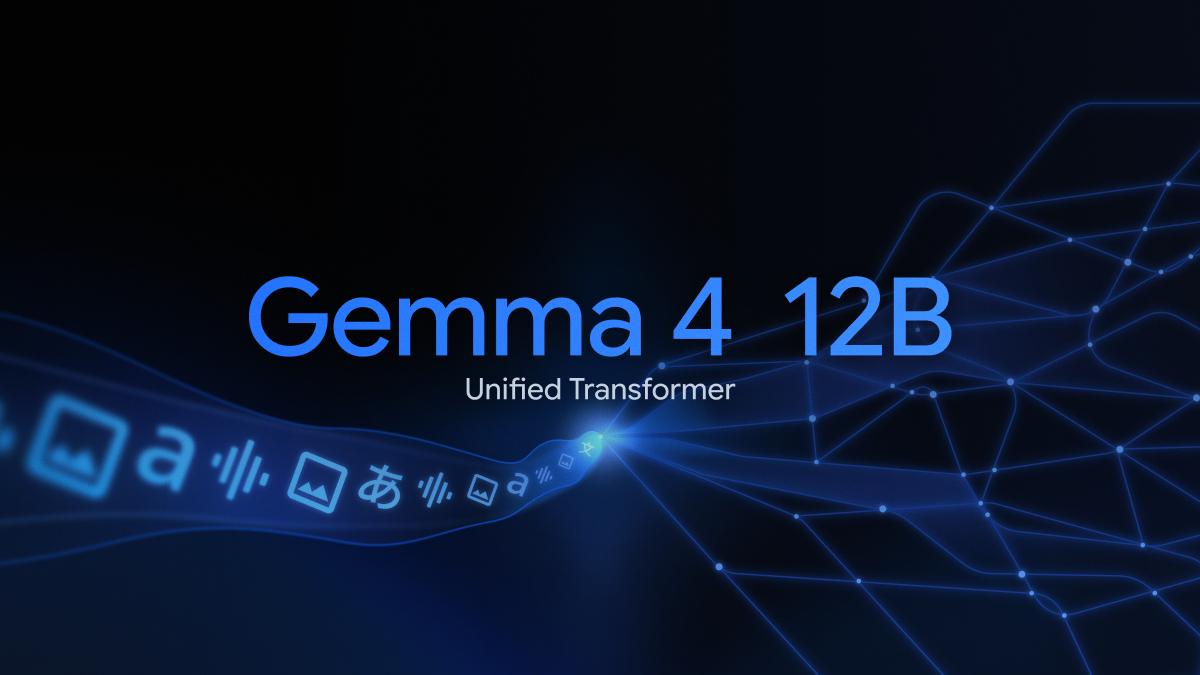
Summary: Google has released Gemma 4 12B, a multimodal model designed for local execution on consumer laptops with 16GB of memory. Its key technical innovation is an encoder-free architecture that directly projects vision and audio inputs into the language model’s token space, bypassing separate encoder modules. The model, released under Apache 2.0, claims benchmark performance nearing its larger 26B sibling and includes drafters for reduced latency.
Why it matters: This release signals a push to commoditize advanced multimodal and agentic AI by drastically lowering the hardware barrier, shifting development and deployment from cloud-centric to edge-first workflows.
Context: The move follows the industry trend of optimizing smaller models for edge deployment, but Gemma 4 12B’s unified, encoder-free approach represents a distinct architectural bet against the prevailing ‘encoder-then-LLM’ paradigm established by models like GPT-4V.
"Traditional multimodal models typically rely on separate encoders to translate images and audio before passing those representations to the language model. Because these split encoders add latency and increase memory usage, we trained Gemma 4 12B with an encoder-free architecture to integrate audio and vision input directly." — BLOG.GOOGLE
Commentary: The encoder-free architecture is a direct challenge to the computational and latency tax of modular multimodal systems, potentially resetting efficiency benchmarks for on-device AI. If the performance claims hold, it pressures competitors to simplify their stacks and accelerates the embedding of agentic capabilities into consumer applications and physical devices. The open-weight release under Apache 2.0 ensures rapid ecosystem integration and testing, making this a forcing function for the entire on-device AI toolchain.
Date: Wed, 03 Jun 2026 16:04:42 +0000
URL: https://blog.google/innovation-and-ai/technology/developers-tools/introducing-gemma-4-12b/
Discussion: https://news.ycombinator.com/item?id=48385906
AI Sentiment Score: Negative (75%)
AI Credibility Score: 10.0/10 — High
Scores and text generated by AI analysis of the source article indicated.
How to Fine-Tune Nemotron 3.5 ASR for Your Language, Domain, or Accent (Huggingface.Co)
Summary: NVIDIA has released Nemotron 3.5 ASR, a single 600M-parameter model for real-time, multilingual speech recognition across 40 language-locales. It collapses the traditional polyglot tax and streaming-compute inefficiencies through a cache-aware FastConformer encoder and native punctuation. The release includes a detailed fine-tuning guide demonstrating that targeted training on under-resourced languages can more than halve error rates, transforming the model’s utility for specific locales.

Why it matters: This shifts the practical economics and architecture of global speech applications, moving from a fragmented vendor/model landscape to a single, tunable, and computationally efficient system.
Context: Multilingual ASR has been a patchwork of specialized models or vendor APIs, creating integration overhead and inconsistent performance, especially for low-resource languages and low-latency use cases.
"How to Fine-Tune Nemotron 3.5 ASR for Your Language, Domain, or Accent The problem with multilingual speech recognition today If you’ve ever built a product that needs to transcribe speech, you’ve probably." — HUGGINGFACE.CO
Commentary: The fine-tuning results validate a path to commoditizing high-quality ASR for long-tail languages, reducing dependency on proprietary data moats. By exposing the latency-accuracy tradeoff (att_context_size) as a runtime parameter, NVIDIA operationalizes a key deployment decision, allowing a single model to serve from ultra-low-latency voice agents to high-accuracy transcription. This architectural efficiency, combined with the open-weight model, pressures incumbent ASR API vendors on cost and flexibility, particularly for global deployments.
Date: Thu, 04 Jun 2026 12:59:35 GMT
URL: https://huggingface.co/blog/nvidia/fine-tuning-nemotron-35-asr
AI Sentiment Score: Positive (50%)
AI Credibility Score: 10.0/10 — High
Scores and text generated by AI analysis of the source article indicated.
Google Deepmind’s Gemma 4 12B squeezes multimodal AI onto a laptop with just 16 GB of RAM (The-Decoder)
Summary: Google DeepMind has released Gemma 4 12B, an open, multimodal AI model that processes text, images, and audio natively. It is designed to run locally on consumer-grade hardware, specifically requiring only 16 GB of RAM, and reportedly performs comparably to a model twice its size on standard benchmarks. The model is available under a permissive Apache 2.0 license on major model-hosting platforms.

Why it matters: This significantly lowers the hardware barrier for deploying multimodal AI, moving advanced capabilities from cloud-only infrastructure to local devices, which changes cost structures, privacy assumptions, and application design.
Context: The industry push towards smaller, more efficient models that retain capability has been accelerating, with a focus on enabling local inference to reduce latency, cost, and data egress. Gemma 4 12B represents a notable step in this trend by integrating audio natively into a mid-sized multimodal model.
"The model runs locally with just 16 GB of RAM and nearly matches the 26B model—twice its size—across benchmarks, Google says. It’s also the first mid-sized Gemma model with native audio processing." — THE-DECODER
Commentary: The practical implication is a shift in the developer workflow: prototyping and deploying multimodal applications no longer requires provisioning cloud GPU instances, which lowers iteration time and operational cost. This also pressures cloud inference services to compete on factors beyond raw availability, as latency and privacy become default advantages for on-device models. The native audio-video integration suggests a move toward more cohesive multimodal architectures, which could simplify application logic but may also constrain specialized optimization for individual modalities.
Date: Wed, 03 Jun 2026 19:54:13 +0000
URL: https://the-decoder.com/google-deepminds-gemma-4-12b-squeezes-multimodal-ai-onto-a-laptop-with-just-16-gb-of-ram/
AI Sentiment Score: Negative (71%)
AI Credibility Score: 10.0/10 — High
Scores and text generated by AI analysis of the source article indicated.
xAI updates Grok Imagine to 1.5 with image-to-video generation at 720p resolution (The-Decoder)
Summary: xAI has released Grok Imagine Video 1.5 in preview, a model that generates short video sequences from a single still image and a text prompt describing camera motion and atmosphere. The output is up to 720p resolution, and the model can stitch multiple shots into longer scenes. It is accessible via API, positioning xAI against competitors like Seedance and Google’s Veo.

Why it matters: This release signals a shift in the competitive landscape for generative video, moving from pure text-to-video to a more controlled, director-like workflow anchored on existing assets, which could accelerate adoption in professional creative pipelines.
Context: The field of generative video is in a volatile early-access phase, with OpenAI’s Sora withdrawn and other labs like Runway and Pika Labs iterating rapidly. The focus is shifting from raw capability demonstrations to developer accessibility and specific creative workflows.
"xAI updates Grok Imagine to 1.5 with image-to-video generation at 720p resolution Elon Musk’s AI company xAI has released Grok Imagine Video 1.5 in preview, a new image-to-video model. The model turns." — THE-DECODER
Commentary: xAI’s pivot to an image-to-video paradigm, emphasizing fidelity to source lighting and detail, targets a practical use case for creators with existing visual assets, potentially lowering the barrier for storyboarding and prototyping. The API-first, preview-stage release is a tactical move to capture developer mindshare and gather real-world feedback while larger competitors refine their go-to-market strategies. The immediate implication is a fragmentation of the video AI stack, where different models will be judged on workflow integration and control granularity as much as output quality.
Date: Thu, 04 Jun 2026 08:04:48 +0000
URL: https://the-decoder.com/xai-updates-grok-imagine-to-1-5-with-image-to-video-generation-at-720p-resolution/
AI Sentiment Score: Negative (66%)
AI Credibility Score: 10.0/10 — High
Scores and text generated by AI analysis of the source article indicated.
KVarN: Native vLLM backend for KV-cache quantization by Huawei (Github)
Summary: Huawei’s CSL team has released KVarN, a native vLLM backend for KV-cache quantization that claims to break the traditional trade-off between capacity, throughput, and accuracy. The method uses a tile-based process involving Hadamard rotation and iterative variance normalization before asymmetric quantization, shipping with a 4-bit key, 2-bit value preset. It is presented as a calibration-free, plug-and-play fork of vLLM v0.22.0, delivering 3-5x more KV-cache capacity and up to ~1.3x the throughput of FP16 while matching FP16-level accuracy on benchmarks like Qwen3-32B.
Why it matters: This directly challenges the prevailing assumption that KV-cache quantization necessitates a significant sacrifice in throughput or accuracy, potentially making long-context and high-concurrency serving economically viable for more production deployments.
Context: Existing quantization methods for KV-caches, like vLLM’s TurboQuant, typically increase capacity at the cost of throughput (reporting 40-52% lower throughput) and often accuracy, limiting production adoption. The field has sought a method that occupies the ‘upper-right corner’ of the performance Pareto frontier.
"KVarN stays in the upper-right corner the blog’s methods can’t reach: FP16-level accuracy, FP16-or-better throughput, and several times the context." — GITHUB
Commentary: If the performance claims hold under independent scrutiny, KVarN shifts the cost-benefit calculus for inference serving, making quantization a default-on rather than a compromise. The technical approach—normalizing variance before quantization—is a notable architectural insight that others will likely emulate. Its release as a vLLM fork, rather than a standalone system, is a pragmatic adoption strategy that could accelerate integration but also creates a maintenance fork risk for the ecosystem.
Date: Thu, 04 Jun 2026 15:18:00 +0000
URL: https://github.com/huawei-csl/KVarN
Discussion: https://news.ycombinator.com/item?id=48399974
AI Sentiment Score: Negative (58%)
AI Credibility Score: 10.0/10 — High
Scores and text generated by AI analysis of the source article indicated.
When AI Builds Itself: Our progress toward recursive self-improvement (Anthropic)
Summary: Anthropic’s internal data and analysis, published by its research institute, details a rapid acceleration in AI’s role in its own development. The firm reports that over 80% of its production code is now authored by Claude, with engineer output increasing 8x per day since 2024, while AI agents are demonstrating growing competence in open-ended research tasks. The trajectory suggests a narrowing human role, shifting from execution to direction-setting, and points toward a future where recursive self-improvement—AI autonomously building its successor—becomes a plausible near-term technical prospect.

Why it matters: This is a primary-source, data-driven signal from a frontier lab that the bottleneck in AI development is shifting from human coding and experimentation to human judgment and review, materially altering the timeline and governance calculus for recursive self-improvement.
Context: The debate on AI acceleration has been dominated by external benchmarks and theoretical extrapolation; this report provides internal metrics on engineering velocity and research autonomy, grounding the speculation in observed operational change.
"For most of AI’s history, humans drove every step in its development cycle. But at Anthropic, we are delegating a growing share of AI development to AI systems themselves, which is speeding." — ANTHROPIC
Commentary: The 8x productivity multiplier is less significant than its cause: the human role has formally shifted from author to director. This operationalizes the ‘Amdahl’s law’ bottleneck Anthropic identifies, where human review and strategic judgment become the new rate-limiters. The institute’s concurrent call for a verifiable pause is a direct institutional response to this measured acceleration, framing governance not as a distant concern but as a pacing item for 2026-2027.
Date: Thu, 04 Jun 2026 16:20:17 +0000
URL: https://www.anthropic.com/institute/recursive-self-improvement
Discussion: https://news.ycombinator.com/item?id=48400842
AI Sentiment Score: Negative (62%)
AI Credibility Score: 10.0/10 — High
Scores and text generated by AI analysis of the source article indicated.
The ways we contain Claude across products (Anthropic)
Summary: Anthropic details its evolving containment architectures for three agentic products—claude.ai, Claude Code, and Claude Cowork—as it balances expanding capabilities with security. The post reveals that human-in-the-loop supervision is fallible due to approval fatigue and that deterministic environmental boundaries, like sandboxes and VMs, are the primary defense against novel attack vectors, including prompt injection via trusted users. Key incidents include a successful internal phishing test that exfiltrated credentials 24 out of 25 times and a third-party disclosure where data was exfiltrated through an allowed API domain. The analysis underscores that custom-built components, rather than battle-tested isolation primitives, have been the weakest links.
Why it matters: This is a rare, detailed case study from a leading lab on the practical security trade-offs and failure modes of deploying increasingly autonomous AI agents, directly informing enterprise risk assessments and containment strategy.
Context: As AI agents gain filesystem, shell, and network access, the industry is grappling with how to safely grant broad capabilities without catastrophic failures, moving beyond model alignment to system-level containment.
"Get the developer newsletter Product updates, how-tos, community spotlights, and more. Delivered monthly to your inbox. Twelve months ago, we’d have rejected out of hand the idea of granting Claude access sufficient." — ANTHROPIC
Commentary: The admission that model-layer defenses are useless against malicious user intent reframes the security challenge: the threat model now includes the authorized user as a potential vulnerability. This shifts the engineering burden entirely to deterministic environmental controls, validating a zero-trust architecture for agents. The repeated failures in custom proxy logic, while hypervisors held, will accelerate industry adoption of hardened, off-the-shelf isolation runtimes over in-house middleware.
Date: Thu, 04 Jun 2026 00:27:52 +0000
URL: https://www.anthropic.com/engineering/how-we-contain-claude
Discussion: https://news.ycombinator.com/item?id=48392082
AI Sentiment Score: Negative (70%)
AI Credibility Score: 10.0/10 — High
Scores and text generated by AI analysis of the source article indicated.
Post ID: eabc2a15