Emerging Tech Signals (Pre-Mainstream)
Controlling Reasoning Effort in LLMs (Magazine.Sebastianraschka)
Summary: OpenAI’s GPT-5.6 family introduces multiple reasoning-effort settings, a feature now standard in flagship LLMs. This article provides a technical deep dive into how these effort modes are implemented, covering methods from supervised fine-tuning to reinforcement learning with verifiable rewards. It analyzes six open-weight models—DeepSeek V4, Nemotron 3 Ultra, Kimi K2.5, GLM-5, Qwen3, and Inkling—to reveal a shared framework of mode-conditioned training and inference-time controls. The piece concludes that automatic effort selection remains elusive, with explicit user input likely persisting in the near term.
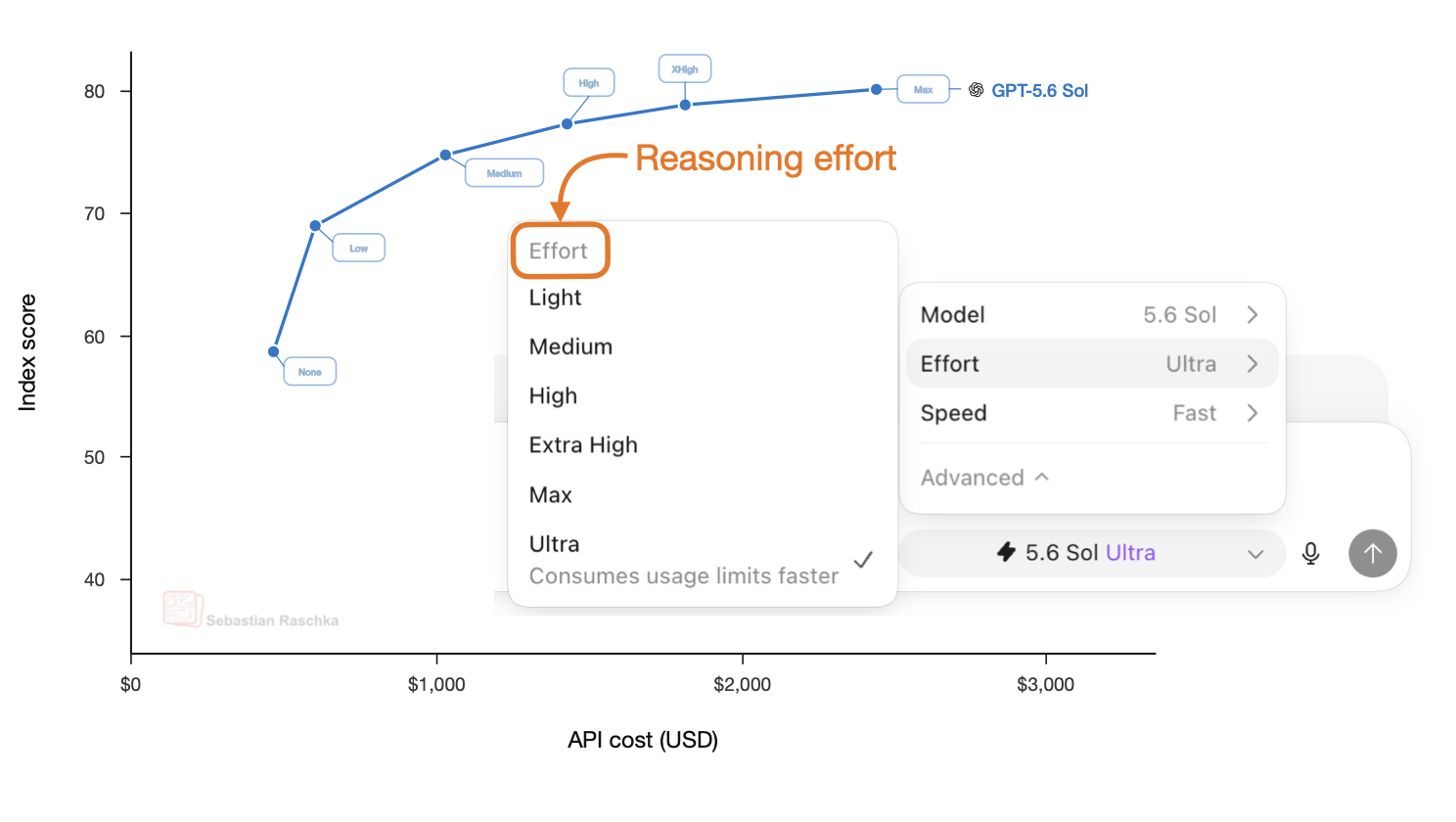
Why it matters: Reasoning-effort controls are becoming a critical interface for balancing cost, latency, and accuracy in LLM deployment, directly affecting how developers and enterprises optimize their AI spend.
Context: Since OpenAI’s o1 popularized reasoning models in 2024, the industry has moved from dedicated reasoning models to hybrid systems that can toggle between direct and chain-of-thought responses. The challenge now is granular control over reasoning depth.
"Controlling Reasoning Effort in LLMs How LLMs Learn Low-, Medium-, and High-Effort Reasoning Modes It has been almost two years since OpenAI released o1, a model that popularized the idea of LLM-based." — MAGAZINE.SEBASTIANRASCHKA
Commentary: The removal of GPT-5’s Auto mode is a telling signal that dynamic effort selection is harder than anticipated, likely due to the difficulty of predicting the optimal reasoning depth for arbitrary queries. This leaves a gap for agentic frameworks or routers to infer effort from task state, a space where startups like Thinking Machine Labs (Inkling) are already experimenting with continuous effort values. The practical implication is that for the foreseeable future, developers will need to manually tune effort settings or build their own routing logic, making this a key differentiator in LLM serving infrastructure.
Date: July 18, 2026 07:16 AM ET
URL: https://magazine.sebastianraschka.com/p/controlling-reasoning-effort-in-llms
AI Sentiment Score: Negative (85%)
AI Credibility Score: 10.0/10 — High
Scores and text generated by AI analysis of the source article indicated.
Mira Murati’s Thinking Machines drops Inkling, an open-weights model anyone can access – SiliconANGLE (Siliconangle)
Summary: Thinking Machines Lab, led by former OpenAI CTO Mira Murati, released Inkling, a 975-billion-parameter mixture-of-experts model with open weights. The model, trained from scratch in under nine months, uses only 41 billion parameters per prompt and supports native reasoning across text, image, audio, and video, though output is text-only. Thinking Machines is monetizing through its Tinker fine-tuning platform rather than API access, positioning Inkling as a Western alternative to Chinese open-weight models. Early benchmarks show coding performance comparable to Nvidia’s Nemotron 3 Ultra with two-thirds fewer tokens, and a Bridgewater Associates fine-tune achieved 84.7% on financial reasoning at under 10% of proprietary model costs.
Why it matters: Inkling shifts the open-weight AI center of gravity back to the West, offering enterprises a credible, customizable alternative to Chinese models while challenging the API-based pricing model of proprietary AI leaders.
Context: The Western open-source AI ecosystem has lagged behind China’s, especially after Meta deprioritized its Llama family in favor of proprietary systems. Thinking Machines’ strategy mirrors the shift from per-token API pricing to infrastructure-controlled customization.
"Mira Murati’s Thinking Machines drops Inkling, an open-weights model anyone can access Mira Murati’s Thinking Machines Lab Inc. today launched its first foundation model with the release of Inkling, making its full." — SILICONANGLE
Commentary: The real innovation here is the business model: charging for the fine-tuning platform rather than the model itself. If Tinker gains traction, it could accelerate LLM commoditization and force incumbents to rethink their pricing. The nine-month training timeline also suggests that the cost and time barriers to building frontier models are collapsing faster than many expected. Enterprises should watch how quickly fine-tuned Inkling instances displace API calls in regulated or cost-sensitive verticals.
Date: July 15, 2026 07:51 PM ET
URL: https://siliconangle.com/2026/07/15/mira-muratis-thinking-machines-drops-inkling-open-weights-model-anyone-can-access
AI Sentiment Score: Negative (66%)
AI Credibility Score: 10.0/10 — High
Scores and text generated by AI analysis of the source article indicated.
What building Shippy taught us about building agents (Huggingface.Co)
Summary: The Skylight team at Ai2 has published a detailed technical postmortem on building Shippy, an AI agent for maritime domain awareness used by 300+ partners across 70 countries. The core insight is that reliability in high-stakes operational domains comes from a layered architecture—typed APIs, a deterministic CLI, and versioned skills—that constrains what the nondeterministic LLM can get wrong. The team built a custom evaluation framework scoring the whole agent against live data, not static benchmarks, and an isolated hosting platform called Mothership that provisions per-user Kubernetes sessions. The post reveals specific failure patterns: patrol-planning overreach, geometry boundary errors, and hallucinated CLI commands, all of which directly inform skill improvements.

Why it matters: This is a rare, honest account of production agent engineering from a team that ships to real government users, showing that the hard problems are not model capability but tool design, evaluation methodology, and sandbox isolation.
Context: Most agent-building advice comes from demos or controlled benchmarks; Shippy’s team had to make an agent that could not be wrong about vessel positions without risking real patrol resources and personnel safety.
"In early prototypes, we let Shippy construct API calls from scratch. It produced a steady stream of subtle bugs: malformed pagination that silently dropped results, geometry encoding errors, and correct-looking queries that returned wrong data because of a misunderstood filter type." — HUGGINGFACE.CO
Commentary: The decision to interpose a purpose-built CLI between the agent and the API is the most transferable insight here—it turns a nondeterministic model into a deterministic tool user. The eval framework, scoring the whole stack against live data with subject-matter expert rubrics, is the second. The fact that Shippy still hallucinated a CLI command in production is a sobering reminder that even with these constraints, the model will find new ways to fail.
Date: July 15, 2026 01:29 PM ET
URL: https://huggingface.co/blog/allenai/shippy-tech-blog
AI Sentiment Score: Negative (80%)
AI Credibility Score: 10.0/10 — High
Scores and text generated by AI analysis of the source article indicated.
CreateOS Sandbox (Producthunt)
Summary: CreateOS launched a hardware-isolated sandbox for AI agents that enforces egress policy in-kernel via iptables and a transparent proxy, not eBPF as initially claimed. The product offers sub-30ms cold starts, forkable snapshots, encrypted mesh networking, and BYO-infrastructure support. A critical design limitation emerged in the comments: domain-based allowlists are only secure for HTTPS traffic, as plain HTTP connections can be hijacked by a compromised agent. The team is transparent about this gap, recommending IP/CIDR rules for HTTP use cases.

Why it matters: This sandbox architecture directly addresses the trust gap in AI agent execution, but the HTTPS-only safety of domain rules means builders must understand the threat model precisely before relying on it for untrusted code.
Context: Most sandbox solutions run policy in userspace proxies that compromised code can bypass. CreateOS moves enforcement outside the guest kernel, but the proxy’s reliance on SNI inspection leaves plain HTTP traffic vulnerable to malicious clients that skip certificate validation.
"CreateOS Sandbox Instant, hardware Isolated Sandboxes for AI agents 194 followers Instant, hardware Isolated Sandboxes for AI agents 194 followers 194 followers 194 followers Hey Product Hunt 👋 I’m Pratik, CTO and." — PRODUCTHUNT
Commentary: The HTTP/HTTPS asymmetry is the kind of detail that separates production-ready from demo-ready. A compromised agent that controls its own TLS stack can set SNI to an allowlisted host, connect to an attacker IP, and accept a self-signed cert — the proxy sees the right SNI string and passes the rule. For any workflow involving untrusted code, IP/CIDR rules are the only real answer today unless cert pinning at the proxy gets added. The team’s willingness to document this gap publicly is a stronger signal than the buzzword correction.
Date: July 16, 2026 05:24 AM ET
URL: https://www.producthunt.com/products/createos-sandbox
AI Sentiment Score: Negative (60%)
AI Credibility Score: 10.0/10 — High
Scores and text generated by AI analysis of the source article indicated.
Last Week In Multimodal AI #61: Multimodal Systems Went Real-Time (Thelivingedge.Substack)
Summary: The past two weeks in multimodal AI saw a decisive shift from static generation to continuous, real-time interaction, led by OpenAI’s GPT-Live and OpenMOSS’s MOSS-VL Realtime. Open-weight models crossed the 975B-parameter mark with Inkling, though practical deployment remains gated by hardware requirements exceeding 2 TB. Video is being repurposed from pure generation into controllable systems for simulation, robot evaluation, and camera trajectory recovery. Perception models are moving into production workflows, with NVIDIA’s DeepStream 9.1 and LeRobot 0.6 providing developer tooling for multi-camera tracking and robot policy evaluation.
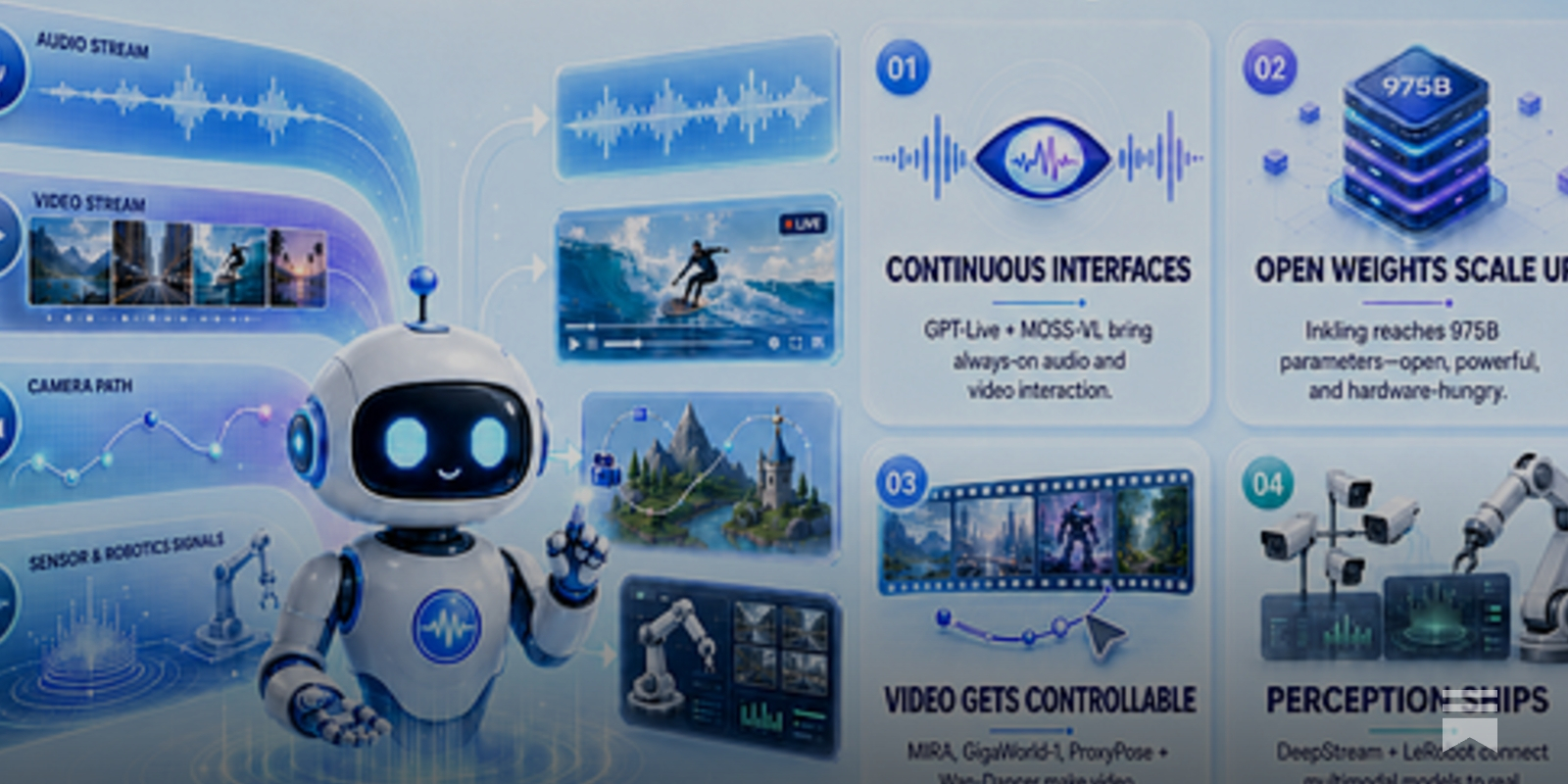
Why it matters: The transition to real-time, continuous interaction and controllable video systems signals a maturation of multimodal AI from experimental demos to infrastructure that can be embedded into products, robotics pipelines, and surveillance deployments.
Context: Multimodal AI has historically been dominated by text-to-image and text-to-video generation, with limited real-time capability and sparse integration into production systems. This roundup marks a clear pivot toward operationalizing these models.
"Last Week In Multimodal AI #61: Real-Time, Controllable Systems Your Multimodal AI Roundup (July 1 – July 15, 2026) Quick Hits (TL;DR) GPT-Live and MOSS-VL Realtime made continuous audio and video interaction." — THELIVINGEDGE.SUBSTACK
Commentary: The most significant signal is the convergence of real-time interaction and controllable video: GPT-Live and MOSS-VL make continuous audio/video the default interface, while MIRA and GigaWorld-1 turn video into a simulation environment for multi-agent and robotics evaluation. This shifts the competitive landscape from model size to latency, session management, and deployment tooling. The hardware gating of open-weight models like Inkling will accelerate demand for compressed formats and specialized inference hardware, creating a bifurcation between accessible and enterprise-grade multimodal systems.
Date: July 17, 2026 12:21 PM ET
URL: https://thelivingedge.substack.com/p/last-week-in-multimodal-ai-61-real
AI Sentiment Score: Negative (71%)
AI Credibility Score: 10.0/10 — High
Scores and text generated by AI analysis of the source article indicated.
Post ID: 2389ad6d