
Emerging Tech Signals (Pre-Mainstream)
Separating signal from noise in coding evaluations (Openai)
Summary: OpenAI’s audit of SWE-Bench Pro reveals that approximately 30% of its tasks are broken due to issues like overly strict tests, underspecified prompts, low-coverage tests, and misleading prompts. The benchmark, previously recommended as a replacement for the flawed SWE-Bench Verified, now faces similar credibility problems. OpenAI retracts its earlier recommendation to adopt SWE-Bench Pro, highlighting the difficulty of creating hard but fair coding evaluations. The findings underscore the growing utility of AI agents for scalable data quality checks in benchmark curation.
Why it matters: This matters because flawed benchmarks can misrepresent model capabilities, affecting safety decisions and research priorities under frameworks like OpenAI’s Preparedness Framework.
Context: SWE-Bench Pro was designed to test longer-horizon, realistic coding tasks, with frontier models improving from 23.3% to 80.3% pass rate in eight months, but the audit reveals systematic task issues that undermine its validity.
"Separating signal from noise in coding evaluations Through a detailed audit, we find widespread task issues in SWE-Bench Pro and estimate that ~30% of the tasks are broken. Accurately measuring our models’." — OPENAI
Commentary: The retraction of a recommendation for a widely used benchmark signals a trust crisis in AI evaluation infrastructure. As models improve, the same tools used to test them are increasingly being turned inward to audit the tests themselves, creating a recursive quality assurance loop. The finding that human reviewers flagged more issues than agent pipelines suggests current automated checks are conservative, undercounting subtle failures like low-coverage tests. This will likely accelerate investment in hybrid human-agent evaluation pipelines and pressure the community to build benchmarks from scratch with experienced developers, not scraped from open-source history.
Date: July 08, 2026 05:03 PM ET
URL: https://openai.com/index/separating-signal-from-noise-coding-evaluations/
Discussion: https://news.ycombinator.com/item?id=48837396
AI Sentiment Score: Negative (80%)
AI Credibility Score: 10.0/10 — High
Scores and text generated by AI analysis of the source article indicated.
Benchmarking coding agents on Databricks’ multi-million line codebase (Databricks)
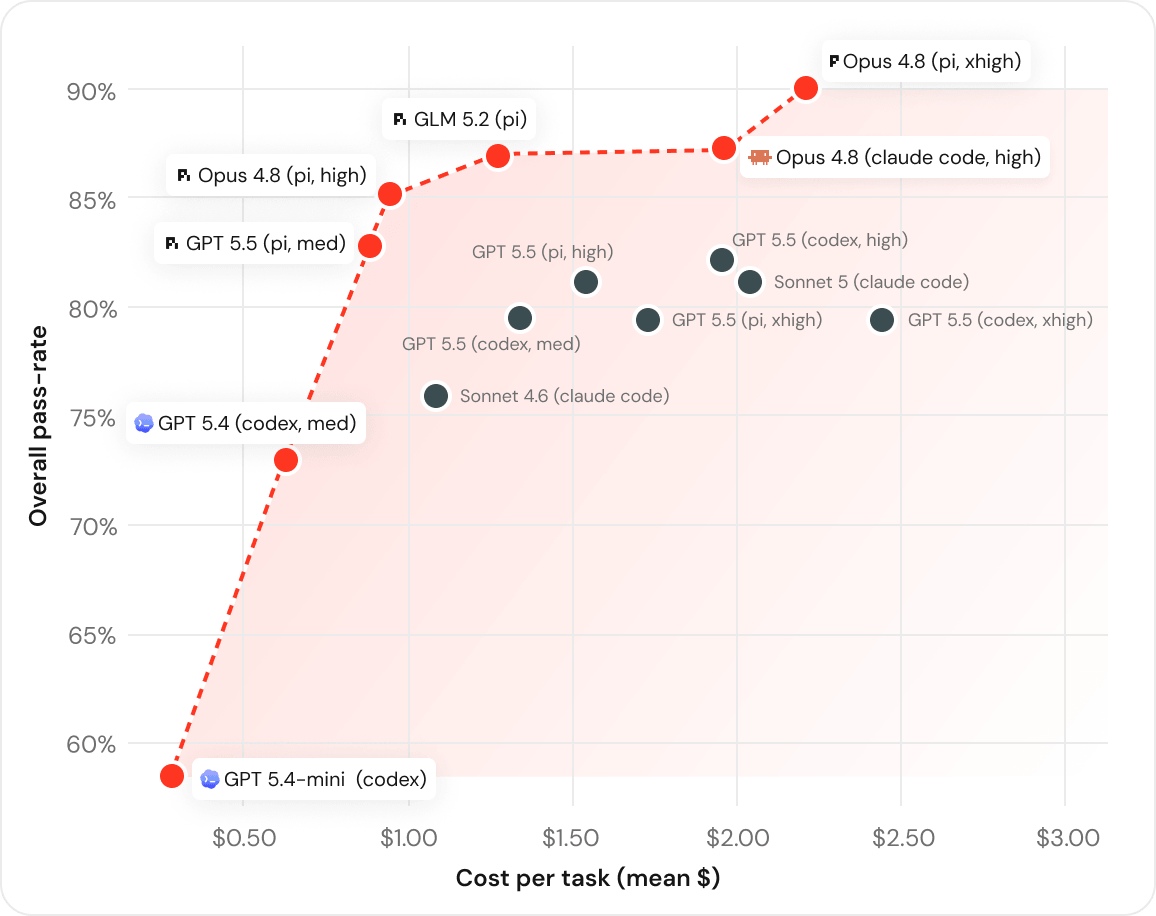
Summary: Databricks built an internal benchmark using real pull requests from its multi-million line codebase to evaluate coding agents on actual engineering tasks. The results revealed three capability tiers, with GLM 5.2 matching top-tier quality at 34% lower cost per task than Opus 4.8. A key finding was that per-token cost is a poor proxy for total task cost, as models like Sonnet 5 consumed 1.9x more tokens to complete tasks, making them more expensive despite cheaper per-token rates. The harness also significantly impacted cost, with Pi sending 3x less context per turn than Claude Code/Codex, achieving the same quality at less than half the cost.
Why it matters: This provides a replicable methodology for any engineering team to benchmark coding agents against their own codebase, revealing that model choice alone is insufficient—harness efficiency and task-level cost measurement are critical for optimizing AI-assisted development.
Context: Public benchmarks like SWE-Bench lack the specificity of real-world, multi-language codebases and cannot account for harness-level context management, which this study shows can double cost without affecting quality.
"by Vinay Gaba, Ankit Mathur, Rishabh Singh, Patrick Wendell and Matei Zaharia At Databricks, the way we build software is changing quickly as we aggressively adopt AI for engineering. The landscape of." — DATABRICKS
Commentary: The finding that harness context management can more than double cost for identical quality is the most actionable signal here—teams should audit their agent tooling’s context window usage before switching models. Databricks’ approach of sealing git history to prevent agents from finding pre-merged solutions is a methodological detail that could become standard practice as more organizations build internal benchmarks. The GLM 5.2 result suggests the cost-performance frontier is shifting faster than many enterprise procurement cycles can adapt.
Date: July 08, 2026 05:30 PM ET
URL: https://www.databricks.com/blog/benchmarking-coding-agents-databricks-multi-million-line-codebase
Discussion: https://news.ycombinator.com/item?id=48837696
AI Sentiment Score: Negative (90%)
AI Credibility Score: 10.0/10 — High
Scores and text generated by AI analysis of the source article indicated.
Small AI Models Gain Traction In places with unreliable networks (Spectrum.Ieee)
Summary: Adebay Alonge’s RxScanner, designed to detect counterfeit medication in Africa, failed during a 2019 demo in Cape Town because the AI model required a server connection 14,000 kilometers away. His team shrunk the model to run locally on an Android phone in two hours, birthing a new device that works offline. This incident exemplifies the growing traction of ‘small AI’—models with at most a few billion parameters that run on low-power devices—as a practical alternative to large language models in regions with unreliable networks and electricity. The World Bank now actively promotes small AI, and by end of 2027, over half of smartphones will be capable of running such models.

Why it matters: For readers tracking pre-mainstream AI signals, small AI represents a shift from centralized, resource-intensive models to distributed, context-specific systems that can operate at the edge, potentially reshaping how AI delivers value in infrastructure-poor environments.
Context: Small AI models, created through pruning, distillation, or direct training on small devices, are gaining institutional support from organizations like the World Bank, which sees them as essential for global health, agriculture, and development in regions where only 0.7% of internet users have used ChatGPT.
"One morning in 2019, Adebayo Alonge was in a Cape Town hotel room, preparing to demonstrate his startup’s AI answer to a serious problem in African health care: counterfeit medication, which kills." — SPECTRUM.IEEE
Commentary: The shift to small AI is not just a technical optimization but a strategic response to infrastructure gaps that large models cannot bridge. The World Bank’s active promotion signals that small AI may become a development priority, potentially accelerating adoption in agriculture, health, and environmental monitoring. However, as Alonge notes, small AI cannot solve the underlying challenges of reliable power and supply chains, meaning its long-term impact depends on political will to invest in complementary infrastructure.
Date: July 06, 2026 07:59 PM ET
URL: https://spectrum.ieee.org/small-language-models-ai-pharmaceuticals
Discussion: https://news.ycombinator.com/item?id=48812055
AI Sentiment Score: Neutral (33%)
AI Credibility Score: 10.0/10 — High
Scores and text generated by AI analysis of the source article indicated.
Full Writeup of the Windows GDID (Github)
Summary: A detailed reverse-engineering analysis reveals that Microsoft’s Global Device Identifier (GDID), cited in the July 2026 Scattered Spider criminal complaint, is a 64-bit MSA Device PUID assigned by login.live.com during device provisioning, not a 128-bit hardware-derived hash. The identifier is minted by the wlidsvc service, stored in the registry, and registered into Microsoft’s Device Directory Service by the Connected Devices Platform (cdp.dll). The analysis debunks viral claims, confirms the GDID changes on reinstall, and provides reproducible methods to locate the value on any Windows 11 machine. This clarifies the technical basis for device attribution in federal investigations and exposes the telemetry pipeline from OS to Microsoft’s cloud graph.
Why it matters: This demystifies a key forensic identifier used in federal cybercrime attribution, revealing it as a server-assigned account token rather than a hardware fingerprint, which has direct implications for privacy expectations, defense strategies, and the reliability of device-based evidence.
Context: The GDID surfaced in a DOJ complaint against a Scattered Spider member, sparking misinformation about its generation and persistence; this writeup provides the first public, source-verified technical breakdown.
"How Microsoft’s "Global Device Identifier", the persistent Windows fingerprint named in the July 2026 Scattered Spider complaint, is actually generated, stored, and transmitted. Note Listed below is true, but missing some information." — GITHUB
Commentary: The analysis confirms the GDID is a server-assigned token, not a hardware anchor, which weakens its reliability as a persistent device identifier across OS reinstalls but strengthens its utility for linking activity to a specific Microsoft account session. For defenders, this means the GDID is more about account hygiene than hardware anonymity; for forensic analysts, it underscores the need to correlate GDID with account-level telemetry rather than treating it as a device fingerprint. The reproducible registry read lowers the barrier for independent verification, which is healthy for adversarial testing of attribution claims.
Date: July 06, 2026 06:02 PM ET
URL: https://github.com/SmtimesIWndr/gdid-reversal
Discussion: https://news.ycombinator.com/item?id=48811081
AI Sentiment Score: Negative (60%)
AI Credibility Score: 10.0/10 — High
Scores and text generated by AI analysis of the source article indicated.
Post ID: 40efb187