

Space Exploration
NASA’s COFFIES Uses AI to Predict Storm-Causing Active Regions on Sun (Science.Nasa.Gov)
Summary: NASA’s COFFIES DRIVE Science Center has developed a machine-learning model that predicts the emergence of active regions on the Sun up to 12 hours before they become visible, using a sliding-window transformer architecture to detect subtle acoustic and magnetic precursors. The model, published in the Journal of Geophysical Research: Machine Learning and Computation, was trained on Solar Dynamics Observatory data and NASA Ames supercomputing resources. It is not yet operational but could supplement NOAA and USAF forecasting, which currently rely on tracking already-visible sunspots. The capability is seen as a potential asset for Artemis and Mars mission safety, with validation across more solar events planned.
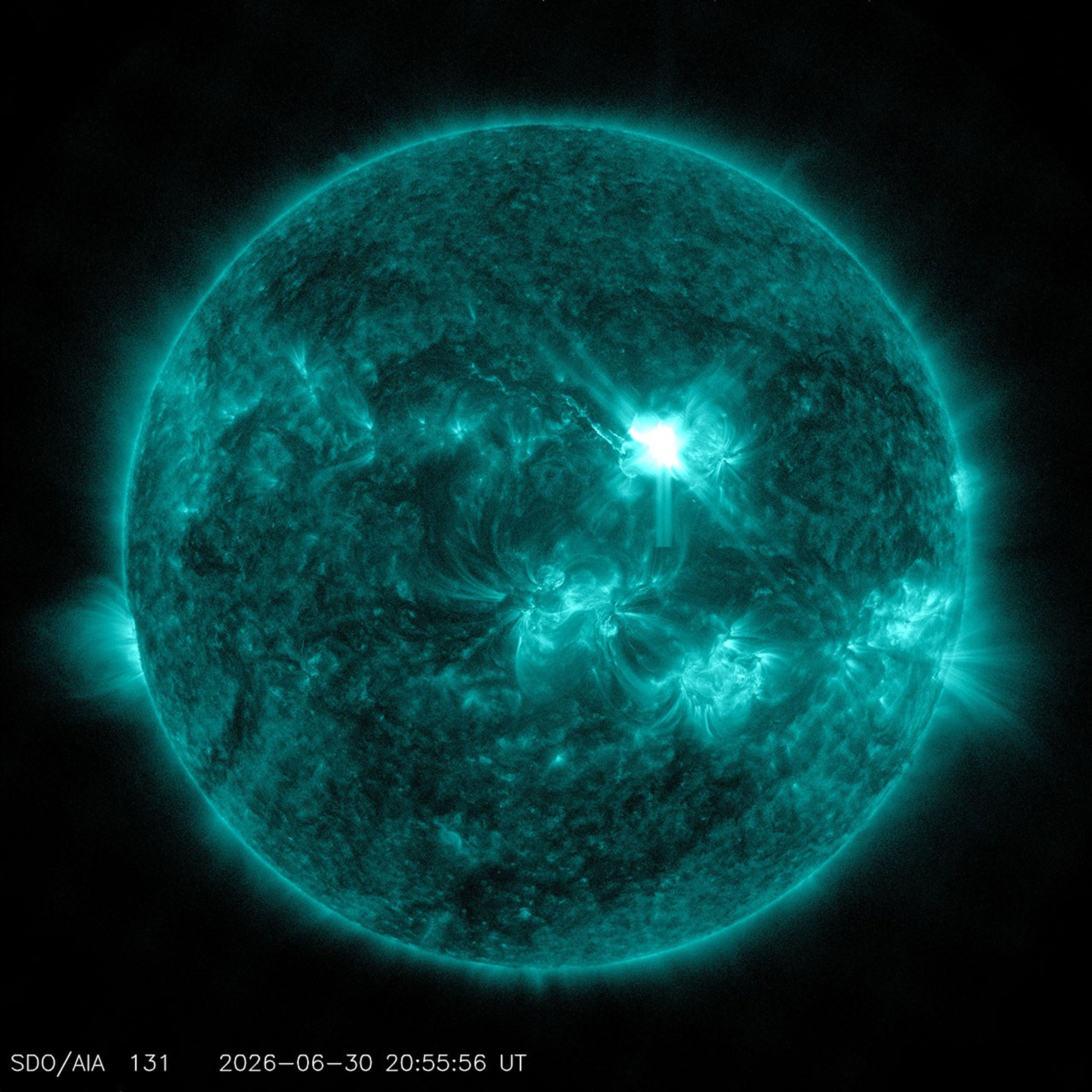
Why it matters: This shifts space weather forecasting from reactive sunspot counting to proactive emergence prediction, potentially giving mission operators and satellite owners a 12-hour lead on flare-prone regions—critical for crewed lunar and Mars operations.
Context: Current operational forecasts by NOAA’s Space Weather Prediction Center and the USAF depend on visible sunspot analysis; this model is the first to use acoustic wave fluctuations to predict emergence, building on earlier deep learning attempts that lacked temporal focus.
“We cannot directly see the magnetic structure while it is still rising through the solar interior. Instead, we must look for indirect effects — very small changes in the magnetic field and in the pattern of acoustic waves continually traveling through the Sun,” said Alexander Kosovichev, a COFFIES co-investigator at NJIT.
Commentary: The 12-hour lead time is modest but operationally meaningful, especially for far-side emergence that current tools miss entirely. The sliding-window transformer’s ability to handle long sequences is a technical step forward, but the real test is validation across historical events—expect a multi-year gap before this reaches NOAA’s operational pipeline. If it holds, it could also feed M2M SWAO’s lunar and Mars radiation assessments, making it a quiet but strategic asset for Artemis scheduling.
Date: August 14, 2026 01:00 PM ET
URL: https://science.nasa.gov/science-research/heliophysics/nasas-coffies-uses-ai-to-predict-storm-causing-active-regions-on-sun/
AI Sentiment Score: Negative (83%)
AI Credibility Score: 10.0/10 — High
Scores and text generated by AI analysis of the source article indicated.
Lunar orbiter among upcoming NASA CLPS task orders (Spacenews)
Summary: NASA is expected to award three more CLPS task orders by year-end, including an orbiter imaging service to replace the aging Lunar Reconnaissance Orbiter. Firefly Aerospace and Intuitive Machines, the two companies that have landed on the Moon through CLPS, confirmed the plans in earnings calls. The orbiter mission would mark the first non-lander task order under the program, signaling a shift toward sustained lunar infrastructure. Both companies are also preparing for CLPS 2.0, a $10 billion follow-on contract, with larger landers capable of delivering multiple metric tons to support a future Moon base.

Why it matters: This signals a strategic pivot from bespoke landings to repeatable, production-line lunar services, and the first commercial replacement for a flagship NASA science orbiter—reshaping how lunar reconnaissance and logistics will be procured.
Context: LRO has operated since 2009, and the scientific community has long flagged the need for a successor. CLPS has historically focused on landers, so an orbiter task order would expand the program’s scope into orbital infrastructure.
"“Plans for a next-generation long-lived integrated orbiter with modern instruments that can replace the highly productive LRO (launched in 2009) are long overdue,” a 2022 report by the Lunar Exploration Analysis Group noted." — SPACENEWS
Commentary: The orbiter task order is the quiet headline: it converts a flagship NASA asset into a commercial service, a template likely to extend to other orbital capabilities. The CS-8 ‘build-to-print’ lander push and the parallel Nova-D production plans indicate the industry is gearing for volume, not just missions. Watch whether CLPS 2.0’s larger lander requirements force engine upgrades that become a bottleneck—Altemus’s three-engine Nova-D is a direct admission of that constraint. The lack of public source selection statements remains a transparency gap, but the commercial cadence is becoming the real lunar architecture.
Date: August 15, 2026 07:49 PM ET
URL: https://spacenews.com/lunar-orbiter-among-upcoming-nasa-clps-task-orders/
AI Sentiment Score: Negative (80%)
AI Credibility Score: 10.0/10 — High
Scores and text generated by AI analysis of the source article indicated.
Swift spacecraft, and a mission to save it, caught on video (Earthsky)
Summary: NASA’s commercial rescue of the Swift gamma-ray observatory is in a critical phase after two of LINK’s three reaction wheels failed, sending the vehicle into an uncontrolled spin. A flight software update with new attitude control algorithms has been uploaded, and amateur video from Puerto Rico shows LINK and Swift in similar orbits, with LINK now slightly ahead. The clock is ticking: if Swift drops below roughly 300 km, recovery becomes impossible, a point NASA expects around October. Science operations remain suspended until the boost is complete.

Why it matters: This is a live test of commercial in-orbit servicing for a flagship science mission, with failure meaning the loss of a unique gamma-ray burst observatory and a setback for the emerging satellite-repair industry.
Context: Swift has operated since 2004, and its orbit is decaying due to atmospheric drag. NASA contracted Katalyst Space’s LINK vehicle in July 2026 to boost it, but the mission has been jeopardized by actuator failures.
"The software update’s new attitude control algorithms are designed to maintain LINK’s stability using the spacecraft’s remaining actuators." — EARTHSKY
Commentary: The fact that LINK is now slightly ahead of Swift suggests the software patch is working, but the margin for error is thin. If the boost is delayed past October, the mission is lost, and the commercial servicing model takes a credibility hit. Watch for NASA’s next blog update on LINK’s stability and the planned burn window.
Date: August 16, 2026 08:00 AM ET
URL: https://earthsky.org/space/swift-spacecraft-boost-plunging-back-to-earth/
AI Sentiment Score: Negative (80%)
AI Credibility Score: 10.0/10 — High
Scores and text generated by AI analysis of the source article indicated.
Post ID: e71ff8c3