Artemis Moon Program Updates and Milestones
NASA’s Artemis III Moon Rocket Hardware Arrives, Artemis II Capsule Returns to Kennedy (Nasa.Gov)
Summary: NASA’s Kennedy Space Center is now the primary assembly site for SLS core stages, with the Artemis III stage arriving for integration in the Vehicle Assembly Building. Concurrently, booster segments from Northrop Grumman are being processed, and the flown Artemis II Orion capsule has returned for post-flight analysis to inform future missions. Hardware for Artemis III, including an Orion module with a completed heat shield, is advancing through functional testing.
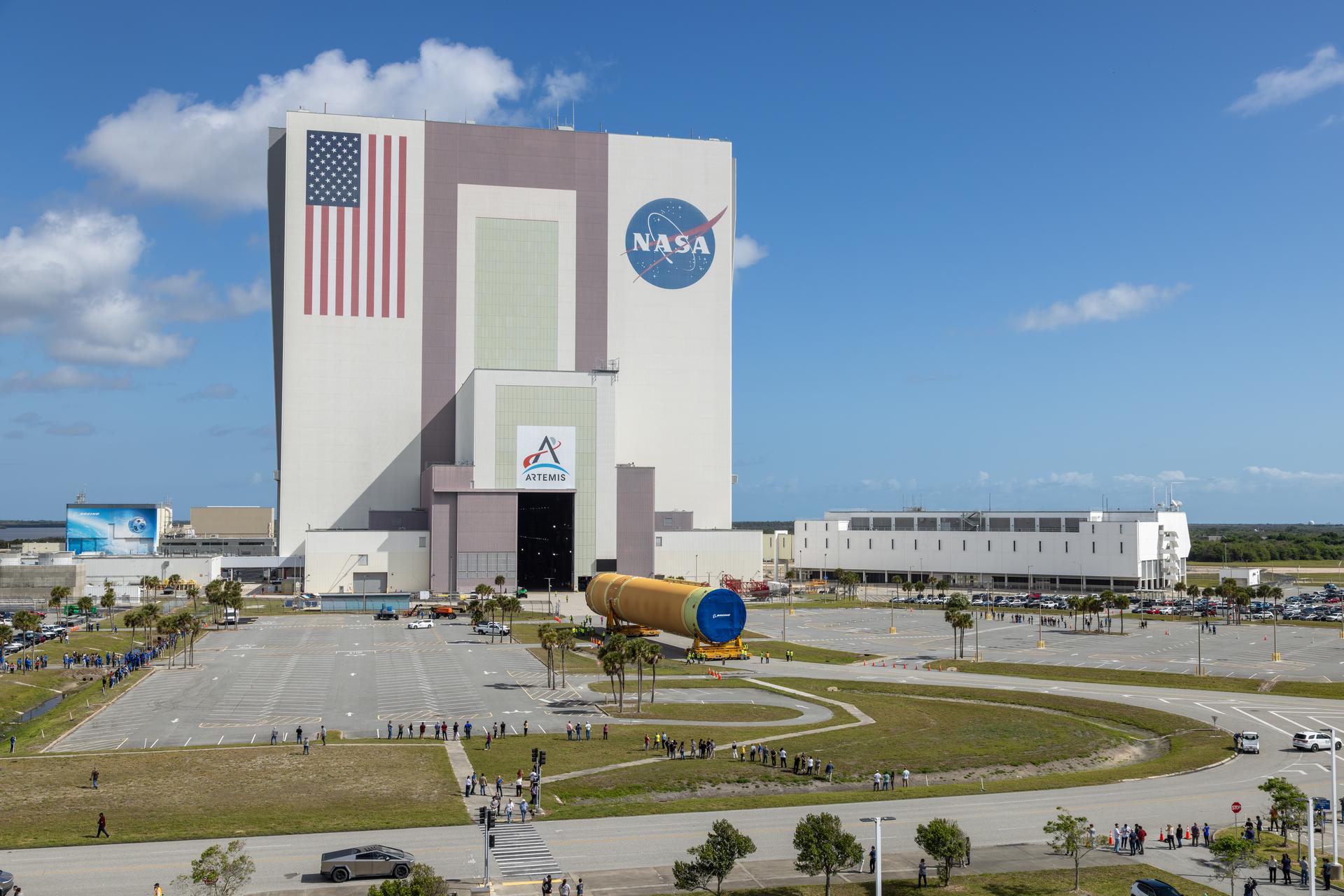
Why it matters: This marks a logistical and operational shift for SLS assembly, centralizing core stage work at the launch site, while post-flight data from Artemis II provides the first human-rated performance benchmarks for the Orion system.
Context: Artemis III is a crewed orbital test of rendezvous systems, a stepping stone to the Artemis IV lunar landing, making the parallel processing of its hardware and the analysis of its predecessor’s flight data critical path items.
"This marks the first time core stage assembly operations are taking place at NASA Kennedy." — NASA.GOV
Commentary: The shift of core stage integration to Kennedy signals a move toward a more streamlined, launch-site-centric production line, potentially reducing transportation costs and schedule risk compared to the previous Michoud-to-Kennedy pipeline. The simultaneous arrival of flown hardware for tear-down and new hardware for build-up creates a unique feedback loop, where Artemis II’s empirical data can directly influence the final configuration and procedures for Artemis III’s Orion.
Date: Tue, 28 Apr 2026 20:52:59 +0000
URL: https://www.nasa.gov/blogs/missions/2026/04/28/nasas-artemis-iii-moon-rocket-hardware-arrives-artemis-ii-capsule-returns-to-kennedy/
AI Sentiment Score: Negative (77%)
AI Credibility Score: 10.0/10 — High
Scores and text generated by AI analysis of the source article indicated.
NASA’s Mobile Launcher Arrives at Vehicle Assembly Building (Nasa.Gov)
Summary: NASA’s mobile launcher, used for the Artemis II launch, has been moved from Launch Pad 39B back to the Vehicle Assembly Building at Kennedy Space Center. The 380-foot-tall structure, which carries the umbilicals and ground support equipment for the SLS rocket and Orion spacecraft, completed its final solo trek along the crawlerway. It will now undergo post-flight inspections and repairs inside the VAB in preparation for stacking the Artemis III vehicle.
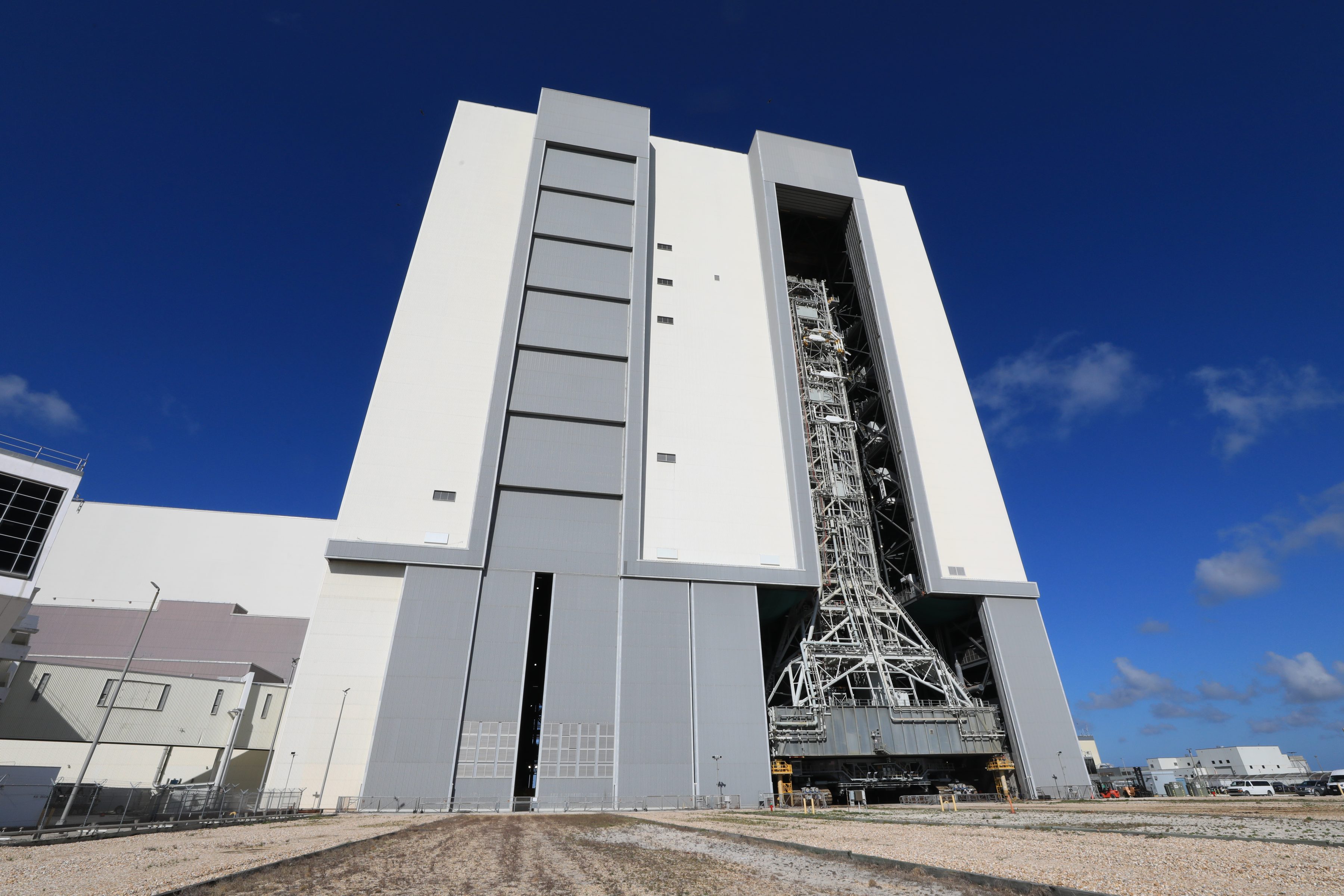
Why it matters: The move marks the formal transition from the Artemis II post-launch phase to the active hardware integration phase for Artemis III, signaling the next concrete step in NASA’s lunar campaign timeline.
Context: The mobile launcher is a critical, single-point-of-failure ground infrastructure asset for the SLS program; its movement and readiness directly gate the assembly schedule for each mission.
"This was the mobile launcher’s last solo trek out to the launch pad ahead of integration of the SLS rocket, and it will remain inside the VAB until it is ready to return to the pad with the rocket." — NASA.GOV
Commentary: The operational cadence is becoming visible: the launcher’s return to the VAB initiates the critical path for Artemis III stacking. The ‘last solo trek’ framing underscores the shift from a standalone test article to an integrated launch system, where future delays will now be compounded by rocket assembly timelines. The built-in pauses during the move, while routine, subtly highlight the program’s institutional caution with this unique asset.
Date: Fri, 17 Apr 2026 15:59:01 +0000
URL: https://www.nasa.gov/blogs/missions/2026/04/17/nasas-mobile-launcher-arrives-at-vehicle-assembly-building/
AI Sentiment Score: Negative (80%)
AI Credibility Score: 10.0/10 — High
Scores and text generated by AI analysis of the source article indicated.
Artemis II crewed lunar flyby & Starlink expansion and orbital debris – Space News (Apr 26, 2026) (Youtube)
Summary: NASA’s Artemis II mission completed a successful 10-day crewed lunar flyby, validating the SLS and Orion systems for the planned Artemis III landing. SpaceX’s Starlink constellation surpassed 1,000 satellites launched in 2026, accompanied by a fragmentation event that generated trackable debris but was assessed as non-threatening to major assets. Routine cargo missions to the ISS and significant progress on upcoming deep-space probes underscore the operational tempo and strategic planning across multiple agencies.

Why it matters: Artemis II’s success moves the lunar program from theory to operational crewed flight, while the Starlink expansion and debris incident highlight the tangible collision risks emerging from the commercialization of low Earth orbit.
Context: Artemis II is the critical pathfinder for NASA’s return-to-the-moon architecture; the Starlink constellation’s growth rate now defines the baseline for orbital traffic and collision risk modeling.
"An anomalous Starlink fragmentation event produced trackable debris but was assessed as not increasing risk to the ISS or Artemis II." — YOUTUBE
Commentary: The ‘anomalous fragmentation’ phrasing from SpaceX is a notable shift from past denials, signaling internal acknowledgment of a debris-generating event. While assessed as low-risk, each such incident adds to the cataloged population that future missions must avoid, incrementally raising operational costs for all operators. The Artemis II success, while a major milestone, now enters the more complex phase where its follow-on landing mission must be financed and technically executed amid this increasingly congested orbital environment.
Date: April 26, 2026 12:00 AM ET
URL: https://www.youtube.com/watch?v=WAJ7lRGqVy8
AI Sentiment Score: Positive (57%)
AI Credibility Score: 10.0/10 — High
Scores and text generated by AI analysis of the source article indicated.
Artemis II returns from Moon & SpaceX Starlink launch at Vandenberg – Space News (Apr 18, 2026) (Youtube)
Summary: NASA’s Artemis II crewed mission has returned from a lunar flyby, validating Orion spacecraft operations beyond Earth orbit and setting a new distance record for human spaceflight. Concurrently, SpaceX continues its high-cadence Starlink launches from Vandenberg, and Blue Origin prepares for a critical first reflight of its New Glenn booster, aiming to demonstrate competitive reusability.
Why it matters: Artemis II’s success is a non-negotiable prerequisite for subsequent lunar landings, while the parallel launch activity signals a maturing commercial market where operational tempo and reusability are now primary competitive metrics.
Context: Artemis II is the first crewed test in a program dependent on sequential validation; New Glenn’s reflight attempt follows years of development lag behind SpaceX’s demonstrated reuse, making it a pivotal market-entry proof point.
"Artemis II returns from Moon – NASA’s Artemis II mission has safely returned after a 10-day lunar flyby, setting a new distance record for human spaceflight and validating Orion operations beyond Earth." — YOUTUBE
Commentary: The Artemis return provides essential engineering data but does not alter the program’s fundamental schedule and budget pressures. More telling is the operational landscape: SpaceX’s routine cadence normalizes a tempo Blue Origin must now match, making NG-3’s reflight a direct test of whether New Glenn can transition from a development vehicle to a operational, cost-competitive system. Failure here would cede the heavy-lift reusable market further.
Date: April 26, 2026 12:00 AM ET
URL: https://www.youtube.com/watch?v=_SLWYHOY5O0
AI Sentiment Score: Negative (71%)
AI Credibility Score: 10.0/10 — High
Scores and text generated by AI analysis of the source article indicated.
Artemis III, Gaganyaan & Global Space Boom | MERI Daily Space News Bulletin (Youtube)
Summary: NASA has rolled out the SLS core stage for Artemis III, signaling hardware progression for the planned 2027 lunar landing mission. The Nancy Grace Roman Space Telescope is now complete, targeting a late 2026 launch to survey dark energy and exoplanets. Global space investment hit a record $7.95 billion in Q1 2026, driven by IPO speculation and infrastructure expansion. China’s Shenzhou-23 and India’s Gaganyaan program continue advancing their respective human spaceflight objectives.
Why it matters: The simultaneous maturation of flagship hardware, record capital inflows, and international crewed programs marks a tangible shift from planning to execution in the new space era.
Context: Artemis III represents the first planned human lunar landing since Apollo; its schedule is a key benchmark for NASA’s lunar architecture. Global private investment now heavily influences the pace and direction of space infrastructure.
"##### Apr 25, 2026 (0:04:09) Janya Batra (BBA LLB Student) presents today’s MERI Daily Space News Bulletin, covering major developments shaping the future of space exploration. The update highlights NASA’s progress on." — YOUTUBE
Commentary: The near-doubling of quarterly investment is a leading indicator of market confidence, but the reliance on a potential SpaceX IPO highlights systemic concentration risk. The parallel progress on Artemis III core hardware and the Roman Telescope demonstrates NASA’s operational capacity across disparate major programs, even as its human lunar timeline remains ambitious. ISRO’s Gaganyaan and China’s long-duration station missions solidify a tri-polar structure in government-led human spaceflight, moving beyond a US-Russia duopoly.
Date: April 25, 2026 12:00 AM ET
URL: https://www.youtube.com/watch?v=Ei2-WCa-U2M
AI Sentiment Score: Positive (50%)
AI Credibility Score: 10.0/10 — High
Scores and text generated by AI analysis of the source article indicated.
NASA’s April 2026 Report: Missions, Milestones and News (Theoceaniacables)
Summary: NASA’s April 2026 operational updates signal a pragmatic shift in tempo and strategy. The Nancy Grace Roman Space Telescope launch is accelerated to early September, eight months ahead of schedule. Artemis 3 is restructured from a lunar landing to an Earth-orbit demonstration mission, deferring the crewed surface return to Artemis 4. Concurrently, Curiosity rover data reveals the most chemically diverse set of organic molecules ever found on Mars, including a nitrogen heterocycle precursor. The Artemis Accords now include 63 signatory nations, with Latvia as the latest addition.

Why it matters: The Artemis 3 realignment is a major programmatic decision with cascading effects on schedules, commercial partner obligations, and international coordination, while the Mars discovery materially alters the scientific prioritization for future sample-return and life-detection missions.
Context: Artemis mission architecture has faced persistent technical and schedule pressures; deferring the landing to Artemis 4 formalizes a slip that was widely anticipated in engineering circles. The Roman telescope acceleration is unusual for a flagship-class mission and suggests either exceptional readiness or a strategic slot in the launch manifest.
"In April 2026, NASA marked a period of accelerated scientific achievement and global collaboration. The Nancy Grace Roman Space Telescope, NASA’s next flagship astrophysics mission, is now scheduled for an early September." — THEOCEANIACABLES
Commentary: The Artemis 3 pivot is a de-risking move that acknowledges the integration complexity between Orion and commercial landers, effectively making Artemis 4 the new programmatic minimum success criterion. The Mars organics data, while not evidence of life, creates a concrete target list for the Mars Sample Return campaign and will influence instrument selection on subsequent rovers. The Roman telescope acceleration, if sustained, could compress the astrophysics timeline, potentially creating early data overlap with JWST and Euclid.
Date: April 24, 2026 12:00 AM ET
URL: https://www.theoceaniacables.com/blog/nasas-april-2026-report-roman-telescope-launch-artemis-restructure-mars-organic-molecules-discovered-and-more/
AI Sentiment Score: Neutral (33%)
AI Credibility Score: 10.0/10 — High
Scores and text generated by AI analysis of the source article indicated.
Days after Artemis II, scientists warn of deep cuts to NASA missions (Planetary)
Summary: The White House has proposed a 46% cut to NASA’s science budget, targeting over 50 missions for cancellation or reduction. This includes terminating active missions like New Horizons and scaling back operations for flagship assets like the Perseverance rover. The cuts would shutter major telescopes and eliminate thousands of jobs, creating a stark contrast with the recent high-profile success of the Artemis II lunar mission.
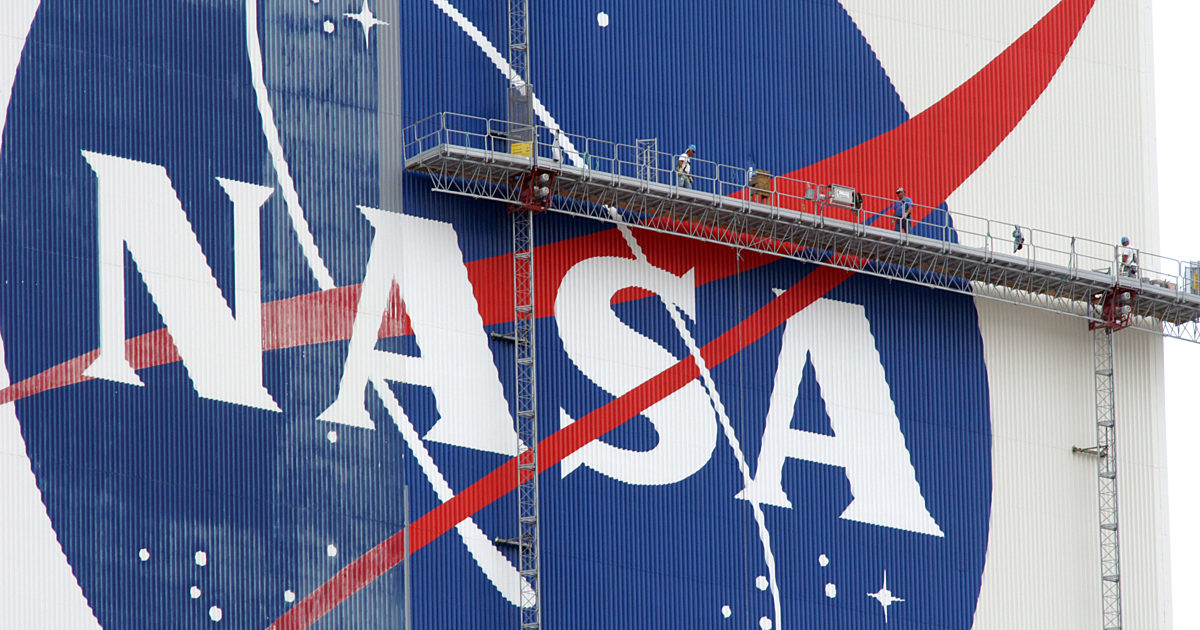
Why it matters: This represents a structural shift in U.S. space priorities, trading long-term scientific discovery and technological development for immediate fiscal contraction, with consequences for workforce, international partnerships, and the foundational data pipeline for future exploration.
Context: The proposal follows a pattern of budget-driven mission attrition, but its scale and targeting of operational, data-producing spacecraft is unprecedented in modern NASA history.
"On April 3, 2026, the White House announced a plan to cancel over 50 space missions — including spacecraft already paid for, launched, and making discoveries — as part of a devastating." — PLANETARY
Commentary: The operational impact is the critical signal: terminating New Horizons mid-campaign destroys unique Kuiper Belt data, while halving Perseverance’s budget directly reduces the sample collection rate for the Mars Sample Return program, creating downstream delays. This prioritizes near-term budget figures over sunk costs and irreplaceable scientific return, effectively stranding capital assets. The timing, days after Artemis II, suggests a deliberate decoupling of human exploration spectacle from the robotic science that enables it.
Date: April 24, 2026 12:00 AM ET
URL: https://www.planetary.org/articles/meet-the-people-behind-nasas-endangered-missions
AI Sentiment Score: Neutral (50%)
AI Credibility Score: 10.0/10 — High
Scores and text generated by AI analysis of the source article indicated.
NASA’s Post-Artemis II Mission Assessment (Newspaceeconomy.Ca)
Summary: NASA’s initial postflight review of the Artemis II mission, conducted in April 2026, indicates the crewed lunar test flight met its primary objectives. The Orion spacecraft’s heat shield exhibited significantly less char loss than on the uncrewed Artemis I flight, validating corrective measures. The Space Launch System (SLS) and upgraded Kennedy Space Center ground systems performed nominally, with recovery operations concluding smoothly. The mission’s main remaining issues, including a urine vent line anomaly, are described as bounded technical findings requiring corrective action for Artemis III.

Why it matters: The review confirms the Artemis program’s foundational systems are operationally sound for crewed lunar return, de-risking the critical path to the planned Artemis III lunar landing in 2027.
Context: Artemis I’s 2022 flight revealed unexpected, extensive charring of Orion’s Avcoat heat shield, prompting a major investigation and redesign effort; Artemis II’s primary mandate was to validate that fix under actual crewed reentry conditions.
"- NASA’s first Artemis II postflight review points to a mission that met its main flight goals – Orion’s heat shield showed far less char loss than Artemis I during the April." — NEWSPACEECONOMY.CA
Commentary: The shift from a systemic heat shield crisis to a manageable urine vent line issue represents a critical programmatic transition: Artemis is moving from proving survival to refining operations. This data supports NASA’s stated 2027-2028 timeline for Artemis III and subsequent surface missions, contingent on resolving these bounded anomalies. The clean SLS performance and minimal ground system damage signal maturation of the launch infrastructure, reducing schedule risk from repeat repairs. The mission’s success as a validation flight, not a spectacle, underscores that the program’s near-term viability hinges on engineering discipline, not public relations.
Date: April 23, 2026 12:00 AM ET
URL: https://newspaceeconomy.ca/2026/04/23/nasas-post-artemis-ii-mission-assessment/
AI Sentiment Score: Negative (75%)
AI Credibility Score: 10.0/10 — High
Scores and text generated by AI analysis of the source article indicated.
NASA’s Moon Base No Longer Science Fiction (Autonomyglobal.Co)
Summary: NASA’s ‘Ignition’ strategic pivot, announced in March 2026, formally redirects resources from the Gateway lunar station toward establishing a permanent surface base at the south pole. The plan calls for an aggressive near-term campaign of robotic and crewed landings, scaling the Commercial Lunar Payload Services (CLPS) program to target up to 30 robotic landings starting in 2027 using only proven landers. The objective is a human landing by 2028 and initial outpost elements by 2030, with a stated investment horizon scaling to $10 billion by 2028.
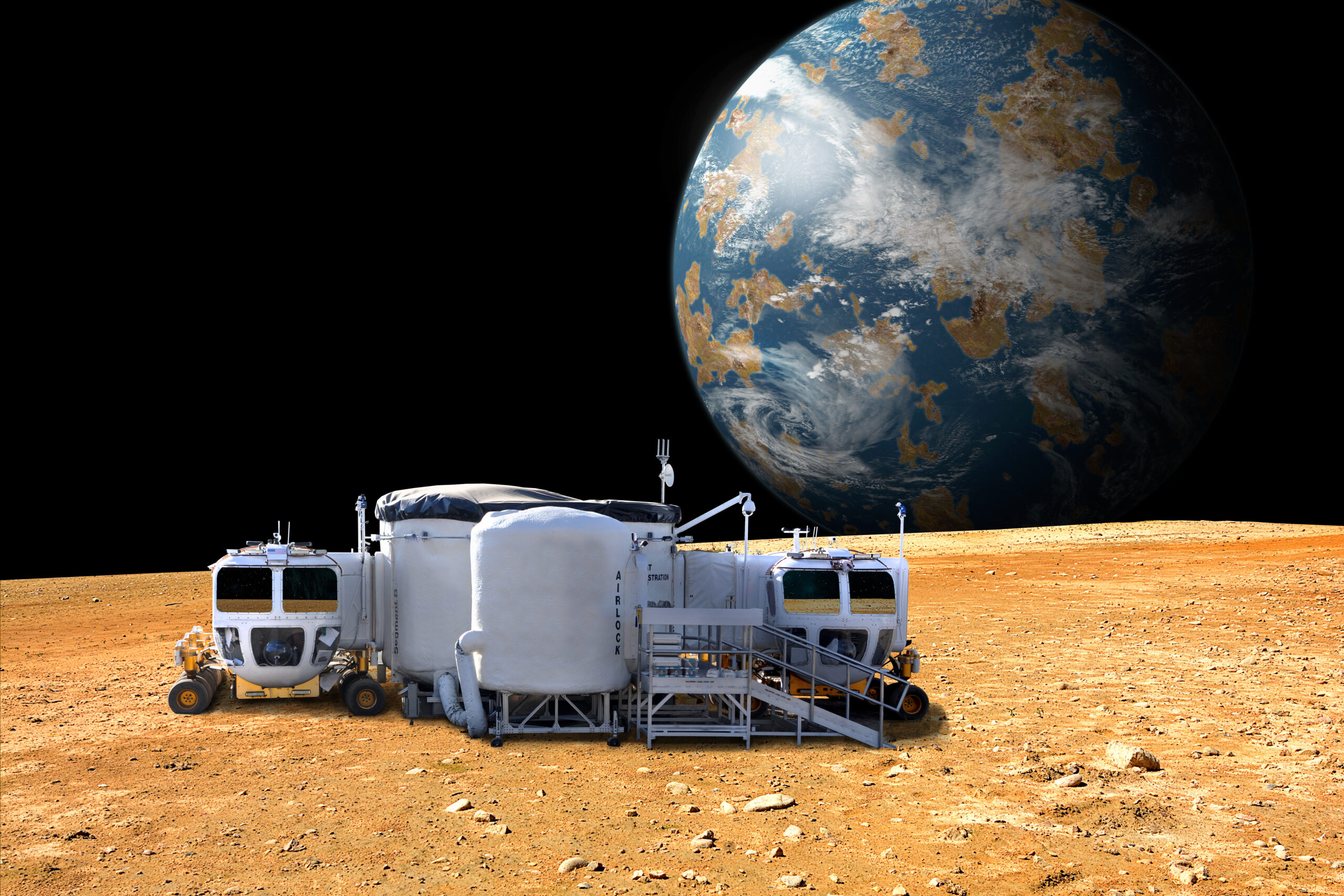
Why it matters: This represents a fundamental reallocation of capital and risk in the Artemis program, shifting the primary development vector from orbital infrastructure to immediate surface operations with significant consequences for contractors, international partners, and technology roadmaps.
Context: The pivot follows the operational success of commercial robotic landers like IM-1 in 2024 and growing political pressure to demonstrate tangible lunar surface progress ahead of the 2030s.
"The big idea is to pivot away from Gateway in its current form and focus all available resources on building a permanent surface base at the lunar south pole." — AUTONOMYGLOBAL.CO
Commentary: The acceleration of CLPS to 30 landings using only flight-proven hardware signals a maturation of the commercial model but imposes a severe filter on the lander vendor landscape, likely consolidating work around Intuitive Machines and Astrobotic. De-prioritizing Gateway as a prerequisite re-sequences major program dependencies, creating new critical paths for surface habitat and rover development while potentially straining the existing Orion/SLS/Starship launch architecture not designed for direct base support. The $10B horizon by 2028 indicates a real funding reallocation, not just a paper exercise.
Date: April 23, 2026 12:00 AM ET
URL: https://www.autonomyglobal.co/nasas-moon-base-no-longer-science-fiction-industry-has-four-weeks-to-get-ready/
AI Sentiment Score: Positive (50%)
AI Credibility Score: 10.0/10 — High
Scores and text generated by AI analysis of the source article indicated.
Lunar Communications Infrastructure Development and … (Ibhe)
Summary: A SpaceX launch will deploy the first lunar 4G network, built by Nokia Bell Labs and carried by an Intuitive Machines lander to the Moon’s south pole. The network will support two rovers surveying for lunar ice, transmitting data in near real-time. The project, backed by a $14.1 million NASA Tipping Point grant and a subsequent DARPA contract, serves as a foundational test for standardized off-world communications.
Why it matters: It validates a low-cost, commercial model for critical space infrastructure, directly enabling in-situ resource utilization and de-risking the communications layer for a projected trillion-dollar space economy.
Context: This represents a shift from bespoke, government-built space systems to ruggedized commercial-off-the-shelf hardware, funded through public-private partnerships like NASA’s Tipping Point initiative.
"This analysis evaluates the upcoming lunar 4G network deployment project, a collaborative public-private partnership between NASA, Nokia Bell Labs, and Intuitive Machines. It assesses the project’s near-term utility for NASA’s Artemis lunar." — IBHE
Commentary: The real signal is the deliberate creation of a dual-use technology stack. Nokia’s architecture is being stress-tested in the most extreme environment to create a proven product for both lunar operations and high-value terrestrial markets like remote industrial sites and defense. This isn’t just a science mission; it’s a market-creation strategy with a clear path to commercial scalability, funded by public capital to de-risk the initial investment.
Date: April 23, 2026 12:00 AM ET
URL: https://ibhe.org/first-dry/Lunar-Communications-Infrastructure-Development-and-CrossSector-Commercial-Opportunities-10-7418
AI Sentiment Score: Negative (66%)
AI Credibility Score: 10.0/10 — High
Scores and text generated by AI analysis of the source article indicated.
The Race to Return to the Moon: Where Every Nation Stands in 2026 (Spaceodysseyhub)
Summary: The lunar exploration landscape in early 2026 is defined by a multi-nation competition focused on the strategic south pole. The US Artemis III crewed landing is now targeting 2026-2027, contingent on Starship HLS and spacesuit readiness, while China’s Chang’e program has executed consecutive sample returns, including a first from the far side. India’s low-cost Chandrayaan-3 confirmed south polar mineralogy, and commercial CLPS providers are establishing a nascent cargo delivery capability, albeit with operational challenges.

Why it matters: The operational tempo and technical achievements of major state programs now directly inform the timeline and feasibility of establishing a sustained lunar presence, with commercial logistics as a new variable.
Context: Post-Apollo lunar exploration has shifted from symbolic flags to sustained resource prospecting, with sample-return science and in-situ resource utilization (ISRU) as critical path objectives for future infrastructure.
"More than 50 years later, humanity is preparing to return — and this time, the competition is genuinely international. The United States, China, India, Japan, South Korea, the UAE, Russia, and a." — SPACEODYSSEYHUB
Commentary: China’s methodical execution with Chang’e 5 and 6 provides a tangible science and engineering lead, while Artemis’s schedule dependency on Starship introduces a high-stakes, single-point technical risk. The confirmed water ice transforms the south pole from a scientific curiosity into a non-negotiable site selection criterion for all serious surface architecture, locking in a future of contested operational zones.
Date: April 25, 2026 12:00 AM ET
URL: https://spaceodysseyhub.com/articles/race-to-return-to-the-moon-2026
AI Sentiment Score: Negative (50%)
AI Credibility Score: 8.4/10 — High
Scores and text generated by AI analysis of the source article indicated.
Artemis spacesuit development risks further delays – ISS Tracker (Isstracker.Pl)
Summary: NASA’s Office of Inspector General warns that new spacesuits for the Artemis lunar missions and the International Space Station, developed by Axiom Space under the xEVAS program, face significant delays. The OIG report criticizes NASA’s original 2025/2026 demonstration schedules as overly optimistic, noting current delays of at least 18 months. It projects that, based on historical averages for major spaceflight programs, suit demonstrations could slip to 2031, leaving little schedule margin for the Artemis III lunar landing and the ISS’s planned decommissioning.

Why it matters: The spacesuit is a critical path item for Artemis III; further delays directly threaten the timeline for returning humans to the Moon and complicate operations during the ISS’s final years.
Context: This follows a pattern of schedule pressure within the Artemis program, where multiple critical systems—SLS, Orion, HLS, and now xEVAS—have experienced development slippage, compounding interdependencies.
"If Axiom experiences design and testing delays in line with this historical average, the lunar and microgravity spacesuit demonstrations would not occur until 2031." — ISSTRACKER.PL
Commentary: The OIG’s framing shifts the narrative from a specific vendor failure to a systemic procurement optimism bias, suggesting the commercial services model for complex, human-rated hardware may require more conservative scheduling. A 2031 projection, while presented as a statistical scenario, effectively resets external expectations and increases pressure on NASA to formally reassess the Artemis III launch date, which remains officially late 2026.
Date: April 22, 2026 12:00 AM ET
URL: https://isstracker.pl/en/news/ryzyko-dalszych-opoznien-w-rozwoju-skafandra-artemis,6TKhs5
AI Sentiment Score: Negative (80%)
AI Credibility Score: 7.0/10 — Medium
Scores and text generated by AI analysis of the source article indicated.
NASA’s Artemis Core Stage Arrives at Kennedy (Nasa.Gov)
Summary: The core stage for the Artemis III SLS rocket has arrived at Kennedy Space Center, completing a 900-mile barge journey from its manufacturing site at Michoud. The 212-foot-long upper section will now be integrated with the previously delivered lower engine section in the Vehicle Assembly Building. This marks a tangible step toward assembling the complete launch vehicle for the mission intended to test lunar landing support operations.
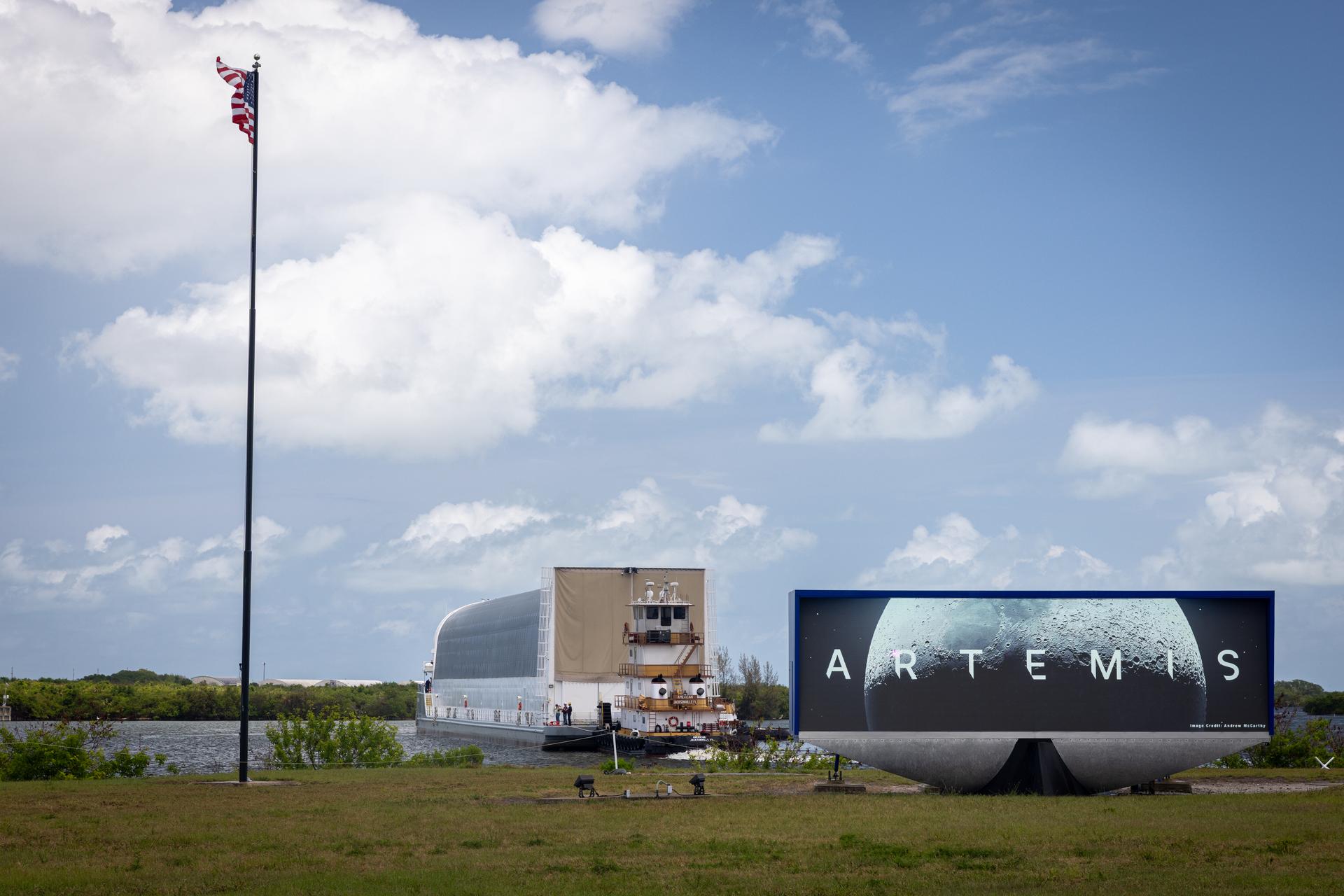
Why it matters: Physical hardware arrival at the launch site is a critical, non-reversible milestone that transitions the program from factory production to final integration and testing, reducing schedule risk for the Artemis III mission.
Context: Artemis III is the first Artemis mission planned to land astronauts on the Moon, dependent on the SLS rocket and complex in-space rendezvous with a commercial human landing system. Core stage delivery has historically been a pacing item for SLS schedules.
"The largest rocket section for NASA’s Artemis III mission arrived at the agency’s Kennedy Space Center in Florida on April 27. The SLS (Space Launch System) core stage traveled 900 miles on the Pegasus barge from NASA’s Michoud Assembly Facility in New Orleans where the stage is manufactured, to complete assembly of the massive rocket at NASA Kennedy." — NASA.GOV
Commentary: The delivery signals that the primary long-lead item for the Artemis III stack is now in position, shifting the critical path to vertical integration and subsequent wet dress rehearsals. However, the mission’s ultimate schedule remains contingent on parallel development of the SpaceX Starship HLS and Orion’s docking system, making this a necessary but insufficient step for a 2026 launch target.
Date: Mon, 27 Apr 2026 19:33:20 +0000
URL: https://www.nasa.gov/blogs/missions/2026/04/27/nasas-artemis-core-stage-arrives-at-kennedy/
AI Sentiment Score: Negative (66%)
AI Credibility Score: 10.0/10 — High
Scores and text generated by AI analysis of the source article indicated.
Artemis II Mission Milestones: An Image and Video Recap – NASA (Nasa.Gov)
Summary: NASA’s Artemis II mission, launched April 1, 2026, has concluded with a successful splashdown. The crewed Orion spacecraft completed a 10-day circumlunar flight, setting a new human distance record of 252,756 miles from Earth and surpassing the Apollo 13 benchmark. The mission tested Orion systems with astronauts aboard and conducted a close-range lunar flyby.

Why it matters: This operational success validates the Orion spacecraft’s crew-rated systems for deep space, establishes a new performance baseline for human exploration, and provides critical data for planning the Artemis III lunar landing.
Context: Artemis II is the first crewed flight test in the Artemis program, following the uncrewed Artemis I mission. Its primary objective was not lunar landing but proving life support, navigation, and re-entry systems for the more complex missions that follow.
"At their farthest point, the crew traveled 252,756 miles from Earth, setting a record for the greatest distance humans have traveled in space and observing the lunar surface like never before." — NASA.GOV
Commentary: The distance record is a symbolic but necessary milestone, shifting the operational envelope for human spaceflight beyond Apollo-era limits. The real signal is the nominal performance of Orion’s systems; a clean shakedown cruise reduces perceived risk for Artemis III’s critical path and for the commercial and international partners building its supporting infrastructure. The mission’s success locks in the program’s political and budgetary momentum, making the lunar surface timeline more credible.
Date: April 21, 2026 12:00 AM ET
URL: https://www.nasa.gov/general/artemis-ii-mission-milestones-an-image-and-video-recap/
AI Sentiment Score: Positive (62%)
AI Credibility Score: 10.0/10 — High
Scores and text generated by AI analysis of the source article indicated.
NASA on Track for Future Missions with Initial Artemis II Assessments (Nasa.Gov)
Summary: NASA’s initial post-flight assessment of the Artemis II mission indicates nominal performance for the Orion spacecraft and SLS rocket, with Orion landing within 2.9 miles of its target after a 694,481-mile circumlunar journey. The agency is now conducting detailed engineering analysis of all systems, from the launch pad to re-entry, to validate hardware for the crewed Artemis III mission planned for next year.

Why it matters: The operational success of this uncrewed test flight is a critical gatekeeper for the schedule and technical viability of the crewed lunar landing program and its supporting infrastructure.
Context: Artemis II was the first integrated flight test of the full SLS/Orion stack on a lunar trajectory, serving as the essential dress rehearsal for the complex Artemis III mission architecture.
"Orion splashed down with precision, just 2.9 miles from the targeted landing site." — NASA.GOV
Commentary: The reported landing precision is a strong early signal for the spacecraft’s guidance, navigation, and control systems, which must be reliable for crewed operations. However, the real engineering work now begins in the subsystems data; any anomalies discovered will directly pressure the Artemis III schedule and may force design revisions before astronauts are committed to the same systems.
Date: April 20, 2026 12:00 AM ET
URL: https://www.nasa.gov/missions/nasa-on-track-for-future-missions-with-initial-artemis-ii-assessments/
AI Sentiment Score: Negative (50%)
AI Credibility Score: 10.0/10 — High
Scores and text generated by AI analysis of the source article indicated.
NASA’s Mobile Launcher Rolls Ahead of Artemis III Preparation (Nasa.Gov)
Summary: Following the Artemis II test flight, NASA has moved the mobile launcher from Launch Complex 39B to the Vehicle Assembly Building at Kennedy Space Center. This marks the formal start of ground processing for Artemis III, the mission intended to return humans to the lunar surface, which is currently targeted for next year. The move initiates the stacking of the Space Launch System rocket and repairs to ground equipment damaged during the previous launch.
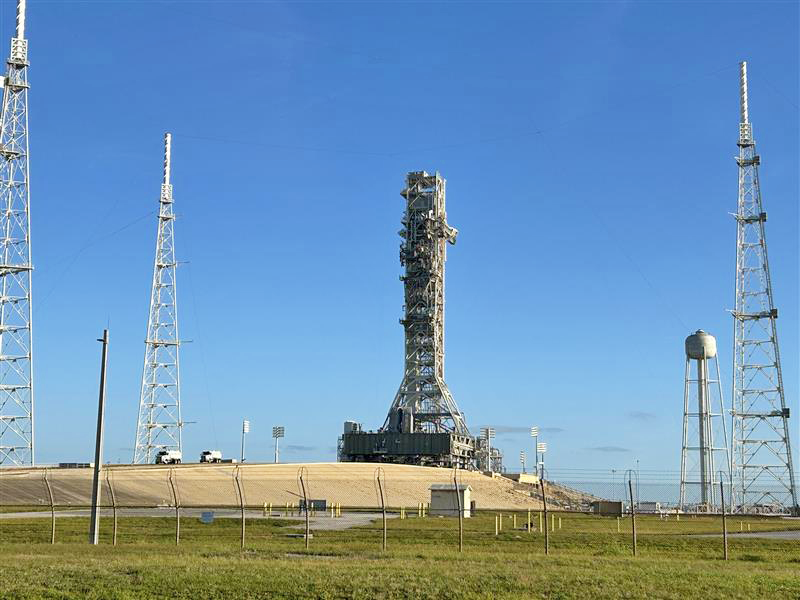
Why it matters: The transition from test flight to hardware processing is a critical, schedule-dependent phase for the Artemis program, and the condition of the ground infrastructure after Artemis II provides a direct measure of design improvements and ongoing operational risks.
Context: Artemis III is the program’s first planned crewed lunar landing mission, but its schedule is contingent on the readiness of multiple, independently developed systems including the SLS rocket, Orion spacecraft, SpaceX’s Starship Human Landing System, and new lunar spacesuits.
"Application of lessons learned from Artemis I to harden and reinforce ground support equipment at the pad proved successful as the mobile launcher and launch pad sustained minimal damage from the 8.8 million pounds of thrust expelled at booster ignition." — NASA.GOV
Commentary: The reported ‘minimal damage’ is a positive engineering signal, validating post-Artemis I modifications and suggesting reduced turnaround time and cost for pad refurbishment. However, the move itself is a routine procedural step; the more significant schedule risk for Artemis III lies not with SLS ground ops, but with the delayed development and testing of the lunar lander and supporting orbital infrastructure.
Date: Thu, 16 Apr 2026 12:33:08 +0000
URL: https://www.nasa.gov/blogs/missions/2026/04/16/nasas-mobile-launcher-rolls-ahead-of-artemis-iii-preparation/
AI Sentiment Score: Negative (57%)
AI Credibility Score: 10.0/10 — High
Scores and text generated by AI analysis of the source article indicated.
NASA on track for future missions with initial Artemis II assessments (Phys)
Summary: NASA has completed the initial post-flight assessment of the Artemis II mission, which successfully returned its crew to Earth after a lunar flyby. The agency is analyzing performance data from the Orion spacecraft, SLS rocket, and ground systems to inform upcoming missions. The stated schedule aims for Artemis III in 2027 and lunar surface missions beginning in 2028.

Why it matters: The post-flight data review is the critical engineering gate determining the realism of NASA’s ambitious lunar landing schedule and the operational readiness of its deep-space hardware.
Context: Artemis II was the first crewed test of the integrated SLS/Orion system, a necessary precursor to any landing attempt. Historical precedent shows that post-flight anomaly resolution often dictates major program timelines.
"Using data from the first crewed mission under the Artemis program, NASA continues preparing the hardware and teams to launch and fly the Artemis III mission in 2027 ahead of subsequent missions to the moon’s surface beginning in 2028." — PHYS
Commentary: The 2027 target for Artemis III remains aggressive, contingent on resolving any significant anomalies from Artemis II and on the parallel, delayed development of the Human Landing System and lunar spacesuits. The ‘initial assessments’ framing suggests no show-stoppers were found, but the real schedule risk will emerge from the detailed subsystem reviews now underway.
Date: April 21, 2026 12:00 AM ET
URL: https://phys.org/news/2026-04-nasa-track-future-missions-artemis.html
AI Sentiment Score: Negative (66%)
AI Credibility Score: 10.0/10 — High
Scores and text generated by AI analysis of the source article indicated.
What’s Happening in Space Policy April 19-25, 2026 (Spacepolicyonline)
Summary: The House Science, Space, and Technology Committee will hold a hearing on NASA’s FY2027 budget request with Administrator Jared Isaacson as the sole witness. The budget proposal, submitted by President Trump, seeks a $5.6 billion cut to NASA’s base budget, a 23% overall reduction, with deep cuts to science (46%), technology, aeronautics, and space operations (~30% each), while increasing Moon-to-Mars exploration funding by 9.5%. This follows Congress’s bipartisan rejection of a similar proposal for FY2026. Concurrently, NASA will unveil the Nancy Grace Roman Space Telescope, and the Mars Exploration Program Analysis Group (MEPAG) will meet.
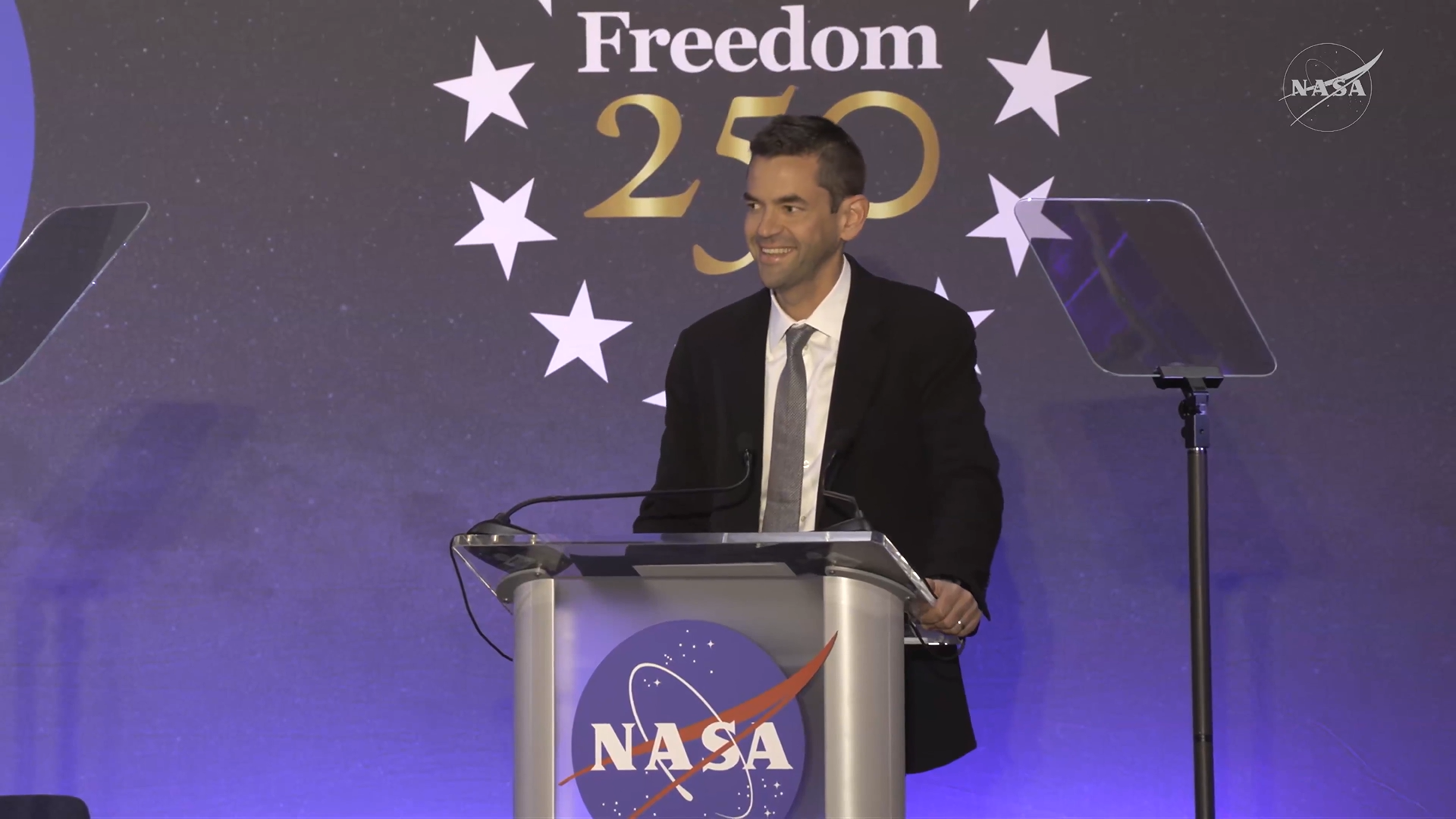
Why it matters: The proposed budget represents a fundamental reallocation of national space priorities, threatening established science and technology programs to accelerate human lunar and Mars exploration, with immediate consequences for missions, industry contracts, and international partnerships.
Context: This is the second consecutive year the White House has proposed severe cuts to NASA’s non-exploration portfolios, testing congressional support for a Moon-to-Mars focus against bipartisan defense of planetary science, Earth observation, and aeronautics.
"Here is SpacePolicyOnline.com’s list of space policy events for the week of April 19-25, 2026 and any insight we can offer about them. The House and Senate are in session this week." — SPACEPOLICYONLINE
Commentary: The hearing is a political stress test for the exploration-centric vision. The proposed cuts to science and technology are operationally untenable, likely designed as a negotiating position rather than a viable plan. The real signal is the administration’s continued willingness to cannibalize other directorates to protect Artemis, forcing Congress to explicitly choose which capabilities to sacrifice. Contractor earnings calls this week (Boeing, Lockheed Martin) will now be read through this lens of budgetary risk versus exploration commitment.
Date: April 20, 2026 12:00 AM ET
URL: https://spacepolicyonline.com/news/whats-happening-in-space-policy-april-19-25-2026/
AI Sentiment Score: Negative (66%)
AI Credibility Score: 10.0/10 — High
Scores and text generated by AI analysis of the source article indicated.
Ames’s contributions to Artemis II – Phys.org (Phys)
Summary: NASA’s Artemis II mission, launched on April 1, 2026, successfully completed a crewed lunar flyby with astronauts Reid Wiseman, Victor Glover, Christina Koch, and Jeremy Hansen. The 10-day test flight validated Orion spacecraft systems for deep space operations, marking the first human return to lunar vicinity since Apollo. The mission’s success establishes a critical operational baseline for subsequent Artemis lunar landing missions.

Why it matters: Artemis II’s completion transitions the Artemis program from theory and uncrewed tests to proven crewed operations, de.risking the architecture for the politically and technically complex Artemis III landing attempt.
Context: Artemis II follows the uncrewed Artemis I test (2022) and precedes the planned Artemis III lunar landing. Its success was a non-negotiable gate for the program’s political support and technical timeline.
"NASA successfully sent four astronauts around the moon for the first time in more than 50 years, setting the stage for future lunar landing missions." — PHYS
Commentary: The mission’s nominal performance validates Orion’s life support and re-entry systems, but the real test was operational: demonstrating NASA and its international partners can execute a complex crewed deep-space mission on schedule. This success likely secures continued congressional funding and locks in the core Artemis sequence, though it does not mitigate the separate, severe technical challenges facing the Artemis III Human Landing System and lunar spacesuits.
Date: April 22, 2026 12:00 AM ET
URL: https://phys.org/news/2026-04-ames-contributions-artemis-ii.html
AI Sentiment Score: Positive (57%)
AI Credibility Score: 10.0/10 — High
Scores and text generated by AI analysis of the source article indicated.
Artemis Rewritten: NASA’s New Moon Plan, Its Risks, and Whether … (Aerospace.Csis)
Summary: NASA has formally restructured the Artemis program, converting Artemis III from a crewed lunar landing to a low Earth orbit demonstration mission. The first crewed landing is now scheduled for Artemis IV in 2028, with the agency adding an extra mission to the manifest and standardizing the early SLS configuration. This revision prioritizes risk reduction by testing lander docking operations closer to Earth before attempting them in lunar orbit.

Why it matters: The shift signals a major tactical recalibration of the US lunar return program, trading near-term political optics for engineering prudence while locking in a new, more complex flight order with its own schedule dependencies.
Context: This follows years of independent analyst warnings about the compressed schedule and untested integration of the Human Landing System (HLS) with Orion, representing an institutional acknowledgment of those technical realities.
"In early 2026, NASA made a consequential change to the Artemis program: Artemis III was no longer planned as a crewed lunar landing mission. Instead, Artemis III had been changed to a." — AEROSPACE.CSIS
Commentary: The move de-risks the critical docking and crew transfer sequence but creates a new programmatic fragility: Artemis IV’s 2028 date is now wholly contingent on the success of the Artemis III demo and the readiness of two different commercial landers. NASA’s concurrent ‘Ignition’ base initiative suggests the agency is betting this operational pause will pay off in long-term sustainability, but it concedes the symbolic first-landing timeline to external pressures.
Date: April 20, 2026 12:00 AM ET
URL: https://aerospace.csis.org/artemis-rewritten-nasas-new-moon-plan-its-risks-and-whether-the-u-s-can-still-beat-china/
AI Sentiment Score: Neutral (33%)
AI Credibility Score: 7.0/10 — Medium
Scores and text generated by AI analysis of the source article indicated.
Artemis III moon rocket rolls out of factory onto barge – Boeing (Boeing)
Summary: Boeing has rolled out the forward assembly of the Artemis III SLS core stage from the Michoud Assembly Facility, shipping it without the engine section for the first time. The hardware will be barged to Kennedy Space Center for integration. This marks a procedural change intended to accelerate production for the lunar program.
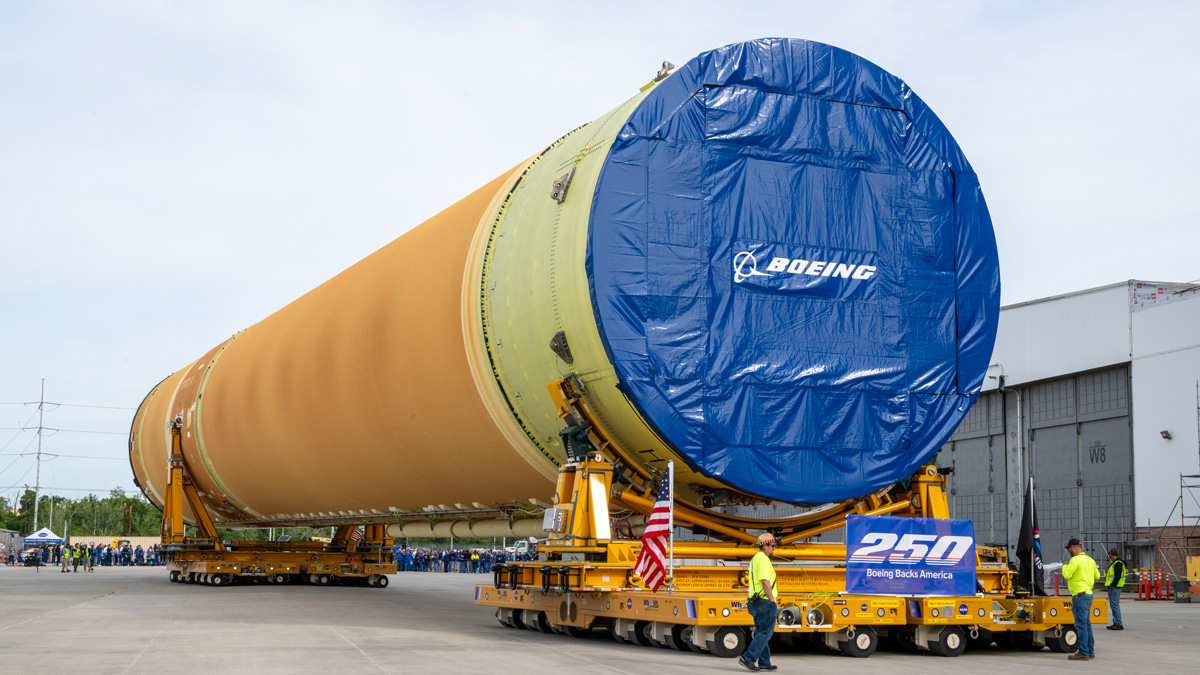
Why it matters: The shift in manufacturing logistics signals a tangible effort to improve SLS production cadence, a critical factor for sustaining the Artemis schedule beyond initial missions.
Context: SLS core stage production has faced schedule pressures; decoupling the engine section assembly from the main tank structure is a pragmatic attempt to parallelize workflows and mitigate bottlenecks.
"This is the first time the Boeing program for NASA’s Space Launch System (SLS) has shipped a core stage without its engine section, a change aimed at accelerating production for future Artemis missions." — BOEING
Commentary: The operational change is a minor but telling adaptation to the program’s industrial reality. It reflects a focus on throughput over traditional monolithic integration, though the ultimate test remains whether it materially compresses the interval between Artemis III and Artemis IV. The barge journey itself is a routine but necessary step, underscoring the continued geographical and logistical constraints of the SLS architecture.
Date: April 20, 2026 12:00 AM ET
URL: https://www.boeing.com/features/2026/04/artemis-iii-moon-rocket-rolls-out-of-factory-onto-barge
AI Sentiment Score: Positive (50%)
AI Credibility Score: 7.0/10 — Medium
Scores and text generated by AI analysis of the source article indicated.
Artemis II Mission Recap 2026: Humans Return to the Moon’s Far Side (Collegesimplified.In)
Summary: The Artemis II Mission Recap 2026 marks a historic turning point in human space exploration. For the first time in over 50 years, since the conclusion of the Apollo era in 1972, four humans have ventured beyond Low Earth Orbit (LEO) to witness the lunar far side. On April 10, 2026, the Orion spacecraft, named Integrity, splashed down safely in the Pacific Ocean, successfully concluding a 10-day journey that pushed the boundaries of technology and human endurance.

Why it matters: This matters for Space Exploration because it gives a concrete current signal to track: The Artemis II Mission Recap 2026 marks a historic turning point in human space exploration.
Context: The Artemis II Mission Recap 2026 marks a historic turning point in human space exploration. For the first time in over 50 years, since the conclusion of the Apollo era in 1972, four humans have ventured beyond Low Earth Orbit (LEO) to witness the lunar far side. On April 10, 2026, the Orion spacecraft, named Integrity, splashed down safely in the Pacific Ocean, successfully concluding a 10-day journey that pushed the boundaries of technology and human endurance.
"The Artemis II Mission Recap 2026 marks a historic turning point in human space exploration. For the first time in over 50 years, since the conclusion of the Apollo era in 1972,." — COLLEGESIMPLIFIED.IN
Commentary: The immediate implication is operational rather than speculative: watch how this changes budgets, workflows, or risk assumptions over the next cycle.
Date: April 20, 2026 12:00 AM ET
URL: https://www.collegesimplified.in/post/artemis-ii-lunar-flyby-mission-recap-2026
AI Sentiment Score: Negative (50%)
AI Credibility Score: 7.0/10 — Medium
Scores and text generated by AI analysis of the source article indicated.
Post ID: 3a488d15