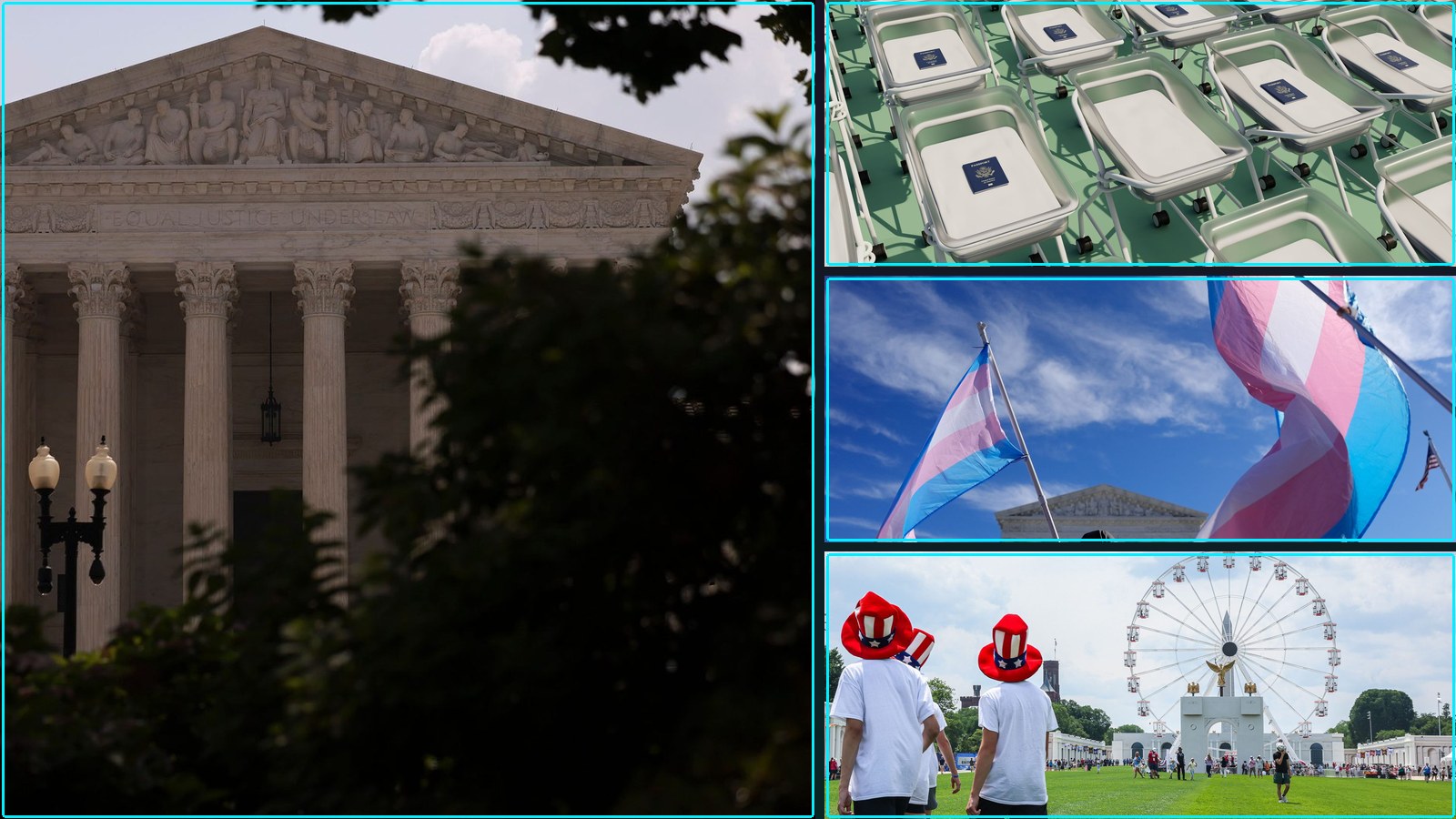
Trump, the Supreme Court, and the Future of American Politics
Donald Trump Celebrates America’s Two-Hundred-and-Fiftieth Birthday (Newyorker)
Summary: The New Yorker reports on the transformation of America’s 250th anniversary into a Trump-branded spectacle, with the Freedom 250 commission replacing the bipartisan America250, a state fair on the National Mall that felt more like a corporate expo and military recruitment drive, and a library opening in North Dakota that doubled as a campaign rally. The piece captures the hollowing out of civic ritual into partisan performance, where the First Amendment is a Truth Social ad and the Declaration of Independence is a basketball game prop.

Why it matters: This is a case study in how a president can repurpose a national anniversary into a personal branding exercise, eroding the distinction between state ceremony and political campaign.
Context: The semiquincentennial was originally planned by America250, a bipartisan commission established in 2016; Trump diverted its funding in 2025 to create Freedom 250, which he controls directly.
"Instead of featuring gently patriotic nonpartisan content, the event was a pure reflection of Trump-branded America. (The First Amendment was displayed as part of a promotion for Truth Social, the President’s social network.)." — NEWYORKER
Commentary: The piece’s power lies in its accumulation of small, telling details: the First Amendment as a social-media ad, the Department of Justice booth offering prison-recruitment chapsticks, the Declaration of Independence as a basketball backdrop. These are not just aesthetic choices—they signal a deeper redefinition of what ‘America’ means when the state’s anniversary apparatus is captured by a single political figure. The result is a civic ritual that no longer binds the nation but instead deepens its fractures.
Date: July 03, 2026 06:00 AM ET
URL: https://www.newyorker.com/news/the-lede/donald-trump-celebrates-americas-two-hundred-and-fiftieth-birthday
AI Sentiment Score: Negative (75%)
AI Credibility Score: 10.0/10 — High
Scores and text generated by AI analysis of the source article indicated.
What Trump’s July 4 Speech Revealed (Theatlantic)
Summary: The Atlantic’s analysis of Trump’s July 4 speech frames it as a Norma Desmond moment—a performance that recites America’s founding ideals while the president has systematically abandoned them. The speech honored past military triumphs but revealed a leader who views those ideals as a sucker’s game, preferring authoritarian allies and wars of plunder. The 250th anniversary became a fiasco, delayed by weather and marred by Trump’s inability to deliver a single memorable line. The piece argues that Trump’s America is being reshaped in the image of Russia and Saudi Arabia, not the Declaration of Independence.
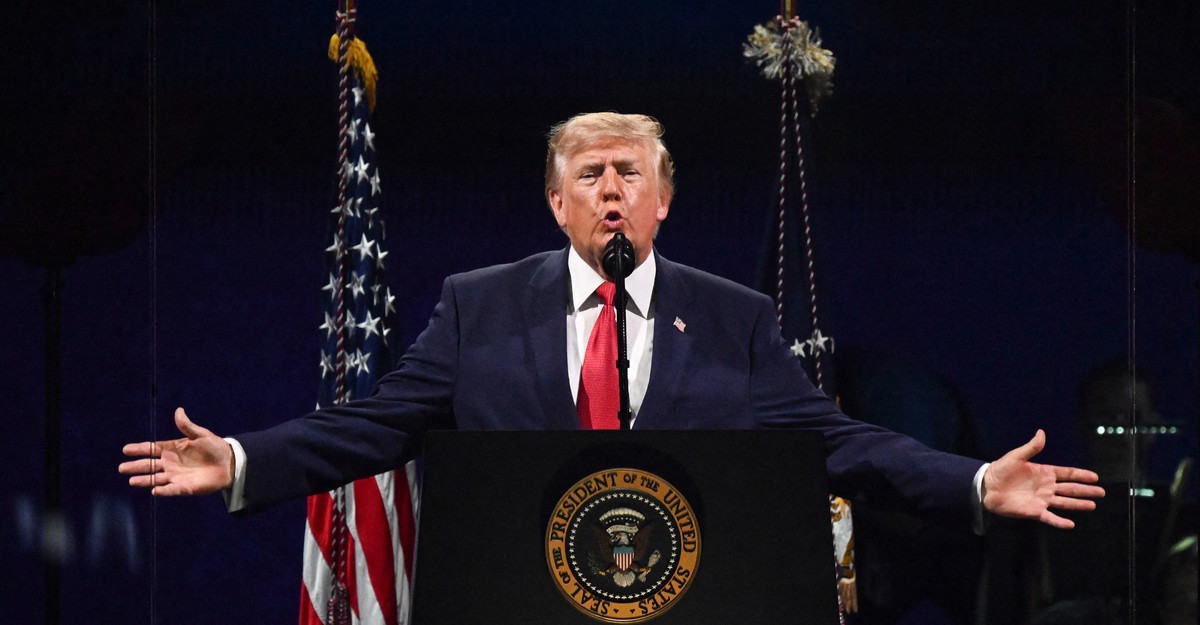
Why it matters: This is not just a speech critique; it’s a diagnosis of how a president can hollow out national mythology while still performing it, and what that means for American credibility abroad.
Context: Trump’s July 4 address came amid ongoing military conflicts in Venezuela and Iran, threats to annex Greenland and Canada, and a pivot toward authoritarian states—all while the U.S. reduced aid to Ukraine.
"Trump’s speech demanded credit for a history that Trump regards as a sucker’s mistake. Trump is building an American future oriented toward authoritarian and corrupt states: Russia, Turkey, Saudi Arabia. Democratic allies are treated, at best, as subjects to be bullied and, at worst, as targets to be carved up into new American territories." — THEATLANTIC
Commentary: The Sunset Boulevard framing is apt but almost too generous—Norma Desmond was delusional about her past glory, while Trump seems to hold the past in contempt. The real story is the gap between the rhetoric on the teleprompter and the policy reality, a gap that foreign audiences see arguably even if domestic ones don’t. The piece’s closing line—’Americans have not clung to their dream nearly desperately enough’—is a quiet indictment of the electorate’s complicity.
Date: July 05, 2026 08:50 AM ET
URL: https://www.theatlantic.com/ideas/2026/07/trump-july-4/687811/
AI Sentiment Score: Neutral (50%)
AI Credibility Score: 10.0/10 — High
Scores and text generated by AI analysis of the source article indicated.
The Supreme Court’s Check on Trump’s Power Was Too Close for Comfort (Newyorker)
Summary: The Supreme Court’s 6-3 ruling upholding birthright citizenship was a narrow escape, with four conservative justices arguing the Constitution does not suggest it. Chief Justice Roberts and Justice Kavanaugh provided the margin, but Kavanaugh relied on a separate federal statute rather than the Fourteenth Amendment itself. The term saw a sharp increase in ideologically split decisions (23% of cases), and the Court simultaneously granted the president sweeping new power to fire officials at independent agencies, overturning a 1935 precedent. The defining move was not the citizenship case but the gutting of Section 2 of the Voting Rights Act in a Louisiana redistricting decision, completing a long-term demolition of the law’s protections.

Why it matters: This term reveals a Court that is both willing to check Trump on specific overreaches and eager to entrench a unitary executive theory that will outlast his presidency, while accelerating the erosion of voting rights and campaign finance limits.
Context: The conservative majority has now overturned or hollowed out precedents on abortion, affirmative action, administrative deference, campaign finance, and voting rights within five years, with unanimity rates masking a growing ideological chasm.
"The defining moment of the term—the one that exposed what this Court is about and that will reverberate for decades—was not birthright citizenship but the Court’s lunge, in a redistricting case from Louisiana, to undo the remaining protections of the Voting Rights Act." — NEWYORKER
Commentary: The birthright citizenship ruling is a trap for liberals: it feels like a win but masks the Court’s deeper project. The real story is the consolidation of a post-New Deal executive power structure and the near-complete neutralization of the Voting Rights Act, both achieved with Roberts’s institutionalist cover. The 23% ideological split rate is a structural warning: a Court this predictable in high-stakes cases is a political institution in judicial robes, and its architecture will constrain governance long after Trump leaves office.
Date: June 30, 2026 05:53 PM ET
URL: https://www.newyorker.com/news/the-lede/the-supreme-courts-check-on-trumps-power-was-too-close-for-comfort
AI Sentiment Score: Positive (40%)
AI Credibility Score: 10.0/10 — High
Scores and text generated by AI analysis of the source article indicated.
The Supreme Court Upheld Birthright Citizenship—but the Fight May Not Be Over (Newyorker)
Summary: The Supreme Court ruled 6-3 in Trump v. Barbara that Trump’s executive order denying birthright citizenship to children of undocumented or temporary-status parents is unlawful, with a 5-4 majority holding it unconstitutional under the Fourteenth Amendment. Chief Justice Roberts wrote the majority opinion affirming that the Citizenship Clause applies to nearly all babies born in the U.S., rejecting the administration’s ‘dramatically revisionist view.’ However, Justice Kavanaugh’s concurrence argued the order was unlawful only because Congress had codified birthright citizenship in statute, leaving open the possibility that Congress could legislate to restrict it. The dissents from Alito, Thomas, and Gorsuch, along with Trump’s immediate call for congressional action, signal that the political and legal fight over who qualifies as American is far from settled.

Why it matters: This ruling preserves a foundational principle of American citizenship, but the narrow 5-4 margin on the constitutional question and Kavanaugh’s statutory reasoning create a clear legislative vulnerability that could reshape national identity and immigration politics.
Context: The Fourteenth Amendment’s Citizenship Clause, ratified in 1868, has been understood since the 1898 Wong Kim Ark decision to grant citizenship to nearly all persons born in the U.S., with exceptions only for children of diplomats, occupying armies, or certain Native American tribes. Trump’s 2025 executive order directly challenged this settled interpretation.
"The distinction is important because, according to Kavanaugh’s logic, what Congress gives, it can also take away: it could pass a law stripping citizenship from many American-born babies, even if Trump, acting alone, cannot." — NEWYORKER
Commentary: The real story here is not the win but the fragility of the victory. Kavanaugh’s statutory framing hands Trump and future administrations a ready-made legislative playbook, and the four dissenting justices—plus Trump’s immediate call for congressional action—mean this issue will return the moment Republicans control both chambers. The Court has bought time, not peace.
Date: June 30, 2026 07:13 PM ET
URL: https://www.newyorker.com/news/the-lede/the-supreme-court-upheld-birthright-citizenship-but-the-fight-may-not-be-over
AI Sentiment Score: Negative (75%)
AI Credibility Score: 10.0/10 — High
Scores and text generated by AI analysis of the source article indicated.
Behind the Supreme Court’s Ruling on Transgender Athletes (Newyorker)
Summary: In January, during oral arguments in the Supreme Court, in a case about whether states may exclude transgender female athletes from girls’ sports teams, the lawyer for Becky Pepper-Jackson, a transgender teen-ager, made a point of emphasizing her athletic mediocrity. Competing on her school’s track-and-field and cross-country teams, “where nobody was cut,” her lawyer said, “she came in near the back.” Becky (known in the case as B.P.J.) hadn’t gone through male puberty, and didn’t have male testosterone levels, because she had taken puberty blockers and was on female hormones. The other transgender plaintiff, an Idaho college student named Lindsay Hecox, had gone through male puberty, but, her brief said, she “was not fast enough” to make her university’s N.C.A.A.

Why it matters: This matters for Long-Form Worth Your Time because it gives a concrete current signal to track: In January, during oral arguments in the Supreme Court, in a case about whether states may exclude transgender female athletes from girls’ sports teams, the lawyer for Becky Pepper-Jackson, a transgender teen-ager, made a point of emphasizing her athletic mediocrity.
Context: In January, during oral arguments in the Supreme Court, in a case about whether states may exclude transgender female athletes from girls’ sports teams, the lawyer for Becky Pepper-Jackson, a transgender teen-ager, made a point of emphasizing her athletic mediocrity. Competing on her school’s track-and-field and cross-country teams, “where nobody was cut,” her lawyer said, “she came in near the back.” Becky (known in the case as B.P.J.) hadn’t gone through male puberty, and didn’t have male testosterone levels, because she had taken puberty blockers and was on female hormones. The other transgender plaintiff, an Idaho college student named Lindsay Hecox, had gone through male puberty, but, her brief said, she “was not fast enough” to make her university’s N.C.A.A.
"In January, during oral arguments in the Supreme Court, in a case about whether states may exclude transgender female athletes from girls’ sports teams, the lawyer for Becky Pepper-Jackson, a transgender teen-ager,." — NEWYORKER
Commentary: The immediate implication is operational rather than speculative: watch how this changes budgets, workflows, or risk assumptions over the next cycle.
Date: July 01, 2026 04:53 PM ET
URL: https://www.newyorker.com/news/the-lede/behind-the-supreme-courts-ruling-on-transgender-athletes
AI Sentiment Score: Negative (75%)
AI Credibility Score: 10.0/10 — High
Scores and text generated by AI analysis of the source article indicated.
The Unprecedented Profiteering Revealed by Donald Trump’s Financial Disclosure (Newyorker)
Summary: Donald Trump’s 2025 financial disclosure reveals over $2.2 billion in earnings, a staggering sum driven largely by crypto ventures launched during his campaign and presidency. The report details profits from World Liberty Financial and $TRUMP memecoins, alongside payments from foreign entities like the UAE ruling family and a pardoned crypto founder. These disclosures arrive as the value of these same tokens has collapsed by 80-90%, devastating the small investors the Trump family encouraged to buy in. The scale and brazenness of the profiteering, including a $400 million jet from Qatar, represent an unprecedented fusion of public office and private enrichment.

Why it matters: This story crystallizes the fundamental corruption of a presidency where personal financial gain has become the primary output of public service, with the president’s own supporters bearing the losses.
Context: Trump’s previous financial disclosures as president showed foreign revenue around $40 million annually; the 2025 figure of $2.2 billion represents a 35-fold increase, driven almost entirely by crypto assets that were marketed directly to his political base.
"It recorded more than $2.2 billion in earnings, up from six hundred and twenty-two million dollars in 2024, a jump in profits without precedent in Presidential history. More than $1.4 billion of those earnings came from crypto tokens or investments like the ones Trump sold Sun, including some eight hundred million dollars associated with World Liberty and more than six hundred million dollars that appears to come from the partnership that sold his $TRUMP memecoins." — NEWYORKER
Commentary: The disclosure transforms what looked like isolated grift into a systematic extraction machine, with the presidency serving as the ultimate marketing platform. The collapse of these same assets by 80-90% reveals the mechanism: Trump monetized his supporters’ trust in his political future, not any underlying value. The Sun lawsuit and the UAE transaction suggest this was less a business than a protection racket, where payments flowed in exchange for regulatory and diplomatic favors. The real scandal may not be the conflicts of interest, but that the entire enterprise was built on selling worthless tokens to the very people who voted for him.
Date: July 02, 2026 02:20 PM ET
URL: https://www.newyorker.com/news/the-lede/the-unprecedented-profiteering-revealed-by-donald-trumps-financial-disclosure
AI Sentiment Score: Positive (50%)
AI Credibility Score: 10.0/10 — High
Scores and text generated by AI analysis of the source article indicated.
The Alabamafication of National Politics (Theatlantic)
Summary: Doug Jones, the Democratic nominee for Alabama governor, is attempting a long-shot upset against Tommy Tuberville by betting on MAGA voter apathy and a shifting demographic and economic landscape. The race highlights Alabama’s enduring tradition of performative, grievance-driven politics, which has increasingly become a national template. Jones’s strategy relies on a ‘magic number’ of 920,000 votes and a turnout pattern that saw Democratic primary participation surge while Republican turnout dropped. The outcome will test whether the state’s progressive coalition can overcome its entrenched oligarchic and cultural resistance to change.
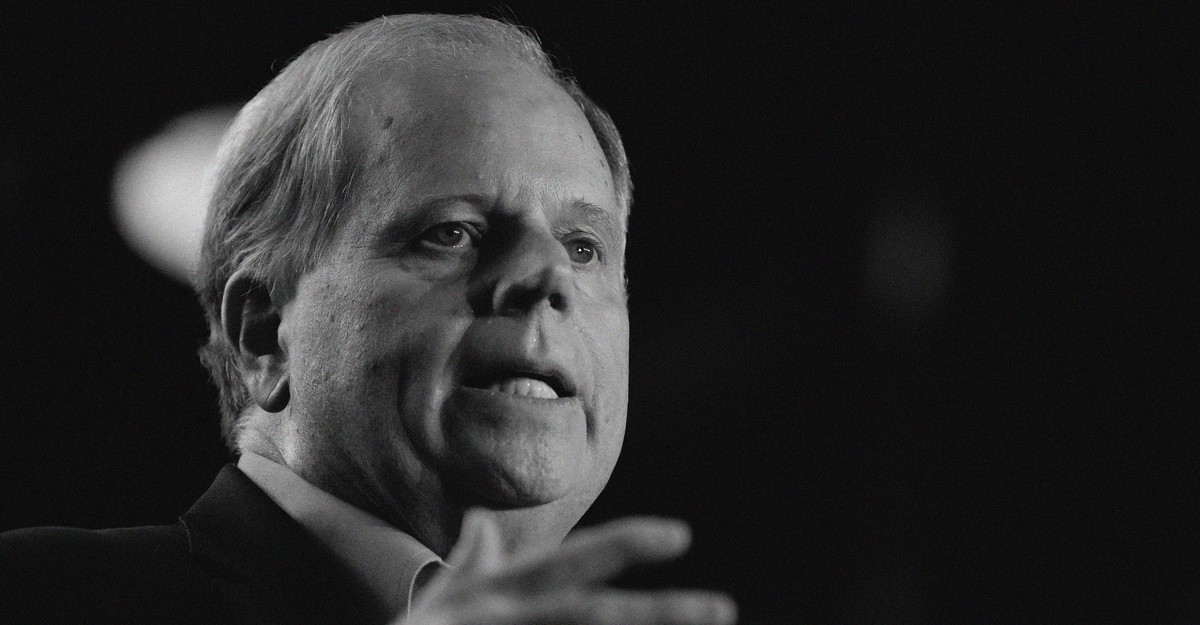
Why it matters: This race is a bellwether for whether the national Republican coalition is fraying at its reddest edges, and whether the ‘Alabamafication’ of U.S. politics—regressive tax structures, oligarchic control, and performative extremism—can be reversed by demographic and economic modernization.
Context: Alabama has not had a Democratic governor in over two decades, and Jones previously won a Senate seat in 2017 against a deeply flawed Republican candidate. The state’s political culture, rooted in white grievance and oligarchic power, has often foreshadowed national trends, from George Wallace to Donald Trump.
"The Alabamafication of National Politics What the race between Doug Jones and Tommy Tuberville says about America’s past and future On Juneteenth, I watched Doug Jones, the Democratic nominee for Alabama governor,." — THEATLANTIC
Commentary: The piece’s most incisive contribution is its framing of ‘Alabamafication’ as a national export—a system where oligarchic interests capture the state while stoking cultural resentment among the voters who bear the cost. Jones’s campaign is a fascinating stress test of whether economic modernization (data centers, auto plants, foodie culture) can eventually erode that political architecture, or whether the state’s ‘comic opera’ will simply absorb the new economy into its old patterns. The residency lawsuit against Tuberville adds a procedural wildcard, but the deeper story is whether turnout mechanics can overcome a century of structural advantage.
Date: July 05, 2026 08:00 AM ET
URL: https://www.theatlantic.com/politics/2026/07/doug-jones-tommy-tuberville-alabama/687789/
AI Sentiment Score: Negative (71%)
AI Credibility Score: 10.0/10 — High
Scores and text generated by AI analysis of the source article indicated.
Why Have Liberals Abandoned a Moral Reading of the Constitution? (Newyorker)
Summary: Harvard law professor Adrian Vermeule’s ‘Common Good Constitutionalism’ has revived natural law as a conservative legal weapon, prompting a liberal scholar to argue that progressives must reclaim the moral reading of the Constitution rather than cede it to the right. The piece traces the long history of natural law in American jurisprudence—from the Declaration through Dred Scott, Brown, and Obergefell—to show that both sides have always invoked higher principles when text alone fails. The author warns that liberals, having grown defensive about moral reasoning after decades of originalist attacks, now risk losing the interpretive framework that delivered Griswold, Roe, and marriage equality. The semiquincentennial is presented as an opportunity for liberals to openly embrace natural law arguments against the current administration’s legally permissible but substantively unjust policies.

Why it matters: This reframes the Supreme Court’s legitimacy crisis not as a battle between textualism and activism but as a contest over which moral vision gets to define ‘the common good’—a fight liberals are currently losing by default.
Context: Vermeule’s 2022 book explicitly rejected originalism as a spent force and proposed a Catholic-infused natural law framework that would overturn Roe, Casey, and Obergefell. The author, a liberal Harvard colleague, argues that Dworkin’s ‘moral reading’ was always natural law in disguise, and that liberals should stop pretending otherwise.
"The stark disagreements over the moral values underlying our legal tradition are no reason for liberals to disavow a moral approach to legal interpretation. Quite the opposite. Liberals should take a page from Vermeule just as he has taken a page from Dworkin, and reclaim the interpretation of law explicitly in terms of moral values." — NEWYORKER
Commentary: The piece is both a historical corrective and a tactical playbook: it exposes the originalist pose as a strategic fiction while urging liberals to stop fighting on conservative epistemic ground. The risk is that ‘natural law’ remains too freighted with religious and anti-LGBTQ associations to serve as a unifying progressive banner, but the author’s point—that you cannot beat a moral argument with a procedural one—is structurally sound. Expect this to become a key reference in the coming confirmation battles and in any liberal effort to articulate a positive constitutional vision rather than merely defending the status quo.
Date: July 02, 2026 06:00 AM ET
URL: https://www.newyorker.com/news/the-lede/why-have-liberals-abandoned-a-moral-reading-of-the-constitution
AI Sentiment Score: Negative (70%)
AI Credibility Score: 10.0/10 — High
Scores and text generated by AI analysis of the source article indicated.
680. Can Universities Win Back Our Trust? (Freakonomics)
Summary: This episode of Freakonomics Radio examines the crisis of trust facing American universities through conversations with two university presidents: Dartmouth’s Sian Beilock, who applies her research on performance under pressure to higher education leadership, and Vanderbilt’s Daniel Diermeier, who advocates for using ‘magnets over wedges’ to navigate political pressures. The episode also features discussions on alternative protein advocacy, the economics of food trucks, and the shifting taboos around financial conversations. The core question is whether institutions of higher learning can rebuild public confidence amid low trust, high political pressure, and fragile finances.

Why it matters: For readers tracking institutional legitimacy, this episode offers a rare look at how two university presidents are operationalizing trust repair—one through psychological insights on choking, the other through political strategy—providing concrete frameworks for an issue that affects everything from research funding to social mobility.
Context: Public trust in higher education has declined sharply in recent years, with Gallup reporting that confidence in colleges fell from 57% in 2015 to 36% in 2024, driven by perceptions of political bias, rising costs, and questions about value.
"Dartmouth president Sian Beilock, a psychologist by training, made her name studying why people choke. Now she’s applying those insights to one of the most scrutinized jobs in America. No pressure! Levitt." — FREAKONOMICS
Commentary: The ‘magnets over wedges’ framing is the most actionable insight here: Diermeier argues that institutions should attract broad support rather than exploit divisions, a counterintuitive strategy in an era of performative polarization. Beilock’s background in ‘choking’ research adds a psychological layer—she’s essentially treating the university itself as a system under pressure, which reframes administrative decisions as performance optimization rather than political positioning. The inclusion of the Good Food Institute’s Bruce Friedrich suggests a parallel argument: that market-driven solutions can restore trust in systems (food, education) where ideological battles have failed.
Date: July 03, 2026 06:00 AM ET
URL: https://freakonomics.com
AI Sentiment Score: Positive (50%)
AI Credibility Score: 10.0/10 — High
Scores and text generated by AI analysis of the source article indicated.
Post ID: dc006904