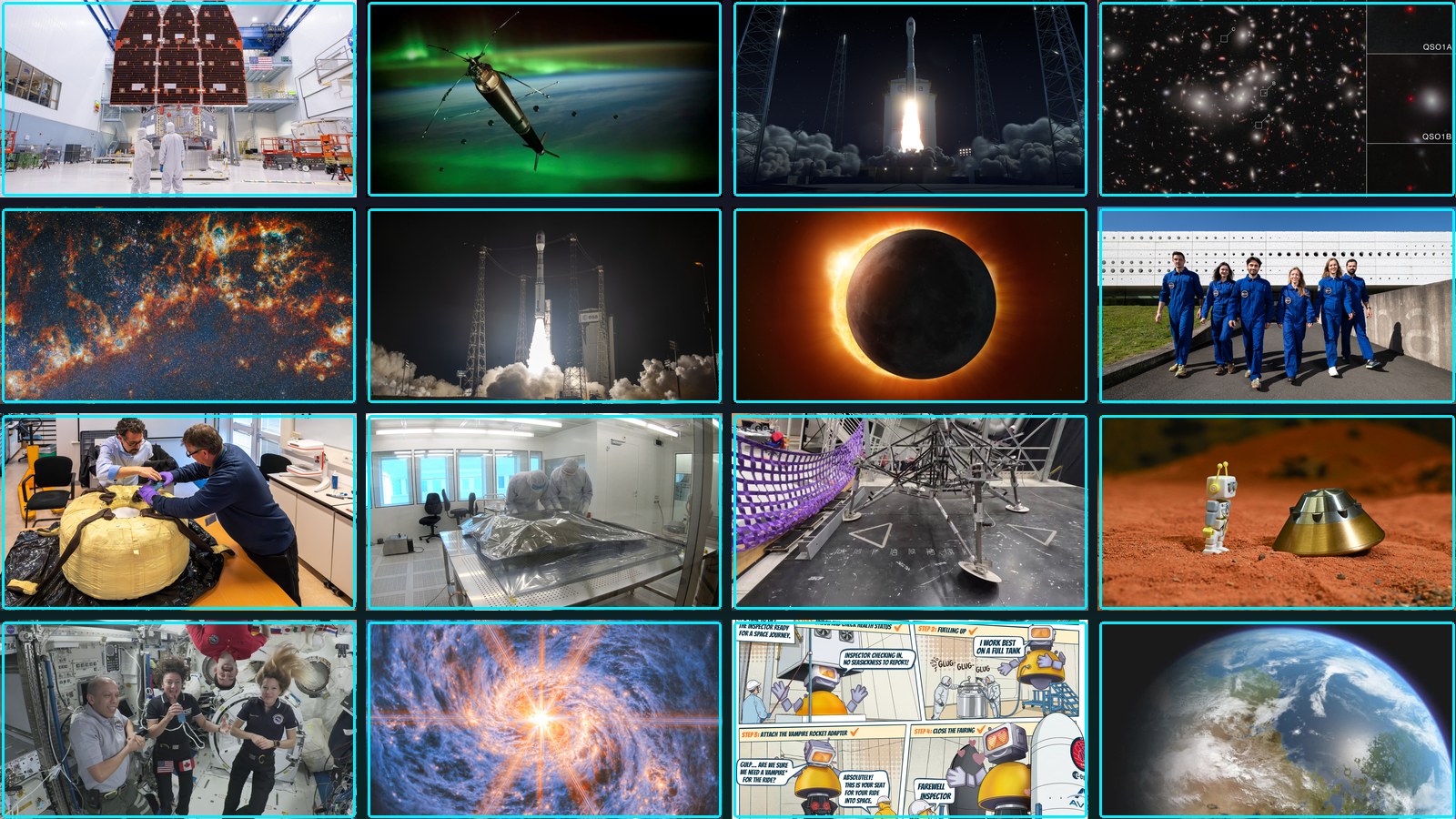
Telescope Discoveries and Space Science Missions
Webb reveals black hole that formed before its galaxy (Esa.Int)
Summary: Webb NIRSpec IFU observations of gravitationally lensed quasar Abell2744-QSO1 provide the first direct mass measurement of a supermassive black hole in the early Universe. The data show a 50-million-solar-mass black hole comprising two-thirds of the host system’s total mass, surrounded by pristine, low-metallicity gas with Keplerian rotation. This suggests the black hole formed before its host galaxy, likely via primordial or direct collapse mechanisms, challenging the standard model of gradual growth from stellar remnants.

Why it matters: It provides the first direct, kinematic evidence for a ‘black hole first’ pathway in galaxy formation, forcing a revision of early-Universe astrophysical models and seeding mechanisms.
Context: Webb’s discovery of numerous ‘little red dots’—compact, early-Universe objects hosting massive black holes—had raised questions about indirect mass estimates and growth timelines.
"They found that not only is the black hole immense – roughly 50 million solar masses – it makes up an astonishing two-thirds of QSO1’s total mass. This proportion is thousands of times greater than in nearby galaxies, where supermassive black holes make up only a tiny fraction of the host galaxy’s total mass." — ESA.INT
Commentary: The direct kinematic measurement validates Webb’s earlier indirect estimates, increasing confidence in the census of early massive black holes. The extreme mass fraction and low metallicity point decisively toward heavy-seed formation channels, shifting research focus from ‘how they grew so fast’ to ‘how they were born so big’. This will redirect theoretical work and observational proposals toward primordial black hole signatures and direct collapse scenarios.
Date: Wed, 27 May 2026 17:00:00 +0200
URL: https://www.esa.int/Science_Exploration/Space_Science/Webb/Webb_reveals_black_hole_that_formed_before_its_galaxy
AI Sentiment Score: Negative (62%)
AI Credibility Score: 10.0/10 — High
Scores and text generated by AI analysis of the source article indicated.
Webb & Hubble find massive star clusters emerge faster (Esa.Int)
Summary: A joint Hubble-Webb survey of four nearby galaxies has quantified the timescale for star clusters to clear their natal gas clouds. The study, using data from the FEAST program, analyzed nearly 9,000 clusters and found that the most massive clusters emerge after about five million years, while less massive clusters take seven to eight million years. This provides a direct observational constraint on the process of stellar feedback, where radiation and winds from young stars disperse gas and regulate further star formation.

Why it matters: This empirical timeline for stellar feedback directly informs galaxy evolution models and refines our understanding of the environmental conditions for planet formation.
Context: Simulations of star formation have historically struggled to accurately reproduce the dispersal of natal gas clouds by stellar feedback. This multi-wavelength, multi-telescope survey provides a large-sample observational benchmark.
"The most massive clusters had fully emerged and dispersed the clouds of gas after around five million years, while less massive clusters were between seven and eight million years old when they emerged from their nurseries." — ESA.INT
Commentary: The finding that feedback strength is mass-dependent and operates on a million-year timescale is a concrete input for cosmological simulations. It also implies that planetary systems in massive clusters face an earlier and more intense ultraviolet radiation environment, potentially truncating the gas accretion phase of giant planet formation. The operational success of correlating Hubble’s optical and Webb’s infrared data for population studies validates this combined-observatory approach for future galactic archaeology.
Date: Wed, 06 May 2026 12:00:00 +0200
URL: https://www.esa.int/Science_Exploration/Space_Science/Webb/Webb_Hubble_find_massive_star_clusters_emerge_faster
AI Sentiment Score: Negative (50%)
AI Credibility Score: 10.0/10 — High
Scores and text generated by AI analysis of the source article indicated.
A beacon of light in swirls of dust (Esa.Int)
Summary: The James Webb Space Telescope’s MIRI instrument has captured a new mid-infrared image of the barred spiral galaxy Messier 77 (M77), located 45 million light-years away. The image highlights the galaxy’s active galactic nucleus (AGN), powered by an eight-million-solar-mass black hole, its star-forming ring, and intricate dust structures. The data is part of a broader survey program (#3707) of massive, nearby, star-forming galaxies.

Why it matters: The image demonstrates Webb’s operational maturity and the specific scientific utility of its MIRI instrument for dissecting the physics of star formation and black hole activity in nearby galaxies.
Context: Webb’s mid-infrared capability, provided by the ESA-led MIRI consortium, is critical for observing warm dust and complex molecules obscured at other wavelengths, turning galaxies like M77 into detailed astrophysical laboratories.
"The data used to create this image are from an observing programme (#3707) that surveyed massive, nearby, star-forming galaxies to create a rich dataset useful for many scientific investigations. As can be seen here, the stunning resolution of Webb’s instruments reveals star clusters and rich reservoirs of gas, which can be used to explore the cycle of star formation, life and death in these and other galaxies." — ESA.INT
Commentary: This release signals a shift from pure instrument validation to targeted, programmatic science. The focus on a well-studied galaxy like M77 provides a high-fidelity benchmark, allowing astronomers to calibrate Webb’s data against prior observations and refine models of AGN feedback and star formation efficiency. The explicit mention of the observing program number underscores that this is not a one-off image but part of a structured data archive intended for community-wide use.
Date: Thu, 07 May 2026 10:00:00 +0200
URL: https://www.esa.int/Science_Exploration/Space_Science/Webb/A_beacon_of_light_in_swirls_of_dust
AI Sentiment Score: Positive (50%)
AI Credibility Score: 10.0/10 — High
Scores and text generated by AI analysis of the source article indicated.
The Nancy Grace Roman Space Telescope, NASA’s next great … (Space)
Summary: The Nancy Grace Roman Space Telescope has been assembled at NASA’s Goddard Space Flight Center, with a launch now projected for September 2026—eight months ahead of schedule and under budget. Its primary mirror is comparable in size to Hubble’s, but its Wide Field Instrument offers a survey capability over 1,000 times faster, designed to generate 500 terabytes of data annually. The mission is optimized for wide-field imaging in visible and near-infrared light to study dark energy and dark matter through galaxy dynamics and cosmic expansion. A key technological advance is its coronagraph, capable of directly imaging exoplanets up to 1,000 times fainter relative to their stars than current space-based instruments.
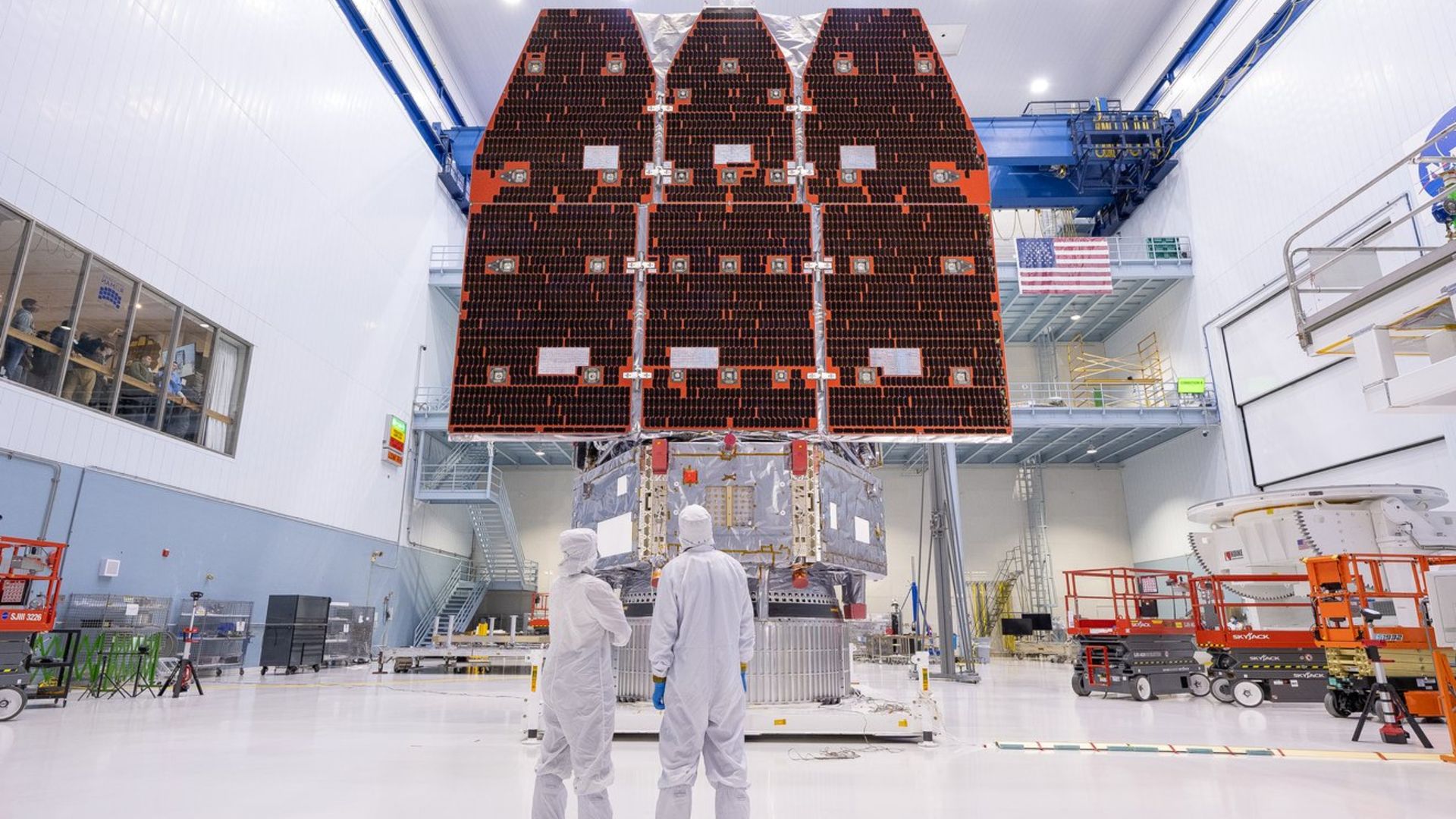
Why it matters: Roman’s accelerated schedule and unique wide-field survey power represent a major shift in observational astrophysics strategy, moving from deep but narrow probes to statistical, large-scale mapping of the universe’s structure and exoplanet populations.
Context: Roman fills a strategic gap between the deep, narrow-field infrared observations of JWST and the aging but versatile Hubble, positioning NASA to conduct systematic, large-scale sky surveys for statistical cosmology and exoplanet demographics.
"GREENBELT, Md. — On Tuesday (April 21) here at NASA’s Goddard Space Flight Center, I watched as scientists stood proudly around a metal contraption with towering orange solar panels and a sparkling." — SPACE
Commentary: Roman’s operational model—prioritizing data volume and survey speed over extreme depth—signals a pivot toward big-data astrophysics, where statistical power from vast samples could drive discoveries in dark energy and exoplanet frequency. The coronagraph’s order-of-magnitude improvement is a quiet but significant step toward future direct imaging of Earth-like worlds, validating technology for more ambitious flagship missions. The ahead-of-schedule, under-budget delivery is a notable anomaly in modern astrophysics project management, suggesting potential lessons for cost and schedule control on complex science missions.
Date: April 21, 2026 12:00 AM ET
URL: https://www.space.com/space-exploration/the-nancy-grace-roman-space-telescope-nasas-next-great-observatory-is-finally-complete
AI Sentiment Score: Negative (62%)
AI Credibility Score: 10.0/10 — High
Scores and text generated by AI analysis of the source article indicated.
Smile lifts off on quest to reveal Earth’s invisible shield against the solar wind (Esa.Int)
Summary: The Solar wind Magnetosphere Ionosphere Link Explorer (Smile) mission, a joint ESA-CAS project, successfully launched on a Vega-C rocket. It will enter a highly elliptical orbit to conduct the first continuous X-ray imaging of Earth’s magnetosphere and 45-hour ultraviolet observations of the auroral oval. The mission represents the first fully joint selection, design, implementation, launch, and operation between ESA and China, with a €130 million ESA contribution.

Why it matters: Smile provides a novel, continuous observational dataset to model space weather dynamics, directly informing satellite and astronaut safety while testing a major international collaboration framework.
Context: This launch follows a seven-year development cycle and marks Vega-C’s return to flight after a 2022 anomaly. It builds on heritage from ESA’s Cluster and XMM-Newton missions but applies the technology in a new, integrated way.
"Smile lifts off on quest to reveal Earth’s invisible shield against the solar wind The Smile spacecraft lifted off on a Vega-C rocket from Europe’s Spaceport in French Guiana at 04:52 BST." — ESA.INT
Commentary: The operational success of Smile’s unique instrument suite will validate a new class of integrated, multi-wavelength space weather observation. Its data pipeline, requiring 11 engine burns to achieve its elliptical data-collection orbit, represents a deliberate engineering trade for continuous coverage over low-Earth orbit’s frequent but brief passes. The ESA-CAS co-development model, surviving pandemic disruptions, now faces the harder test of joint, real-time mission operations and data sharing protocols.
Date: Tue, 19 May 2026 07:00:00 +0200
URL: https://www.esa.int/Science_Exploration/Space_Science/Smile/Smile_lifts_off_on_quest_to_reveal_Earth_s_invisible_shield_against_the_solar_wind
AI Sentiment Score: Negative (60%)
AI Credibility Score: 10.0/10 — High
Scores and text generated by AI analysis of the source article indicated.
ESA’s Prodex programme brings scientific research to space (Esa.Int)
Summary: ESA’s Prodex programme, an optional funding mechanism for scientific instrument development, secured a 38% funding increase to €327.52 million at the 2025 Ministerial Council. The programme, now 40 years old, currently manages over 400 contracts supporting hardware for missions like SMILE, Comet Interceptor, and Envision. Recent launches and deliveries, such as Norway’s 4DSpace-Daedalus sounding rocket and Poland’s DFP-B2 instrument for Comet Interceptor, demonstrate its role in enabling national institutes to contribute to major science missions.

Why it matters: Prodex’s funding growth and longevity signal sustained European political commitment to distributed, institute-led space science, which shapes instrument development timelines and international partnership structures for upcoming missions.
Context: Prodex is a long-standing, opt-in ESA programme that allows member states to fund national scientific teams to build flight hardware, effectively decentralizing instrument development and fostering national space capabilities.
"At the Ministerial Council 2025, 17 ESA Member States pledged a total of €327.52 million to this optional programme – a 38% increase on the commitment given at the previous Ministerial in 2022." — ESA.INT
Commentary: The substantial funding increase, despite being optional, indicates member states see tangible returns in scientific prestige and industrial capability. This model creates a resilient, multi-national supply chain for complex instruments, but also introduces coordination overhead that can impact mission schedules, as seen in the staggered deliveries for Comet Interceptor.
Date: Fri, 22 May 2026 18:10:00 +0200
URL: https://www.esa.int/About_Us/Business_with_ESA/ESA_s_Prodex_programme_brings_scientific_research_to_space
AI Sentiment Score: Positive (60%)
AI Credibility Score: 10.0/10 — High
Scores and text generated by AI analysis of the source article indicated.
How to follow the Smile launch live (Esa.Int)
Summary: ESA has announced live broadcast details for the launch of the SMILE mission, a joint European-Chinese solar-terrestrial science satellite, scheduled for May 19, 2026, on a Vega-C rocket from French Guiana. The mission will undergo a 25-day orbit-raising campaign to reach its highly elliptical operational orbit for a three-year science phase studying space weather. ESA provides the payload module, one instrument, and the launcher, while CAS provides the spacecraft bus and three instruments.

Why it matters: The launch marks a significant milestone in a major international science collaboration and a return to flight for the Vega-C rocket after its grounding, with implications for space weather research and European launch autonomy.
Context: SMILE represents a key ESA-CAS collaboration under ESA’s Cosmic Vision programme, following a period of geopolitical tension affecting space cooperation. The Vega-C launch follows a return-to-flight campaign after a 2022 failure.
"How to follow the Smile launch live ESA will be broadcasting live as the European-Chinese Smile mission launches at 04:52 BST/05:52 CEST (00:52 local time) on 19 May 2026. Smile will launch." — ESA.INT
Commentary: The detailed, public timeline and mission profile signal confidence in the Vega-C return-to-flight and the complex orbital insertion sequence. The operational split—ESA handling payload and launch, CAS the bus and operations—formalizes a pragmatic division of labor for this politically sensitive partnership, setting a template for future joint missions where shared science objectives outweigh terrestrial disputes.
Date: Tue, 12 May 2026 11:30:00 +0200
URL: https://www.esa.int/Science_Exploration/Space_Science/Smile/How_to_follow_the_Smile_launch_live
AI Sentiment Score: Negative (63%)
AI Credibility Score: 10.0/10 — High
Scores and text generated by AI analysis of the source article indicated.
The great parachute bake-out (Esa.Int)
Summary: ESA has completed a critical planetary protection step for the ExoMars Rosalind Franklin rover mission by sterilizing its 35-meter main parachute. The parachute, the largest ever flown beyond Earth, was baked at 125°C for 36 hours in a specialized cleanroom oven at ESTEC to eliminate terrestrial microbes. This process, developed through iterative testing on exact copies, ensures compliance with international planetary protection protocols to prevent forward contamination of Mars. The sterilized parachute has been returned to Thales Alenia Space in Turin for spacecraft integration ahead of the 2028 launch.

Why it matters: This validates a novel, large-scale sterilization protocol essential for life-detection missions, directly impacting mission schedule and de-risking a key landing system component.
Context: Planetary protection imposes stringent cleanliness requirements on Mars-bound hardware, especially for missions like ExoMars that search for biosignatures. Developing procedures for large, complex, fabric-based systems like parachutes presents unique engineering challenges not faced by rigid spacecraft components.
"Through multiple rounds of testing, they found that sterilising at 125°C for 36 hours – following a 50-hour preheating procedure to make sure even the innermost parts of the parachute reach that temperature – results in a parachute clean enough to meet all planetary protection requirements." — ESA.INT
Commentary: The 86-hour total thermal cycle underscores the engineering overhead required for planetary protection on soft goods, a constraint future large-payload Mars missions must budget. Successfully clearing this parachate moves ExoMars from a paper compliance exercise to a verified, flight-ready component, narrowing the path to the 2028 launch. The process also establishes a reproducible benchmark for other agencies and commercial entities aiming to meet Category IVb protection standards.
Date: Thu, 30 Apr 2026 13:30:00 +0200
URL: https://www.esa.int/ESA_Multimedia/Images/2026/04/The_great_parachute_bake-out
AI Sentiment Score: Negative (75%)
AI Credibility Score: 10.0/10 — High
Scores and text generated by AI analysis of the source article indicated.
Baking a parachute for Mars (Esa.Int)
Summary: ESA engineers have completed dry-heat sterilization of the 35-meter diameter parachute for the ExoMars Rosalind Franklin rover, a critical step in planetary protection. The parachute, the largest ever to be used beyond Earth, must be exceptionally clean to prevent terrestrial microbes from contaminating the Martian environment and compromising the mission’s astrobiological search. This process highlights the stringent technical and biological constraints of landing heavy payloads on Mars while adhering to international protocols.

Why it matters: Sterilization protocols directly impact mission viability and scientific integrity; a failure here could invalidate the search for life on Mars.
Context: ExoMars has faced repeated delays, with the rover now slated for launch in 2028; each component’s readiness signals progress against a complex schedule.
"Watch ESA’s Mars chief engineer Albert Haldemann explain the sterilisation process of one of the parachutes of the ExoMars Rosalind Franklin rover mission and why it matters. Carefully wrapped inside a donut-shaped." — ESA.INT
Commentary: The operational focus on a single parachute underscores the mission’s fragility; sterilization is not just a cleanliness exercise but a hard engineering constraint that influences material selection, assembly timelines, and overall risk posture. This level of biocontainment, while standard for life-detection missions, adds cost and schedule pressure distinct from purely engineering-driven projects like Perseverance.
Date: Thu, 30 Apr 2026 11:29:00 +0200
URL: https://www.esa.int/ESA_Multimedia/Videos/2026/04/Baking_a_parachute_for_Mars
AI Sentiment Score: Negative (77%)
AI Credibility Score: 10.0/10 — High
Scores and text generated by AI analysis of the source article indicated.
Join ESA for a total solar eclipse on 12 August 2026 (Esa.Int)
Summary: ESA is organizing a coordinated public engagement campaign around the total solar eclipse of 12 August 2026, which will be the first visible from mainland Spain since 1905. The program includes a live scientific broadcast from a Spanish observatory, a public observation event in León, educational kits, and collaboration with Spanish national initiatives. The effort leverages the event to promote ESA’s solar science missions like Solar Orbiter, Smile, and Proba 3.

Why it matters: This represents a major, strategically timed public outreach investment by a major space agency, using a predictable celestial event to build public support and connect its science portfolio to a mass audience.
Context: Space agencies increasingly treat high-profile astronomical events as fixed points for public engagement, aligning them with mission narratives and educational goals.
"Join ESA for a total solar eclipse on 12 August 2026 Follow the total solar eclipse with the European Space Agency (ESA), in person or online. On 12 August 2026, a solar." — ESA.INT
Commentary: ESA is executing a classic soft-power play: anchoring its scientific brand to a shared, emotive experience. The focus on Spain, a key member state, and the coordination with national bodies suggests this is as much about political optics and securing future funding as it is about pure science communication. The explicit linkage to operational missions (Solar Orbiter) and upcoming ones (Smile, Proba-3) turns a passive spectacle into an active showcase for the agency’s portfolio.
Date: Thu, 21 May 2026 15:00:00 +0200
URL: https://www.esa.int/Science_Exploration/Space_Science/Join_ESA_for_a_total_solar_eclipse_on_12_August_2026
AI Sentiment Score: Negative (50%)
AI Credibility Score: 10.0/10 — High
Scores and text generated by AI analysis of the source article indicated.
Inspector Smile, chapter 3: the countdown begins (Esa.Int)
Summary: The ESA-CAS Smile mission has arrived at Europe’s Spaceport in French Guiana, completing the final ground preparations before integration with its Vega-C launch vehicle. The spacecraft underwent a health check, fueling, and integration with the ‘Vampire’ payload adapter before encapsulation within the rocket fairing. The mission profile involves using 90% of its fuel in the first month to raise its orbit to a 121,000 km apogee for data collection, followed by a descent to 5,000 km for data downlink.

Why it matters: This marks the transition of a major international science mission from development to operational launch readiness, a critical and often risky phase for any space project.
Context: Smile is a collaborative mission between ESA and the Chinese Academy of Sciences to study the Sun-Earth connection, representing a rare current example of substantive space science cooperation between Western and Chinese agencies.
"After a health check that goes well, she is fuelled up. Smile carries four fuel tanks. 90% of this fuel will be used in her first month in space to gradually elongate her orbit until she reaches 121 000 km above the North Pole to collect data." — ESA.INT
Commentary: The high fuel burn in the initial orbital raising phase underscores the mission’s unique, highly elliptical orbit requirement for its science objectives. The successful completion of these final integration steps at the launch site signals that the program is on schedule for its upcoming launch window, a positive data point for the Vega-C rocket’s return-to-flight campaign following its 2022 anomaly.
Date: Mon, 18 May 2026 10:00:00 +0200
URL: https://www.esa.int/ESA_Multimedia/Images/2026/05/Inspector_Smile_chapter_3_the_countdown_begins
AI Sentiment Score: Negative (57%)
AI Credibility Score: 10.0/10 — High
Scores and text generated by AI analysis of the source article indicated.
Landing sideways (Esa.Int)
Summary: ESA engineers conducted final drop tests on a full-scale replica of the ExoMars Rosalind Franklin rover’s landing platform, subjecting it to sideways impacts at speeds up to 4 m/s on a 20-degree slope. The tests validated the leg design’s ability to absorb shock and maintain stability, and confirmed the critical function of touchdown sensors that shut down engines to prevent soil blastback. The data feeds into computer models for further scenario simulation ahead of the mission’s planned 2030 surface arrival.

Why it matters: For Mars missions, landing is the single highest-risk phase; these tests directly address a known failure mode that has compromised past landers, offering a tangible signal of engineering progress for a program with a history of delays.
Context: The ExoMars program, a joint ESA-Roscosmos effort now reconfigured post-Ukraine invasion, has faced significant schedule slips and technical hurdles. This test campaign represents concrete hardware validation for a critical subsystem, moving beyond paper studies to physical proof under simulated Martian conditions.
"“We want to make sure that we don’t tip over at landing. These results are fundamental to increasing confidence in the reliability of the ExoMars landing sequence,” Pietro adds." — ESA.INT
Commentary: The focus on off-nominal, tilted touchdowns reflects lessons from Schiaparelli’s 2016 failure and Curiosity’s ‘seven minutes of terror.’ Validating sensor-triggered engine cutoff is crucial; a delayed shutdown could overturn the lander, dooming the mission. This data provides a rare public milestone of subsystem maturity for a program that needs to rebuild stakeholder confidence.
Date: Mon, 18 May 2026 09:30:00 +0200
URL: https://www.esa.int/ESA_Multimedia/Videos/2026/05/Landing_sideways
AI Sentiment Score: Positive (44%)
AI Credibility Score: 10.0/10 — High
Scores and text generated by AI analysis of the source article indicated.
Sensitive and sturdy (Esa.Int)
Summary: ESA conducted scaled supersonic flight tests of a miniature ExoMars descent module replica, launching it at 4300 km/h to gather aerodynamic data. The 8 cm capsule, a 1:47.5 scale model of the actual 3.8-meter spacecraft, survived accelerations of 17,000 g and carried a suite of sensors during its 230-meter, half-second flight. The tests at the French-German Research Institute of Saint-Louis (ISL) simulate the conditions of Martian atmospheric entry, which the full-scale module will experience at 21,000 km/h.

Why it matters: For Mars mission planners, these hypervelocity tests provide critical, low-cost validation of entry, descent, and landing (EDL) designs before committing to full-scale hardware, directly de-risking the delayed ExoMars mission.
Context: The ExoMars Rosalind Franklin rover mission, a collaboration between ESA and Roscosmos, has faced significant delays; its landing system relies on a complex sequence of heat shields, parachutes, and retro-rockets, a phase where past Mars missions have failed.
"The mini capsule is one of 20 models launched during a test campaign that mimicked the aerodynamics of a Mars atmospheric entry at supersonic speeds last year. A robust, miniaturised piece of technology, it can withstand almost 17 000 g-force of acceleration." — ESA.INT
Commentary: The test underscores a pragmatic, incremental engineering approach: using extreme-scale models and ground facilities like ISL’s smooth-bore gun to probe physical regimes too dangerous or expensive for full-system tests. This data directly informs parachute deployment timing and capsule stability margins, reducing the statistical ‘black swan’ risk inherent in the single-attempt EDL sequence at Mars.
Date: Thu, 07 May 2026 09:43:00 +0200
URL: https://www.esa.int/ESA_Multimedia/Images/2026/05/Sensitive_and_sturdy
AI Sentiment Score: Negative (66%)
AI Credibility Score: 10.0/10 — High
Scores and text generated by AI analysis of the source article indicated.
First-of-its-kind ship-to-ship call (Esa.Int)
Summary: On 7 April, NASA’s Artemis II crew—astronauts Reid Wiseman, Victor Glover, Christina Koch, and CSA astronaut Jeremy Hansen—conducted a live audio call with the Expedition 74 crew aboard the International Space Station. The call connected astronauts in deep-space mission training with those on an active low Earth orbit mission. This event is framed as a first-of-its-kind ship-to-ship call between these operational domains.

Why it matters: It signals the operational normalization of multi-destination human spaceflight and tests the communications protocols and crew coordination required for a future where missions to the Moon and the ISS run concurrently.
Context: Artemis II is the first crewed mission of the Orion spacecraft, scheduled for a lunar flyby no earlier than September 2025. Such rehearsals integrate procedural and human elements ahead of the flight.
"The first‑of‑its‑kind ship‑to‑ship call between astronauts on deep‑space and low Earth orbit missions." — ESA.INT
Commentary: While largely a symbolic and procedural exercise, it marks a shift from standalone missions to an integrated, multi-theatre operational model for human spaceflight. The real test will be replicating this during actual Artemis II mission operations, not just in training.
Date: Mon, 13 Apr 2026 16:20:00 +0200
URL: https://www.esa.int/ESA_Multimedia/Videos/2026/04/First-of-its-kind_ship-to-ship_call
AI Sentiment Score: Negative (50%)
AI Credibility Score: 10.0/10 — High
Scores and text generated by AI analysis of the source article indicated.
A new method in the search for life: Brilliant news (Nasaspacenews)
Summary: Researchers from the Institute of Science Tokyo propose a novel statistical method for detecting potential life by analyzing patterns across clusters of exoplanets, rather than relying on ambiguous biosignatures from individual worlds. The approach models how terraforming or panspermia might alter observable planetary properties on a population scale, using data from approximately 1,000 exoplanet atmospheres to identify statistical anomalies. This agnostic strategy aims to prioritize targets for intensive follow-up by looking for the large-scale environmental effects of life, irrespective of its specific biochemistry or technology.

Why it matters: This reframes the search for extraterrestrial life from a chemical detection problem to a statistical pattern-recognition challenge, potentially accelerating discovery by sidestepping the persistent issue of abiotic false positives.
Context: Traditional astrobiology has been hampered by the difficulty of distinguishing biological from non-biological origins for single-molecule detections like phosphine or oxygen, leading to a search for more robust, system-level signatures.
"A new method in the search for life identifies biological presence through statistical patterns in exoplanet clusters. This agnostic approach avoids false positives associated with single-planet biosignatures during deep space surveys. Scientists." — NASASPACENEWS
Commentary: The proposal is a pragmatic response to the limitations of current spectroscopy, shifting the burden of proof from definitive chemical identification to statistical correlation across populations. If validated, it would fundamentally re-prioritize telescope time and mission design, favoring broad survey instruments over deep, single-target characterization for initial screening. However, its success hinges on acquiring sufficiently large and uniform datasets of exoplanet properties—a task for next-generation observatories like the Habitable Worlds Observatory. This method treats life as a planetary-scale process, a philosophical shift that could suggest as significant as any technical advancement.
Date: April 22, 2026 12:00 AM ET
URL: https://nasaspacenews.com/2026/04/a-new-method-in-the-search-for-life/
AI Sentiment Score: Negative (70%)
AI Credibility Score: 8.2/10 — High
Scores and text generated by AI analysis of the source article indicated.
SOLIS100 isolation study begins in Germany (Esa.Int)
Summary: ESA and DLR have initiated the SOLIS100 isolation study, placing six volunteers in a sealed habitat in Cologne for 100 days. The study is a space analogue focused on the psychological, behavioral, and team-dynamic challenges of long-duration missions, distinct from physiological microgravity simulations like bed rest. It includes experiments from ESA and the UAE’s MBRSC, aiming to refine risk models and crew support protocols for future lunar and Martian missions.

Why it matters: For mission planners and space agencies, ground-based isolation studies are critical for de-risking the human factors of exploration where real-time Earth support is limited, directly informing crew selection, training, and operational design for Artemis and beyond.
Context: This study is part of a broader, integrated ESA research strategy using parallel analogues—bed rest for physiology, isolation for psychology—to address the full spectrum of risks for long-duration spaceflight, a necessary step as missions move beyond the ISS.
"By contrast, SOLIS100 does not simulate microgravity. Instead, it investigates the human consequences of long-term isolation and confinement, including limited social interaction. The study examines impacts on mental health, team dynamics, stress regulation, sleep, cognitive performance, as well as changes in the crew and habitat microbiome." — ESA.INT
Commentary: The explicit separation of the isolation analogue from microgravity studies signals a maturation of pre-flight testing, treating psychological and operational risks as distinct, parallel domains requiring dedicated experimental frameworks. The inclusion of MBRSC experiments underscores the operationalization of these analogues as international testbeds, not just academic exercises, directly feeding into multinational mission planning.
Date: Thu, 23 Apr 2026 09:00:00 +0200
URL: https://www.esa.int/Science_Exploration/Human_and_Robotic_Exploration/SOLIS100_isolation_study_begins_in_Germany
AI Sentiment Score: Negative (50%)
AI Credibility Score: 10.0/10 — High
Scores and text generated by AI analysis of the source article indicated.
Just opened: five tonnes of science and supplies (Esa.Int)
Summary: Northrop Grumman’s Cygnus NG-24 cargo spacecraft, launched on April 11, was berthed to the International Space Station on April 13. The vehicle delivered approximately five metric tonnes of scientific experiments, spare parts, and supplies, including several European payloads. The capture was performed by NASA astronaut Chris Williams using the Station’s Canadarm2 robotic arm.

Why it matters: Regular, successful resupply missions are the operational backbone of the ISS, enabling continuous scientific research and crew support, and validating the commercial cargo model.
Context: This represents another routine execution in the established cadence of ISS logistics, currently provided by SpaceX’s Dragon and Northrop Grumman’s Cygnus under NASA’s Commercial Resupply Services contracts.
"ESA astronaut Sophie Adenot and NASA astronauts Jack Hathaway, Jessica Meir and Chris Williams take a moment to capture the occasion as they first open the Cygnus NG‑24 cargo spacecraft after its." — ESA.INT
Commentary: The event’s normalcy is its significance; it underscores the mature, reliable logistics chain now in place for low-Earth orbit. The focus shifts from the engineering feat of docking to the utility of the cargo—the European experiments and fresh fruit—highlighting the station’s transition to a sustained operational platform. This reliability is the prerequisite for the more complex commercial and international operations planned for the post-ISS era.
Date: Thu, 16 Apr 2026 09:34:00 +0200
URL: https://www.esa.int/ESA_Multimedia/Images/2026/04/Just_opened_five_tonnes_of_science_and_supplies
AI Sentiment Score: Neutral (33%)
AI Credibility Score: 10.0/10 — High
Scores and text generated by AI analysis of the source article indicated.
Research Fellows in space science 2026 (Esa.Int)
Summary: ESA has selected six new Research Fellows for 2026, offering early-career scientists three-year postdoctoral positions at ESA establishments to conduct independent research tied to ESA Science missions. The fellows, Emma Esparza-Borges, Ekaterina Ilin, Gregor Rihtaršič, Peter Stephenson, Paola I. Tiranti, and Jiří Žák, will work on topics spanning heliophysics, planetary science, astrophysics, and fundamental physics.

Why it matters: The fellowship program is a critical talent pipeline for ESA, seeding its science directorate with next-generation researchers whose work will directly feed into mission planning, data analysis, and future scientific priorities.
Context: ESA’s Research Fellowships are a long-standing, competitive program designed to attract and retain top postdoctoral talent, ensuring a steady flow of expertise into the agency’s core science teams.
"Early career postdoctoral scientists are offered the unique opportunity to carry out advanced research related to the space science areas covered by ESA Science missions at one of three ESA establishments (ESAC, ESTEC or STScI) for a period of up to three years." — ESA.INT
Commentary: This annual cohort signals ESA’s ongoing investment in human capital, not just hardware. The specific research themes—from Jupiter’s Great Red Spot to dark matter via galaxy clusters—are not random; they align precisely with active ESA missions (like JUICE) and strategic science goals, ensuring fellows’ work has immediate operational relevance and strengthens in-house expertise.
Date: Tue, 28 Apr 2026 10:00:00 +0200
URL: https://www.esa.int/ESA_Multimedia/Images/2026/04/Research_Fellows_in_space_science_2026
AI Sentiment Score: Negative (75%)
AI Credibility Score: 10.0/10 — High
Scores and text generated by AI analysis of the source article indicated.
Preparing Smile for space (Esa.Int)
Summary: ESA’s Smile mission, a joint European-Chinese scientific satellite, is undergoing final launch preparations at Europe’s Spaceport in French Guiana. The spacecraft will be launched aboard a Vega-C rocket (flight VV29) to a highly elliptical orbit for a three-year mission studying solar wind interactions with Earth’s magnetosphere. It will use X-ray and ultraviolet imagers to observe the magnetosphere and auroral phenomena from a high-latitude vantage point.

Why it matters: The launch represents a critical operational milestone for a major international space science collaboration and for the Vega-C launch vehicle’s return to flight and schedule reliability.
Context: Smile’s development faced significant delays, and its launch marks a return to service for the Vega-C rocket following a previous failure. Joint missions between ESA and CNSA remain politically sensitive but scientifically valuable.
"Smile (the Solar wind Magnetosphere Ionosphere Link Explorer) is a joint European-Chinese mission to study the interaction between the solar wind and Earth’s magnetic environment from a unique highly elliptical orbit." — ESA.INT
Commentary: The mission’s progression to launch pad signifies a de-risking of both the spacecraft’s complex instrument suite and the Vega-C’s post-anomaly redesign. Successful deployment would provide a unique, sustained dataset for magnetospheric physics, a field increasingly relevant for space weather forecasting. The operational tempo—a high-latitude pass every two days—imposes a specific cadence on data collection and downlink planning that will shape the science team’s analysis pipeline.
Date: Fri, 15 May 2026 16:00:00 +0200
URL: https://www.esa.int/ESA_Multimedia/Videos/2026/05/Preparing_Smile_for_space
AI Sentiment Score: Negative (54%)
AI Credibility Score: 10.0/10 — High
Scores and text generated by AI analysis of the source article indicated.
A Lyrid meteor from orbit (Esa.Int)
Summary: ESA astronaut Sophie Adenot, aboard the International Space Station, successfully captured images of Lyrid meteors from orbit using an automated camera setup. The images were compiled into a timelapse, providing a rare orbital perspective on the annual meteor shower produced by debris from comet Thatcher. This demonstrates the operational use of the ISS as a platform for astronomical observation beyond its primary mission parameters.

Why it matters: It validates the ISS as a flexible, crew-operated observation platform for transient astronomical phenomena, with implications for future on-orbit science planning and public engagement.
Context: The ISS crew routinely conducts Earth observation and astronomical photography, but capturing specific, fleeting events like meteors requires precise planning and automation, highlighting the station’s evolving role as a multi-disciplinary lab.
"She successfully captured two on camera, and the images were combined into a timelapse, offering a beautiful, if accelerated, view of Earth at night from orbit." — ESA.INT
Commentary: This is a minor but elegant demonstration of opportunistic science on the ISS, turning routine crew time into a public outreach asset. It reinforces the value of human-tended platforms for capturing unpredictable events, a capability less suited to fully automated satellites. For mission planners, it underscores the utility of simple, automated payloads operated by crew to augment primary science objectives.
Date: Fri, 15 May 2026 09:06:00 +0200
URL: https://www.esa.int/ESA_Multimedia/Images/2026/05/A_Lyrid_meteor_from_orbit
AI Sentiment Score: Negative (50%)
AI Credibility Score: 10.0/10 — High
Scores and text generated by AI analysis of the source article indicated.
Smile launch highlights (Esa.Int)
Summary: ESA and CAS successfully launched the Smile satellite aboard a Vega-C rocket from French Guiana. The joint mission will deploy four instruments to study the interaction between the solar wind and Earth’s magnetosphere, aiming to improve forecasting of space weather events.

Why it matters: Successful launch of a major joint science mission validates international collaboration frameworks and the Vega-C’s return-to-flight status, while advancing operational space weather prediction capabilities.
Context: Smile represents a significant ESA-CAS partnership initiated in 2015, following a period of scrutiny over European-Chinese space cooperation. The launch also marks a critical demonstration for the Vega-C rocket following its 2022 failure and subsequent grounding.
"ESA’s Smile satellite launched aboard a Vega-C rocket from Europe’s Spaceport in French Guiana. The rocket lifted off on at 04:52 BST / 05:52 CEST (00:52 local time) on 19 May 2026." — ESA.INT
Commentary: The launch success secures a key data stream for heliophysics models, with direct implications for protecting orbital infrastructure and terrestrial grids from geomagnetic storms. Operationally, it reinstates Vega-C as a viable light-lift option for European institutional payloads, rebalancing launch dependency. The sustained ESA-CAS collaboration, despite geopolitical tensions, signals a pragmatic compartmentalization of scientific cooperation from broader strategic competition.
Date: Tue, 19 May 2026 10:00:00 +0200
URL: https://www.esa.int/ESA_Multimedia/Videos/2026/05/Smile_launch_highlights
AI Sentiment Score: Negative (62%)
AI Credibility Score: 10.0/10 — High
Scores and text generated by AI analysis of the source article indicated.
Smile’s journey from launch to orbit (Esa.Int)
Summary: ESA and CAS’s SMILE mission is scheduled for launch on a Vega-C rocket from French Guiana on 19 May, following a decade-long development cycle. The spacecraft will be inserted into a 700 km circular orbit before performing 11 engine burns to reach a high-inclination orbit for its primary science operations. Its novel instrumentation suite will combine X-ray and ultraviolet imaging to observe the interaction of the solar wind with Earth’s magnetosphere in a way not previously attempted.

Why it matters: The mission represents a significant step in operationalizing a new observational technique for space weather, with direct implications for understanding magnetospheric physics and improving predictive models.
Context: SMILE is a notable example of sustained ESA-CAS collaboration in space science, moving from proposal through a long development phase to a firm launch date, which is a critical milestone for any joint program.
"Smile will then fire its own engines 11 times, taking itself higher and higher above the North Pole. From there, it will use X-ray and ultraviolet vision to watch how Earth defends itself from streams of particles and bursts of radiation from the Sun. Nobody has ever seen Earth’s magnetic shield like this before." — ESA.INT
Commentary: The 11-burn orbit-raising maneuver indicates a complex and precise transfer strategy, likely to optimize the final observation orbit for continuous auroral zone coverage. Success here validates not just the instrument package but also the mission’s autonomous propulsion and navigation planning. The ‘first-of-its-kind’ claim hinges on the simultaneous X-ray and UV data fusion, which, if successful, could set a new standard for global magnetosphere imaging and could shift the operational paradigm for future heliophysics missions.
Date: Tue, 12 May 2026 10:00:00 +0200
URL: https://www.esa.int/ESA_Multimedia/Videos/2026/04/Smile_s_journey_from_launch_to_orbit
AI Sentiment Score: Positive (60%)
AI Credibility Score: 10.0/10 — High
Scores and text generated by AI analysis of the source article indicated.
Post ID: 6b844d9b