AI Development Tools & Frameworks
Accelerating Transformers Fine-Tuning with NVIDIA NeMo AutoModel (Huggingface.Co)
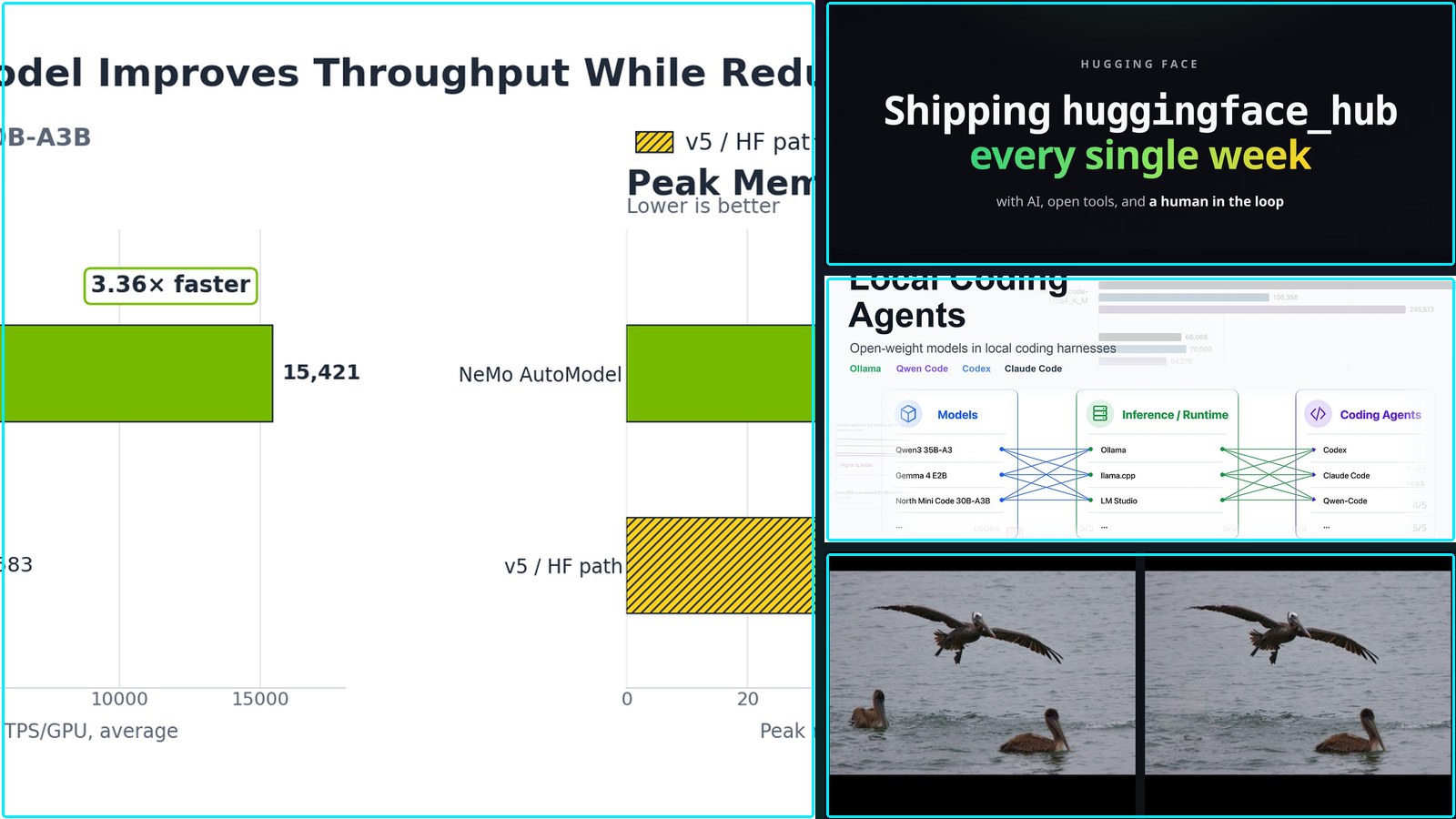
Summary: NVIDIA’s NeMo AutoModel library delivers a 3.4-3.7x throughput increase and 29-32% memory reduction for fine-tuning MoE models like Qwen3-30B-A3B, compared to native Hugging Face Transformers v5. It achieves this by layering Expert Parallelism, DeepEP fused dispatch, and TransformerEngine kernels atop Transformers v5’s dynamic weight loading, requiring only an import change for API compatibility. The performance gains enable full fine-tuning of frontier-scale models like the 550B Nemotron 3 Ultra, which is infeasible with v5 alone.

Why it matters: This shifts the practical ceiling for who can fine-tune frontier MoE models and at what cost, directly impacting the economics of model customization and the competitive landscape for training frameworks.
Context: Efficient distributed training of MoE architectures remains a core infrastructure challenge, with Hugging Face Transformers v5 recently adding foundational support. NVIDIA’s move represents a vendor-specific optimization layer that leverages but surpasses the open-source baseline.
"The payoff is 3.4-3.7x higher training throughput and 29-32% less GPU memory on fine-tuning MoE models than native Transformers v5, using the same from_pretrained() API: a single import line, with no other code changes." — HUGGINGFACE.CO
Commentary: NeMo AutoModel is less a new framework and more a high-performance shim that exploits v5’s modularity, signaling a maturation phase where core infrastructure becomes a substrate for specialized, vendor-optimized layers. The benchmark reveals a stark performance delta that could pressure other cloud providers and open-source teams to respond, potentially fragmenting the training stack along hardware lines. Crucially, it maintains checkpoint compatibility, ensuring downstream inference tooling remains agnostic to the training-time optimizations.
Date: June 24, 2026 12:00 PM ET
URL: https://huggingface.co/blog/nvidia/accelerating-fine-tuning-nvidia-nemo-automodel
AI Sentiment Score: Positive (42%)
AI Credibility Score: 10.0/10 — High
Scores and text generated by AI analysis of the source article indicated.
Using Local Coding Agents (Magazine.Sebastianraschka)
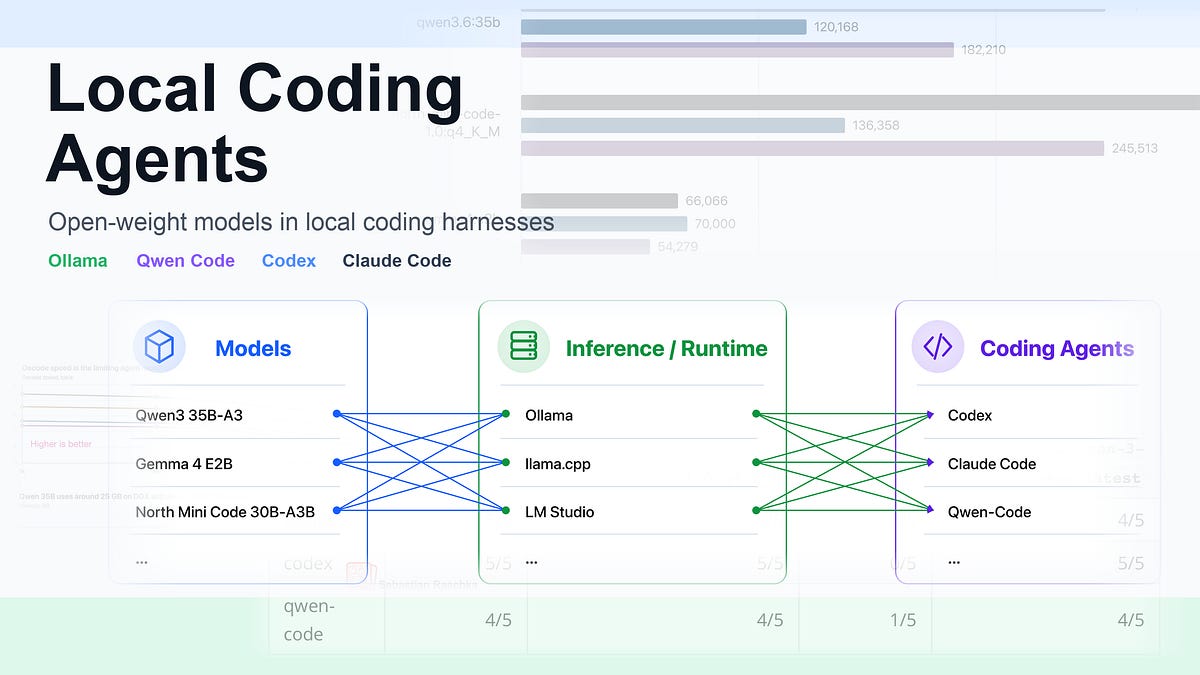
Summary: Using Local Coding Agents Using Open-Weight Models in Local Coding Harnesses as an Alternative to Claude Code and Codex Subscriptions Many people reached out to me in the past asking about my local agent stack as well as how I set up my local agent stack. So, I thought it might be useful to put together a little tutorial on how to set up a local (coding) agent using open-source tools and open-weight LLMs. This article is a tutorial on setting up a production-ready coding agent with a fully local stack.
Why it matters: This matters for Emerging Tech Signals (Pre-Mainstream) because it gives a concrete current signal to track: Using Local Coding Agents Using Open-Weight Models in Local Coding Harnesses as an Alternative to Claude Code and Codex Subscriptions Many people reached out to me in the past asking about my local agent stack as well as how I set up my local agent stack.
Context: Using Local Coding Agents Using Open-Weight Models in Local Coding Harnesses as an Alternative to Claude Code and Codex Subscriptions Many people reached out to me in the past asking about my local agent stack as well as how I set up my local agent stack. So, I thought it might be useful to put together a little tutorial on how to set up a local (coding) agent using open-source tools and open-weight LLMs. This article is a tutorial on setting up a production-ready coding agent with a fully local stack.
"Using Local Coding Agents Using Open-Weight Models in Local Coding Harnesses as an Alternative to Claude Code and Codex Subscriptions Many people reached out to me in the past asking about my." — MAGAZINE.SEBASTIANRASCHKA
Commentary: The immediate implication is operational rather than speculative: watch how this changes budgets, workflows, or risk assumptions over the next cycle.
Date: June 27, 2026 07:21 AM ET
URL: https://magazine.sebastianraschka.com/p/using-local-coding-agents
AI Sentiment Score: Positive (55%)
AI Credibility Score: 10.0/10 — High
Scores and text generated by AI analysis of the source article indicated.
Porting the Moebius 0.2B image inpainting model to run in the browser with Claude Code (Simonwillison.Net)
Summary: Porting the Moebius 0.2B image inpainting model to run in the browser with Claude Code 22nd June 2026 This morning on Hacker News I saw Moebius: 0.2B Lightweight Image Inpainting Framework with 10B-Level Performance, describing a small but effective inpainting model—a model where you can mark regions of an image to remove and the model imagines what should fill the space. The released model required PyTorch and NVIDIA CUDA, but since it described itself as 0.2B I decided to try and get it running using WebGPU in a browser. TL;DR: I got it working, and you can try the demo at simonw.github.io/moebius-web/.

Why it matters: This matters for Emerging Tech Signals (Pre-Mainstream) because it gives a concrete current signal to track: Porting the Moebius 0.2B image inpainting model to run in the browser with Claude Code 22nd June 2026 This morning on Hacker News I saw Moebius: 0.2B Lightweight Image Inpainting Framework with 10B-Level Performance, describing a small but effective inpainting model—a model where you can mark regions of an image to remove and the model imagines what should fill the space.
Context: Porting the Moebius 0.2B image inpainting model to run in the browser with Claude Code 22nd June 2026 This morning on Hacker News I saw Moebius: 0.2B Lightweight Image Inpainting Framework with 10B-Level Performance, describing a small but effective inpainting model—a model where you can mark regions of an image to remove and the model imagines what should fill the space. The released model required PyTorch and NVIDIA CUDA, but since it described itself as 0.2B I decided to try and get it running using WebGPU in a browser. TL;DR: I got it working, and you can try the demo at simonw.github.io/moebius-web/.
"Porting the Moebius 0.2B image inpainting model to run in the browser with Claude Code 22nd June 2026 This morning on Hacker News I saw Moebius: 0.2B Lightweight Image Inpainting Framework with." — SIMONWILLISON.NET
Commentary: The immediate implication is operational rather than speculative: watch how this changes budgets, workflows, or risk assumptions over the next cycle.
Date: June 22, 2026 07:43 PM ET
URL: https://simonwillison.net/2026/Jun/22/porting-moebius/
Discussion: https://news.ycombinator.com/item?id=48630171
AI Sentiment Score: Positive (66%)
AI Credibility Score: 10.0/10 — High
Scores and text generated by AI analysis of the source article indicated.
Shipping huggingface_hub every week with AI, open tools, and a human in the loop (Huggingface.Co)
Summary: Hugging Face has automated its weekly release process for the huggingface_hub Python client using a GitHub Actions workflow that integrates open-weights AI models for drafting release notes and announcements. The system employs a deterministic ‘trust-but-verify’ loop to ensure completeness and accuracy, keeping a human reviewer in the loop for final approval. This shift from a 4-6 week to a weekly cadence has improved release quality and accelerated feedback loops with downstream libraries.

Why it matters: This demonstrates a practical, reproducible pattern for using open-source AI tooling to automate complex, judgment-dependent workflows in software maintenance, reducing toil while maintaining auditability and security.
Context: AI-assisted software development is moving beyond code generation to encompass project management and communication tasks, but reliability and security concerns often hinder adoption.
"Shipping huggingface_hub every week with AI, open tools, and a human in the loop huggingface_hub is the Python client at the base of the Hugging Face ecosystem. transformers , datasets , diffusers." — HUGGINGFACE.CO
Commentary: The workflow’s architecture—grounding the model in deterministic manifests and documentation diffs—provides a template for reliable AI augmentation in critical paths. Its explicit design for portability, using OIDC and pinned runtimes, sets a standard for secure, maintainer-controlled automation that avoids vendor lock-in. This signals a maturation point where AI tooling can be integrated into core operational processes without sacrificing control or introducing new supply-chain risks.
Date: June 22, 2026 08:00 PM ET
URL: https://huggingface.co/blog/huggingface-hub-release-ci
AI Sentiment Score: Negative (50%)
AI Credibility Score: 10.0/10 — High
Scores and text generated by AI analysis of the source article indicated.
Show HN: Smart model routing directly in Claude, Codex and Cursor (Github)
Summary: Weave has released a model-agnostic routing proxy that integrates directly into Claude Code, Codex, and Cursor, using a local embedder and a cluster-scoring algorithm to select the optimal model per request. It abstracts provider APIs (Anthropic, OpenAI, Gemini, OpenRouter) behind a single endpoint, enabling BYOK key management and observability. The tool is positioned as a drop-in replacement for developers, shifting routing logic from application code to an intelligent infrastructure layer.
Why it matters: This moves model routing from an application-level concern to a configurable infrastructure service, potentially lowering costs and improving performance for developers while creating a new control point in the AI toolchain.
Context: As LLM providers proliferate, developers face increasing complexity in managing multiple APIs, keys, and cost-performance trade-offs. Existing routing solutions often rely on manual rules or simplistic heuristics.
"A drop-in proxy for Anthropic, OpenAI, and Gemini that picks the best model for every request: using a tiny on-box embedder, not a vibes-based prompt." — GITHUB
Commentary: The operationalization of a routing algorithm like ‘Avengers-Pro 1’ into a developer tool signals a shift from manual model selection to automated, performance-optimized orchestration. If effective, this could commoditize access to frontier models by making cost-latency-accuracy trade-offs automatic, weakening individual provider lock-in. The direct integration into popular coding assistants (Claude Code, Cursor) suggests a play for the developer workflow layer, where routing becomes a default service rather than a custom build.
Date: June 26, 2026 12:40 PM ET
URL: https://github.com/workweave/router
Discussion: https://news.ycombinator.com/item?id=48688700
AI Sentiment Score: Negative (71%)
AI Credibility Score: 10.0/10 — High
Scores and text generated by AI analysis of the source article indicated.
Post ID: 31fed8d1