AI Tools & Workflows for Creators
The AI Agency Race Is a Data Race (Medium)
Summary: Publicis Groupe’s acquisition of LiveRamp signals a strategic shift in the agency holding company model, moving beyond AI agent demos to secure the underlying data infrastructure. The deal highlights a broader industry race where WPP, Omnicom, and dentsu are also investing in data collaboration platforms and governed environments. The real competition is no longer for the most impressive AI interface, but for the data connectivity, identity resolution, and permissioned collaboration layers that make AI commercially viable and safe for enterprise clients.

Why it matters: This pivot redefines the agency-client relationship from a service vendor to a provider of embedded operational infrastructure, creating new dependencies and governance challenges for marketing organizations.
Context: Agency holding companies are consolidating data collaboration assets (e.g., WPP/InfoSum, Publicis/Epsilon) to build AI-powered operating systems, shifting competition from creative and media scale to control of the marketing data layer.
"The agency holding companies are no longer competing only over creative reputation, media scale, client relationships, or AI demos. They are beginning to compete over the data systems that allow AI to operate inside marketing." — MEDIUM
Commentary: This is valuable analysis that correctly frames the M&A as an infrastructure land grab, not an AI feature war. The implication is that agency value will be determined by who builds the most governable, connective data environment, not the flashiest agent. Clients must now evaluate agencies as strategic technology partners, with procurement, legal, and data governance teams needing to scrutinize these embedded systems for lock-in and operational risk.
Date: Wed, 20 May 2026 10:01:02 GMT
URL: https://medium.com/@markus_brinsa/the-ai-agency-race-is-a-data-race-62fa5376bd5b
AI Sentiment Score: Negative (66%)
AI Credibility Score: 10.0/10 — High
Scores and text generated by AI analysis of the source article indicated.
The solution might be cancelling my AI subscription (Simonwillison.Net)
Summary: Developer David Wilson observes that AI coding agents, while powerful, are generating a ‘thermonuclear ADHD amplifier’ effect, enabling rapid project creation that often lacks follow-through. He argues the ease of generating functional code leads to a proliferation of abandoned side projects, questioning their ultimate value. The post sparks a counterpoint discussion on Hacker News, where several users with ADHD report the opposite: that AI agents help them complete projects by maintaining engagement. This highlights a growing tension between AI’s capacity for frictionless creation and the discipline required for sustainable output.

Why it matters: This captures a critical, under-examined operational cost of AI tool adoption for independent creators and developers: the risk of productivity theater and cognitive sprawl undermining real-world impact.
Context: The debate mirrors earlier cycles of productivity tool hype, but is distinct due to AI’s ability to generate functional, complex outputs instantly, lowering the barrier to project initiation to near zero.
"I didn’t mean to build most of these things. Usually the Claude session started with something like "write a quick script for X", and one hour later the result is not a quick script for X, nor in the usual case is my problem solved, whatever the original itch happened to be." — SIMONWILLISON.NET
Commentary: Wilson’s observation is valuable field reporting on a nascent behavioral tax. The divergent experiences from the ADHD community suggest the impact is less about the technology and more about individual cognitive wiring and pre-existing work systems. The real market shift may be towards tools and practices that manage AI-induced sprawl, not just those that amplify creation. This moves the conversation from raw capability to the economics of attention and maintenance, a more mature framing for the technology’s integration.
Date: May 31, 2026 12:31 PM ET
URL: https://simonwillison.net/2026/May/31/the-solution-might-be-cancelling-my-ai-subscription/
Discussion: https://news.ycombinator.com/item?id=48345896
AI Sentiment Score: Negative (66%)
AI Credibility Score: 10.0/10 — High
Scores and text generated by AI analysis of the source article indicated.
You Don’t Need More AI Tools — You Need a Workflow (Youtube)
Summary: A YouTube video argues that independent operators and creators should stop accumulating AI tools and instead design a deliberate workflow that assigns specific roles to AI, defines concrete outputs, and mandates human review points. The piece critiques the common ‘tool-first’ approach as a source of chaos, advocating for a ‘job-first’ methodology where AI assists in discrete steps like research, summarization, or drafting within a repeatable process.
Why it matters: For independent operators managing finite time and cognitive load, this framework shifts AI from a novelty to a controlled, repeatable system, directly impacting productivity and output quality.
Context: This advice emerges as a counter-narrative to the prevailing hype cycle of ‘AI tool of the week,’ reflecting a maturation in practical AI adoption among solo creators and small teams.
"You’ll learn how to think about inputs, tool roles, outputs, and human review points so AI becomes easier to control instead of another source of chaos. … A creator workflow might use." — YOUTUBE
Commentary: The argument is valuable as field observation and operational analysis, moving beyond generic evangelism. Its insistence on ‘specific, not helpful ideas’ as outputs and a mandatory human review point targets the core failure mode of casual AI use: vague, unreviewed outputs that create more work. The prescription to ‘pick one workflow’ and test it for a week is a tactical intervention for an audience paralyzed by choice, directly linking tool utility to creator economics.
Date: May 24, 2026 12:00 AM ET
URL: https://www.youtube.com/watch?v=DDSo-0GJwlk
AI Sentiment Score: Negative (77%)
AI Credibility Score: 10.0/10 — High
Scores and text generated by AI analysis of the source article indicated.
Twegs – how to automate your work with AI (Twegs)
Summary: Twegs, a newsletter focused on AI automation for independent operators, publishes practical workflows, tool breakdowns, and case studies. Its latest issue highlights a critique of data platform Clay’s pricing model, a workflow for automating release note analysis, and a reported piece on women using Claude. The core editorial thesis is that while AI features are proliferating inside individual apps, the real productivity gain comes from automating the handoffs between them.

Why it matters: For independent operators and creators, the efficiency of their own workflows directly impacts scalability and revenue; understanding the real cost of tools and the mechanics of automation is a competitive advantage.
Context: The ‘AI inside everything’ phase has created a landscape of fragmented, point-solution features, shifting the bottleneck from task execution to workflow orchestration.
"How to automate your work with AI. Real AI workflows you can build in an afternoon, the tools, the costs, and what to do when they break. What’s new on Twegs Ladies." — TWEGS
Commentary: Twegs is valuable as field observation and practical analysis, moving beyond generic AI enthusiasm to the operational mechanics of integration. The critique of Clay’s margin exemplifies its focus on cost-aware tool selection, a critical concern for bootstrapped operators. Its emphasis on ‘handoffs’ correctly identifies the next frontier: the middleware layer connecting AI-enabled apps, which will determine whether AI augments labor or merely accelerates it within silos.
Date: May 19, 2026 12:00 AM ET
URL: https://twegs.com
AI Sentiment Score: Negative (57%)
AI Credibility Score: 9.7/10 — High
Scores and text generated by AI analysis of the source article indicated.
Why AI Workflow Compression Lets One Person Do a Team’s Work (Plansale.Ca)
Summary: PlanSale.ca, a consultancy, argues that AI’s primary impact on small businesses is structural, enabling ‘workflow compression’ where a single operator can manage processes—from content creation to CRM updates and reporting—that previously required a team. This shifts competition from headcount to system design, allowing leaner organizations to out-execute larger, more fragmented ones. The piece positions this not as mere tool adoption but as a fundamental redesign of operating models.

Why it matters: For independent operators and small businesses, this redefines the leverage equation, making execution speed and capital efficiency the new competitive moats.
Context: The argument builds on the broader trend of AI moving from productivity augmentation to organizational redesign, a shift increasingly discussed in management literature but rarely framed for the small-business operator.
"AI workflow compression is a structural productivity shift, not a tool upgrade. According to McKinsey’s 2023 research on generative AI, the technology could add trillions of dollars in annual economic value, largely by changing how knowledge work is performed." — PLANSALE.CA
Commentary: The piece is valuable as a field observation and practical argument, though it serves as a soft launch for PlanSale.ca’s audit service. Its thesis—that the winners will be those who redesign workflows first—is a testable hypothesis for the 2026 market. The risk is that it underestimates the coordination costs and judgment required to manage these compressed systems, potentially trading communication drag for systemic fragility.
Date: May 18, 2026 12:00 AM ET
URL: https://www.plansale.ca/insights/ai-workflow-compression
AI Sentiment Score: Negative (71%)
AI Credibility Score: 7.0/10 — Medium
Scores and text generated by AI analysis of the source article indicated.
Build the room before you write the memo. Grab the 4-prompt pro (Abovo.Co)
Summary: A new framework for independent operators proposes structuring research and writing projects as ‘rooms’ before drafting, using four specific prompts to manage sources, track duplicates, identify missing context, and produce grounded drafts. This shifts the workflow from linear writing to structured knowledge assembly, treating the memo as the output of a prepared environment rather than the starting point.
Why it matters: For newsletter operators and independent analysts, this systematizes the core research-to-writing pipeline, potentially increasing output quality and credibility while reducing cognitive overhead.
Context: This reflects the ongoing professionalization of the independent creator economy, where tools and frameworks are increasingly modeled on institutional knowledge-work practices but adapted for solo or small-team scale.
"May 22, 2026 @ 2:08 PM … Build the room before you write the memo. Grab the 4-prompt project room kit: source inventory, duplicate log, missing-context list, grounded draft. … – **Grab." — ABOVO.CO
Commentary: The piece is valuable as a concrete operational argument, translating the abstract principle of ‘working with sources’ into a repeatable, tool-agnostic protocol. Its utility hinges on whether the prescribed prompts genuinely reduce friction more than existing ad-hoc methods for operators already using AI-assisted research.
Date: May 22, 2026 12:00 AM ET
URL: https://www.abovo.co/natesnewsletter@substack.com/145435
AI Sentiment Score: Negative (60%)
AI Credibility Score: 7.0/10 — Medium
Scores and text generated by AI analysis of the source article indicated.
The State of AI in the Creator Economy (2026 Survey) – Kit (Kit)
Summary: A 2026 survey of creators by Kit finds AI adoption is now pervasive, with over 80% using it for writing, editing, and brainstorming. Its primary value is positioned upstream as a ‘thinking partner’ for ideation and research, not as a downstream content replacement engine. This signals a maturation in the creator economy’s relationship with AI tools, moving beyond novelty toward integrated workflow augmentation.
Why it matters: It reveals the operational reality of AI integration for independent operators, showing where the competitive edge now lies and where human creative capital remains non-negotiable.
Context: This follows years of hype around AI-generated content and automation, testing the thesis that a creator’s unique voice is their defensible moat.
"Across the creator economy, AI is most valuable upstream of content creation, as a thinking partner, rather than as a content generator that replaces the creator’s voice." — KIT
Commentary: The data confirms a strategic shift: AI’s economic value for creators is in scaling thought, not output. This pressures toolmakers to build better ideation and research engines, while creators who master this ‘upstream’ layer will outpace those focused purely on content volume. The low adoption for project management (33%) suggests a market gap or a persistent belief that core operations require a human touch.
Date: May 19, 2026 12:00 AM ET
URL: https://kit.com/resources/blog/ai-creator-economy-report
AI Sentiment Score: Negative (50%)
AI Credibility Score: 7.0/10 — Medium
Scores and text generated by AI analysis of the source article indicated.
Report: AI’s Role In Creator Monetization Shifts From … (Netinfluencer)
Summary: A Fanvue report on AI monetization in the creator economy argues that the primary financial value of AI for creators is shifting. It suggests AI-powered fan engagement, such as personalized interactions and automated community management, is now a more significant income driver than using AI for content production assistance. The report positions this as a correction to a common misallocation of effort, where creators focus on AI as a production tool rather than a scalable relationship engine.
Why it matters: For independent operators, this signals a strategic pivot point: optimizing for scalable intimacy may yield better returns than optimizing for content volume.
Context: The creator economy’s growth projections ($1T by 2033) have fueled a gold rush in ‘creator tools,’ with most initial AI investment aimed at content creation, not monetization mechanics.
"AI-powered fan engagement now represents a more significant income driver than AI-assisted content production." — NETINFLUENCER
Commentary: The report’s thesis, if validated, redefines the core competency for successful creators from being the best content producer to being the best community architect. This shifts competitive advantage towards operators who master CRM-like systems and algorithmic personalization, potentially consolidating power with platforms that control those engagement APIs. It’s a field observation worth testing against real operator dashboards.
Date: May 18, 2026 12:00 AM ET
URL: https://www.netinfluencer.com/report-ai-role-in-creator-monetization-shifts-from-content-output-to-fan-engagement/
AI Sentiment Score: Positive (62%)
AI Credibility Score: 10.0/10 — High
Scores and text generated by AI analysis of the source article indicated.
Creator Economy in 2026: How AI Became a New Team … (Mgid)
Summary: By 2026, generative AI has transitioned from an experimental tool to an integral operational team member for creators, handling tasks from scriptwriting to audience engagement. The Wondercraft report indicates 80% of creators now incorporate AI into their workflows. The core challenge has shifted from audience growth to managing the operational scale of a creator business, a burden AI is increasingly shouldering. This is creating a performance gap between creators who leverage AI for operations and those who do not.
Why it matters: This signals a fundamental restructuring of the independent creator’s role and competitive dynamics, where operational efficiency, not just content quality, becomes the primary constraint and differentiator.
Context: This follows the long-predicted but slow-moving automation of creative workflows, where AI initially focused on content generation but is now finding its most consequential role in back-end business operations.
"With AI, what we see is a widening gap between creators who use AI for operations and those who don’t." — MGID
Commentary: The article’s value is in its field observation of a tipping point: AI’s most significant impact may not be in displacing the creator, but in enabling a new class of hyper-efficient, scalable solo operators. This pressures the ‘human touch’ branding model and could accelerate industry consolidation around those who automate effectively. The thesis that operations are the new bottleneck is testable and shifts investment focus from audience tools to back-office AI.
Date: May 22, 2026 12:00 AM ET
URL: https://www.mgid.com/blog/creator-economy-how-ai-became-a-new-team-member
AI Sentiment Score: Negative (57%)
AI Credibility Score: 7.2/10 — Medium
Scores and text generated by AI analysis of the source article indicated.
Structuring Your Company For AI In 2026 (Blackmatter.Vc)
Summary: A venture capital firm’s internal memo outlines a three-month operational plan for integrating AI into company workflows by 2026, focusing on ruthless tool consolidation, centralized logging, and the disciplined deployment of a few high-leverage automated routines. The framework prioritizes audit, cancellation, and incremental automation over expansive experimentation.

Why it matters: It provides a concrete, anti-fragile operational blueprint for companies moving beyond AI pilot projects, emphasizing cost control and reliability over feature chasing.
Context: As AI tooling proliferates, companies face sprawl, redundant costs, and operational fragility; this memo reflects a shift from exploration to disciplined, production-grade integration.
"Resist the urge to build a fourth until the first three have run for two weeks without intervention." — BLACKMATTER.VC
Commentary: The memo’s value is its field-tested, operator-centric focus on logistics over vision. It treats AI not as magic but as enterprise software, demanding the same rigor in vendor management, change control, and system observability. This is a necessary corrective to the current hype cycle, framing success as boring reliability.
Date: May 18, 2026 12:00 AM ET
URL: https://blackmatter.vc/lab/structuring-your-company-for-ai-2026
AI Sentiment Score: Negative (50%)
AI Credibility Score: 8.6/10 — High
Scores and text generated by AI analysis of the source article indicated.
Rowan Cheung: Newsletter operating model | OnePersonAI (Ailearngo)
Summary: Rowan Cheung’s The Rundown AI demonstrates a three-tiered media-to-education model: a free daily AI newsletter captures professional attention, which is monetized via sponsorships; that same audience is then funneled into paid educational products like guides, courses, and workshops. The core innovation is structuring the free product’s promise—’learn AI in five minutes a day’—to naturally bridge into paid upskilling. The business has evolved from a newsletter into a multi-layered platform encompassing media, utility content, and a paid education subscription called AI University.
Why it matters: It provides a replicable blueprint for independent operators seeking to build durable, high-margin businesses by moving an audience up the value stack from information to implementation.
Context: This reflects a broader trend among successful solo and small-team media ventures that leverage a core habit-forming product (like a daily newsletter) as the top of a funnel for higher-value services.
"The Rundown AI uses a daily AI-news habit to capture professional attention, sells that attention to sponsors, then turns the same audience into a paid education platform for applying AI at work." — AILEARNGO
Commentary: The analysis is valuable as a concrete operator case study, revealing the mechanics of audience segmentation and product ladder construction. Its thesis—that a newsletter’s ultimate value lies in becoming infrastructure for a broader professional platform—is worth testing against other verticals beyond AI. The model’s dependence on audience quality over raw size signals a maturation in the independent media space, where sustainable economics require moving beyond ad-supported scale alone.
Date: May 24, 2026 12:00 AM ET
URL: https://ailearngo.com/case/rowan-cheung-rundown-ai
AI Sentiment Score: Positive (44%)
AI Credibility Score: 7.0/10 — Medium
Scores and text generated by AI analysis of the source article indicated.
AI Biweekly Recap Newsletter by Fellow (Fellow.Ai)
Summary: This New Way is a show and accompanying newsletter for leaders who want real examples and step-by-step workflows from executives and operators using AI to radically improve how work gets done. Focus on actionable, workflow-level AI integration rather than theoretical potential. Signals practical adoption curves.
Why it matters: Focus on actionable, workflow-level AI integration rather than theoretical potential. Signals practical adoption curves.
Context: The emphasis on ‘step-by-step’ executive examples suggests a shift from hype to documented operational utility.
"This New Way is a show and accompanying newsletter for leaders who want real examples and step-by-step workflows from executives and operators using AI to radically improve how work gets done." — FELLOW.AI
Commentary: The signal is still worth tracking, but the current extraction path did not yield enough body text for a fuller analytical read. The immediate test is whether this becomes repeatable operator practice rather than another surface-level workflow claim.
Date: May 19, 2026 12:00 AM ET
URL: https://fellow.ai/newsletter
AI Sentiment Score: Neutral (50%)
AI Credibility Score: 9.9/10 — High
Scores and text generated by AI analysis of the source article indicated.
Daily AI Newsletter — 2026-05-21 (Youtube)
Summary: A set of operational guidelines for deploying AI agents in regulated or high-stakes environments emphasizes boundary-level authorization, sandbox isolation, and multi-model fallback strategies. The advice prioritizes measurable, reversible systems in finance and stresses benchmarking against real device constraints before scaling.
Why it matters: For operators integrating AI into critical workflows, these are concrete, failure-aware implementation steps that move beyond theoretical risk frameworks.
Context: As AI agent deployment matures, the industry is shifting from proof-of-concept to production hardening, with a focus on auditability and resilience.
"# Daily AI Newsletter — 2026-05-21 … – For regulated workflows, require boundary-level authorization and audit trails before allowing agents to access sensitive data or tools. – Use **sandbox isolation and network." — YOUTUBE
Commentary: The directive to ‘assume bypasses are possible unless proven otherwise’ reframes security from a compliance checkbox to a continuous adversarial test. This moves the field toward the operational rigor of financial trading systems or cloud infrastructure, where failure modes are engineered first.
Date: May 22, 2026 12:00 AM ET
URL: https://www.youtube.com/watch?v=MCILx58kMvU
AI Sentiment Score: Negative (80%)
AI Credibility Score: 10.0/10 — High
Scores and text generated by AI analysis of the source article indicated.
Daily Digest – 2026-05-18 (Antoinebuteau)
Summary: The operational bottleneck for startups has shifted from engineering output to learning capacity, as AI accelerates code deployment but obscures user feedback. Agent performance is increasingly determined by the quality of the software harness—context management and tool routing—rather than the underlying model. A new class of ‘bloodhound’ operators is emerging to identify broken processes before automation, while marketing strategies adopt creator-led clipping tactics to cut through noise.

Why it matters: Founders and operators must reorient from shipping velocity to validation speed and cost-efficient architecture, as commodity models shift competitive advantage to workflow integration and operational clarity.
Context: This follows a broader industry recognition that foundational AI models are becoming utilities, pushing value creation to the application layer and the systems that manage agentic workflows.
"Shipping fast is easy now; the hard part is knowing if what you built actually works." — ANTOINEBUTEAU
Commentary: The shift from code output to learning capacity reframes startup risk: the primary constraint is no longer technical feasibility but the speed of validating product-market fit. This demands new metrics for engineering teams and a likely rise in roles focused on process discovery and agent observability. Concurrently, the commoditization of models will accelerate vertical SaaS adoption while increasing the strategic importance of routing platforms and cost-control architectures.
Date: May 18, 2026 12:00 AM ET
URL: https://www.antoinebuteau.com/daily-digest-2026-05-18/
AI Sentiment Score: Negative (55%)
AI Credibility Score: 10.0/10 — High
Scores and text generated by AI analysis of the source article indicated.
Daily Digest – 2026-05-23 – Antoine Buteau (Antoinebuteau)
Summary: Antoine Buteau’s digest outlines a post-hype operational reality for independent operators. He argues that baseline AI intelligence is now a commodity, shifting the competitive edge to systems for evaluating and enforcing a distinct point of view. He observes that structural barriers in sectors like law and B2B SaaS remain intact despite disruption narratives, and posits that the human operator’s role is pivoting from execution to managing noise and directly linking code to revenue.
Why it matters: This matters because it provides a concrete, anti-hype framework for operators navigating a landscape where AI’s promised disruption is running into hard institutional and economic realities.
Context: This reflects a broader maturation in the discourse around AI and independent work, moving from pure capability speculation to the mechanics of integration, defensibility, and revenue capture.
"- Evaluation > Generation: Baseline intelligence is now a commodity. The hard part is building systems that can accurately grade AI outputs and enforce an actual point of view. – **Old Moats." — ANTOINEBUTEAU
Commentary: Buteau’s thesis is valuable as a field observation and an argument worth testing. It correctly identifies the shift from raw output generation to curation and quality control as the new moat, a practical insight for any operator building with AI tools. His skepticism about ‘hype dissolving structural barriers’ serves as a necessary corrective to more breathless disruption narratives, grounding strategy in enduring business mechanics like customer churn and data access.
Date: May 23, 2026 12:00 AM ET
URL: https://www.antoinebuteau.com/daily-digest-2026-05-23/
AI Sentiment Score: Negative (50%)
AI Credibility Score: 10.0/10 — High
Scores and text generated by AI analysis of the source article indicated.
Reddit AI Agent – 2026-05-19¶ (Genisisiq)
Summary: Reddit’s AI agent communities show a decisive shift from autonomous demos toward constrained, human-in-the-loop automation. Practitioners are focusing on workflow builders like n8n-MCP for productivity gains, while emphasizing approval gates, version control, and security audits for production readiness. The highest-value use cases are narrow, such as a florist’s follow-up sequence generating repeat revenue, and the loudest frustrations concern agent slop degrading community trust and the risks of irreversible actions. The demand is crystallizing around permission infrastructure, verification tooling, and compliance scaffolding for regulated domains.

Why it matters: This signals the maturation of AI agents from a research novelty into a practical engineering discipline, with clear implications for tooling markets, enterprise adoption, and regulatory oversight.
Context: The discourse reflects a broader industry correction away from hype-driven full autonomy, mirroring earlier cycles in software automation where reliability and observability became prerequisites for scale.
"The day favored bounded agents over full autonomy. Inbox, payments, production, and safety threads all pushed toward scoped tools, approvals, receipts, and deterministic guardrails rather than agents making irreversible decisions alone." — GENISISIQ
Commentary: The community’s pragmatic turn reveals a market gap: infrastructure for least-privilege agent tooling and verifiable completion tracking will be the next venture battleground. Simultaneously, the degradation of community trust by AI-generated content poses a systemic risk to open-source knowledge sharing, potentially accelerating a shift toward first-party, vetted resources.
Date: May 19, 2026 12:00 AM ET
URL: https://genisisiq.com/reddit/ai-agent/2026-05-19/
AI Sentiment Score: Negative (50%)
AI Credibility Score: 7.0/10 — Medium
Scores and text generated by AI analysis of the source article indicated.
Anthropic’s run-rate revenue hits $47 billion (Simonwillison.Net)
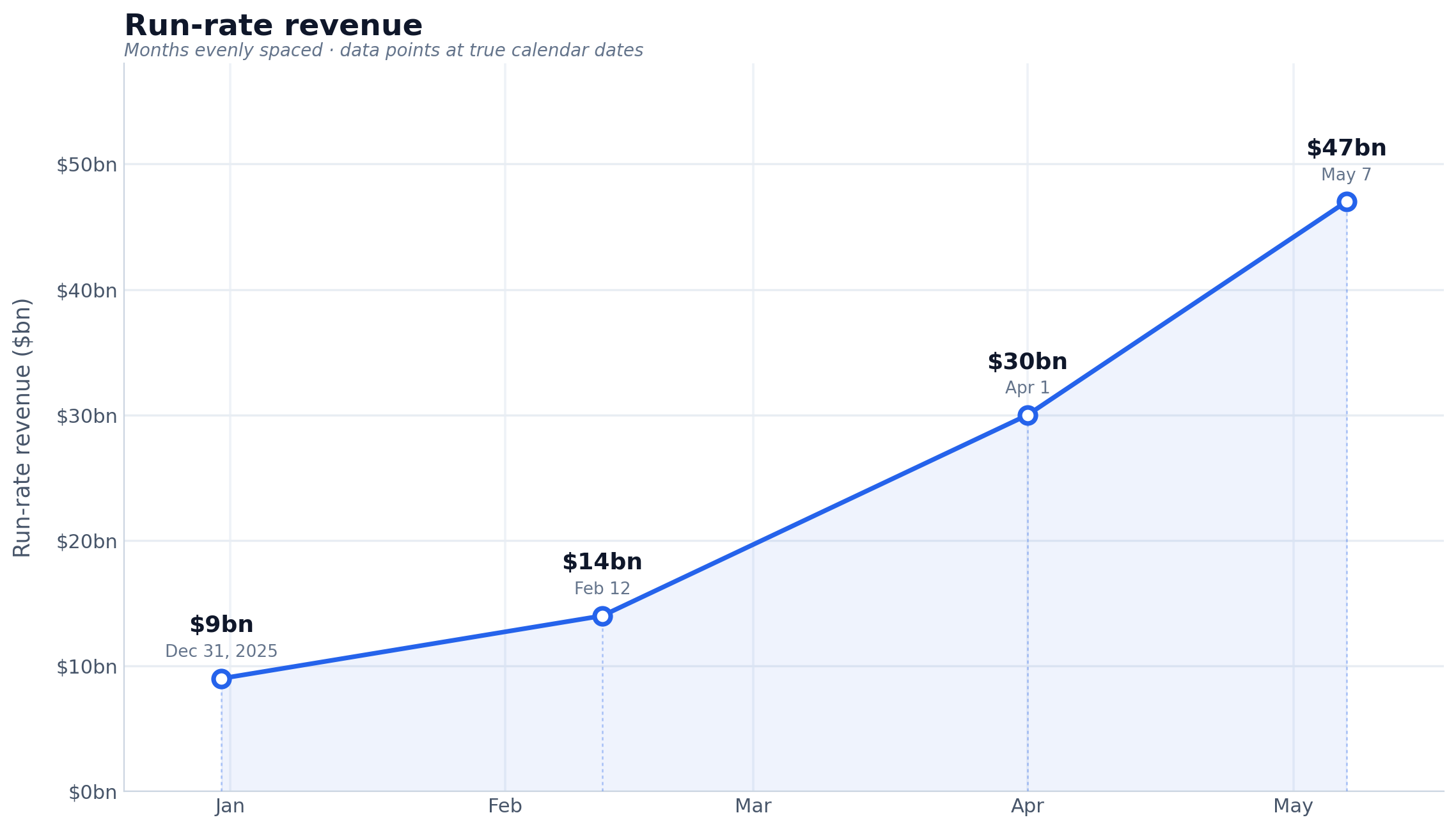
Summary: Anthropic’s Series H funding announcement reveals its run-rate revenue has reached $47 billion, a figure derived from annualizing its most recent monthly revenue. This marks a dramatic acceleration from $14 billion in February and $30 billion in April, suggesting unprecedented enterprise adoption and spending. The numbers are presented as credible given their inclusion in formal fundraising disclosures to investors.
Why it matters: The scale and velocity of Anthropic’s revenue growth signals a fundamental shift in enterprise software economics and AI infrastructure spending, with material consequences for competitors, cloud providers, and capital markets.
Context: Anthropic has established a pattern of announcing run-rate revenue figures during major funding rounds, using the metric to demonstrate hyper-growth to investors and the market. This practice invites scrutiny but carries legal weight when presented to financing partners.
"Since our Series G in February, adoption has continued to grow across global enterprise customers, and our run-rate revenue crossed $47 billion earlier this month." — SIMONWILLISON.NET
Commentary: The figures, if accurate, validate the thesis that generative AI has moved beyond experimentation into core enterprise operations at staggering cost. This growth trajectory pressures legacy software vendors and suggests AI spending is becoming non-discretionary for large firms. The anecdote about a client overspending by half a billion dollars in a month highlights the operational and financial control challenges inherent in this scale of consumption.
Date: May 28, 2026 09:23 PM ET
URL: https://simonwillison.net/2026/May/29/anthropic/
AI Sentiment Score: Positive (50%)
AI Credibility Score: 10.0/10 — High
Scores and text generated by AI analysis of the source article indicated.
Post ID: 0aa9a83b