Space Exploration
Webb reveals millions of stars in nearby galaxy (Esa.Int)
Summary: The James Webb Space Telescope has released new images of Centaurus A, revealing millions of individual stars in its dust-obscured core and unprecedented detail of its active black hole and merger-driven structure. The images, marking Webb’s fourth science anniversary, show a warped parallelogram dust band, an ‘S’-shaped feature, and resolved stellar populations that enable galactic archaeology. Early spectroscopy indicates fast-moving ionized gas and warm molecular hydrogen near the black hole, offering a nearby laboratory for studying black hole-galaxy coevolution. The release also highlights Webb’s broader fourth-year achievements, including evidence for a planet around Alpha Centauri, the earliest supernova yet, and new insights into early black holes.

Why it matters: Centaurus A is the nearest active galaxy with a supermassive black hole, and Webb’s ability to resolve individual stars through dust and trace gas dynamics provides a direct observational testbed for models of feedback, star formation, and merger-driven evolution that apply to more distant systems.
Context: Previous infrared surveys by Spitzer resolved large-scale structures but not individual stars, while Hubble’s visible-light view was blocked by dust in the core. Webb’s combination of NIRCam and MIRI now bridges that gap, turning a known object into a resolved stellar population and kinematic laboratory.
"Webb reveals millions of stars in nearby galaxy In new images from the NASA/ESA/CSA James Webb Space Telescope to celebrate its fourth science anniversary, a familiar galaxy transforms into something far richer,." — ESA.INT
Commentary: The shift from unresolved infrared blobs to resolved stellar archaeology in an active nearby galaxy is a genuine capability milestone, not just a prettier picture. The ‘S’-shaped MIRI feature and the warped molecular hydrogen disk are concrete anomalies that could drive follow-up spectroscopy and dynamical modeling. For mission planners, the four-year performance record—better than anticipated—reinforces Webb’s role as a long-duration observatory for nearby galaxy physics, not just deep-field cosmology.
Date: July 06, 2026 12:00 PM ET
URL: https://www.esa.int/Science_Exploration/Space_Science/Webb/Webb_reveals_millions_of_stars_in_nearby_galaxy
AI Sentiment Score: Positive (80%)
AI Credibility Score: 10.0/10 — High
Scores and text generated by AI analysis of the source article indicated.
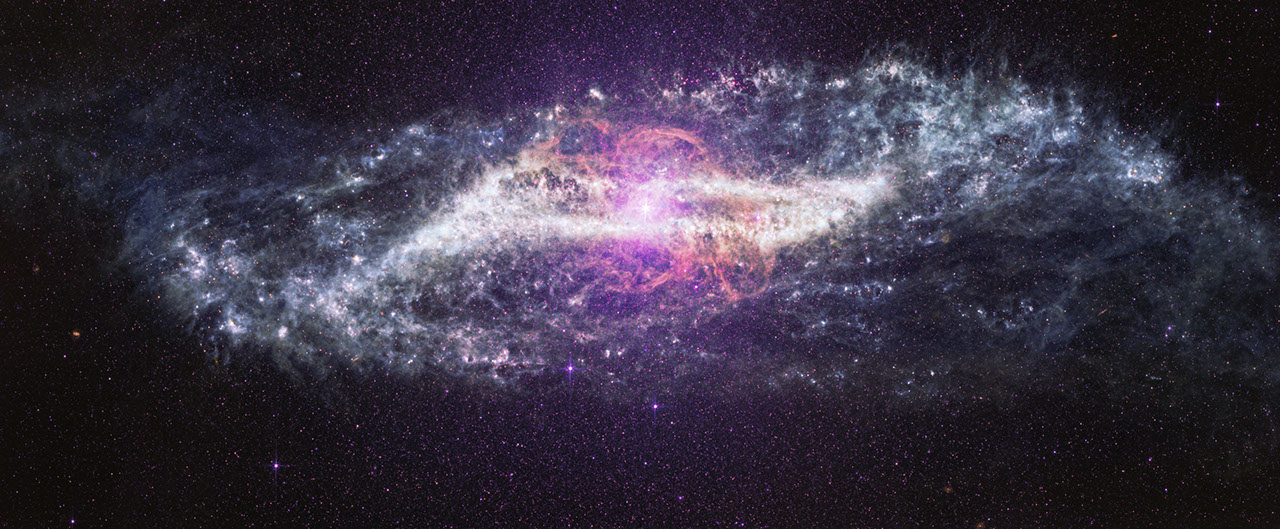
NASA Webb Uncovers Unusual Galaxy Shaped by Cosmic Collision (Science.Nasa.Gov)
Summary: NASA’s James Webb Space Telescope has released new mid- and near-infrared images of the active galaxy Centaurus A, marking its fourth science anniversary. The observations reveal individual stars in the galaxy’s previously obscured central region, detailed dust structures including an unexplained ‘S’-shaped feature, and spectroscopic evidence of gas motion driven by the central supermassive black hole. These data provide a high-resolution record of the galaxy’s evolution following a major merger two billion years ago, demonstrating Webb’s ability to perform galactic archaeology.
Why it matters: This confirms Webb’s operational capability to resolve individual stars in dust-obscured galactic cores, enabling direct study of black hole-galaxy co-evolution in a nearby laboratory.
Context: Centaurus A is the nearest active galaxy with a supermassive black hole, previously studied by Hubble (visible light) and Spitzer (low-resolution infrared). Webb’s combination of angular resolution and infrared sensitivity fills a critical observational gap.
"NASA Webb Uncovers Unusual Galaxy Shaped by Cosmic Collision The mid-infrared view of Centaurus A from NASA’s James Webb Space Telescope reveals dusty structures and hidden activity within the nearby, active galaxy." — SCIENCE.NASA.GOV
Commentary: The ‘S’-shaped mid-infrared feature and the warped parallelogram dust band are genuinely new structures not predicted by existing merger models, suggesting the black hole’s feedback geometry is more complex than simulated. The spectroscopic detection of fast ionized outflows and warm molecular hydrogen in a warped disk provides direct kinematic evidence for how the active nucleus regulates star formation. This dataset will likely become a benchmark for testing feedback prescriptions in cosmological simulations.
Date: July 06, 2026 10:00 AM ET
URL: https://science.nasa.gov/missions/webb/nasa-webb-uncovers-unusual-galaxy-shaped-by-cosmic-collision/
AI Sentiment Score: Negative (50%)
AI Credibility Score: 10.0/10 — High
Scores and text generated by AI analysis of the source article indicated.
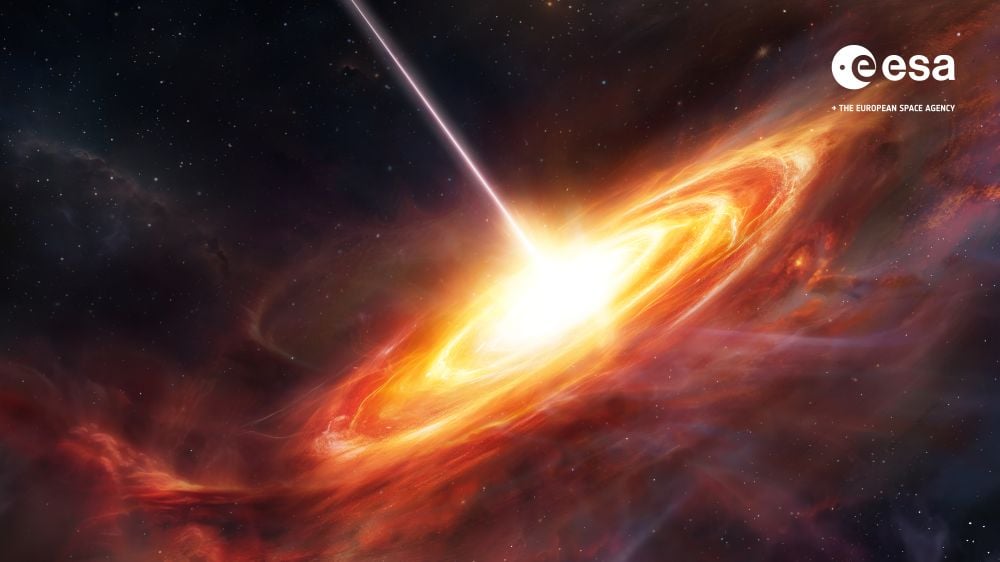
Euclid discovers the most ancient quasar in the Universe (Esa.Int)
Summary: ESA’s Euclid telescope has discovered 31 ancient quasars, including two record-breaking objects from when the universe was just 670 million years old. The findings more than double the known quasars at redshift 7 or above, achieved in a single year of survey operations. This census shifts quasar astronomy from studying rare bright outliers to characterizing the full population of early supermassive black holes.

Why it matters: This census-quality dataset directly constrains models of supermassive black hole seed formation and growth in the first billion years, a regime where theory has outpaced observations.
Context: Previous quasar surveys at redshift >7 relied on wide-field ground telescopes and suffered from small-number statistics; Euclid’s combination of large area, depth, and space-based infrared enables systematic detection of fainter, more representative objects.
"Euclid discovers the most ancient quasar in the Universe In brief The European Space Agency’s Euclid space telescope has discovered 31 of the most ancient quasars ever found. Two of these giant." — ESA.INT
Commentary: The yield rate—31 quasars in one year versus ~10 over a decade—validates Euclid’s survey design for high-redshift science beyond its primary dark energy mission. The two record holders at z=7.77 and z=7.69 push the observational frontier 30 million years deeper than the previous 2021 record, tightening the timeline for black hole assembly mechanisms. Follow-up spectroscopy of the second-most ancient quasar revealing a dusty, star-forming host galaxy provides the first direct glimpse of the environment in which these early supermassive black holes reside.
Date: July 06, 2026 02:30 AM ET
URL: https://www.esa.int/Science_Exploration/Space_Science/Euclid/Euclid_discovers_the_most_ancient_quasar_in_the_Universe
AI Sentiment Score: Positive (45%)
AI Credibility Score: 10.0/10 — High
Scores and text generated by AI analysis of the source article indicated.
The Euclid Space Telescope Has Found 31 New Ancient Quasars, Including the Most Ancient One Ever Found (Universetoday)
Summary: ESA’s Euclid telescope has discovered 31 new high-redshift quasars at 6.6 < z < 7.8, including two at z=7.7 and z=7.69 that beat the previous record of z=7.64. These quasars were found in just the first 1.5 years of the Euclid Wide Survey, covering about 3000 square degrees. The sample more than doubles the known quasars at z≥7, providing a representative census rather than just the brightest outliers. The findings are published in Astronomy and Astrophysics.
Why it matters: This gives cosmologists a statistically meaningful sample to test the Lambda-CDM model against early supermassive black hole growth, rather than relying on a handful of extreme outliers.
Context: Previous searches took over a decade to find the first 10 quasars at z≥7; Euclid’s wide-field 600-megapixel camera and near-infrared spectroscopy were designed for dark matter and dark energy studies but are proving transformative for high-redshift quasar discovery.
[Summary note] ESA’s Euclid telescope has discovered 31 new high-redshift quasars at 6.6 < z < 7.8, including two at z=7.7 and z=7.69 that beat the previous record of z=7.64.
Commentary: The key shift here is from outlier-based to census-based early-Universe astrophysics. With 31 quasars in 1.5 years and six years of mission remaining, Euclid will likely deliver hundreds of high-z quasars, enabling robust statistical tests of dark matter halo assembly timescales and SMBH seeding models that single-object studies could never resolve.
Date: July 07, 2026 03:17 PM ET
URL: https://www.universetoday.com/articles/the-euclid-space-telescope-has-found-31-new-ancient-quasars-including-the-most-ancient-one-ever-foun
AI Sentiment Score: Positive (50%)
AI Credibility Score: 10.0/10 — High
Scores and text generated by AI analysis of the source article indicated.
The government’s options to address strained spaceports (Spacenews)
Summary: The May 28 explosion of a Blue Origin New Glenn rocket at Cape Canaveral has exposed severe strain on U.S. spaceport infrastructure, with NASA’s Inspector General warning that Kennedy Space Center and Wallops could reach launch capacity by 2028. A NASA OIG report estimates Kennedy needs at least $1 billion for upgrades, but only $250 million has been secured. The Space Force has received $500 million for national security launch infrastructure, but interagency coordination remains nascent. Industry and policy figures are now debating four options: more direct funding, deeper cooperation between NASA, Space Force, and NRO, enforced competition among launch providers, and development of new inland spaceports.

Why it matters: The U.S. launch market’s near-total reliance on a single operator (SpaceX Falcon 9) and two coastal ranges creates a brittle national capability that a single accident or grounding could cripple for months, directly affecting national security, commercial payloads, and Artemis lunar timelines.
Context: The New Glenn explosion follows a February Vulcan Centaur anomaly and ongoing delays for Neutron and Eclipse, leaving SpaceX as the only active large-vehicle provider. The NASA OIG report and a Space Force study (not yet public) both flag capacity limits at existing ranges.
"“NASA officials have estimated that Kennedy will need at least $1 billion to completely upgrade its launch infrastructure,” the report concluded. It did not provide an itemized list, but noted repairs to the electric system will cost $136 million while repairs to bridges and roads at the center will cost at least $200 million." — SPACENEWS
Commentary: The $1 billion figure is a floor, not a ceiling, and the OIG’s silence on itemization suggests the true cost may be higher once pad-specific rebuilds (LC-36) and nitrogen pipeline upgrades are included. The administration’s $87.6B supplemental request, which omits NASA entirely, signals that spaceport resilience is not a near-term political priority despite the Artemis program’s dependence on both New Glenn and Starship. The PPI proposal to cap any single provider’s share of government launch contracts is the most structural lever available, but it would require Congress to override entrenched procurement patterns and would take years to diversify the industrial base.
Date: July 08, 2026 07:00 AM ET
URL: https://spacenews.com/the-governments-options-to-address-strained-spaceports/
AI Sentiment Score: Negative (75%)
AI Credibility Score: 10.0/10 — High
Scores and text generated by AI analysis of the source article indicated.
Europe just unveiled a new rival to SpaceX’s Starship (Sciencedaily)
Summary: Europe just unveiled a new rival to SpaceX’s Starship – Date: – July 10, 2026 – Source: – Universe Today – Summary: – A detailed independent study found that SpaceX’s Starship is every bit as revolutionary as expected, while revealing both its impressive capabilities and its biggest remaining hurdles. It also introduces an ambitious European rocket concept that could offer a very different route to affordable super heavy launches. – Share: When SpaceX’s Starship lifted off from the Texas coast in the summer of 2023, it marked a milestone that aerospace engineers had discussed for decades but few expected to witness so soon.

Why it matters: This matters for Space Exploration because it gives a concrete current signal to track: Europe just unveiled a new rival to SpaceX’s Starship – Date: – July 10, 2026 – Source: – Universe Today – Summary: – A detailed independent study found that SpaceX’s Starship is every bit as revolutionary as expected, while revealing both its impressive capabilities and its biggest remaining hurdles.
Context: Europe just unveiled a new rival to SpaceX’s Starship – Date: – July 10, 2026 – Source: – Universe Today – Summary: – A detailed independent study found that SpaceX’s Starship is every bit as revolutionary as expected, while revealing both its impressive capabilities and its biggest remaining hurdles. It also introduces an ambitious European rocket concept that could offer a very different route to affordable super heavy launches. – Share: When SpaceX’s Starship lifted off from the Texas coast in the summer of 2023, it marked a milestone that aerospace engineers had discussed for decades but few expected to witness so soon.
"Europe just unveiled a new rival to SpaceX’s Starship – Date: – July 10, 2026 – Source: – Universe Today – Summary: – A detailed independent study found that SpaceX’s Starship is." — SCIENCEDAILY
Commentary: The immediate implication is operational rather than speculative: watch how this changes budgets, workflows, or risk assumptions over the next cycle.
Date: July 10, 2026 09:14 PM ET
URL: https://www.sciencedaily.com/releases/2026/07/260710003526.htm
AI Sentiment Score: Negative (66%)
AI Credibility Score: 10.0/10 — High
Scores and text generated by AI analysis of the source article indicated.
Post ID: 3eb9fe18