

AI News Digests and Weekly Roundups
Vendor Benchmarks Are Your Ceiling, Not Your Forecast – TianPan.co (Tianpan.Co)
Summary: Vendor-supplied benchmark scores for AI models are increasingly recognized as misleading for enterprise deployment decisions, with a documented 37% performance gap and up to 50x cost variance between lab results and real-world application. The emerging best practice is a rigorous, in-house shadow evaluation pipeline that mirrors production traffic to compare candidate and incumbent models across a fixed suite of real-world tasks and failure modes. This method, adapted from legacy ranking model testing, yields a comparative distribution of outcomes rather than a single score, enabling procurement and engineering decisions based on actual performance under specific operational conditions.
Why it matters: Procurement and engineering teams relying on vendor benchmarks are systematically overestimating performance and underestimating cost, leading to failed rollouts and wasted investment.
Context: This reflects a maturation phase in enterprise AI adoption, where the focus shifts from model capabilities to integration efficacy, mirroring the evolution of testing practices for earlier generations of machine learning systems.
"The only honest way to know what a candidate model will do for your product is to run it on your product’s evaluation surface alongside the incumbent, before any rollout decision." — TIANPAN.CO
Commentary: The shift to shadow evals institutionalizes skepticism, turning vendor marketing into a mere input for a proprietary, data-driven decision loop. It creates a new class of internal artifact—the calibration table—that becomes a core competitive asset, quantifying an organization’s specific model-evaluation fit over time. This practice could pressure AI vendors to provide more transparent, granular evaluation tooling and could bifurcate the market between vendors that facilitate rigorous testing and those that resist it. Ultimately, it moves the center of gravity for AI value from the model itself to the operational rigor of the evaluating organization.
Date: April 28, 2026 12:00 AM ET
URL: https://tianpan.co/blog/2026-04-28-vendor-benchmark-ceiling-realized-lift
AI Sentiment Score: Negative (85%)
AI Credibility Score: 10.0/10 — High
Scores and text generated by AI analysis of the source article indicated.
2026-04-25 front – Hacker News (News.Ycombinator)
Summary: Hacker News on April 25, 2026, surfaces signals across hardware commoditization, AI infrastructure, and legacy system reinterpretation. Key threads include the arrival of cooler, cheaper 10 GbE USB adapters, a bounty program for GPT-5.5 Bio, and open-source projects aiming to replicate proprietary AI agent memory layers. The list also highlights continued community efforts to modernize or benchmark foundational computing concepts, from Turbo Vision ports to lambda calculus.

Why it matters: These signals trace the practical, pre-mainstream evolution of compute density, AI safety economics, and the open-source reclamation of proprietary infrastructure, which collectively define the next phase of developer tooling and system trust.
Context: The forum consistently acts as an early-warning system for engineering-led adoption, where cost-performance breakthroughs, security disclosures, and open-source alternatives to walled gardens gain initial traction before broader market recognition.
"Stories from April 25, 2026 Go back a … 1. New 10 GbE USB adapters are cooler, smaller, cheaper ( jeffgeerling.com ) 620 points by calcifer 6 days ago | 371 comments." — NEWS.YCOMBINATOR
Commentary: The 10 GbE USB adapter trend signals the final commoditization of high-speed networking, removing a final barrier to distributed edge compute. The GPT-5.5 Bio bug bounty formalizes the economic model for externalized AI safety testing, while open-source memory layers for AI agents represent a direct institutional challenge to the moats of Anthropic and OpenAI. Concurrently, the revival of projects like Turbo Vision and MS-DOS succession debates indicate a maturation phase where the community re-evaluates and productizes historical paradigms for modern constraints.
Date: April 25, 2026 12:00 AM ET
URL: https://news.ycombinator.com/front?day=2026-04-25
AI Sentiment Score: Negative (50%)
AI Credibility Score: 10.0/10 — High
Scores and text generated by AI analysis of the source article indicated.
2026-05-03 front (News.Ycombinator)
Summary: A Hacker News front page from May 3, 2026, surfaces signals across automotive UX, mesh networking, AI diagnostics, agentic coding, and hardware emulation. Notable threads include Mercedes-Benz reversing its touchscreen-heavy interface strategy, a new high-bandwidth LoRa mesh radio, and OpenAI’s o1 model outperforming human triage in an emergency room diagnostic trial. The list reflects a continued push toward specialized, efficient tools and a reassessment of purely digital interfaces.
Why it matters: These signals collectively indicate a maturation phase where raw capability is being tempered by practical constraints, user experience, and integration costs, moving beyond pure technological novelty.
Context: The front page often acts as a leading indicator for developer and engineering sentiment, highlighting pre-mainstream technical shifts and operational critiques before they reach broader industry discourse.
"OpenAI’s o1 correctly diagnosed 67% of ER patients vs. 50-55% by triage doctors." — NEWS.YCOMBINATOR
Commentary: The Mercedes-Benz reversal on physical buttons is a significant market signal that the automotive industry’s UI over-correction is hitting a practical limit, potentially resetting supplier and interior design roadmaps. The o1 diagnostic result, while a narrow trial, suggests a near-term path to regulatory and liability frameworks for AI in high-stakes clinical support, shifting from pure assistant to decision-augmentation.
Date: May 03, 2026 12:00 AM ET
URL: https://news.ycombinator.com/front?day=2026-05-03
AI Sentiment Score: Positive (42%)
AI Credibility Score: 10.0/10 — High
Scores and text generated by AI analysis of the source article indicated.
DTF:HN for April 24, 2026 (Youtube)
Summary: Matz (Yukihiro Matsumoto), the creator of Ruby, has released Spinel, an ahead-of-time native compiler for Ruby, built in about a month with Claude as a coding partner. The project was presented live at RubyKaigi 2026, and early benchmarks show significant performance improvements. This move signals a major shift in the Ruby ecosystem’s approach to performance, moving beyond just-in-time compilation and interpreter optimizations.
Why it matters: AOT compilation for a dynamic language like Ruby, driven by its creator and AI-assisted development, could reset expectations for scripting language performance and developer toolchain evolution.
Context: Ruby’s performance has long been a topic of discussion, with efforts like MJIT and YJIT focusing on JIT compilation within the Ruby runtime. An AOT compiler represents a more fundamental architectural shift, potentially enabling new deployment models and use cases previously impractical for Ruby.
"##### Apr 24, 2026 (0:35:46) Your Daily Tech Feed covering the top 10 stories on Hacker News for April 24, 2026. Featuring: S. Korea police arrest man over AI image of runaway." — YOUTUBE
Commentary: The project’s origin and development speed are as significant as the technical outcome. Matz’s direct involvement lends immediate credibility and signals strategic priority. The use of Claude as a ‘coding partner’ to rapidly prototype a core systems tool validates a new, high-stakes category of AI-assisted development: not just automating boilerplate, but accelerating research and implementation of foundational compiler technology. If Spinel’s performance gains hold, it pressures other dynamic language stewards to re-evaluate their roadmaps and could accelerate the integration of AI co-pilots into core language development workflows.
Date: April 24, 2026 12:00 AM ET
URL: https://www.youtube.com/watch?v=l6lOTu6xvok
AI Sentiment Score: Positive (50%)
AI Credibility Score: 10.0/10 — High
Scores and text generated by AI analysis of the source article indicated.
reverse engineering (T.Me)
Summary: A Telegram channel focused on reverse engineering and security research aggregates signals of emerging vulnerabilities and tooling. It documents a BFLA/BOLA authorization bypass in a live API, a claimed EgyptAir HR database breach, a solved Intigriti CTF challenge, and the release of a utility bot for saving Telegram content. It also highlights a pattern of AI-generated code introducing security flaws, a claimed source code leak of Anthropic’s Claude Code CLI via an exposed source map, and the release of Qwen3.6-plus with a 1M context window.

Why it matters: These signals collectively illustrate the accelerating, low-friction intersection of offensive security research, AI-assisted development pitfalls, and the proliferation of accessible tooling, which is reshaping the vulnerability discovery and exploitation landscape.
Context: The channel operates as a real-time feed for technical security practitioners, blending vulnerability disclosures, tool releases, and commentary on the security implications of AI adoption.
"Usually when I see emojis inside a code (like ✅ and ❌❎) I understand it was written by AI or this code wasn’t written by a professional developer so I start my investigations from that point." — T.ME
Commentary: The heuristic of emojis as an indicator of AI-generated, insecure code is a pragmatic, if crude, signal for auditors. It underscores a broader, systemic risk: the democratization of code generation is outpacing the dissemination of secure development practices, creating a new class of vulnerabilities born from developer inexperience rather than complex logic flaws. The claimed Anthropic leak, if verified, points to a persistent class of deployment errors (exposed source maps) now threatening proprietary AI tooling itself.
Date: April 27, 2026 12:00 AM ET
URL: https://t.me/s/reverseengineer101?before=275
AI Sentiment Score: Negative (80%)
AI Credibility Score: 10.0/10 — High
Scores and text generated by AI analysis of the source article indicated.
Hacker News Digest — 2026-04-26 – S T C H E N G (News.Cheng.St)
Summary: Hacker News activity on April 26 highlighted a recurring tension between technological capability and operational responsibility. Key threads included an amateur mathematician using ChatGPT to solve a long-standing Erdős problem, Asahi Linux’s incremental but vital progress on Apple Silicon, and a cautionary tale of a registrar arbitrarily transferring a domain, causing immediate business disruption. Meanwhile, OpenAI deprecated the SWE-bench Verified benchmark as frontier models saturated its ceiling, and a PlayCanvas demo showed Gaussian splats being adapted into a functional game environment.
Why it matters: These signals collectively map the shifting boundaries of control, evaluation, and practical application in emerging tech, revealing where theoretical capability meets real-world consequence.
Context: The discussion reflects a maturation phase where the focus shifts from raw capability demonstrations to questions of reliability, ownership, and the scaffolding required to move from prototype to production.
"The story lands because it reduces domain ownership to its uncomfortable reality: the registrar is often the real point of control, and when that control fails, the business damage is immediate." — NEWS.CHENG.ST
Commentary: The pattern across these stories underscores that the next phase of adoption is less about breakthrough demos and more about systemic integrity—be it in platform control, evaluation metrics, or engineering completeness. As AI capabilities plateau on narrow benchmarks, the critical work shifts to hardening interfaces, securing operational chains, and building the mundane infrastructure that turns novel techniques into dependable tools.
Date: April 26, 2026 12:00 AM ET
URL: https://news.cheng.st/2026/04/26/hacker-news-digest-2026-04-26/
AI Sentiment Score: Negative (50%)
AI Credibility Score: 10.0/10 — High
Scores and text generated by AI analysis of the source article indicated.
LLM Daily: May 02, 2026 • Buttondown (Buttondown)
Summary: PFlash, a new C++/CUDA tool, claims a 10x prefill speedup over llama.cpp at 128K context on consumer-grade GPUs like the RTX 3090. This directly addresses the computational bottleneck of long-context inference, potentially democratizing access outside of enterprise-scale infrastructure. Concurrently, the open-source TradingAgents framework’s surge in adoption, integrating advanced reasoning models for autonomous financial trading, signals maturation in domain-specific, agentic LLM applications. Community benchmarks are now rigorously comparing open-weight and closed models on professional creative workflows like consistent character generation from reference sheets.

Why it matters: These developments signal a shift from theoretical capability to practical, accessible implementation, lowering the cost and expertise barriers for high-performance, specialized LLM applications.
Context: The frontier of LLM utility has been constrained by the high cost and latency of long-context inference and the integration complexity of multi-agent systems. Community-driven tooling and benchmarking are increasingly setting the practical agenda for what is feasible outside major labs.
"• PFlash, a new C++/CUDA tool for local LLM inference, claims a 10x prefill speedup over llama.cpp at 128K context on consumer hardware (RTX 3090), potentially making long-context inference far more accessible." — BUTTONDOWN
Commentary: PFlash’s claimed performance, if validated, redefines the hardware floor for serious long-context work, moving it from cloud clusters to enthusiast workstations. The TradingAgents surge indicates a market forming around composable, auditable agent frameworks for high-stakes domains, a direct challenge to opaque, monolithic API offerings. The character-sheet benchmarking reflects a maturation where open-weight models are evaluated not on generic quality but on specific, repeatable professional outputs, shifting the competitive landscape from raw scale to workflow integration.
Date: May 02, 2026 12:00 AM ET
URL: https://buttondown.com/agent-k/archive/llm-daily-may-02-2026/
AI Sentiment Score: Positive (44%)
AI Credibility Score: 10.0/10 — High
Scores and text generated by AI analysis of the source article indicated.
Hacker News Digest — 2026-04-27 – S T C H E N G (News.Cheng.St)
Summary: The tech ecosystem is shifting from a period of subsidized AI abundance to one of metered usage and contested control. Microsoft and OpenAI are loosening their exclusive revenue-sharing and cloud partnership, while GitHub Copilot is introducing usage-based billing, signaling a broader industry move away from flat-rate subsidies. Simultaneously, China’s block of Meta’s acquisition of a Singapore-based AI startup underscores the geopolitical hardening of tech supply chains, and the deprecation of the widely-used pgBackRest tool highlights the persistent fragility of open-source infrastructure stewardship.
Why it matters: These shifts collectively redefine the cost structure, strategic autonomy, and operational stability for developers and enterprises building on modern platforms.
Context: This follows a multi-year cycle of major cloud providers subsidizing AI tool access to capture developer mindshare and lock-in, while geopolitical tensions increasingly fracture the global AI talent and intellectual property market.
"Cheap AI abundance is giving way to metered usage, exclusive alliances are loosening, and even reliable open-source infrastructure is reminding everyone that stewardship does not happen by magic." — NEWS.CHENG.ST
Commentary: The unwinding of the Microsoft-OpenAI exclusivity deal reduces strategic lock-in but may increase procurement complexity. GitHub’s billing change directly impacts developer workflow economics, making efficient prompt and context management a tangible cost-center skill. China’s intervention transforms a corporate acquisition into a state-level signal, further Balkanizing AI development paths. The pgBackRest case is a stark, operational reminder that ‘stable’ open source is a maintenance covenant, not a permanent state.
Date: April 27, 2026 12:00 AM ET
URL: https://news.cheng.st/2026/04/27/hacker-news-digest-2026-04-27/
AI Sentiment Score: Positive (40%)
AI Credibility Score: 10.0/10 — High
Scores and text generated by AI analysis of the source article indicated.
GenAI Product Launch Playbook 2026 | Dupple Blog (Dupple)
Summary: A 2026 playbook from Dupple outlines a 21-day launch sequence for GenAI products, emphasizing tactical timing, a single compelling demo, and orchestrated distribution across Product Hunt, Hacker News, and curated newsletters. It codifies a post-hype, efficiency-driven launch culture where success hinges on precise execution, from embargoed press outreach weeks in advance to a viral-optimized demo tweet template. The guide treats launch as a concentrated engineering and marketing sprint, with distinct phases for foundation, content, warm-up, launch day, momentum, and conversion.

Why it matters: This signals the formalization and professionalization of GenAI product launches, moving from ad-hoc virality to a repeatable, data-driven process that will shape market entry timing, press and newsletter economics, and competitive visibility windows.
Context: This follows the 2023-2025 era of chaotic, hype-driven AI launches and reflects a market where developer attention is a scarcer, more structured commodity, and where Product Hunt and Hacker News remain durable gatekeepers despite platform decay elsewhere.
"The format that consistently goes viral for GenAI launches in 2026: > "We built [specific thing]. It [does specific action] in [specific time]. [30-second video]. Try it free: [link]." Don’t lead with the company name. Don’t say "we’re excited to announce." Don’t pitch. Show the thing doing the thing." — DUPPLE
Commentary: The playbook’s existence and specificity indicate GenAI is entering a phase of operational maturity, where competitive advantage shifts from raw model access to distribution craftsmanship. The prescribed avoidance of corporate messaging and focus on a single, concrete demo suggests audience fatigue with speculative claims, demanding immediate, tangible utility. This codified sequence could pressure early-stage infrastructure, as newsletter sponsorships and embargo timelines become saturated, raising costs for newcomers. Ultimately, it benchmarks a new minimum viable launch, turning what was once art into a repeatable, and therefore commodifiable, process.
Date: April 23, 2026 12:00 AM ET
URL: https://dupple.com/blog/genai-product-launch-playbook
AI Sentiment Score: Positive (40%)
AI Credibility Score: 10.0/10 — High
Scores and text generated by AI analysis of the source article indicated.
Hacker News Digest — 2026-05-01 – S T C H E N G (News.Cheng.St)
Summary: WhatCable, a macOS utility, exposes USB-C cable specifications via system data, translating opaque technical identifiers into user-readable charging, data, and display capabilities. Flock employees accessed city camera feeds, including a children’s gymnastics room, for a product demo, raising operational oversight questions. An open letter urges NHS England to maintain public code repositories, arguing openness enforces security discipline over secrecy. Spotify introduces a ‘Verified’ badge to authenticate artists against AI-generated content farms. Lucid dream communication research suggests constrained task rehearsal during sleep may be possible.
Why it matters: These signals highlight tightening accountability pressures on tech infrastructure—from consumer hardware transparency and surveillance ethics to public code governance and content authenticity—ahead of regulatory and market shifts.
Context: USB-C remains a compliance minefield; surveillance tech oversight is often contractual; public-sector open source faces security-policy tension; platform verification battles synthetic media; sleep tech edges toward applied interfaces.
"WhatCable is a small macOS utility that reads cable data the system already exposes and translates it into plain English: charging wattage, data speed, display support, and Thunderbolt capability." — NEWS.CHENG.ST
Commentary: WhatCable exemplifies reverse-engineering as a consumer tool, shifting evaluation practice from guesswork to system-level verification—potentially pressuring manufacturers toward clearer labeling. Flock’s access logs reveal a surveillance-ops trust deficit that could trigger stricter contractual access controls and audit requirements. The NHS open-source argument reframes security as a function of scrutiny, not obscurity, challenging public-sector procurement norms. Spotify’s verification badge is a market-quality signal aimed at preserving listener trust amid synthetic content proliferation, creating a new class of platform-validated identity.
Date: May 01, 2026 12:00 AM ET
URL: https://news.cheng.st/2026/05/01/hacker-news-digest-2026-05-01/
AI Sentiment Score: Negative (66%)
AI Credibility Score: 10.0/10 — High
Scores and text generated by AI analysis of the source article indicated.
Product Hunt Digest — 2026-04-23 – N E W S – S T C H E N G (News.Cheng.St)
Summary: The April 23 Product Hunt digest reveals a distinct market signal: the top five products were unified in addressing practical, infrastructural gaps in AI-augmented workflows. FocuSee 2.0 and Magic Patterns Agent 2.0 focus on compressing creative production and design-to-code handoffs. Kollab, Monid, and Claude Code /ultrareview treat AI agents as durable operational components requiring shared memory, financial plumbing, and parallelized verification.
Why it matters: This coherence indicates a maturation phase where developer and enterprise attention is shifting from model capability to operational integration, directly impacting toolchain investment and team structures.
Context: This follows a period of fragmented experimentation with individual AI tools, where novelty often outweighed utility. The market is now selecting for systems that reduce friction and increase reliability in multi-agent, multi-human collaborative environments.
"Yesterday’s Product Hunt board was unusually coherent. The top five products all tried to make AI systems more usable inside real work: editing a demo, coordinating with agents, pushing a prototype toward." — NEWS.CHENG.ST
Commentary: The shift from spectacle to compression signals a re-pricing of venture and developer effort toward boring but essential middleware. Products like Monid expose the next critical bottleneck: the financial and identity layer for autonomous services, which will dictate the scale and security of agent ecosystems. The parallel emergence of tools for memory, payment, and verification suggests these are now the binding constraints on AI-augmented productivity, not raw model performance.
Date: April 24, 2026 12:00 AM ET
URL: https://news.cheng.st/2026/04/24/product-hunt-digest-2026-04-23/
AI Sentiment Score: Neutral (33%)
AI Credibility Score: 10.0/10 — High
Scores and text generated by AI analysis of the source article indicated.
Your Prompts Ship Like Cowboys: Why Code Review Discipline … (Tianpan.Co)
Summary: A proposal for formalizing AI artifact review shifts the focus from generic code review practices to a discipline built around specific failure modes, specialized reviewer routing, and mandatory behavioral validation. It argues that treating prompts, rubrics, and tool descriptions as config with high blast radius necessitates a review process analogous to infrastructure or database migrations. The core mechanism involves cataloging failure modes per artifact type, routing changes to reviewers with evaluation fluency, and enforcing CI checks that test behavioral slices rather than code coverage.
Why it matters: As AI-integrated systems move from prototype to production, the discipline for managing their behavioral components remains dangerously ad-hoc, creating systemic reliability and safety risks.
Context: This reflects a maturation phase in applied AI engineering, where the operational focus shifts from model capability to the governance of the prompts, evaluation rubrics, and tool-calling descriptions that direct that capability.
"What teams need is a review discipline tailored to the failure modes of each AI artifact, with reviewer routing, gating, and tooling that makes the behavior change visible — not the text change." — TIANPAN.CO
Commentary: The proposal effectively treats AI artifacts as a new class of critical infrastructure, demanding specialized review protocols akin to database schemas or network configs. Its insistence on behavioral validation over text diffs targets the core opacity of LLM-driven systems, where semantic equivalence is non-trivial. Implementing this would force a re-skilling of review cadres toward evaluation fluency and likely spur a market for CI/CD tooling that slices and tests AI artifact changes. The underlying shift is from ‘prompt engineering’ as a creative act to ‘prompt operations’ as a reliability engineering discipline.
Date: April 28, 2026 12:00 AM ET
URL: https://tianpan.co/blog/2026-04-28-ai-artifacts-need-code-review-discipline
AI Sentiment Score: Negative (83%)
AI Credibility Score: 10.0/10 — High
Scores and text generated by AI analysis of the source article indicated.
Import AI 453: Breaking AI agents; MirrorCode; and ten views on gradual disempowerment (Jack-Clark.Net)
Summary: MirrorCode, a benchmark from METR and Epoch, demonstrates that frontier models like Claude Opus 4.6 can autonomously reimplement complex CLI programs—including a 16,000-line bioinformatics toolkit—within a timeframe comparable to a human engineer taking weeks. This signals a leap in AI’s long-horizon, specification-driven coding capability, with performance scaling via increased inference compute. Concurrently, a Google DeepMind paper categorizes six genres of attack against AI agents, shifting the security focus from platform to ecosystem, while forecaster Ryan Greenblatt doubles his probability of full AI R&D automation by end-2028, citing rapid progress on ‘easy-to-verify’ software tasks.

Why it matters: These developments collectively indicate that AI capability is advancing faster than conservative estimates, with tangible implications for software labor markets, security postures, and the feasibility of recursive self-improvement.
Context: The pace of AI progress in complex, autonomous tasks has consistently outpaced expert forecasts, with recent benchmarks and agent deployments exposing new capability thresholds and novel vulnerability classes.
"Claude Opus 4.6 successfully reimplemented gotree — a bioinformatics toolkit with ~16,000 lines of Go and 40+ commands. We guess this same task would take a human engineer without AI assistance 2–17 weeks." — JACK-CLARK.NET
Commentary: MirrorCode is less a coding test and more a demonstration of high-fidelity behavioral cloning, suggesting that for well-specified, verifiable tasks, AI can already substitute for senior engineers. This capability, combined with the identified agent attack surfaces, means the economic displacement and security risks from agentic AI are not speculative but operational. Greenblatt’s updated forecast, grounded in observed performance on ‘easy’ but lengthy tasks, implies the feedback loop for AI R&D acceleration may be tighter than institutional planning cycles account for.
Date: Mon, 13 Apr 2026 10:02:22 +0000
URL: https://jack-clark.net/2026/04/13/import-ai-453-breaking-ai-agents-mirrorcode-and-ten-views-on-gradual-disempowerment/
AI Sentiment Score: Positive (50%)
AI Credibility Score: 10.0/10 — High
Scores and text generated by AI analysis of the source article indicated.
The AI Evaluation Suite Designer – Prompt Library (Promptsmint)
Summary: Promptsmint has published a detailed, prescriptive framework for designing AI evaluation suites, moving beyond generic advice to a structured, six-part planning process. The framework mandates categorizing features against specific eval archetypes, designing falsifiable metrics, and generating concrete artifacts like a judge prompt and golden examples. It operationalizes evaluation as a production engineering discipline, with explicit instructions on dataset stratification, adversarial slices, and cost guardrails.
Why it matters: This signals a maturation in AI product development, shifting evaluation from an ad-hoc, qualitative practice to a rigorous, repeatable engineering workflow with direct implications for deployment safety, cost control, and regulatory compliance.
Context: As generative AI moves into production, the lack of standardized, scalable evaluation methods has been a critical bottleneck, often leading to silent failures and eroded trust.
"Ask these in order. Wait for answers — don’t guess. If the user gives you all of it upfront, skip ahead. 1. The feature. What does it do? One sentence. Then: who." — PROMPTSMINT
Commentary: The framework’s insistence on naming a ‘falsifiable property’ forces teams to define success in testable terms, moving evaluation from subjective judgment to measurable engineering criteria. This rigor could pressure AI vendors to provide more transparent, auditable performance data and could become a de facto standard for enterprise procurement and regulatory oversight. It also creates a market for tooling that automates this suite generation, directly from feature intake.
Date: April 28, 2026 12:00 AM ET
URL: https://promptsmint.com/prompts/the-ai-evaluation-suite-designer/
AI Sentiment Score: Negative (66%)
AI Credibility Score: 10.0/10 — High
Scores and text generated by AI analysis of the source article indicated.
PromptAnalysis – Mendeley Data (Data.Mendeley)
Summary: A 2026 dataset release on Mendeley Data provides structured vulnerability analysis of embedded system GitHub repositories, comparing outputs from small LLMs (Gemma, Phi-3) and large LLMs (GPT, Gemini). A separate dataset pairs real-world CVE-grounded C/C++ code snippets with outputs from static analysis tools Cppcheck and Flawfinder. This creates a benchmark for evaluating automated security code review across model scales and against traditional static analysis methods.
Why it matters: It provides a concrete, artifact-driven benchmark for assessing the evolving trade-offs between cost, scale, and accuracy in automated security auditing, directly impacting developer tooling, DevSecOps workflows, and the evaluation of AI-assisted code review.
Context: The push to integrate LLMs into software development lifecycles, particularly for security, lacks standardized, real-world benchmarks comparing model performance across scales and against established tools.
"# PromptAnalysis Published: 28 April 2026| Version 1 | DOI: 10.17632/9vdbnhc84j.1 Contributor: Sadib Hassan ## Description Dataset Descriptions 1. Embedded_System_Security_-_SmallLLM.csv Shape: 1,213 rows × 7 columns This dataset captures security vulnerability analyses." — DATA.MENDELEY
Commentary: The dataset formalizes a shift from speculative capability claims to measurable, comparative evaluation on a security-critical task. It implicitly tests whether smaller, potentially on-premise models can close the gap with large, cloud-based counterparts for specific, structured analysis—a key question for cost and privacy-sensitive embedded development. By including static analysis tool outputs on CVE-grounded code, it also provides a baseline against which LLM performance can be judged, moving beyond LLM-vs-LLM comparisons to assess whether new methods surpass traditional automated analysis in recall and precision.
Date: April 28, 2026 12:00 AM ET
URL: https://data.mendeley.com/datasets/9vdbnhc84j/1
AI Sentiment Score: Negative (90%)
AI Credibility Score: 7.0/10 — Medium
Scores and text generated by AI analysis of the source article indicated.
Daily Digest – 2026-04-27 (Antoinebuteau)
Summary: The digest captures a moment of operational hardening across the AI stack. Engineering teams are shifting from theoretical agent evaluation to production-grade self-healing loops, while application builders are pivoting from API reliance to post-training for economic and latency control. Concurrently, severe physical infrastructure bottlenecks in power and memory are colliding with volatile GPU spot markets, defining the near-term scaling ceiling.

Why it matters: These signals collectively mark the transition from speculative capability to operational and economic reality, where success is dictated by engineering discipline, supply chain access, and unit economics.
Context: This follows a quarter of intense focus on frontier model releases, with attention now shifting downstream to deployment, cost management, and the physical constraints of scaling.
"The AI industry is currently bottlenecked by four critical constraints: capital, electricity, GPUs, and high-bandwidth memory (HBM)." — ANTOINEBUTEAU
Commentary: The convergence of these reports outlines a new phase: the low-hanging fruit of model capability is being harvested, exposing a grueling marathon of systems integration, resource competition, and financial engineering. The firms that navigate this will be those that treat AI not as a magic API but as a heavy industrial process.
Date: April 27, 2026 12:00 AM ET
URL: https://www.antoinebuteau.com/daily-digest-2026-04-27/
AI Sentiment Score: Neutral (33%)
AI Credibility Score: 7.0/10 — Medium
Scores and text generated by AI analysis of the source article indicated.
This Week In AI Research (12-18 April 26) 🗓️ – Into AI (Intoai.Pub)
Summary: This week’s AI research signals show a consolidation of multimodal and embodied AI capabilities, with Alibaba’s Qwen3.5-Omni pushing the envelope on integrated audio-visual processing and code generation. Google DeepMind and Physical Intelligence are advancing robotic foundation models that promise more general, out-of-the-box physical reasoning. Concurrently, architectural analysis of Anthropic’s Claude Code and new native multimodal generation models like Seedance 2.0 indicate a maturation phase where scaling, efficiency, and real-world application are prioritized over pure novelty.
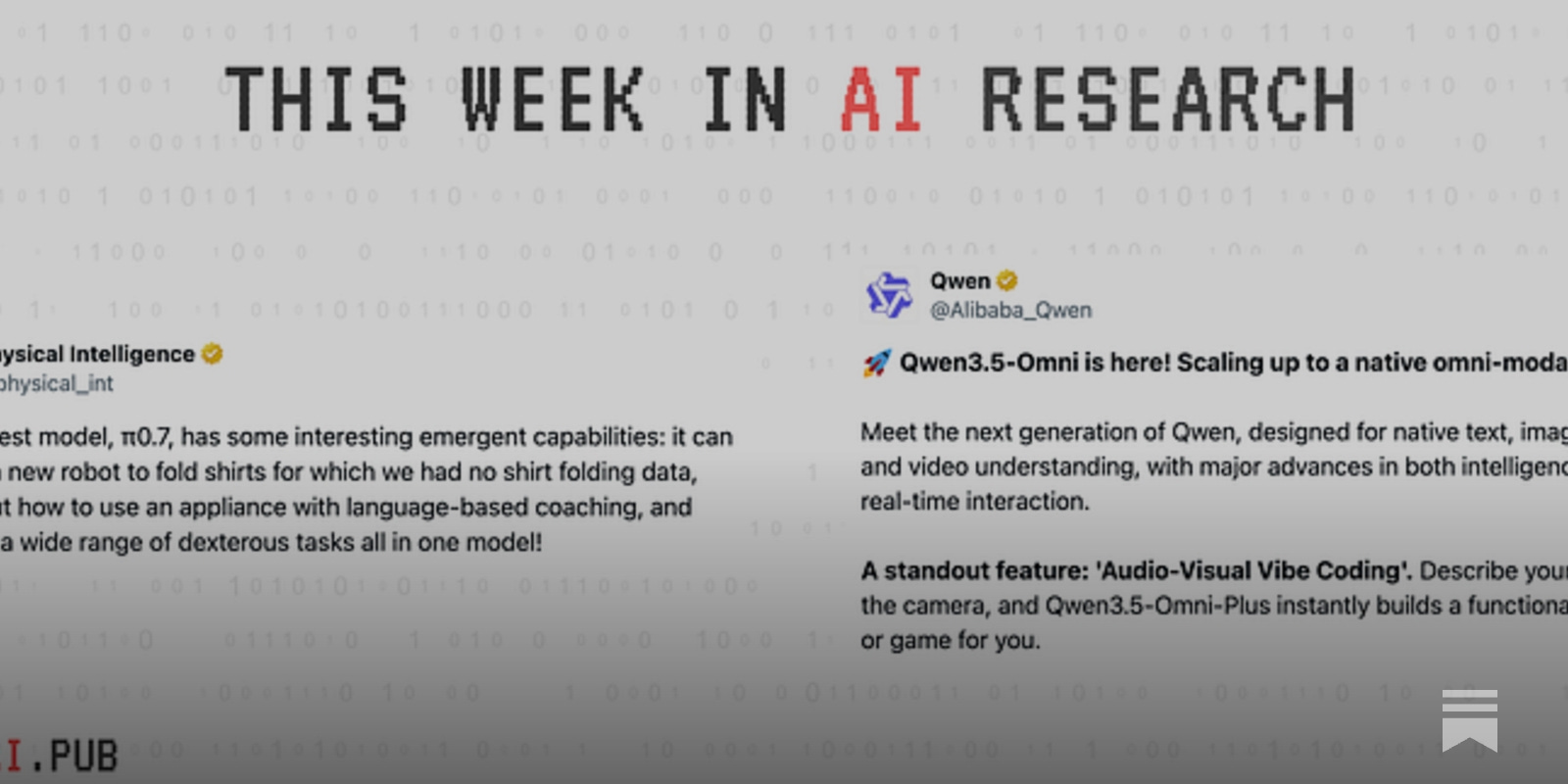
Why it matters: The convergence of massive multimodal models with robotics and code generation marks a shift from research demos to systems with tangible operational and economic impact.
Context: The field is moving beyond benchmark-chasing to focus on architectural efficiency, cost-effective scaling, and practical deployment in physical and creative workflows.
"# This Week In AI Research (12-18 April 26) 🗓️ ### The top 10 AI research papers that you must know about this week. … This research paper describes the architecture of." — INTOAI.PUB
Commentary: Alibaba’s scale play—hundreds of billions of parameters, 100M+ hours of training data—directly challenges Western incumbents on cost-per-capability, not just leaderboards. The ‘Audio-Visual Vibe Coding’ feature is a tacit admission that the next productivity frontier is converting ambient media into executable instructions, collapsing the creative-to-development pipeline. Meanwhile, the robotics papers suggest a coming commodification of basic physical intelligence, shifting value to dataset curation and real-world integration layers.
Date: April 22, 2026 12:00 AM ET
URL: https://www.intoai.pub/p/this-week-in-ai-research-12-18-april
AI Sentiment Score: Negative (60%)
AI Credibility Score: 7.0/10 — Medium
Scores and text generated by AI analysis of the source article indicated.
AI Digest — May 2, 2026 (Aidigest.Shelfcritter)
Summary: The Pentagon signed classified-network AI deals with eight major tech firms, excluding Anthropic due to its use restrictions and a prior ‘supply chain risk’ designation, while Federal Reserve Vice Chair Bowman flagged Anthropic’s Mythos and Project Glasswing as requiring new supervisory attention. Meta acquired robotics startup Assured Robot Intelligence to bolster its embodied AI stack, NVIDIA’s venture arm made its first legal-AI investment in Legora, and Fermi ousted its co-founder amid anchor-tenant struggles for its Texas power project. Community signals include a 16-node DGX Spark cluster build, a speculative prefill speedup claim for long-context inference, and the release of a 103B-token Usenet corpus.
Why it matters: These developments illustrate hardening fault lines between commercial AI providers and government procurement, the regulatory scrutiny of frontier-model capabilities, and the consolidation of talent and capital in specific AI sub-sectors.
Context: Anthropic’s principled restrictions on military and surveillance use have previously clashed with defense contracting norms, while federal regulators have been gradually escalating their posture on AI cyber-risk. Meta’s serial acquisitions in robotics signal a sustained bet on embodied intelligence as a layer, not hardware.
"Daily Digest · Entry № 56 of 84 AI Digest — May 2, 2026 Pentagon signs eight-company classified-network AI deals while pointedly excluding Anthropic, the same week Fed Vice Chair Bowman flags." — AIDIGEST.SHELFCRITTER
Commentary: The Pentagon’s multi-vendor move strategically isolates Anthropic without foreclosing a separate political deal, reflecting a procurement playbook that can work around principled objections. Bowman’s naming of Mythos formalizes supervisory attention on AI-generated cyber capabilities, shifting the regulatory conversation from abstract risk to specific artifacts. Together, these actions demonstrate how institutional adaptation to frontier AI is progressing through concrete contracting decisions and supervisory statements, not just policy frameworks.
Date: May 01, 2026 12:00 AM ET
URL: https://aidigest.shelfcritter.com/digest/2026-05-02
AI Sentiment Score: Negative (66%)
AI Credibility Score: 7.0/10 — Medium
Scores and text generated by AI analysis of the source article indicated.
This Week in Fine-tuning & Training: Fastest-Growing Projects (Pullrepo)
Summary: The fine-tuning ecosystem is diversifying beyond generic parameter adjustment, with this week’s fastest-growing projects targeting hardware-specific efficiency, novel memory architectures, and domain-specific optimization. The top project, mattmireles/gemma-tuner-multimodal, enables efficient multimodal fine-tuning on Apple Silicon, indicating a push for cost-effective, consumer-grade hardware utilization. Other signals include QingGo/engram-peft’s method for injecting high-capacity conditional memory without inference overhead and WillowHe/EvoOpt_oppangu_optimization_model’s application of LLMs to operations research, demonstrating a shift from general capability to specialized, task-embedded performance.
Why it matters: These projects signal a maturation of the fine-tuning layer, moving from brute-force replication to innovations that change the cost curve, developer workflow, and practical application scope for mid-tier and open-weight models.
Context: The trend follows the saturation of base model capabilities, where competitive advantage now hinges on efficient specialization and integration into existing hardware stacks and professional workflows.
"This repository provides a method for fine-tuning Gemma 4 and 3n models on Apple Silicon using PyTorch and Metal Performance Shaders, allowing for efficient training on diverse data types including audio, images, and text." — PULLREPO
Commentary: The focus on Apple Silicon and Metal Performance Shaders is a direct response to the prohibitive cost of cloud GPU fine-tuning, democratizing advanced model customization. Simultaneously, projects like engram-peft and GFT represent a second-order innovation: improving model utility not through larger parameter counts but through architectural tweaks that enhance memory or group dynamics without inference penalty. The emergence of OffensiveSET and optimization-focused fine-tuning points to the early professionalization of LLM toolchains for niche verticals like cybersecurity and operations research, where data quality and task alignment trump raw scale.
Date: April 25, 2026 12:00 AM ET
URL: https://pullrepo.com/report/this-week-in-fine-tuning-training-fastest-growing-projects-april-25-2026-2
AI Sentiment Score: Negative (50%)
AI Credibility Score: 7.0/10 — Medium
Scores and text generated by AI analysis of the source article indicated.
Video: AI News Week Ending 05/01/2026 (Ethanbholland)
Summary: A cluster of research and product announcements from late April 2026 signals a rapid convergence of generative AI capabilities around dynamic, three-dimensional visual media. Key developments include Vista4D from Netflix enabling post-production camera reframing and scene editing, Microsoft’s TRELLIS.2 model for high-fidelity 3D asset generation, and Kling AI’s push into 4K short film contests. Underlying these are advances in 3D Gaussian avatars, screen-space priors for single-image 3D reconstruction, and efficient video intelligence models.

Why it matters: These signals collectively point to the imminent dissolution of traditional production pipelines for video and 3D content, shifting creative leverage from capture and rendering to post-hoc semantic manipulation.
Context: The field is moving beyond static image generation toward temporally coherent and spatially aware models that treat video as a manipulable 3D scene representation, not a fixed sequence of pixels.
"The model is the render loop and the layout engine. The DOM dissolves – every pixel semantically addressable, every region interactive by default. That is kind of nuts!" — ETHANBHOLLAND
Commentary: The operational shift is from editing assets to editing the generative model’s understanding of a scene. This makes post-production a core competency for model tuning, not just software like After Effects. It pressures hardware and software stacks built for raster graphics and fixed pipelines, while creating new attack surfaces for media provenance and intellectual property.
Date: May 01, 2026 12:00 AM ET
URL: https://ethanbholland.com/2026/05/01/video-ai-news-week-ending-05-01-2026/
AI Sentiment Score: Neutral (50%)
AI Credibility Score: 7.0/10 — Medium
Scores and text generated by AI analysis of the source article indicated.
AI Global Daily · 2026-04-27 – Dr.Goose (Liaoshihang)
Summary: Four arXiv preprints from late April 2026 signal a maturation of agentic AI frameworks from benchmark performance toward operational, domain-specific workflows. The papers focus on emergent mathematical reasoning in communication, reproducible medical image processing, autonomous drug molecule evaluation, and agentic reproduction of social-science results.
Why it matters: These papers indicate a shift from proving capability to engineering reliable, auditable systems for high-stakes domains like medicine and drug discovery, where reproducibility and workflow integration are paramount.
Context: The trend moves beyond monolithic model evaluation toward modular, hierarchical agent frameworks designed for specific scientific and technical pipelines, emphasizing audit trails and adaptive execution.
"## arXiv · Latest Papers – Math Takes Two: A test for emergent mathematical reasoning in communication > arXiv:2604.21935v1 Announce Type: new > Abstract: Although language models demonstrate remarkable proficiency on mathematical." — LIAOSHIHANG
Commentary: The concentration on artifact-based and hierarchical skill frameworks suggests the field is prioritizing operational reliability and methodological rigor over raw benchmark scores. This shift could pressure evaluation practices in academia and industry, favoring systems that can document their reasoning and adapt to novel inputs within constrained domains like clinical workflows or molecular screening.
Date: April 27, 2026 12:00 AM ET
URL: https://liaoshihang.com/posts/ai-news-en-2026-04-27/
AI Sentiment Score: Negative (60%)
AI Credibility Score: 7.0/10 — Medium
Scores and text generated by AI analysis of the source article indicated.
Hacker News Digest — 2026-04-30 | N E W S (News.Cheng.St)
Summary: Mozilla formally opposes Chrome’s Prompt API proposal, arguing it would lock web applications to specific AI models and compromise browser neutrality. Rivian introduces a vehicle connectivity kill-switch, a rare privacy concession in an industry that treats telemetry as non-negotiable. A supply-chain attack compromised PyTorch Lightning releases on PyPI with credential-stealing malware. LinkedIn is found to be scanning for thousands of browser extensions and embedding the results in encrypted session telemetry.
Why it matters: These signals reveal escalating tensions over platform control, supply-chain integrity, and user agency in connected systems, with direct consequences for security posture, market competition, and regulatory scrutiny.
Context: Browser vendors are competing to define the web’s AI interface while grappling with fingerprinting risks. The automotive and SaaS industries face growing pressure to justify data collection as default. Open-source maintainers and corporate security teams are under constant pressure from increasingly sophisticated dependency attacks.
"Mozilla’s standards-position response argues that Chrome’s proposed Prompt API would tie web applications too closely to specific models and make browser AI behavior harder to keep neutral." — NEWS.CHENG.ST
Commentary: Mozilla’s opposition is a strategic move to prevent Chrome from defining a de facto standard that entrenches its own AI ecosystem, a playbook seen previously with other web APIs. Rivian’s concession, while tactical, signals that regulatory and consumer pressure on data collection is reaching a threshold even in hardware-centric industries. The PyTorch Lightning incident underscores that the AI toolchain is now a premium target for supply-chain attacks, demanding more rigorous release provenance checks. LinkedIn’s extension scanning, while framed for security, demonstrates how telemetry is being weaponized for granular user profiling, inviting renewed scrutiny under data minimization principles.
Date: April 30, 2026 12:00 AM ET
URL: https://news.cheng.st/2026/04/30/hacker-news-digest-2026-04-30/
AI Sentiment Score: Negative (87%)
AI Credibility Score: 10.0/10 — High
Scores and text generated by AI analysis of the source article indicated.
DTF:HN for April 30, 2026 (Youtube)
Summary: IBM’s Granite 4.1 demonstrates an 8-billion-parameter model achieving performance parity with a 32-billion-parameter mixture-of-experts model, signaling a shift in the efficiency frontier for open-source AI. Noctua’s release of official 3D CAD models for its cooling fans represents a significant move towards open hardware design and interoperability. The Zig project’s formal anti-AI contribution policy and Mozilla’s opposition to Chrome’s Prompt API highlight escalating institutional tensions over AI tooling and web standards.
Why it matters: These signals indicate near-term shifts in AI model efficiency, hardware design transparency, and the governance of developer tools and web platforms.
Context: The push for smaller, more capable models challenges the scaling hypothesis, while open CAD data accelerates hardware iteration. Policy clashes over AI-generated code and browser APIs reflect a maturation phase where control points are being contested.
"Granite 4.1: IBM’s 8B Model Matching 32B MoE." — YOUTUBE
Commentary: IBM’s result, if validated, pressures the economics of inference and deployment, favoring organizations with integration expertise over raw compute. Noctua’s CAD release lowers barriers for system integrators and custom builders, subtly commoditizing a premium brand’s mechanical IP. Zig’s policy and Mozilla’s stance are defensive maneuvers that will calcify ecosystem boundaries, forcing toolchain and developer workflow choices with longer-term lock-in consequences.
Date: April 30, 2026 12:00 AM ET
URL: https://www.youtube.com/watch?v=GMjHlAgci24
AI Sentiment Score: Negative (50%)
AI Credibility Score: 10.0/10 — High
Scores and text generated by AI analysis of the source article indicated.
Transcribing The Source Of The First DOS For The IBM PC (Hackaday)
Summary: Printed source code listings for 86-DOS 1.00, MS-DOS 1.25, and PC-DOS 1.00-dev, annotated by original developer Tim Paterson, have been scanned and are being transcribed into compilable form. The project, hosted on GitHub, recovers foundational system software artifacts from the early 1980s IBM PC ecosystem, including kernel code and utilities. This provides a rare, complete snapshot of a critical transitional period in personal computing history.

Why it matters: For specialists tracking the evolution of platform software, this is a primary-source correction to the historical record, enabling precise technical analysis of early OS design decisions and their long-term consequences.
Context: Software archaeology projects often rely on incomplete binaries or later versions; contemporaneous source code with developer annotations is exceptionally rare, especially for commercially pivotal but historically opaque systems like DOS.
"These code listings contain the sources of the 86-DOS 1.00 kernel, multiple development snapshots, and also listings for utilities like CHKDSK. These printed listings additionally contain many handwritten notes, making transcribing it into working source code somewhat of a chore." — HACKADAY
Commentary: The recovery of annotated source shifts DOS from a historical abstraction to a tangible engineering artifact, allowing direct study of the constraints and trade-offs that shaped the PC standard. It validates and refines oral histories, potentially recalibrating assessments of Microsoft’s early technical contributions. For the software preservation community, it sets a new benchmark for completeness, demonstrating the latent value of physical archives even for digital objects.
Date: April 30, 2026 12:00 AM ET
URL: https://hackaday.com/2026/04/30/transcribing-the-source-of-the-first-dos-for-the-ibm-pc/
AI Sentiment Score: Positive (40%)
AI Credibility Score: 10.0/10 — High
Scores and text generated by AI analysis of the source article indicated.
May 1, 2026 – Hackaday (Hackaday)
Summary: A Hackaday post documents a hobbyist project building a functional handheld game console for approximately $1, using the ultra-low-cost CH32V003 RISC-V microcontroller and an OLED display. The device, programmed in Rust, runs a simple platform game at 25 frames per second, demonstrating extreme cost-optimization for embedded interactive applications.

Why it matters: It signals a new floor for the cost and accessibility of programmable interactive hardware, potentially reshaping prototyping, educational tools, and low-volume niche product economics.
Context: The CH32V003 represents a class of sub-$0.10 RISC-V microcontrollers pushing the boundaries of price-performance for mass-market embedded design, challenging incumbent architectures in ultra-low-margin applications.
"These days, even an old Game Boy will set you back $100 or more, and a new handheld console will be many multiples of that. However, you can build a really cheap." — HACKADAY
Commentary: The project is less about gaming and more a proof-of-concept for a new cost paradigm in embedded systems. It validates RISC-V’s viability in consumer-facing interactive devices, not just passive IoT nodes, and demonstrates Rust’s maturing ecosystem for resource-constrained targets. This lowers the financial barrier for hardware experimentation and could inspire a wave of disposable or ultra-low-cost interactive gadgets.
Date: May 01, 2026 12:00 AM ET
URL: https://hackaday.com/2026/05/01/
AI Sentiment Score: Negative (87%)
AI Credibility Score: 10.0/10 — High
Scores and text generated by AI analysis of the source article indicated.
Post ID: 9244cc0f