Infrastructure, Hardware & Open Source Projects
ZeroGPU (Producthunt)
Summary: ZeroGPU, a compute efficiency layer for AI, launches with a specialized edge network for high-volume, routine inference tasks like classification and extraction. It benchmarks against GPT-5.4 Nano with claims of 10x faster latency, 50%+ lower cost, and 20% higher accuracy, and is already in production with customer Dappier reporting 10x lower latency and 6x lower cost. The service offers an OpenAI-compatible API and plans to support self-serve BYO-model workflows, targeting the 70-80% of AI app inference that is structured and repetitive rather than deep reasoning.
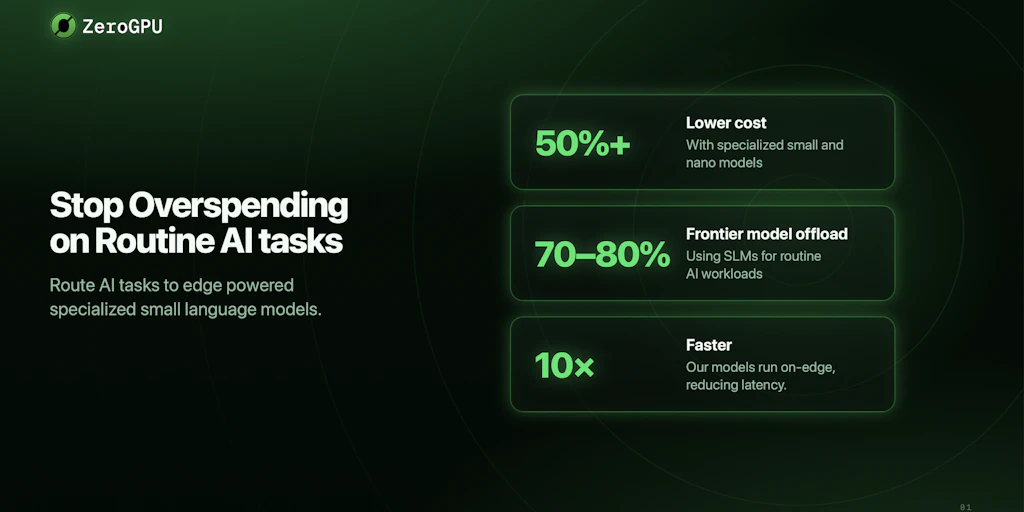
Why it matters: This signals a maturation in AI infrastructure, moving beyond a one-size-fits-all model paradigm to optimize cost and latency at scale, which directly impacts the unit economics of production AI applications.
Context: The launch follows public statements from Salesforce’s Marc Benioff and Coinbase’s Brian Armstrong about the need to route routine tasks away from expensive frontier models, validating a market shift toward specialized, cost-effective inference layers.
"Our thesis is simple. Frontier models are great for reasoning. ZeroGPU is built for repeatable execution: classification, moderation, summarization, routing, extraction, signal detection, and the high-volume calls that run constantly inside apps and agent loops." — PRODUCTHUNT
Commentary: ZeroGPU operationalizes the emerging consensus that frontier model overuse is economically unsustainable, but its real impact lies in the structural shift it enables: by decoupling routine execution from reasoning, it forces a re-architecture of agentic workflows and pipeline design. The commitment to BYO-model support, even if concierge initially, acknowledges that the true friction for teams is not model selection but the end-to-end lifecycle management of specialized models. This moves the competitive battleground from raw model performance to integrated developer experience and operational reliability for high-volume, deterministic tasks.
Date: June 05, 2026 03:45 PM ET
URL: https://www.producthunt.com/products/zerogpu
AI Sentiment Score: Negative (66%)
AI Credibility Score: 10.0/10 — High
Scores and text generated by AI analysis of the source article indicated.
Journey to JPEG XL: open-source experiments shaped the future of image coding (Opensource.Googleblog)
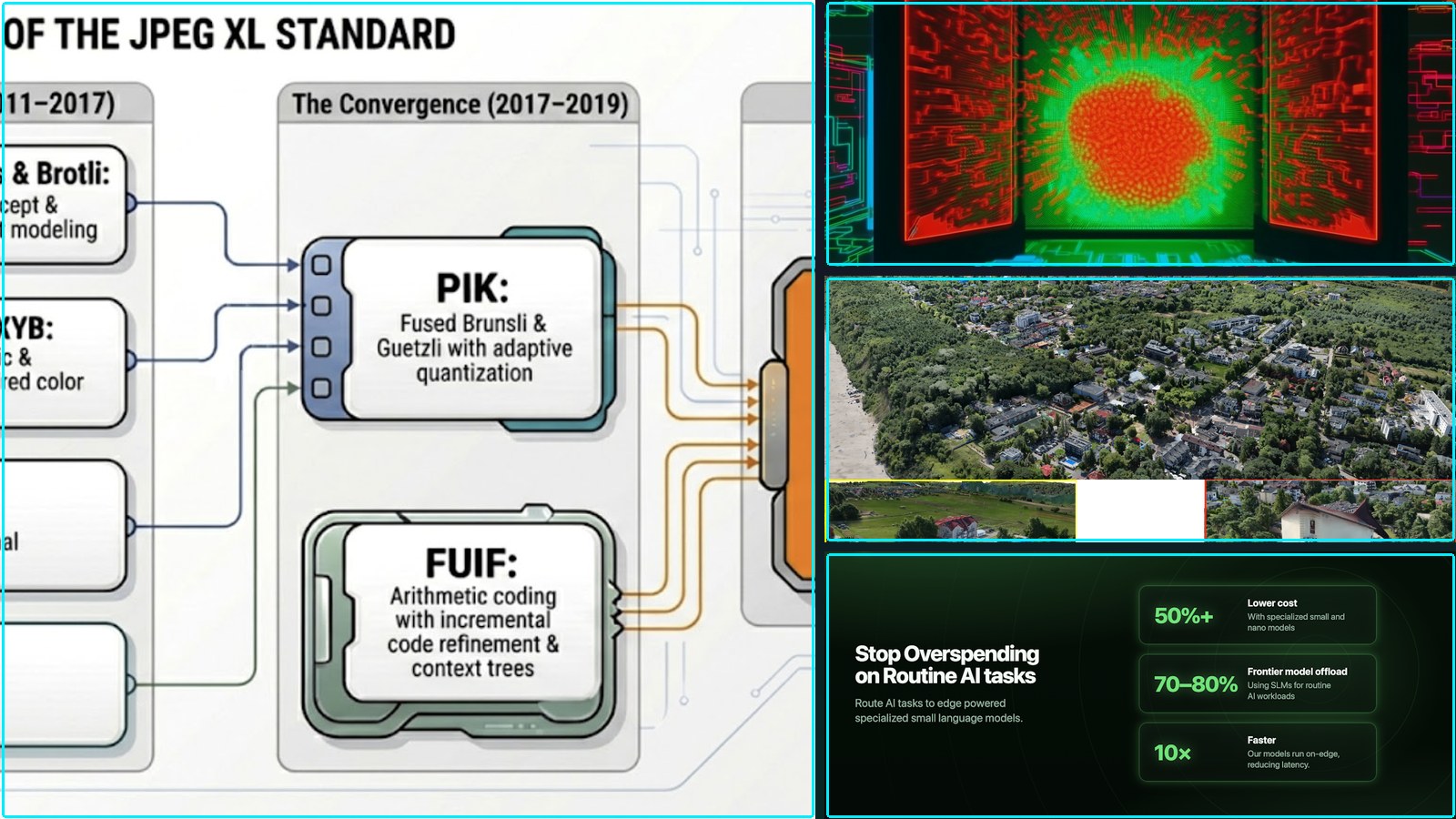
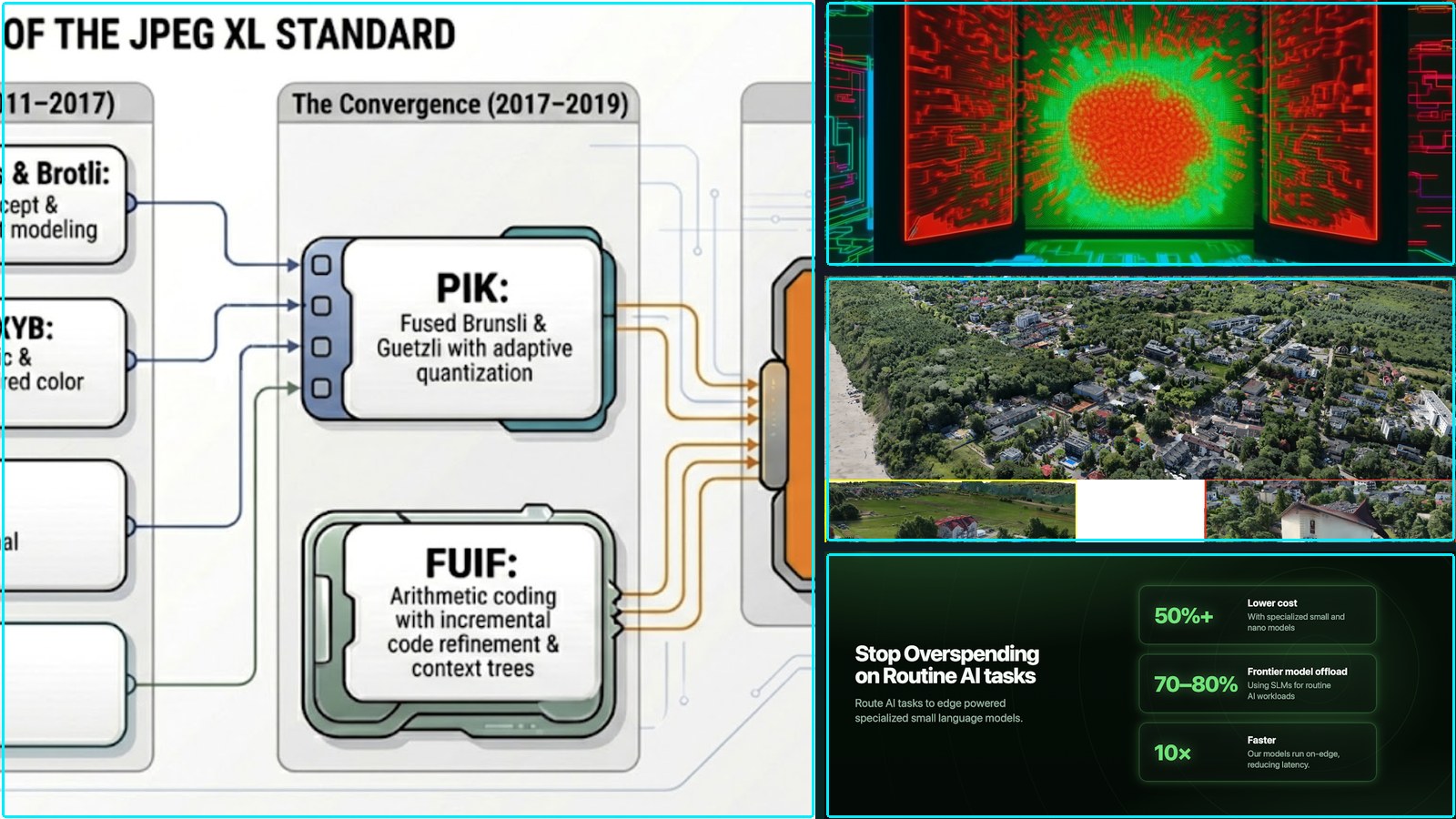
Summary: JPEG XL’s development was a decade-long, iterative process of open-source experimentation, not a top-down design. Key intermediate projects like WebP Lossless, Butteraugli, Guetzli, and Brunsli served as probes to test psychovisual models, entropy coding, and the limits of legacy JPEG, informing the final standard. The eventual merger of Google’s PIK proposal with Cloudinary’s FUIF proposal created a technically synergistic hybrid. The format is now seeing foundational adoption in professional photography, medical imaging, and publishing standards.

Why it matters: It demonstrates how sustained, incremental open-source R&D can successfully navigate complex standardization processes and produce a technically superior, widely adopted format.
Context: The image format landscape has been fragmented between legacy JPEG, newer formats like AVIF and WebP, and proprietary RAW formats, creating inefficiency and compatibility headaches for high-fidelity workflows.
"We didn’t start by trying to write a new standard; we started by trying to make the current ones better, and learning their limitations. This allowed us to make the new formalism more flexible and efficient in the right places." — OPENSOURCE.GOOGLEBLOG
Commentary: The path to JPEG XL validates a ‘probe-first’ R&D strategy for complex standards, where intermediate tools serve as market and technical feedback loops. The merger with FUIF suggests future standards may increasingly be negotiated syntheses of competing open-source implementations rather than proprietary proposals. The commercial encoder IP core signals the format’s transition from a software library to a hardware-accelerated expectation for real-time capture and display.
Date: Wed, 03 Jun 2026 21:55:23 +0000
URL: https://opensource.googleblog.com/2026/06/journey-to-jpeg-xl-how-open-source-experiments-shaped-the-future-of-image-coding.html
Discussion: https://news.ycombinator.com/item?id=48390688
AI Sentiment Score: Neutral (33%)
AI Credibility Score: 10.0/10 — High
Scores and text generated by AI analysis of the source article indicated.
Elixir v1.20: Now a gradually typed language (Elixir-Lang)
Summary: Elixir v1.20 introduces a novel, sound gradual type system that performs type inference and checking on existing, unannotated code, reporting only ‘verified bugs’—type violations guaranteed to cause runtime failures. Its key innovation is the dynamic() type, which employs compatibility and narrowing to minimize false positives while recovering precise type information from ordinary code. The development, sponsored by Fresha and Tidewave, marks a transition from research to practical tooling, with the compiler now able to identify dead code and type errors efficiently. This release also includes compilation speed improvements, particularly on multi-core machines.
Why it matters: This shifts Elixir from a purely dynamic language to one offering static analysis suggests without mandating upfront type annotations, potentially altering adoption calculus for teams prioritizing reliability in distributed systems.
Context: Gradual typing efforts often struggle with balancing soundness, developer experience, and integration into mature ecosystems; Elixir’s set-theoretic approach and focus on zero-annotation value delivery represent a distinct, pragmatically-oriented path.
"With Elixir v1.20, we have completed our first development milestone which is to perform type inference and gradually type check every Elixir program, without introducing type annotations. This means Elixir increasingly reports dead code and verified bugs: typing violations that are guaranteed to fail at runtime if executed." — ELIXIR-LANG
Commentary: The implementation’s performance on the ‘If T’ benchmark and its focus on verified bugs over speculative warnings suggests a deliberate trade-off: sacrificing some completeness for higher signal-to-noise and immediate utility in existing codebases. This could pressure other dynamic language ecosystems to demonstrate similar incremental value. For Elixir’s commercial backers like Fresha, it reduces the maintenance burden of large codebases without disrupting developer workflows, directly impacting operational cost.
Date: Wed, 03 Jun 2026 19:02:26 +0000
URL: https://elixir-lang.org/blog/2026/06/03/elixir-v1-20-0-released/
Discussion: https://news.ycombinator.com/item?id=48388324
AI Sentiment Score: Negative (71%)
AI Credibility Score: 10.0/10 — High
Scores and text generated by AI analysis of the source article indicated.
Signal Recorder SR-7 (Producthunt)
Summary: SR-7 is a privacy-first voice recorder for macOS and iOS that performs transcription and AI summarization entirely on-device using Apple’s Speech and FoundationModels frameworks. It exports recordings as local Markdown files with YAML frontmatter, making them directly usable in knowledge management systems like Obsidian or git. Crucially, it includes a local Model Context Protocol (MCP) server, enabling AI coding assistants like Claude Code to query the personal audio archive without data exfiltration.

Why it matters: It signals a practical, commercial implementation of the ‘local-first AI’ pattern, moving beyond proof-of-concept to a shipped product that directly challenges the data-hosting business models of incumbent voice AI services.
Context: The push for on-device AI processing is accelerating, driven by hardware capabilities (Apple Silicon, NPUs) and privacy concerns, but most commercial applications remain tethered to cloud services for core functionality.
"A built-in local MCP server lets Claude Code and other AI tools query the archive." — PRODUCTHUNT
Commentary: The integration of a local MCP server is the operational differentiator; it transforms a private archive into a queryable dataset for external AI agents, creating a new architecture for personal knowledge bases. This moves the value from mere data ownership to functional interoperability within a user’s existing AI-augmented workflow. It directly pressures subscription-based SaaS voice tools by offering a one-time purchase model where the user’s data remains a sovereign asset, not a platform lock-in mechanism.
Date: June 06, 2026 08:20 PM ET
URL: https://www.producthunt.com/products/signal-recorder-sr-7
AI Sentiment Score: Neutral (50%)
AI Credibility Score: 10.0/10 — High
Scores and text generated by AI analysis of the source article indicated.
ESP32-S31 (Espressif)
Summary: Espressif announces the ESP32-S31, a dual-core RISC-V SoC integrating Wi-Fi 6, Bluetooth 5.4 LE Audio, Thread/Zigbee via 802.15.4, and a 1 Gbps Ethernet MAC. It couples this with advanced HMI features—camera and LCD interfaces, JPEG/2D-DMA accelerators, and capacitive touch—alongside hardware security anchored by a RAM-based PUF and cryptographic accelerators. The chip targets multimedia IoT endpoints like smart displays and video doorbells, with software support extending to ESP-IDF, ESP-Matter, and frameworks for AI agent integration.

Why it matters: This chip signals a convergence of high-bandwidth connectivity, rich multimedia processing, and hardware-rooted security in a cost-optimized MCU class, pushing the performance envelope for embedded endpoints and enabling new application architectures.
Context: The ESP32 series has defined the accessible, connectivity-rich microcontroller category, but competitive pressure demands integration of newer wireless standards, dedicated multimedia accelerators, and stronger security primitives for commercial and industrial IoT.
"Comprehensive Connectivity ESP32-S31 integrates both wireless and wired connectivity for versatile networking. It supports 2.4 GHz Wi-Fi 6 (802.11ax) for enhanced transmission efficiency and reduced power consumption, making it ideal for battery-powered." — ESPRESSIF
Commentary: The S31 moves Espressif from a connectivity-first posture to a systems-on-chip contender, directly challenging application processors in low-cost multimedia devices. The inclusion of RAM-based PUF and ECDSA signature hardware reflects a maturing security model for deployed devices, while the explicit LLM and AI agent support in software signals a pivot toward on-device intelligence rather than pure sensor-to-cloud pipelines.
Date: Wed, 03 Jun 2026 16:10:25 +0000
URL: https://www.espressif.com/en/products/socs/esp32-s31
Discussion: https://news.ycombinator.com/item?id=48385965
AI Sentiment Score: Negative (50%)
AI Credibility Score: 9.1/10 — High
Scores and text generated by AI analysis of the source article indicated.
A Post-Quantum Future for Let’s Encrypt (Letsencrypt)
Summary: Let’s Encrypt has announced its commitment to deploying Merkle Tree Certificates (MTCs) as its path to a post-quantum-safe Web PKI, targeting a staging environment in late 2026 and production readiness in 2027. The move addresses the critical size problem of post-quantum signatures, which would otherwise balloon TLS handshakes past 10KB and degrade web performance. MTCs batch certificate issuance under a single post-quantum signature, reducing handshake size while building certificate transparency directly into the issuance process. This aligns with Chrome’s stated preference and ongoing IETF standardization work.

Why it matters: This signals a concrete, ecosystem-shaping architectural choice for post-quantum authentication on the web, moving from theoretical discussion to a deployable design with a major CA’s backing.
Context: Post-quantum authentication timelines have accelerated, with Google and Cloudflare targeting 2029 migrations and NIST/NSA setting 2030-2035 deprecation dates for current algorithms, shifting the focus from just key exchange to signature forgery risks.
"Let’s Encrypt is committed to a post-quantum-safe Web PKI. The path we’re planning to take is Merkle Tree Certificates (“MTCs”), a new approach that adds post-quantum authentication to the web without sacrificing." — LETSENCRYPT
Commentary: Let’s Encrypt’s endorsement of MTCs validates a structural workaround for the size-cost barrier, prioritizing web-scale performance over a direct algorithm swap. This effectively makes Merkle trees, a proven transparency tool, the new foundational layer for certificate issuance, potentially consolidating and simplifying the CA transparency ecosystem. The 2026-2027 target, while years away, sets a concrete benchmark for library, browser, and client developers to align their own roadmaps.
Date: Wed, 03 Jun 2026 15:06:09 +0000
URL: https://letsencrypt.org/2026/06/03/pq-certs
Discussion: https://news.ycombinator.com/item?id=48385114
AI Sentiment Score: Negative (50%)
AI Credibility Score: 7.0/10 — Medium
Scores and text generated by AI analysis of the source article indicated.
Gaussian Point Splatting (Momentsingraphics.De)
Summary: A SIGGRAPH 2026 paper introduces Gaussian Point Splatting, a stochastic rendering method that scales real-time Gaussian splatting to scenes with hundreds of millions of primitives. The core innovation replaces traditional splatting with a massively parallel, atomic point-splatting technique, trading exact fidelity for manageable noise and aliasing differences. This directly addresses a primary scaling bottleneck in Gaussian splatting pipelines for large-scale environments.

Why it matters: It materially changes the cost curve and practical scene complexity limits for a leading neural rendering technique, shifting the engineering bottleneck from rendering to asset creation and data management.
Context: Gaussian splatting has emerged as a high-quality alternative to NeRFs for novel view synthesis, but rendering performance has been a limiting factor for expansive scenes, confining its use to bounded objects or environments.
"Our method renders hundreds of millions of Gaussians in real time. The only differences compared to the original Gaussian splatting are slight noise and differences in aliasing." — MOMENTSINGRAPHICS.DE
Commentary: The trade-off—accepting stochastic noise for two-orders-of-magnitude scale—is architecturally significant. It moves Gaussian splatting from object-scale to world-scale applications, making city-scale or enterprise digital twin visualization feasible on commodity hardware. The reliance on 64-bit GPU atomics and explicit workload distribution also signals a shift towards compute-focused, rather than rasterization-focused, real-time graphics pipelines for this domain.
Date: Thu, 04 Jun 2026 10:48:13 +0000
URL: https://momentsingraphics.de/Siggraph2026.html
Discussion: https://news.ycombinator.com/item?id=48396792
AI Sentiment Score: Positive (50%)
AI Credibility Score: 10.0/10 — High
Scores and text generated by AI analysis of the source article indicated.
AI can now coach amateur virologists, and top tech leaders want Congress to act on DNA security (The-Decoder)
Summary: A coalition of leading AI executives and scientists has petitioned Congress to mandate universal screening and recordkeeping for synthetic DNA orders. The signatories, including Altman, Amodei, Hassabis, and Suleyman, argue that while many providers already screen voluntarily, uniform legal requirements are now necessary. This urgency is driven by AI systems that now outperform PhD-level virologists on lab procedure questions, significantly lowering the knowledge barrier for potential misuse.

Why it matters: The letter signals a preemptive move by industry to formalize a critical biosecurity control before AI-driven capabilities make existing voluntary measures insufficient, directly affecting synthetic biology supply chains and regulatory oversight.
Context: Screening synthetic DNA orders for hazardous sequences has been a voluntary industry practice for years, but the rapid advancement of AI as a technical co-pilot in complex lab work changes the risk calculus.
"AI systems now outperform PhD-level virologists on questions about lab procedures, raising the risk of misuse." — THE-DECODER
Commentary: The call for legislation is less about a novel threat and more about institutionalizing a defense before AI erodes the last meaningful barrier—specialized knowledge. The unified front from typically competitive AI leaders suggests they view this as a tractable, near-term liability that could jeopardize the sector’s social license. The operational shift would be from patchwork compliance to a legally enforceable audit trail, making providers legally accountable for their role in the supply chain.
Date: Thu, 04 Jun 2026 10:07:51 +0000
URL: https://the-decoder.com/ai-can-now-coach-amateur-virologists-and-top-tech-leaders-want-congress-to-act-on-dna-security/
AI Sentiment Score: Negative (83%)
AI Credibility Score: 10.0/10 — High
Scores and text generated by AI analysis of the source article indicated.
Post ID: 0063d87b