Open Source Tech & Hardware Updates
Journey to JPEG XL: open-source experiments shaped the future of image coding (Opensource.Googleblog)
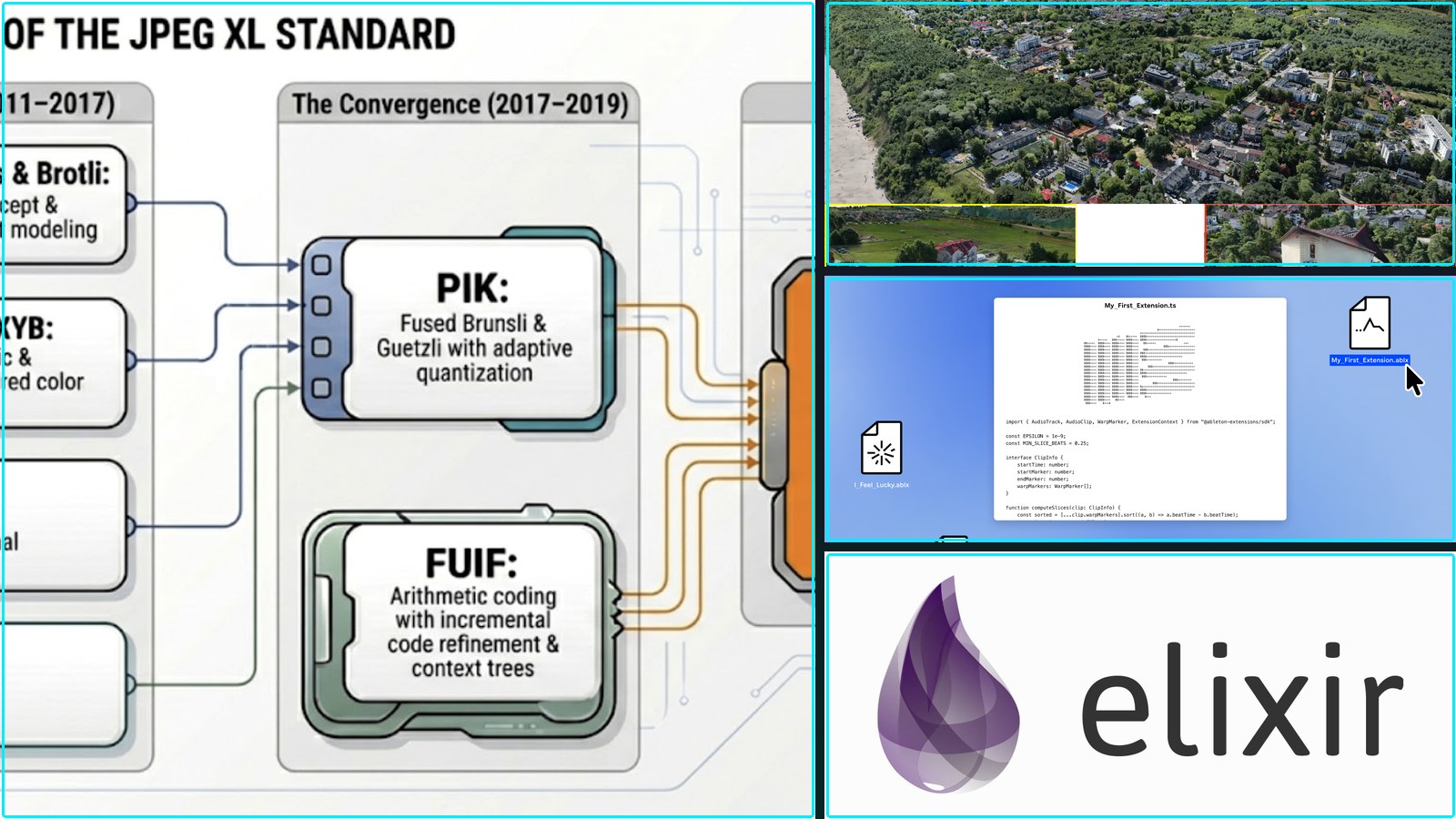
Summary: The development of JPEG XL, a next-generation image format now seeing adoption in professional and medical standards, was not a direct design but a decade-long series of open-source experiments. Google’s blog post details the iterative process, from foundational projects like WebP Lossless and Brotli to psychovisual tools like Butteraugli and format-pushing utilities like Guetzli and Brunsli. These intermediate projects, which squeezed performance from legacy JPEG, informed the eventual fusion of Google’s PIK proposal with Cloudinary’s FUIF into the JPEG XL standard. The format’s current traction in DNG, DICOM, and OS-native support validates this bottom-up, milestone-driven approach to standards development.

Why it matters: For observers of tech standards and compression, this reveals a viable, feedback-driven model for creating durable infrastructure, contrasting with top-down mandates or purely corporate-driven formats.
Context: Image format wars have historically been fraught with competing corporate interests (JPEG vs. GIF, WebP vs. JPEG). JPEG XL’s path demonstrates how open-source prototyping and incremental, community-vetted tools can de-risk and technically validate a standard before formalization.
"The road to JPEG XL (JXL) wasn’t a straight line. It was a decade-long exploration, creating a series of milestone projects testing radical ideas in psychovisual modeling, entropy coding, and optimization." — OPENSOURCE.GOOGLEBLOG
Commentary: The significance is methodological: JPEG XL’s trajectory shows that pre-standardization, open-source tooling (Guetzli, Brunsli) can serve as both technical probes and market validators, reducing adoption friction later. This shifts the playbook for future media standards, making ecosystem readiness a precursor to, not a consequence of, formal ratification. The commercial encoder IP cores and DICOM adoption signal that the format is transitioning from a promising spec to embedded infrastructure.
Date: Wed, 03 Jun 2026 21:55:23 +0000
URL: https://opensource.googleblog.com/2026/06/journey-to-jpeg-xl-how-open-source-experiments-shaped-the-future-of-image-coding.html
Discussion: https://news.ycombinator.com/item?id=48390688
AI Sentiment Score: Negative (50%)
AI Credibility Score: 10.0/10 — High
Scores and text generated by AI analysis of the source article indicated.
Elixir v1.20: Now a gradually typed language (Elixir-Lang)
Summary: Elixir v1.20 introduces a novel, sound, set-theoretic gradual type system that performs type inference and checking on existing, unannotated code. Its key innovation is the dynamic() type, which uses compatibility and narrowing to report only ‘verified bugs’—type violations guaranteed to cause runtime errors—with an extremely low false-positive rate. This milestone, backed by academic and commercial sponsors, enables the compiler to find dead code and latent errors in existing Elixir programs without developer overhead. The release also includes compilation speed improvements, positioning Elixir’s build tool as among the fastest in the BEAM ecosystem.
Why it matters: This shifts the practical calculus for adopting Elixir in production by offering immediate, low-friction reliability gains for existing codebases, and establishes a new benchmark for gradual typing design that prioritizes soundness and developer trust.
Context: Gradual typing efforts in dynamic languages often struggle with adoption due to annotation burden, false positives, or unsoundness. Elixir’s approach, developed in partnership with CNRS, directly addresses these friction points by inferring types from existing code and guaranteeing reported errors are real.
"With Elixir v1.20, we have completed our first development milestone which is to perform type inference and gradually type check every Elixir program, without introducing type annotations. This means Elixir increasingly reports dead code and verified bugs: typing violations that are guaranteed to fail at runtime if executed." — ELIXIR-LANG
Commentary: The dynamic() type’s design—acting as a refinable range rather than an escape hatch—represents a significant advance in gradual typing theory made practical. It lowers the barrier to type-system adoption to near zero for existing projects, potentially accelerating Elixir’s use in larger, more complex systems where runtime reliability is critical. This also pressures other dynamic language ecosystems to demonstrate similar low-friction, high-confidence tooling.
Date: Wed, 03 Jun 2026 19:02:26 +0000
URL: https://elixir-lang.org/blog/2026/06/03/elixir-v1-20-0-released/
Discussion: https://news.ycombinator.com/item?id=48388324
AI Sentiment Score: Positive (62%)
AI Credibility Score: 10.0/10 — High
Scores and text generated by AI analysis of the source article indicated.
Reve 2.0 (Producthunt)
Summary: Reve 2.0 launches as a 4K image generation model built on a ‘layout-first’ architecture. It pre-structures images into labeled, addressable regions before rendering, enabling per-element editing and regeneration without quality degradation. The model is positioned for professional creative workflows requiring iterative, precise compositional control.

Why it matters: It shifts the locus of control in generative AI from prompt refinement to direct structural manipulation, potentially altering production pipelines for design and marketing.
Context: Current text-to-image models treat composition as an emergent property of the prompt, making precise, iterative edits a destructive process of complete regeneration.
"Reve 2.0 separates planning from rendering. Every image is first built as a structured, code-based layout where each region is labeled and addressable. Edit one element without touching the rest." — PRODUCTHUNT
Commentary: The ‘layout-first’ model is a significant architectural departure, treating the image as a structured document rather than a monolithic pixel field. This enables non-destructive editing and direct LLM integration, moving generative AI closer to a component-based, programmatic production tool. It signals a maturation phase where reliability and precision for commercial use cases are prioritized over raw capability expansion.
Date: June 05, 2026 11:43 AM ET
URL: https://www.producthunt.com/products/reve-2-0
AI Sentiment Score: Positive (50%)
AI Credibility Score: 10.0/10 — High
Scores and text generated by AI analysis of the source article indicated.
Signal Recorder SR-7 (Producthunt)
Summary: SR-7 is a privacy-first voice recorder for Apple platforms that performs transcription and AI summarization entirely on-device using Apple’s Speech and FoundationModels frameworks. It exports recordings as local Markdown files with YAML frontmatter, making them portable for tools like Obsidian or git. Crucially, it includes a local MCP server, enabling AI agents like Claude Code to query the archive without data exfiltration. It is sold as a one-time $7.99 universal purchase, rejecting the subscription and cloud-dependency models of competitors like Otter.

Why it matters: It signals a maturation of on-device AI tooling, moving from a privacy feature to a workflow-integrated capability that directly challenges the data-hosting business models of incumbent SaaS voice tools.
Context: The market for voice-to-text tools is dominated by cloud-dependent services that monetize data access or lock-in. Apple’s recent on-device ML frameworks (Speech, FoundationModels) have enabled a new category of local-first applications that prioritize data sovereignty and interoperability over network effects.
"A built-in local MCP server lets Claude Code and other AI tools query the archive." — PRODUCTHUNT
Commentary: The integrated local MCP server is the operational differentiator; it transforms a static archive into a queryable knowledge base for AI agents, enabling new workflows without compromising the core privacy promise. This shifts the value from mere recording to creating a private, machine-readable memory system, directly attacking the moat of cloud-based AI services. It demonstrates that on-device AI is now sufficiently capable to support complex retrieval-augmented generation (RAG) workflows, a threshold with broad implications for personal knowledge management and enterprise data governance.
Date: June 06, 2026 08:20 PM ET
URL: https://www.producthunt.com/products/signal-recorder-sr-7
AI Sentiment Score: Positive (50%)
AI Credibility Score: 10.0/10 — High
Scores and text generated by AI analysis of the source article indicated.
A Post-Quantum Future for Let’s Encrypt (Letsencrypt)
Summary: Let’s Encrypt has committed to a post-quantum future for the Web PKI, targeting Merkle Tree Certificates (MTCs) as its primary path. The announcement formalizes a strategic pivot away from direct adoption of NIST-standardized post-quantum signature algorithms like ML-DSA, which are too large for performant TLS handshakes at web scale. Instead, MTCs batch certificate issuance using a Merkle tree structure, shrinking the authentication payload in the common case while baking certificate transparency directly into the issuance process. The organization is targeting a staging environment for MTC issuance in late 2026, with production readiness in 2027, aligning its massive automated CA infrastructure with Chrome’s stated preference and ongoing IETF standardization work.

Why it matters: The Web PKI’s largest issuer is committing to a specific, non-obvious architectural solution for the post-quantum transition, setting a de facto standard that will shape the ecosystem’s engineering priorities and timelines.
Context: Post-quantum authentication has been considered a less urgent problem than key exchange, but mandates from NSA, NIST, and the EU, alongside commitments from Google and Cloudflare, have accelerated the timeline. The core technical impediment has been the large signature and key sizes of standardized post-quantum algorithms, which would degrade TLS performance.
"The Web PKI is one of the trickiest places to deploy post-quantum signatures. The reason is size." — LETSENCRYPT
Commentary: Let’s Encrypt’s endorsement of MTCs validates a structural workaround over a direct algorithm swap, prioritizing web-scale performance and operational experience over cryptographic purity. This decision could pressure other CAs, root programs, and library maintainers to converge on the MTC design, making the IETF PLANTS working group the central battleground for the next-generation PKI’s architecture. The integration of certificate transparency into issuance is a significant secondary benefit, potentially simplifying the CT ecosystem long-term.
Date: Wed, 03 Jun 2026 15:06:09 +0000
URL: https://letsencrypt.org/2026/06/03/pq-certs
Discussion: https://news.ycombinator.com/item?id=48385114
AI Sentiment Score: Positive (42%)
AI Credibility Score: 7.0/10 — Medium
Scores and text generated by AI analysis of the source article indicated.
Gaussian Point Splatting (Momentsingraphics.De)
Summary: A research team proposes Gaussian point splatting, a stochastic rendering method that uses GPU atomics and parallel primitives to distribute the workload of rendering scenes containing hundreds of millions of Gaussians. The core innovation is sampling opaque, pixel-sized points from each Gaussian and splatting them independently, which introduces a non-trivial problem of determining point count and distribution to achieve correct opacity. The authors formalize and solve this problem, maintaining fidelity to original Gaussian splatting with only minor noise and aliasing differences. The method enables real-time performance for extremely large-scale scenes through hierarchical culling.

Why it matters: This directly addresses a key scalability bottleneck for Gaussian splatting, a foundational 3D reconstruction technique, enabling its application to vastly larger, more complex environments.
Context: Gaussian splatting has rapidly become a standard for novel view synthesis from images, but rendering performance degrades with scene scale. Current optimizations focus on sorting and blending, which hit memory and parallelism limits.
"Our core idea is to sample pixel-sized, opaque points from the Gaussians and to splat them to a framebuffer using 64-bit atomics. Through parallel programming primitives, we achieve an even distribution of the workload across millions of threads." — MOMENTSINGRAPHICS.DE
Commentary: The shift from deterministic, sorted blending to a stochastic, atomic point model is a fundamental architectural change. It trades precise control for massive parallelism, moving the fidelity problem from runtime to a pre-computed sampling solution. This reframes the scalability limit from GPU memory bandwidth to thread occupancy and atomic operation throughput, a different engineering frontier. For industry, it suggests a path to real-time, large-scale Gaussian environments (e.g., city-scale digital twins) without requiring exotic hardware, though it introduces a new trade-off between noise and performance.
Date: Thu, 04 Jun 2026 10:48:13 +0000
URL: https://momentsingraphics.de/Siggraph2026.html
Discussion: https://news.ycombinator.com/item?id=48396792
AI Sentiment Score: Negative (50%)
AI Credibility Score: 10.0/10 — High
Scores and text generated by AI analysis of the source article indicated.
ESP32-S31 (Espressif)
Summary: Espressif announces the ESP32-S31, a dual-core RISC-V microcontroller integrating Wi-Fi 6, Bluetooth 5.4 LE Audio, Thread/Zigbee via 802.15.4, and a 1 Gbps Ethernet MAC. It pairs this connectivity with advanced HMI features—including camera and LCD interfaces, touch sensing, and hardware accelerators—alongside hardware security with PUF and cryptographic accelerators. The chip is positioned for multimedia IoT endpoints, smart displays, and voice-enabled agent devices, supported by Espressif’s ESP-IDF, ESP-Matter, and AI agent frameworks.

Why it matters: This chip signals a convergence of high-bandwidth wireless, low-power mesh, and rich multimedia interfaces in a single, security-hardened RISC-V package, potentially resetting cost-performance expectations for mid-tier interactive IoT devices.
Context: Espressif’s ESP32 series has defined the low-cost connected MCU market, but competitive pressure is increasing from vendors integrating more specialized wireless standards and AI offload. The S31 represents a move upstack, targeting applications that previously required separate connectivity and application processors.
"A standout highlight is the integration of TRNG and RAM-based PUF capabilities, providing a strong foundation for key generation and device security." — ESPRESSIF
Commentary: The inclusion of a Physically Unclonable Function (PUF) moves hardware-rooted trust from a niche premium feature to a mainstream IoT expectation, potentially altering compliance requirements for smart home and industrial edge devices. Coupled with Wi-Fi 6 and LE Audio, the S31 isn’t just an incremental update but a platform shift aimed at video doorbells, multimedia panels, and AI agent endpoints where latency, security, and media synchronization are non-negotiable. This forces competitors to match both the connectivity bundle and the security posture, while giving developers a single-chip answer for designs that previously required discrete components.
Date: Wed, 03 Jun 2026 16:10:25 +0000
URL: https://www.espressif.com/en/products/socs/esp32-s31
Discussion: https://news.ycombinator.com/item?id=48385965
AI Sentiment Score: Negative (50%)
AI Credibility Score: 9.1/10 — High
Scores and text generated by AI analysis of the source article indicated.
Ableton Extensions SDK (Ableton)
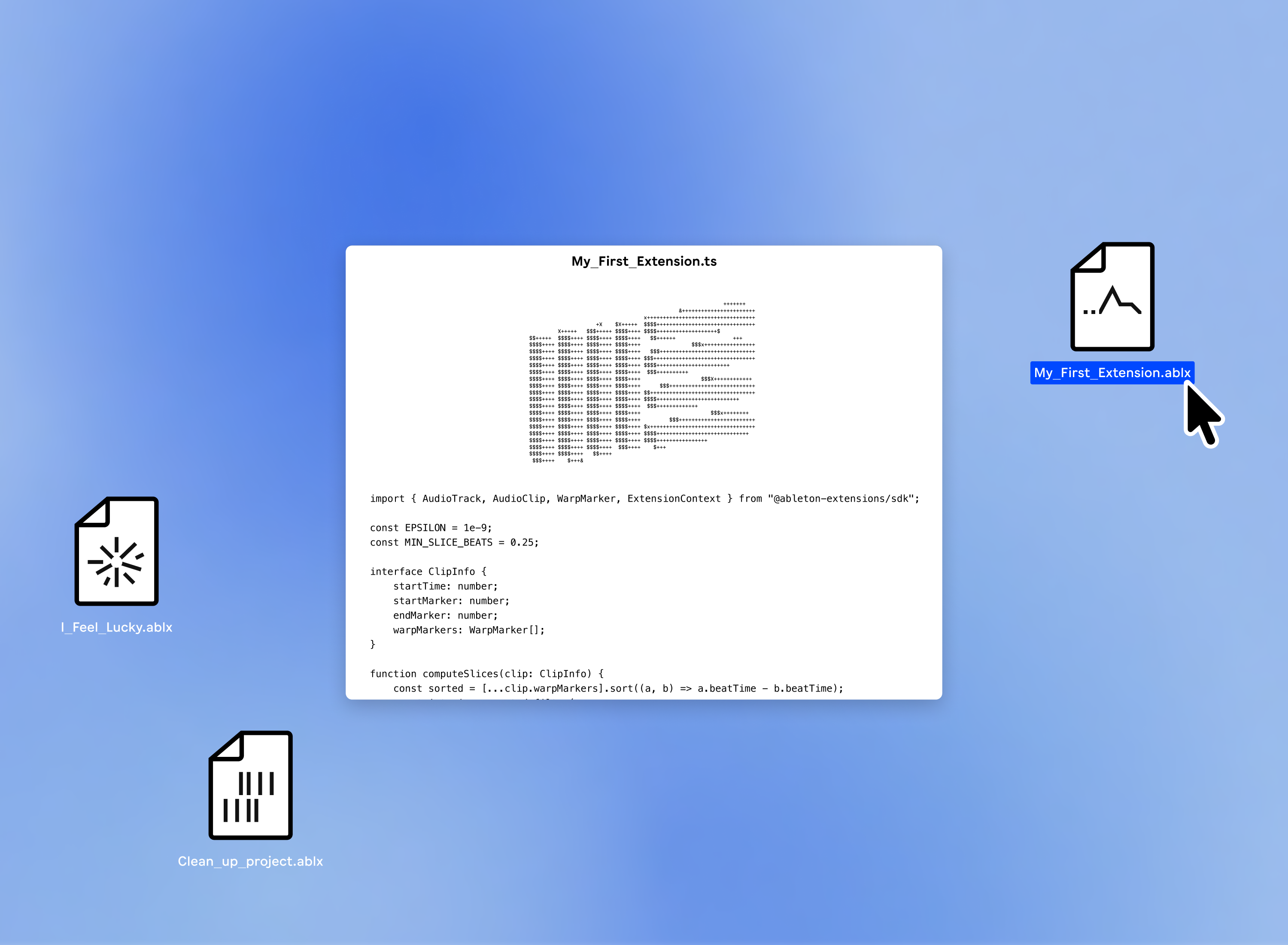
Summary: Ableton has released a public Extensions SDK with Live 12.4.5, enabling developers to build tools that interact programmatically with core elements of a Live Set. This moves beyond scripting and Max for Live by offering a direct, sanctioned API into Live’s internal state and control surface. It shifts the platform’s extensibility from a closed ecosystem to a more open, modular architecture.
Why it matters: This SDK fundamentally alters the developer workflow and creative leverage within the dominant DAW, potentially reshaping the third-party tool market and the technical ceiling of in-session automation.
Context: DAW extensibility has historically been siloed (e.g., Max for Live, VST) or reliant on reverse-engineered APIs. A formal, public SDK from a market leader sets a new precedent for interoperability and platform control.
"Extensions can interact with tracks, clips, MIDI, devices, tempo, and other parts of a Live Set to automate tasks, transform musical data, and customize Live’s capabilities." — ABLETON
Commentary: The move signals Ableton’s intent to formalize and capture high-value workflow automation, which was previously the domain of fragile community scripts. It will likely accelerate the professionalization of niche tools while raising questions about sandboxing and API stability. The real shift is in evaluation practice: developers can now build against a stable interface, lowering the barrier for serious, commercially viable extensions.
Date: Wed, 03 Jun 2026 20:39:34 +0000
URL: https://www.ableton.com/en/live/extensions/
Discussion: https://news.ycombinator.com/item?id=48389681
AI Sentiment Score: Negative (60%)
AI Credibility Score: 10.0/10 — High
Scores and text generated by AI analysis of the source article indicated.
Post ID: ce2bad92